Why E2E Selectors Break, and How Self-Healing Fixes It
Ask any team running a Playwright or Selenium suite what actually costs them time, and it's rarely the test logic. It's selectors. A test that correctly captures "click checkout, verify the confirmation page" will still go red the moment a class name changes, and fixing that has nothing to do with whether the feature actually works.
Why selectors go stale
A few patterns account for most breakage:
- Implementation-detail selectors. Targeting a CSS class or generated ID ties your test to how the component happens to be styled or bundled today, not to what it does.
- Framework-generated class names. Utility-first CSS and CSS-in-JS both produce class names that change on unrelated refactors.
- Redesigns and copy changes. A selector built on visible text breaks the moment marketing changes a button label from "Sign up" to "Get started."
- Dynamic IDs and hashes. Anything auto-generated per build or per session is a selector that was never stable to begin with.
- Conditional rendering shifting DOM order. Adding a banner, a feature flag, or a loading state changes nth-child and sibling selectors without changing anything a user would notice.
None of these mean the feature broke. They mean the test's map of the page went out of date.
The usual fixes, and their limits
data-testid conventions help a lot, but only if the whole org actually applies them consistently, and they still don't survive an element being removed or restructured. The Page Object Model contains the blast radius to one file per page, but someone still has to notice the break and go update the selector. Both approaches reduce how often you get burned. Neither removes the maintenance tax.
What self-healing actually does
When DebuggAI runs a test against a page that's changed, it doesn't stop at "selector not found." It looks at the page as it exists now, identifies the element that's semantically equivalent to what the test was originally targeting, the button with the same role and nearby context, even if the label or the underlying markup shifted, and updates the selector rather than failing the run outright. A renamed button or a shifted DOM position doesn't take down your suite; a genuinely missing or broken flow still does.
This is the same mechanism behind PR Copilot's generated tests staying useful across pushes: the test describes an intent, not a fragile map of today's HTML.
Where it still needs a human
Self-healing is not the same as "the test can never fail." It's built to survive incidental changes, not to guess at intent when the change is substantive:
- If an element is genuinely removed with no equivalent, the test correctly fails.
- If a control is repurposed, "Confirm" now cancels instead of confirming, healing to the visually similar element would be the wrong call, and this is exactly the kind of ambiguous case worth a second look rather than blind trust.
- If your page has multiple visually similar candidates (three "Edit" buttons in a table), review a healed selector before assuming it picked the right one.
Treat a healing event as a diff worth glancing at occasionally, not something to ignore because the test stayed green.
Where this runs
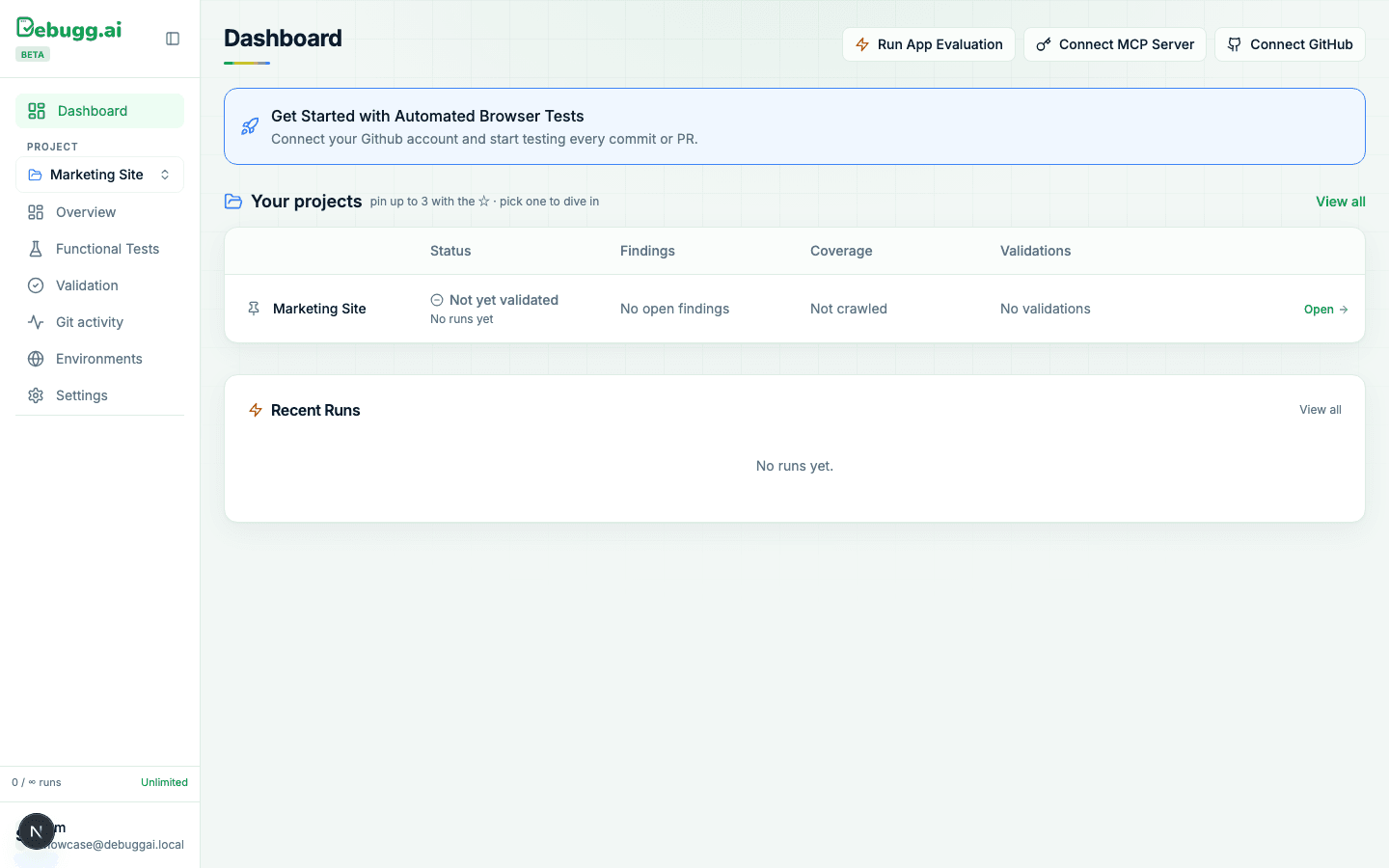
Screen recording, the same place self-healed runs show up alongside everything else, no separate tool, no separate login.
Practical guidance
Self-healing buys you resilience, it doesn't remove the value of writing things clearly in the first place:
- Keep naming and labeling meaningful. It gives both humans and the healing logic a better signal to match against.
- If the same element keeps needing to be healed across runs, that's a signal worth paying attention to, it usually means something in that part of the UI is architecturally unstable, not just cosmetically drifting.
- Pair this with PR Copilot so the tests that benefit from healing are also the ones running automatically on every push.