
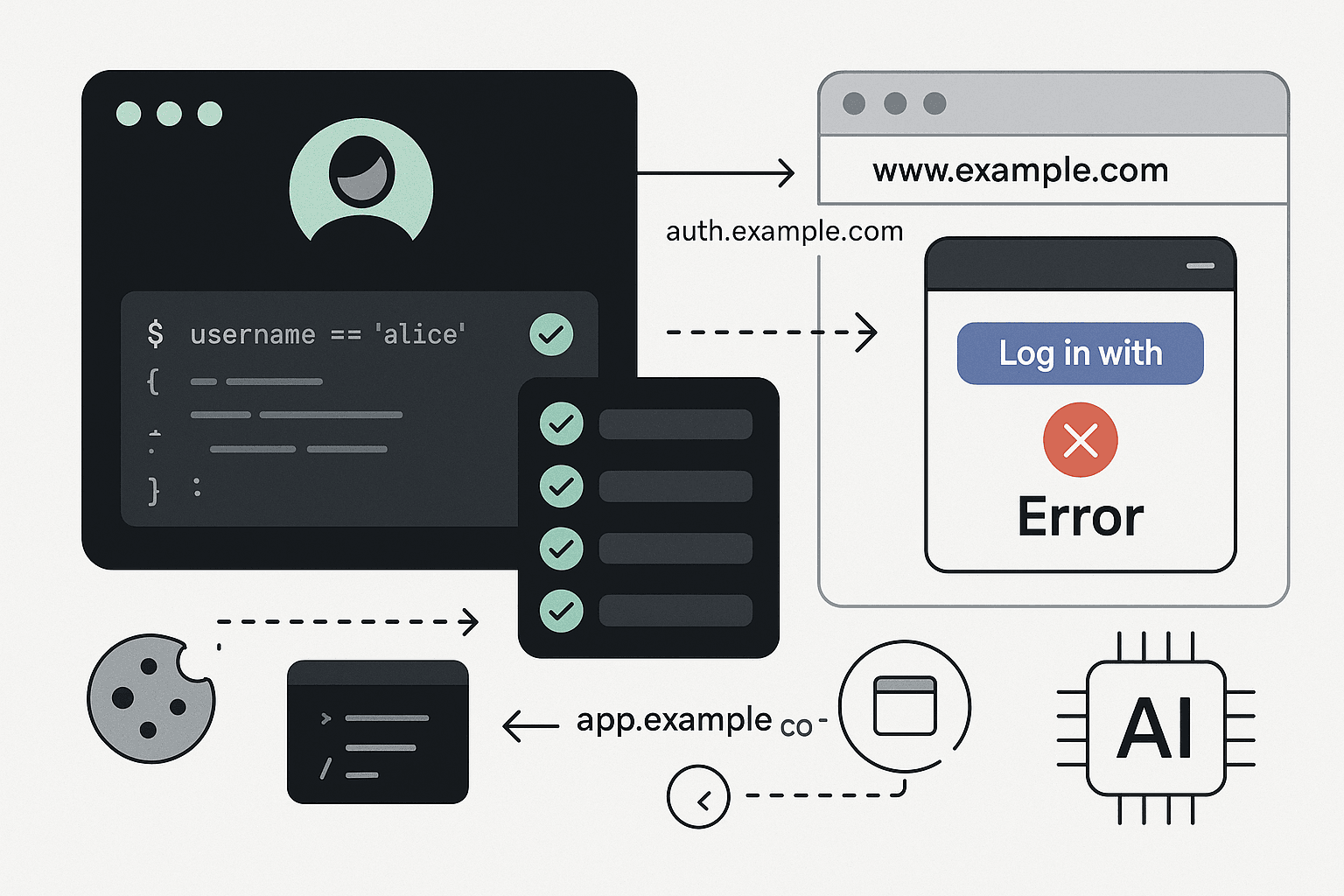
A pull request goes green, the checks pass, the deploy finishes, and five minutes later someone in Slack says they can’t log in.
Not because the API is down. Not because the database is corrupted. Not because the password reset email failed.
They click Sign in with Google, the popup appears, they approve the account, and then the app drops them back on the homepage as a logged-out user. Or worse: they land on a callback URL that works in staging but fails in production. Or Safari silently rejects the session cookie. Or the frontend thinks auth succeeded while the backend session never stuck. Or the popup closes before the parent window receives the token message.
This is one of the most common categories of "everything passed, but the product is broken" failures in modern software.
And it’s not a niche problem. It hits B2B SaaS apps, internal tools, consumer products, marketplaces, developer platforms, and mobile-web hybrids. Anywhere you have OAuth, SSO, magic links, session cookies, redirects, multiple environments, frontend state, reverse proxies, or third-party identity providers, you have a failure surface that traditional testing barely touches.
The blind spot is simple: most teams test auth as a backend protocol and ship it as a browser workflow.
Those are not the same thing.
The failure pattern nobody is surprised by anymore
If you’ve worked on production systems long enough, you’ve seen some version of this:
- A middleware refactor changes how callback URLs are built.
- A frontend cleanup alters popup handling or post-login routing.
- A cookie flag changes from
LaxtoStrict, or a proxy starts terminating TLS differently. - A new environment variable is added for staging, but production still points at the old redirect URI.
- A framework upgrade changes defaults around same-site cookies, cross-origin requests, or server actions.
- AI-generated code updates auth helpers, route handlers, or client state logic in ways that look reasonable in diff review.
The pull request includes tests. CI passes. Maybe coverage even goes up.
But none of that proves a real user can complete the sign-in flow in a real browser, across real origins, with real redirects, real cookies, real browser policies, and real session state.
That gap matters because authentication failures are not isolated implementation bugs. They are workflow failures. They happen in the seams between systems:
- your app and the identity provider
- frontend and backend
- browser and cookie policy
- popup and parent window
- load balancer and app server
- environment config and redirect registration
- local assumptions and production reality
Unit tests almost never cover those seams well. Mock-heavy integration tests often erase them entirely.
Why green CI gives false confidence on login flows
Teams usually feel good about auth if they have some combination of:
- unit tests for auth helpers
- backend integration tests for callback handlers
- mocks for identity provider responses
- API assertions like
200 OKor302 Redirect - maybe a manual QA checklist before release
That sounds responsible. It is also exactly how broken login experiences make it into production.
The problem is not that these tests are useless. The problem is that they validate fragments of the system while the user experiences the entire system.
A green CI run typically proves things like:
- a route handler parses an auth code correctly
- a token exchange function returns expected fields
- a session helper stores user data in the mocked store
- a redirect response contains the expected location header
- a frontend component renders authenticated UI when given mocked auth state
Useful? Yes.
Sufficient? Not remotely.
Consider what the browser-level flow actually includes:
- User clicks a sign-in button.
- The app opens a popup or redirects to another origin.
- The identity provider performs its own UI flow.
- The provider redirects back to a registered callback URL.
- Your backend exchanges the auth code for tokens.
- Your server creates or updates a session.
- Cookies are set with browser-dependent policy behavior.
- The browser follows redirects back into the app.
- Frontend state updates based on the new session.
- The user lands on the right post-login destination.
A single bad assumption in any of those steps can break the workflow without failing a single unit test.
That’s the core issue in modern debugging and testing: CI/CD often validates correctness at the code-path level, while production reliability depends on action-level correctness.
Where auth tests usually stop too early
Here is a typical backend test for an OAuth callback route in JavaScript:
jsimport request from 'supertest'
import app from '../app'
import * as oauth from '../oauth'

jest.mock('../oauth')

describe('GET /auth/callback', () => {
  it('creates a session and redirects to dashboard', async () => {
    oauth.exchangeCodeForToken.mockResolvedValue({
      access_token: 'token',
      id_token: 'id-token',
      user: { id: 'u_123', email: 'dev@example.com' }
    })

    const res = await request(app)
      .get('/auth/callback?code=abc123&state=xyz')

    expect(res.status).toBe(302)
    expect(res.headers.location).toBe('/dashboard')
    expect(res.headers['set-cookie']).toBeDefined()
  })
})
This test is fine. It checks a route. It does not check login.
It does not tell you whether:
- the callback URL registered with Google matches production
- the cookie survives cross-site navigation
- the popup flow correctly resolves in the parent window
- CSRF state actually survives the browser roundtrip
- your CDN rewrites auth paths unexpectedly
- the frontend re-fetches session state after redirect
- Safari, Firefox, and Chrome behave consistently enough for your user base
- the sign-in button points at the right environment host
The same issue appears in Python stacks:
pythonfrom unittest.mock import patch
from app import create_app


def test_oauth_callback_redirects_to_dashboard(client):
    with patch('app.auth.exchange_code_for_token') as mock_exchange:
        mock_exchange.return_value = {
            'access_token': 'token',
            'user': {'id': 'u_123', 'email': 'dev@example.com'}
        }

        response = client.get('/auth/callback?code=abc123&state=xyz')

        assert response.status_code == 302
        assert response.headers['Location'] == '/dashboard'
        assert 'session=' in response.headers.get('Set-Cookie', '')
Again: route tested, workflow untested.
This is where teams confuse HTTP correctness with product correctness.
Why mocking identity providers creates a dangerous blind spot
Mocking third-party identity providers is attractive because it makes tests stable, cheap, and fast. You don’t want CI depending on Google, Okta, Auth0, Azure AD, GitHub, or some SAML provider behaving perfectly every run.
That part is reasonable.
The mistake is not the existence of mocks. The mistake is letting mocks become the only meaningful validation of your auth journey.
Mocks remove exactly the messy variables that tend to break production:
- multiple origins
- browser navigation timing
- popup behavior
- redirect URI registration
- cookie persistence rules
- provider-specific parameter handling
- environment-specific callback hosts
- frame/popup blockers
- state/nonce persistence across navigations
In other words, mocks make the hardest and most failure-prone part of auth disappear.
And then teams wonder why CI/CD says green while users are locked out.
This gets worse when developers optimize for testability by introducing abstractions that are easy to mock but hard to validate end-to-end. You end up with beautifully isolated auth modules and a totally unverified login experience.
That is a developer productivity trap. The test suite gets faster. The architecture looks cleaner. The release still breaks where users actually touch it.
AI-generated code makes the auth reliability gap bigger
AI coding tools are good at producing plausible auth-related changes. They can:
- add middleware
- reorganize route handlers
- refactor callback logic
- update frontend auth state code
- tweak cookies and headers
- alter environment variable usage
- rewrite redirect helpers
- modify session storage
And much of that code looks convincing in a pull request.
The problem is not that AI always writes bad code. The problem is that auth systems are full of implicit constraints that are hard to infer from local code alone.
An AI agent may not know:
- which redirect URIs are registered in each environment
- how your reverse proxy sets
X-Forwarded-Proto - whether session cookies require
Secureonly in certain deployments - how a popup communicates completion to the opener window
- that one frontend route is loaded before session hydration finishes
- that your staging domain structure differs from production in a way that affects same-site behavior
- that your framework’s server/client boundary changes auth timing subtly
So you get a diff that seems harmless:
jsconst redirectUri = `${req.protocol}://${req.get('host')}/auth/callback`
Looks sensible. It may even fix local development.
Then production sits behind a proxy terminating TLS, req.protocol resolves incorrectly, the provider rejects the callback, and login breaks only after deployment.
Or this:
jsres.cookie('session', token, {
  httpOnly: true,
  sameSite: 'strict',
  secure: true,
  path: '/'
})
Looks security-conscious. Also maybe breaks the exact cross-site redirect pattern your login depends on.
Or this frontend cleanup:
jswindow.opener.postMessage({ type: 'oauth:success' }, window.location.origin)
window.close()
Looks fine—unless window.location.origin is the callback origin and not the opener’s expected origin, or the message arrives before the parent listener is ready, or your auth now runs across different subdomains.
AI doesn’t create these categories of bugs, but it increases the rate of changes in exactly the areas where local correctness and workflow correctness diverge.
If more code is being generated, more of your testing must move up from functions and routes to user actions.
The core insight: critical flows must be tested as user actions, not implementation details
The main shift teams need is simple:
Test login as “a user signs in successfully in a browser,” not as “the callback route returns a redirect.”
That sounds obvious. Most teams still don’t do it consistently.
For high-risk journeys—login, checkout, onboarding, password reset, billing upgrade, invitation acceptance—you need action-level tests that exercise the full workflow close to reality.
Especially for multi-origin flows.
Why? Because the reliability question is not:
- Did a function return the expected value?
- Did the route set a cookie header?
- Did the provider SDK get called?
The reliability question is:
- Can a real user complete the journey from start to finish in the deployed environment?
That is a different testing target.
It requires browser automation, environment-aware configuration, and a willingness to test the scary paths teams usually avoid.
What a meaningful auth test actually looks like
For browser-level testing, Playwright is a strong default because it handles navigation, multiple pages, waiting behavior, tracing, screenshots, and CI integration well.
A meaningful OAuth test should aim to verify outcomes the user actually cares about:
- clicking sign-in launches the auth flow
- the identity step completes
- the browser returns to the app
- authenticated UI appears
- session persists on navigation or refresh
- post-login destination is correct
There are a few ways to approach this, depending on your tolerance for external dependencies.
Option 1: Test against a dedicated real identity provider tenant
This is the closest to production reality. Use a dedicated test tenant with stable test accounts.
Example Playwright test:
tsimport { test, expect } from '@playwright/test'

test('user can sign in with OAuth and land on dashboard', async ({ page, context }) => {
  await page.goto('https://staging.example.com/login')

  const popupPromise = page.waitForEvent('popup')
  await page.getByRole('button', { name: 'Sign in with Google' }).click()
  const popup = await popupPromise

  await popup.waitForLoadState('domcontentloaded')
  await popup.getByLabel('Email or phone').fill(process.env.E2E_GOOGLE_EMAIL!)
  await popup.getByRole('button', { name: /next/i }).click()

  await popup.getByLabel('Enter your password').fill(process.env.E2E_GOOGLE_PASSWORD!)
  await popup.getByRole('button', { name: /next/i }).click()

  await popup.waitForEvent('close')

  await expect(page).toHaveURL(/dashboard/)
  await expect(page.getByText(/welcome/i)).toBeVisible()

  const cookies = await context.cookies()
  expect(cookies.some(c => c.name === 'session')).toBeTruthy()

  await page.reload()
  await expect(page.getByText(/welcome/i)).toBeVisible()
})
This is not always pleasant to maintain. Provider UIs change. MFA can complicate things. Rate limits exist.
But if login is mission-critical, having at least one scheduled, environment-level test against the real provider is worth it.
Option 2: Use a controllable test IdP that preserves the browser flow
Many teams need something more deterministic. That’s fine. The key is to keep the browser-level redirect and cookie behavior intact.
Instead of mocking the token exchange inside your app, stand up a fake or test identity provider reachable on another origin. Make the browser really navigate there and back.
That lets you test:
- redirect URLs
- state/nonce handling
- popup mechanics
- cookie/session behavior
- frontend state updates
without depending on Google or Okta UI changes.
Example test provider flow in Playwright:
tsimport { test, expect } from '@playwright/test'

test('oauth flow works across origins', async ({ page }) => {
  await page.goto('https://staging.example.com/login')

  await page.getByRole('button', { name: 'Sign in with Test Provider' }).click()

  await expect(page).toHaveURL(/idp\.staging-auth\.example\.com/)
  await page.getByLabel('Email').fill('e2e-user@example.com')
  await page.getByRole('button', { name: 'Approve' }).click()

  await expect(page).toHaveURL(/staging\.example\.com\/dashboard/)
  await expect(page.getByText('Dashboard')).toBeVisible()
})
This gives you much better signal than internal mocks while remaining operationally manageable.
Don’t stop at “login succeeded once”
One of the easiest ways to under-test auth is to treat successful callback handling as enough.
What actually breaks in production often happens after the redirect:
- session exists on the callback response but disappears on the next navigation
- frontend doesn’t refresh auth state
- the user lands in an infinite redirect loop
- the app restores the wrong return URL
- stale local state keeps showing logged-out UI
- cross-subdomain session sharing fails
So add assertions that match real behavior:
tstest('session persists after login and protected route is accessible', async ({ page }) => {
  await page.goto('https://staging.example.com/login')
  await completeOAuthLogin(page)

  await page.goto('https://staging.example.com/settings')
  await expect(page.getByRole('heading', { name: 'Settings' })).toBeVisible()

  await page.reload()
  await expect(page.getByRole('heading', { name: 'Settings' })).toBeVisible()
})
And test unhappy paths too:
- cancelled popup
- expired state token
- callback with wrong host
- missing cookies
- user denied consent
- provider timeout
- session expiration mid-flow
These are excellent debugging targets because they reveal whether the app fails safely and observably instead of confusing users.
CI/CD should run workflow tests differently from unit tests
Not every PR needs to execute a brittle full login journey against Google production. But every team should have a layered testing strategy where critical workflows are visible before and after deployment.
A practical model:
Fast PR checks
Run:
- unit tests
- route/integration tests
- static analysis
- type checks
- targeted browser smoke tests where feasible
These catch implementation regressions quickly.
Pre-merge or protected-branch workflow tests
Run browser-level tests for critical paths using a controlled environment:
- login
- signup/onboarding
- checkout
- invitation acceptance
- password reset
Post-deploy environment verification
After deployment to staging or production-like environments, run browser tests against the real stack.
This is where you catch:
- misconfigured callback URLs
- cookie issues under real domains
- proxy/header problems
- environment drift
- third-party integration failures
Example GitHub Actions setup:
yamlname: e2e-critical-flows

on:
  push:
    branches: [main]
  workflow_dispatch:
  schedule:
    - cron: '*/30 * * * *'

jobs:
  critical-flows:
    runs-on: ubuntu-latest
    steps:
      - uses: actions/checkout@v4

      - uses: actions/setup-node@v4
        with:
          node-version: 20

      - run: npm ci
      - run: npx playwright install --with-deps

      - name: Run critical auth and checkout flows
        env:
          BASE_URL: https://staging.example.com
          E2E_GOOGLE_EMAIL: ${{ secrets.E2E_GOOGLE_EMAIL }}
          E2E_GOOGLE_PASSWORD: ${{ secrets.E2E_GOOGLE_PASSWORD }}
        run: npx playwright test tests/critical

      - name: Upload Playwright report
        if: always()
        uses: actions/upload-artifact@v4
        with:
          name: playwright-report
          path: playwright-report/
That schedule matters. Lots of auth breakage has nothing to do with the current PR. Certificates rotate. IdP settings drift. environment variables change. cookies break after infra changes. Browser policies evolve.
Critical path testing should not only happen when code changes.
Tools comparison: what each layer catches and misses
Here’s the blunt version.
Unit tests
Best for:
- token parsing
- auth utility functions
- session serialization logic
- validation rules
- edge-case handling in pure code
Misses:
- browser redirects
- popup flows
- real cookie behavior
- multi-origin issues
- environment misconfiguration
Use them heavily. Just don’t confuse them with reliability.
Backend integration tests
Best for:
- callback route behavior
- session creation logic
- database writes
- API contract validation
Misses:
- client-side state synchronization
- browser policy interactions
- real third-party navigation flow
- frontend routing after login
Necessary, but still partial.
Mocked end-to-end tests
Best for:
- frontend behavior under simulated auth state
- deterministic CI coverage
- fast validation of app behavior after login
Misses:
- real auth flow seams
- provider redirect behavior
- cross-origin browser constraints
- environment-specific callback issues
Good for app behavior. Weak for auth journey verification.
Browser-level workflow tests with controllable IdP
Best for:
- redirects across origins
- popup behavior
- state/cookie/session continuity
- frontend and backend coordination
- stable CI signal for critical paths
Misses:
- provider-specific UI drift
- exact real-provider behavior in all cases
This is often the best default for ongoing CI/CD confidence.
Browser-level workflow tests with real provider
Best for:
- production-realistic validation
- provider configuration correctness
- true end-user auth behavior
Misses:
- perfect determinism
- low maintenance cost
Use sparingly but intentionally. These are your “does reality still work?” tests.
What teams should change this quarter
If your current auth validation is mostly mocks and callback assertions, don’t boil the ocean. Fix the blind spot in steps.
1. Define your critical user workflows
Pick the top journeys where breakage is immediately customer-visible or revenue-impacting:
- login / SSO
- signup / onboarding
- checkout / payment confirmation
- password reset
- invitation acceptance
- account switching
If the business stops when this flow breaks, it deserves browser-level testing.
2. Add one browser test per workflow that proves success end to end
Not ten flaky tests. One strong test.
For login, verify:
- sign-in starts from the real UI
- browser completes provider flow
- user lands authenticated
- session persists after reload
That single test gives more reliability signal than dozens of mocked auth assertions.
3. Preserve multi-origin reality in test environments
Do not collapse everything into localhost if production relies on multiple domains, subdomains, or callback hosts.
If your real auth crosses origins, your test setup should too.
This is where teams accidentally eliminate the exact condition that causes failures.
4. Capture debugging artifacts automatically
When auth tests fail, you need more than “expected URL to match /dashboard/.”
Enable:
- Playwright trace capture
- screenshots on failure
- video when needed
- network logs
- console logs
- server-side correlation IDs for auth requests
Example Playwright config:
tsimport { defineConfig } from '@playwright/test'

export default defineConfig({
  use: {
    baseURL: process.env.BASE_URL,
    trace: 'retain-on-failure',
    screenshot: 'only-on-failure',
    video: 'retain-on-failure'
  }
})
Good debugging data turns a flaky mystery into a fixable issue.
5. Test deployed environments, not just ephemeral app instances
Auth failures often appear only when deployed behind real:
- domains
- TLS termination
- proxies
- CDN rules
- cookie policies
- environment variables
- registered provider settings
If you never run workflow tests against deployed environments, you are leaving the most important auth risks untested.
6. Add guardrails around AI-generated auth changes
You do not need a policy memo. You need practical review and validation rules.
For any AI-assisted or automated change touching:
- auth middleware
- callback routes
- cookie settings
- redirect helpers
- frontend session state
- provider configuration
require:
- explicit human review from someone who understands the auth model
- browser-level workflow validation before merge or deploy
- environment-specific verification if callback URLs or cookie behavior changed
The faster code gets produced, the more disciplined testing must become.
Example: a safer layered auth strategy
Here’s a realistic setup that balances speed and confidence.
Layer 1: unit and integration tests
- validate token parsing, state checks, session creation
- mock provider APIs for deterministic route coverage
- run on every PR
Layer 2: browser tests against a controllable IdP
- run on protected branches and in staging
- verify popup/redirect flow across origins
- assert authenticated UI and session persistence
Layer 3: scheduled real-provider smoke tests
- run every 30–60 minutes in staging or a production-like env
- use dedicated test accounts
- alert on failures
Layer 4: post-deploy production verification for core flows
- limited, safe smoke checks
- verify login or SSO path still works from outside-in
- collect traces for debugging
This approach improves developer productivity because it aligns test cost with risk. Fast checks stay fast. High-value workflows get realistic coverage. You stop pretending that mocked callback tests are enough.
The broader lesson: stop testing around the user journey
OAuth login is just the clearest example of a larger engineering problem.
Modern teams are very good at testing code in isolation and surprisingly bad at testing product behavior across boundaries. That gap is getting more expensive as systems become more compositional:
- third-party services
- browser security changes
- edge middleware
- micro-frontends
- AI-generated refactors
- environment sprawl
Traditional testing approaches break down when the failure doesn’t live inside one codebase or one function. The real bug is often an interaction bug.
That’s why critical-path browser testing matters. Not because browser automation is fashionable. Not because end-to-end testing solves everything. But because some failures only become visible when you execute the same sequence your users do.
If your application depends on redirects, cookies, popups, identity providers, payment processors, email links, or multi-step onboarding, then implementation-level tests are necessary but incomplete.
You need workflow proof.
Conclusion
A passing pull request does not mean your login works.
It means a collection of code-level checks passed under test conditions that were probably simpler than reality.
Auth breaks after green CI because teams validate the protocol, not the journey. They mock the identity provider, assert the callback response, and never confirm that a real browser can complete the sign-in flow across real origins with real cookies and real state.
That blind spot has always existed. AI-generated code makes it more dangerous by increasing the frequency of plausible changes in middleware, redirects, session handling, and frontend auth logic.
The fix is not more ceremony. It’s better targets.
Test critical paths as user actions.
Run browser-level workflow tests for login, checkout, onboarding, and other business-critical journeys—especially the multi-origin flows everyone avoids because they’re inconvenient.
Inconvenient is better than broken.
If you want real confidence from CI/CD, stop asking only whether the code path passed. Start asking whether the user workflow still works.