
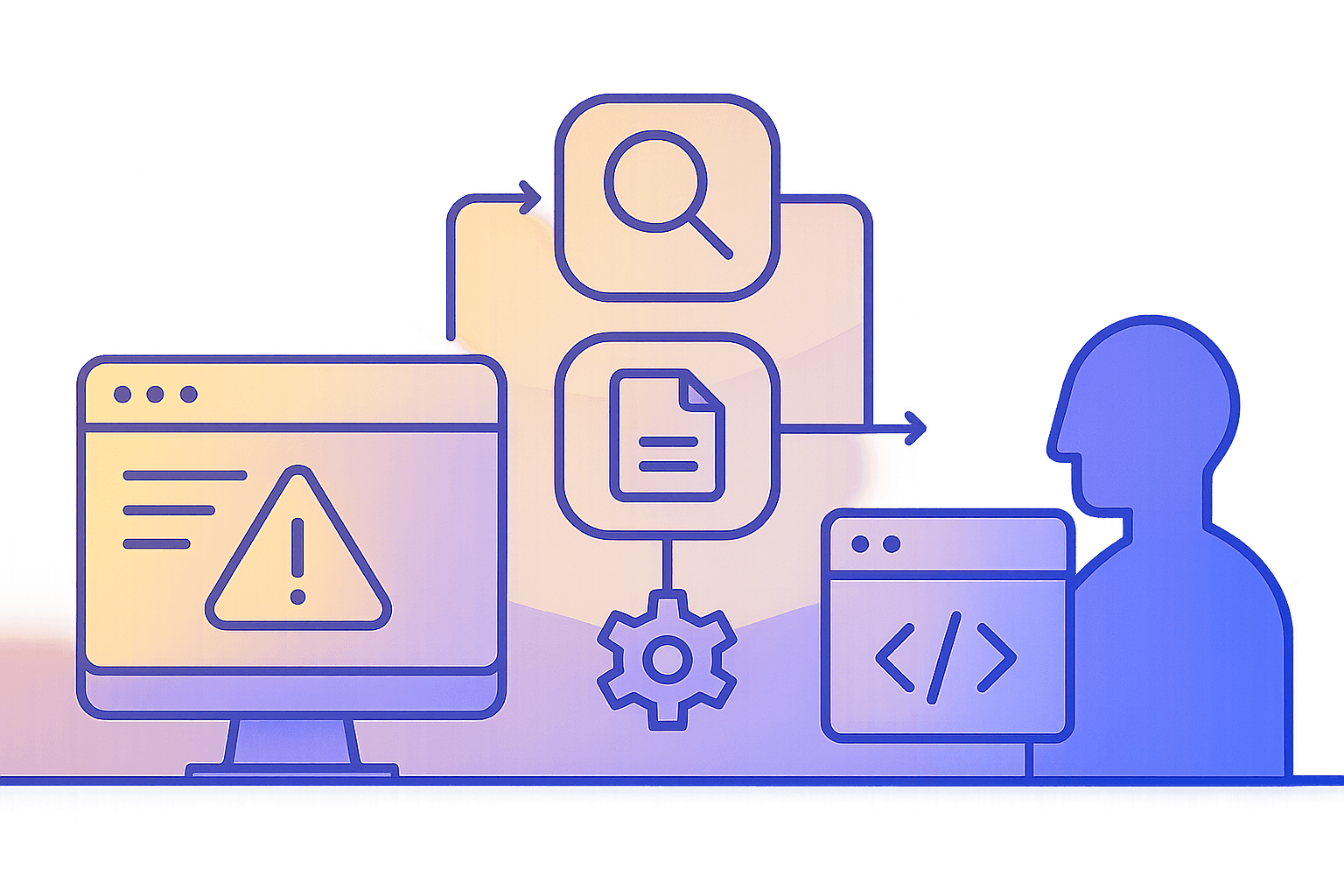
Your Logs Are Lying: Private RAG Pipelines for Code Debugging AI
Logs are a partial truth.
They’re truncated under load. They sample the wrong things. They miss the cross-service context. They’re scrubbed to protect PII but not always well. And if you trust them naively, your AI assistant will hallucinate just as confidently as your junior on-call who hasn’t seen this outage pattern before.
The better path is to treat logs, traces, and crash dumps as noisy signals that must be normalized, de-duplicated, time-aligned, and pinned to code versions before they’re handed to an AI. Retrieval-Augmented Generation (RAG) is an ideal fit—but only if you build it privately, with a schema and retrieval strategy designed for debugging.
This article lays out how to build a privacy-safe RAG pipeline that converts observability exhaust into high-signal context for a code debugging AI. We’ll cover:
- A schema designed for debugging (logs, spans, exceptions, and code artifacts)
- Temporal retrieval that aligns events around an incident
- PII scrubbing that preserves utility without leaking secrets
- Version pinning to commits and symbol maps for actionable code pointers
- How to wire it into on-call workflows without turning your SOC into a helpdesk
The tone here is opinionated-by-experience. The intended reader is technical: senior engineers, SREs, platform/infra leads, and ML practitioners standing up AI copilots for their orgs.
Why Your Logs Are Lying (And What to Do About It)
Logs are not an objective transcript of reality. Common failure modes include:
- Sampling and truncation: Hot paths are sampled or lines are truncated under load. Your error line may be missing the crucial attribute.
- Partial traces: Distributed tracing relies on propagation. Missing headers or ingress egress boundaries can break the chain.
- Time skew: Container clocks drift; sidecar timestamps differ from application clocks.
- Redaction artifacts: PII scrubbing might replace tokens inconsistently, collapsing distinct sessions into one or creating false duplicates.
- Asynchronous causality: The thing that broke a user flow happened two minutes earlier in another service’s queue.
- Deployment drift: Logs reference a version string that’s not tied to a unique commit. Symbolication becomes guesswork.
A debugging-grade RAG pipeline compensates by:
- Normalizing all events to a canonical schema
- Establishing graph links (trace_id, span_id, request_id, exception fingerprint)
- Temporal stitching across services and components
- Version pinning with immutable commit SHAs and symbol maps
- Privacy-preserving content scrubbing with consistent placeholders
- Hybrid retrieval (lexical + semantic) constrained by time and linkage
Architecture Overview
At a high level, the system looks like this:
- Ingestion and normalization: Collect logs, traces, and crash dumps (OpenTelemetry recommended). Normalize to a canonical schema.
- Scrubbing and enrichment: Apply PII scrubbing and secret detection; attach environment, service, version, commit SHA, symbolication metadata.
- Storage:
- Time-series/columnar store for fast temporal scans (e.g., ClickHouse, Elasticsearch, TimescaleDB)
- Object store for crash dumps and large artifacts
- Vector index for embedding-based retrieval (HNSW- or IVF-based; FAISS, Milvus, pgvector)
- Indexing: Chunk documents with debug-aware boundaries (trace span groups, exception blocks). Embed fields that matter for similarity.
- Retrieval:
- Temporal windowing around incident time
- Linkage-based joins via trace_id/request_id
- Hybrid search: BM25 + embeddings + reranking
- Safety filter: ensure no PII or secrets escaped scrubbing
- Reasoning:
- Code-aware model prompt with context (snippets, spans, diffs)
- Tools: symbol lookup, diff viewer, runbook references
- Delivery:
- On-call workflows (Slack/PagerDuty bots)
- Incident timelines with citations to source artifacts
Privacy is a first-class constraint:
- Keep data in your VPC/on-prem
- Use self-hosted embedding models and inference where possible
- Enforce per-tenant segmentation and RBAC
- Log every retrieval for audit
Canonical Debug Schema: Design for Retrieval, Not Storage
The schema should be optimized for retrieval questions like: "What changed in code that could cause this exception?" or "What upstream error led to this 500?" Apply a hybrid approach:
- Row store or columnar DB for structured query and temporal scans
- Vector store for similarity search over unstructured text
- Object store for binary dumps
Key entities:
- Event (base): common envelope
- LogLine: individual log entries
- TraceSpan: spans with timing, attributes, links
- Exception: exception/crash events with stack frames
- BuildArtifact: version metadata, commit SHA, symbol/source map pointers
- CodeArtifact: indexed file snippets, diffs, commit messages
Recommended fields:
- event_id (UUID), event_type (log|span|exception)
- tenant_id, project_id, environment (prod|staging)
- service, subsystem, hostname, pod_id, container_id
- timestamp (UTC, RFC3339), ingest_timestamp
- request_id, session_id, trace_id, span_id, parent_span_id
- severity (trace|debug|info|warn|error|fatal)
- version (semver), commit_sha (40-char), image_digest (OCI)
- scrubbed_text (for logs/exceptions), attributes (JSONB)
- fingerprint (stable hash of exception + top frames)
Schema decisions that pay dividends:
- Denormalize just enough: keep commit_sha and image_digest on every event. You’ll need it constantly.
- Use a deterministic scrubber to replace PII with stable placeholders and salted hashes. This preserves joins and grouping.
- Index by (tenant_id, environment, service, timestamp) and by (trace_id, span_id) for fast linkage.
- Store stack frames as arrays with file, function, line, module, in_app flags.
Example DDL (PostgreSQL + pgvector plus JSONB)
sql-- Enable pgvector
CREATE EXTENSION IF NOT EXISTS vector;

CREATE TABLE event (
  event_id UUID PRIMARY KEY,
  tenant_id TEXT NOT NULL,
  project_id TEXT NOT NULL,
  environment TEXT NOT NULL,
  service TEXT NOT NULL,
  subsystem TEXT,
  hostname TEXT,
  pod_id TEXT,
  container_id TEXT,
  event_type TEXT NOT NULL CHECK (event_type IN ('log','span','exception')),
  timestamp TIMESTAMPTZ NOT NULL,
  ingest_timestamp TIMESTAMPTZ NOT NULL DEFAULT now(),
  severity TEXT,
  request_id TEXT,
  session_id TEXT,
  trace_id TEXT,
  span_id TEXT,
  parent_span_id TEXT,
  version TEXT,
  commit_sha TEXT,
  image_digest TEXT,
  fingerprint TEXT,
  scrubbed_text TEXT,
  attributes JSONB DEFAULT '{}',
  -- Embedding of relevant text for semantic search (e.g., 1024 dims)
  embedding vector(1024)
);

CREATE INDEX ON event (tenant_id, environment, service, timestamp);
CREATE INDEX ON event (trace_id);
CREATE INDEX ON event (fingerprint);
CREATE INDEX ON event USING ivfflat (embedding vector_cosine_ops) WITH (lists = 100);

CREATE TABLE build_artifact (
  tenant_id TEXT NOT NULL,
  service TEXT NOT NULL,
  version TEXT NOT NULL,
  commit_sha TEXT NOT NULL,
  image_digest TEXT,
  build_time TIMESTAMPTZ,
  source_map_url TEXT,
  symbols_url TEXT,
  metadata JSONB,
  PRIMARY KEY (tenant_id, service, commit_sha)
);

CREATE TABLE code_artifact (
  tenant_id TEXT NOT NULL,
  commit_sha TEXT NOT NULL,
  path TEXT NOT NULL,
  lang TEXT,
  content TEXT,
  content_embedding vector(1024),
  PRIMARY KEY (tenant_id, commit_sha, path)
);
Event Document for Vector Indexing
Not every field belongs in the embedding. You want text that captures the semantics:
- For logs: message, selected attributes, stable placeholders
- For spans: name, attributes, error status, selected events
- For exceptions: type, message, top stack frames, code context
A chunking strategy that works well:
- Log windows: group 20–50 lines around an error within the same trace/request
- Span summaries: one chunk per span, include key attributes and in-span logs
- Exception blocks: exception + top N frames + nearest code diff summary
Example chunk for an exception:
json{
  "kind": "exception_block",
  "tenant_id": "acme",
  "service": "checkout",
  "environment": "prod",
  "timestamp": "2026-01-05T01:16:12Z",
  "trace_id": "1-5f9a2c7e-...",
  "commit_sha": "f8a6f2c1...",
  "fingerprint": "exc:ValueError:cart_total_negative@CheckoutService.applyCoupon#L182",
  "text": "Exception ValueError: cart_total_negative\n at CheckoutService.applyCoupon (checkout.py:182)\n at DiscountEngine.apply (discount.py:77)\n attributes: user_id=<USER_2c71>, order_id=<ORDER_9a3b>, coupon=SPRING25\n recent logs: WARN 'coupon SPRING25 expired'\n rollout: canary=10% sha=f8a6f2c1",
  "embedding": [ ... ]
}
Note the placeholders (<USER_...>)—we’ll cover how to generate those deterministically.
PII Scrubbing That Preserves Utility
Regulatory and contractual constraints mean you should assume no raw logs leave your controlled environment. But naïve scrubbing destroys signal: if you replace every user_id with "[REDACTED]", you can’t correlate events for a single user session.
Principles for effective scrubbing:
- Detect broadly, replace specifically: Use detectors for emails, phone numbers, credit cards, access tokens, names, addresses, IPs, and common ID formats.
- Deterministic placeholders: Replace each detected token with a type-specific placeholder that includes a stable salted hash. This preserves equality across events without revealing the original.
- Format-preserving where needed: For things like IPv4/IPv6 or UUIDs, you can optionally use format-preserving encryption or structured placeholders to keep downstream parsers happy.
- Secret detection for high entropy: Scan for credentials and tokens using entropy + pattern heuristics; block or quarantine rather than placeholder.
- Zero-trust policy: Treat logs as untrusted text. Don’t feed them raw to an LLM. Enforce a final guard before inference that re-checks for PII and secrets.
Recommended tools and techniques:
- Use a mature NER/PII framework (e.g., Microsoft Presidio) plus custom regexes and detectors.
- Add a high-entropy detector (like detect-secrets or TruffleHog heuristics) to catch unknown token formats.
- Keep detectors versioned and test them with labeled corpora; measure precision/recall.
- Salt per-tenant and rotate salts with key management (KMS) for placeholder hashing.
Scrubber Skeleton (Python)
pythonimport re
import hashlib
from typing import Dict, Tuple

# Simple detectors (extend with Presidio/NER in production)
EMAIL_RE = re.compile(r"[A-Za-z0-9._%+-]+@[A-Za-z0-9.-]+\.[A-Za-z]{2,}")
UUID_RE = re.compile(r"[0-9a-fA-F]{8}-[0-9a-fA-F]{4}-[1-5][0-9a-fA-F]{3}-[89abAB][0-9a-fA-F]{3}-[0-9a-fA-F]{12}")
IP_RE = re.compile(r"\b(?:(?:2[0-5]{2}|1?\d?\d)\.){3}(?:2[0-5]{2}|1?\d?\d)\b")
CC_RE = re.compile(r"\b(?:\d[ -]*?){13,19}\b")

# Stable, tenant-scoped placeholder hashing

def ph(token: str, tenant_salt: str) -> str:
    h = hashlib.sha256((tenant_salt + ":" + token).encode()).hexdigest()[:8]
    return h

DETECTORS: Dict[str, Tuple[re.Pattern, str]] = {
    "EMAIL": (EMAIL_RE, "<EMAIL_{h}>")
}
# Extend detectors to include UUID, IP, credit cards, phone, etc.

SECRET_RE = re.compile(r"(?i)(api[_-]?key|secret|token|bearer)\s*[:=]\s*([A-Za-z0-9._-]{16,})")

class SecretFound(Exception):
    pass

def scrub(text: str, tenant_salt: str) -> str:
    # Quarantine on explicit secrets
    if SECRET_RE.search(text):
        raise SecretFound("Potential secret in log line")

    def replace(pattern: re.Pattern, fmt: str, s: str) -> str:
        def _r(m):
            token = m.group(0)
            return fmt.format(h=ph(token, tenant_salt))
        return pattern.sub(_r, s)

    s = text
    for _name, (pat, fmt) in DETECTORS.items():
        s = replace(pat, fmt, s)

    # Example: user_id=... style attributes
    s = re.sub(r"user_id=([A-Za-z0-9-]+)", lambda m: f"user_id=<USER_{ph(m.group(1), tenant_salt)}>", s)
    s = re.sub(r"order_id=([A-Za-z0-9-]+)", lambda m: f"order_id=<ORDER_{ph(m.group(1), tenant_salt)}>", s)

    return s
Operational guidance:
- Maintain allowlists for attributes safe to pass through (e.g., feature flags) and blocklists for risky fields.
- Establish quarantine and redaction error handling. If a line triggers secret detection, store it only in a restricted bucket for security review; don’t index it.
- Log scrubber versions alongside events; make them part of the lineage for audits.
Temporal Retrieval: Put Events in Time, Not Just Space
Most debugging questions are temporal: “What changed right before the error?” “Which upstream span started the cascade?” RAG should reflect that.
Core techniques:
- Incident windowing: Center on the primary event time and include a configurable pre/post window (e.g., -10m to +5m). Adjust by severity and pattern.
- Linkage stitching: Include everything with the same trace_id or request_id, even if out-of-window, within a max span (e.g., 1 hour) to capture asynchronous effects.
- Multi-service alignment: Combine by trace_id and join on propagated attributes (user/session/order IDs, scrubbed placeholders).
- Clock skew tolerance: Use span start/end times and tolerate skew (±500 ms) when joining.
- Sessionization: For user-level incidents, group by session and include the last N actions.
Hybrid retrieval pipeline:
- Pre-filter candidate events by time, tenant, environment, service.
- If a trace_id is known, union all events connected to it.
- BM25/keyword search using error keyword, exception type, or fingerprints.
- Vector search over embeddings of chunks (exception blocks, span summaries, log windows).
- Rerank with a lightweight cross-encoder or LLM re-ranker; respect temporal proximity in scoring.
Example SQL for Candidate Gathering
sqlWITH seed AS (
  SELECT trace_id, timestamp FROM event
  WHERE tenant_id = $1
    AND environment = 'prod'
    AND event_type = 'exception'
    AND fingerprint = $2
  ORDER BY timestamp DESC
  LIMIT 1
),
window AS (
  SELECT s.trace_id, s.timestamp AS t0,
         (s.timestamp - interval '10 minutes') AS t_start,
         (s.timestamp + interval '5 minutes') AS t_end
  FROM seed s
)
SELECT e.*
FROM event e, window w
WHERE e.tenant_id = $1
  AND e.environment = 'prod'
  AND e.timestamp BETWEEN w.t_start AND w.t_end
  AND (
    e.trace_id = w.trace_id OR
    (e.request_id IS NOT NULL AND e.request_id IN (
        SELECT request_id FROM event WHERE trace_id = w.trace_id
    ))
  )
ORDER BY e.timestamp ASC
LIMIT 5000;
Vector Retrieval With Temporal Boosting (Python + pgvector)
pythonimport psycopg
import numpy as np

# embed(query_text) -> np.array of shape (1024,)

def semantic_candidates(conn, tenant_id, query_text, t_start, t_end, k=200):
    q = """
    SELECT event_id, timestamp, 1 - (embedding <=> $4) AS sim
    FROM event
    WHERE tenant_id = $1 AND timestamp BETWEEN $2 AND $3
    ORDER BY embedding <=> $4
    LIMIT $5
    """
    v = embed(query_text).tolist()
    with conn.cursor() as cur:
        cur.execute(q, (tenant_id, t_start, t_end, v, k))
        rows = cur.fetchall()
    # Apply temporal decay boost: newer relative to incident gets a slight boost
    return rows
Reranking can combine cosine similarity, BM25 score, and a Gaussian kernel over time difference from the incident time.
Version Pinning: Everything Tied to a Commit SHA
If you want the AI to propose a fix, it must reason over the exact code that ran. That means mapping every event to a commit SHA and symbol map. Version strings like "1.14.2" are necessary but insufficient; you need immutable references.
Practical steps:
- At build time: inject the git commit SHA and OCI image digest as labels and environment variables.
- OCI labels: org.opencontainers.image.revision, org.opencontainers.image.source
- Set COMMIT_SHA and IMAGE_DIGEST env vars
- At deploy time: publish a “release manifest” mapping service -> environment -> SHA/digest, canary percentage, rollout policy.
- At runtime: include commit_sha and image_digest in every log and span attribute (configure OpenTelemetry resource attributes or enrichers in your logging layer).
- Symbolication:
- Native: store debug symbols per SHA in a symbol server
- JS/TypeScript: store source maps keyed by SHA and artifact digest
- JVM/.NET: ensure line number tables and mapping to SHA are preserved
- Code indexing: index code files and diffs per commit. Prefer chunking by function/class and including blame info.
Example: injecting commit metadata into a container image via Dockerfile:
dockerfileARG COMMIT_SHA
ARG IMAGE_SOURCE
LABEL org.opencontainers.image.revision=$COMMIT_SHA \
      org.opencontainers.image.source=$IMAGE_SOURCE
ENV COMMIT_SHA=$COMMIT_SHA
And in app startup (e.g., Python):
pythonimport os
from opentelemetry.sdk.resources import Resource
from opentelemetry import trace

commit_sha = os.getenv("COMMIT_SHA", "unknown")
resource = Resource.create({
    "service.name": "checkout",
    "service.version": commit_sha,
    "code.commit_sha": commit_sha,
})
provider = trace.TracerProvider(resource=resource)
Store a BuildArtifact row per release and map it to the events. When a crash dump arrives, look up symbols_url by commit_sha and symbolicate before indexing.
Wiring It Into On-Call Workflows
The best pipeline is the one operators actually use at 3 AM. Integrate with the tools they live in.
Key patterns:
- ChatOps bot (Slack/Teams): Given a trace_id, exception fingerprint, or Sentry issue URL, it produces a “debug pack” with:
- Incident timeline (top 50 relevant events)
- Suspected root cause spans and recent diff summary
- Rollout context (which commit is running, canary status)
- Links to runbooks and dashboards
- A summarized hypothesis and suggested next steps
- PagerDuty enrichment: Add the commit SHA and suspected owner/team to incidents.
- One-click redaction appeal: If a scrubber over-redacts, allow a privileged human to reprocess safely.
- Guardrails: Ensure no PII escapes the boundary. The bot must run inside the private network and only send summarized, scrubbed text to any external system (preferably none).
Slack Bot Skeleton
pythonfrom slack_bolt import App
from datetime import datetime, timedelta

app = App(token=os.environ["SLACK_BOT_TOKEN"], signing_secret=os.environ["SLACK_SIGNING_SECRET"])

@app.command("/debug")
def debug_command(ack, respond, command):
    ack()
    args = command["text"].strip().split()
    # Usage: /debug trace <trace_id> | exc <fingerprint>
    mode, key = args[0], args[1]
    pack = build_debug_pack(mode, key)  # fetch temporal window, retrieve, summarize
    respond(blocks=pack.to_slack_blocks())

def build_debug_pack(mode, key):
    # 1) resolve seed event/time
    # 2) temporal gather
    # 3) hybrid retrieve + rerank
    # 4) summarize with local model
    # 5) assemble citations
    pass

if __name__ == "__main__":
    app.start(port=3000)
Tie this to RBAC. Only on-call engineers can request packs for prod. Log every retrieval with who/what/when and purpose.
Building the Indexer: From Streams to Chunks
An effective indexer is a streaming job with backpressure and retry semantics. Suggested topology:
- Sources: OpenTelemetry Collector exports to Kafka topics (logs, spans, metrics, exceptions)
- Processors: Scrubber + enricher (commit SHA lookup, release manifest join)
- Sinks:
- Columnar store (ClickHouse/Elasticsearch) for raw queries
- Object store for dumps
- Indexer service for chunking + embeddings + vector DB
OpenTelemetry Collector config snippet with processors:
yamlreceivers:
  otlp:
    protocols:
      http:
      grpc:
processors:
  batch:
  attributes:
    actions:
      - key: code.commit_sha
        from_attribute: service.version
        action: upsert
  transform:
    error_mode: ignore
    log_statements:
      - context: log
        statements:
          - set(attributes["sanitized"], true)
exporters:
  kafka:
    brokers: ["kafka:9092"]
    topic: otel-logs
  clickhouse:
    dsn: tcp://clickhouse:9000
service:
  pipelines:
    logs:
      receivers: [otlp]
      processors: [batch, attributes, transform]
      exporters: [kafka, clickhouse]
Indexer pseudocode:
pythonfrom kafka import KafkaConsumer
from sentence_transformers import SentenceTransformer
import faiss

model = SentenceTransformer("bge-large-en")  # self-hosted
index = faiss.IndexHNSWFlat(1024, 32)

consumer = KafkaConsumer("otel-logs", value_deserializer=json.loads)

for msg in consumer:
    event = normalize(msg.value)               # map to canonical schema
    event.scrubbed_text = scrub(event.raw_text, tenant_salt(event.tenant_id))
    chunks = chunk_event(event)                # windows, spans, exceptions
    for ch in chunks:
        vec = model.encode(ch.text)
        index.add(vec)
        persist_event_and_chunk(event, ch, vec)
Chunker principles:
- Don’t mix tenants or environments
- Keep chunk sizes 200–800 tokens for efficient embedding and retrieval
- Group logs by trace_id and time proximity; avoid one-line chunks unless essential
- For exceptions, attach top frames and nearby logs/spans
Reasoning Layer: Make the AI Code-Smart
The AI shouldn’t merely paraphrase logs; it should map them to code hypotheses. Equip it with:
- Tools for symbol lookup: given a frame and commit SHA, fetch code context
- Diff summarizer: what changed in the function/module since the last healthy commit
- Runbook retriever: relevant SOPs
- Owner mapper: who owns this code path
Prompt scaffolding example:
System: You are a senior debugging assistant. Use only provided context. Do not invent logs or stack frames.

User: Investigate incident {incident_id}. Primary exception: {type}: {message} at {top_frame}. Service {service} on commit {sha}. Time {t0}.

Context:
- Exception block(s):
{exceptions}
- Span summaries:
{spans}
- Recent log windows:
{logs}
- Code context for frames (commit {sha}):
{code_snippets}
- Diffs since previous release {prev_sha}:
{diff_summaries}
- Runbooks:
{runbooks}

Tasks:
1) Identify likely root cause with citations to context IDs.
2) Propose minimal code changes (patch or pseudocode) and tests.
3) Suggest mitigations and rollback if relevant.
Keep the model local or use a gateway running within your VPC. If you must call external APIs, send only scrubbed summaries and never raw logs/dumps.
Evaluation: Measure Retrieval Before You Tune Prompts
Without an evaluation harness, you’ll ship a demo that fails silently in production.
Build a small but high-quality corpus:
- Select 30–100 past incidents with clear root causes and time windows
- Label: key events, top spans, error fingerprints, relevant code diffs
- Define gold context sets and expected hypotheses
Metrics to track:
- Retrieval: Recall@k, nDCG for gold contexts; latency
- Summarization: Factuality via citation coverage, human-rated utility
- PII safety: Rate of PII/secrets detected post-scrub (should be near zero)
- Drift: Embedding distribution and vocabulary drift after deploys
A/B ideas:
- Hybrid vs. vector-only retrieval: hybrid typically outperforms, especially for exceptions with distinct keywords
- Temporal windows: compare -5m/+2m vs. -15m/+10m
- Chunk sizes: smaller chunks aid precision; larger chunks aid recall; pick per entity type
Relevant literature and practitioner guidance has consistently shown that RAG performance depends more on retrieval quality and chunking than model size alone. The original RAG paper (Lewis et al., 2020) and follow-up retrieval studies emphasize strong negatives, hybrid retrieval, and reranking to reduce hallucination. Observability-specific RAG benefits further from temporal constraints and linkage signals.
Safety: Treat Logs as Adversarial Content
Attackers can put adversarial strings into logs. Without guardrails, a model could be prompt-injected via log content. Mitigate:
- Strict content boundaries: Wrap log text as quoted literals in prompts; never execute tool commands suggested by logs without policy checks.
- Content filters: Re-run PII/secret scanners on retrieval output; strip anything suspect.
- Model instructions: System prompt must assert logs are untrusted and to cite, not obey.
- Least privilege: The bot cannot push to prod or escalate tickets; humans must approve.
- Tenant isolation: Separate indexes per tenant/env; avoid cross-tenant contamination.
Cost and Performance Considerations
- Embedding cost: Prefer a single high-quality embedding model across entities; batch to GPU for throughput.
- Index size: Deduplicate near-identical log windows; store only canonical chunks. Consider product quantization (PQ) for vector compression.
- Retention: Keep raw logs short (e.g., 7–14 days) and keep derived chunks/embeddings longer if scrubbed. Respect data minimization.
- Throughput: Use streaming ingestion with backpressure. For spikes, drop low-severity logs before embedding; never drop exceptions.
- Caching: Cache per-fingerprint context results; many errors recur.
End-to-End Blueprint: From Incident to Insight
A concrete step-by-step implementation plan:
- Instrumentation
- Add commit SHA and image digest to services via env/labels.
- Ensure OpenTelemetry spans propagate trace_id across services.
- Include request_id/session_id in logs consistently.
- Ingestion
- Deploy OpenTelemetry Collector in-cluster.
- Export logs/spans to Kafka topics and ClickHouse for query.
- Scrubbing and Enrichment
- Build a scrubber microservice with deterministic placeholders and secret quarantine.
- Join each event with release manifest to enrich commit SHA.
- Storage
- Create event and build_artifact tables with pgvector or ClickHouse + Milvus.
- Store crash dumps and symbol files in S3/GCS with bucket policies.
- Indexing
- Chunk events into exception blocks, span summaries, and log windows.
- Embed with a self-hosted model (e.g., bge-large, E5-large) and index in HNSW.
- Retrieval API
- Implement a /context endpoint: inputs (incident_id, trace_id, fingerprint, time). Outputs: top-k chunks with citations.
- Apply hybrid search with temporal constraints and reranking.
- Reasoning Service
- Host a code-aware LLM (e.g., fine-tuned Llama/CodeLlama/Mistral) behind a gateway.
- Provide tools: code fetch by sha/path, diff summaries, runbook search.
- Enforce PII guard and prompt-injection hardening.
- ChatOps Integration
- Slack slash command to request a debug pack for a trace/exception.
- PagerDuty integration to auto-post initial hypotheses.
- Evaluation and Observability
- Build an incident gold set; run nightly retrieval evaluation.
- Expose metrics: retrieval latency, recall@k, PII escape rate (post-scrub), embedding queue depth.
- Governance
- Per-tenant indexes; RBAC; audit logging for every retrieval; retention policies and DSAR support.
Minimal Retrieval Service Example (FastAPI)
pythonfrom fastapi import FastAPI, Query
from datetime import datetime, timedelta

app = FastAPI()

@app.get("/context")
def get_context(tenant: str,
                fingerprint: str = Query(None),
                trace_id: str = Query(None),
                t0: str = Query(None)):
    # 1) Resolve seed event/time
    if trace_id:
        seed = lookup_latest_event_by_trace(tenant, trace_id)
    else:
        seed = lookup_latest_exception_by_fingerprint(tenant, fingerprint)
    t0 = seed.timestamp if not t0 else datetime.fromisoformat(t0)

    # 2) Candidate gather (SQL as above)
    candidates = gather_candidates(tenant, seed, t0, window=(-600, 300))

    # 3) Hybrid retrieve
    bm25_hits = bm25_search(candidates, seed.exception_type)
    vec_hits = vector_search(tenant, seed, t0, window=(-600, 300))

    # 4) Rerank and dedupe
    ranked = rerank_and_dedupe(bm25_hits, vec_hits, t0)

    # 5) Final PII guard
    safe = [guard_scrub(ch) for ch in ranked[:50]]

    return {"seed": seed.event_id, "chunks": [c.to_dict() for c in safe]}
Practical Tips and Gotchas
- Always index exception fingerprints. They are powerful anchors for retrieval and caching.
- Keep a rolling map of trace_id -> request/session IDs to enable cross-cutting joins.
- Clock skew is real. Use span durations and allow fuzzy joins; don’t overfit to exact timestamps.
- For JS frontends, treat source maps as PII; host privately and fetch on-demand for symbolication.
- For multi-region deployments, track region and zone; prefer region-local context for latency and relevance.
- When sampling logs, never sample exceptions or error-level spans. Sample info/debug aggressively.
- Store scrubber and embedding model versions with each chunk; you’ll want to re-index after upgrades.
Privacy and Compliance Checklist
- Data minimization: Default to the minimum needed context. TTL for raw logs; longer TTL for scrubbed chunks.
- Encryption: At rest and in transit; KMS-managed keys; envelope encryption for object store.
- Access control: RBAC per tenant, per environment; break-glass procedures for sensitive contexts.
- Audit: Immutable audit log for retrieval queries and model inferences, including prompts and outputs.
- Residency: Keep data in-region; replicate scrubbed indexes only within policy bounds.
- DSAR/Right to be forgotten: Given stable placeholders, support re-identification and purge by mapping hash to originals within a secure enclave if required by policy—otherwise, design to avoid storing reversible mappings.
What Good Looks Like
When this pipeline is humming, incident response changes character:
- The on-call asks the bot “why did prod 500 spike at 01:16 UTC?” and gets a timeline with a precise hypothesis: “Null pointer at FooService v1.2.3 (sha abc123) after rollout of changes to applyCoupon(); triggered when coupon=SPRING25; upstream rate-limit at Auth caused missing user segment; suggested fix: guard against None for user.segment; rollback to prev_sha def456.”
- The answer cites specific spans and log windows, shows the diff of the function that changed, and links the runbook section for “degraded discounts.”
- No PII is visible; user_id and order_id are stable placeholders. Everything is self-contained within your network.
- A junior engineer can triage with senior-level efficiency.
Conclusion
Your logs are lying—by omission, by skew, and by lack of context. A private, debugging-grade RAG pipeline turns that noisy narrative into a coherent, actionable story tied to the exact code that ran.
The core ingredients are straightforward but must be engineered thoughtfully:
- A canonical schema that joins logs, spans, exceptions, and code artifacts
- Deterministic PII scrubbing that preserves relational structure
- Temporal retrieval that respects causality and linkage
- Version pinning to immutable commits and symbol maps
- Tight integration with on-call workflows under strong privacy guarantees
Start small: instrument commit SHAs, build a scrubber, index exception blocks, and wire a simple Slack command. Iterate with an incident gold set and measure retrieval quality before tuning your prompts. Over time, you’ll move from reactive firefighting to proactive, explainable debugging—without shipping your users’ data to the public internet.
If your AI is only as good as its context, then for debugging, context is time, linkage, and code. Build your RAG to respect that, and your logs will finally tell the truth you need.