A team ships a seemingly clean pull request on Friday afternoon. The AI agent wrote most of it. It updated the backend handler, adjusted a React component, fixed snapshots, and even added unit tests. CI passed. Reviewers scanned the diff, saw reasonable code, and merged.
On Monday morning, support gets a wave of tickets: users can no longer complete checkout when applying a discount code from the cart page. The API still returns 200. The new component renders. The unit tests pass. The PR looked disciplined. But the actual workflow—the thing the user was trying to do—was broken.
That is the new blind spot in AI-assisted software delivery.
When AI agents generate code, update tests, and open pull requests, they amplify the existing weakness in modern testing: teams validate implementation details far more rigorously than user outcomes. The faster code appears, the easier it becomes to confuse “the diff looks fine” with “the product works.” Traditional CI/CD pipelines reinforce this confusion because most of what they verify is code-centric: static analysis, unit tests, contract tests, and build integrity. Useful checks, yes. Sufficient proof of behavior, no.
The important question is no longer just whether the code compiles, whether a branch is green, or whether a reviewer approves the patch. The question is whether anyone verified that the intended action still works in the product after the agent’s changes landed.
The real problem is not AI-generated code. It is outcome-free validation.
It is tempting to frame this as an AI quality problem. It is not, at least not primarily. AI coding agents did not create flaky test suites, shallow PR reviews, or CI pipelines that reward passing abstractions while missing broken workflows. Those issues were already here. AI simply scales them.
A human engineer might take a few hours to implement a change and maybe manually test a happy path before opening a PR. An AI agent can produce ten coordinated edits in minutes across handlers, components, migrations, mocks, and tests. That speed increases throughput, but it also increases the number of opportunities for a subtle mismatch between intended behavior and actual behavior.
The danger is not only bad code. The danger is believable code.
Believable code is the code that looks internally consistent. Types line up. Tests are updated. Naming is coherent. Review comments are addressed. But the system-level effect is unverified. For technical teams, especially those optimizing developer productivity, this is a serious operational risk. The smoother the artifact, the more likely people are to trust it.
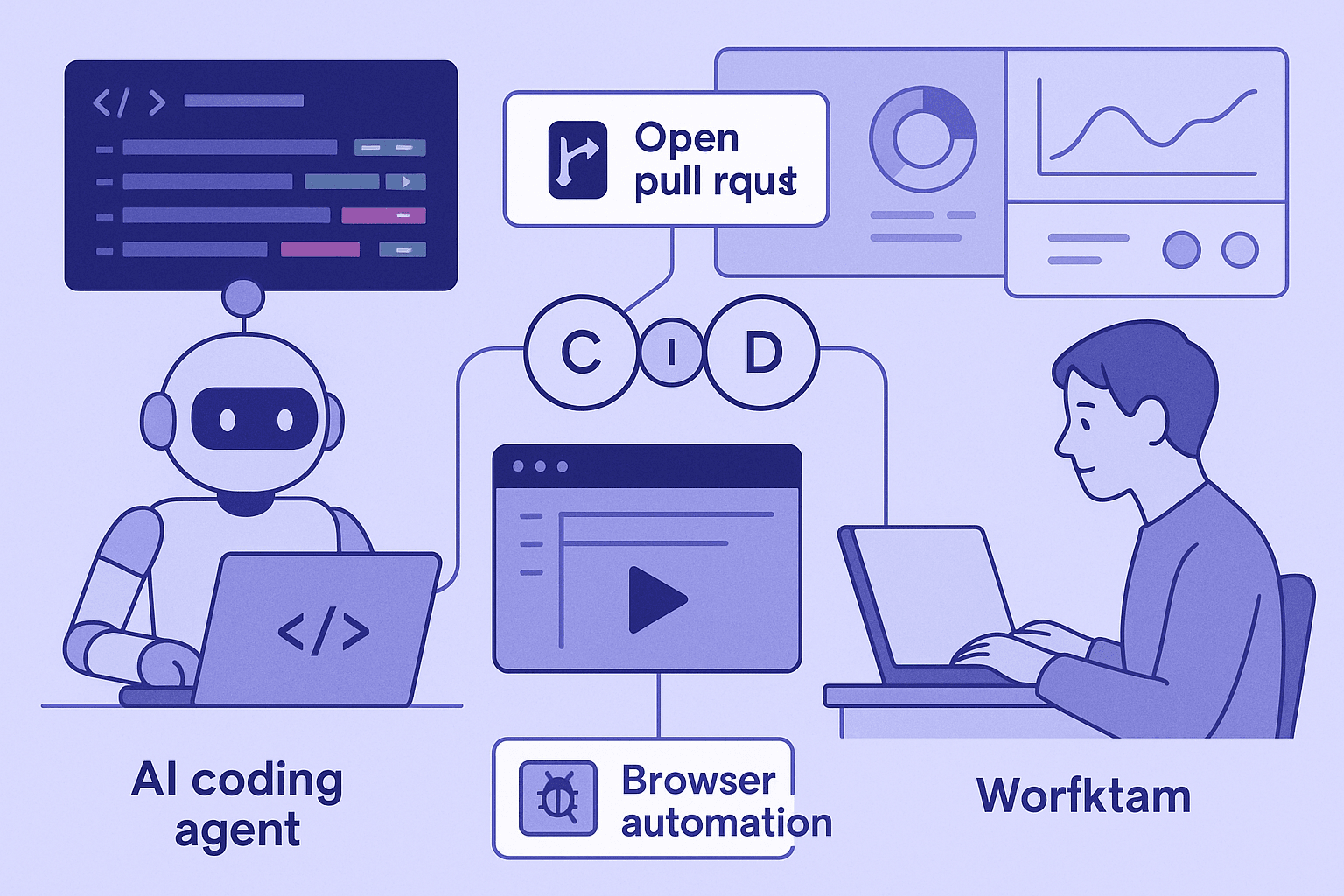
With AI-generated PRs, the handoff chain now looks like this:
- A person expresses intent.
- An agent converts intent into implementation.
- The PR shows code changes and test changes.
- CI validates technical correctness signals.
- Humans review the diff.
- The branch merges.
What is missing is a reliable proof that the original user intent survived all six steps.
That proof has to exist outside the diff.
Why pull request validation is still trapped at the code layer
Most teams treat pull requests as the primary unit of verification. That makes sense organizationally because PRs are where intent, discussion, and code meet. But PRs are a terrible boundary for validating user outcomes.
A pull request is fundamentally an implementation artifact. It answers questions like:
- What changed?
- Who changed it?
- What tests were added?
- Did CI pass?
- Does the code align with architecture and style?
It does not inherently answer:
- Can the user still complete the workflow?
- Did the feature request actually materialize in the product?
- Did a neighboring flow break?
- Does the browser behavior match the intended experience?
- Does the system work across all layers under realistic state?
This gap existed before AI. But AI agents make it worse because they can produce PRs that satisfy every code-layer expectation without ever exercising the product. In other words, the more teams automate code generation, the more they need verification systems that are not themselves code-diff-centric.
If your current process says, “The PR has tests, CI is green, and the reviewer approves,” you are still validating that the implementation seems plausible. You are not validating that the outcome exists.
Why unit tests fail to protect the workflow
Unit tests are good at one thing: narrowing the blast radius of local changes by proving isolated logic still behaves as expected. They are not good at proving users can accomplish goals.
Consider a discount-code flow in ecommerce. You can have excellent unit coverage for:
- discount validation rules
- price calculation helpers
- cart state reducers
- coupon API client wrappers
- frontend rendering of applied discounts
And still break the real workflow.
Maybe the “Apply” button is disabled because of a state synchronization bug. Maybe the code field clears after a re-render. Maybe the backend accepts the discount, but the cart summary component reads stale state. Maybe the mobile viewport hides the action below a collapsed section. Maybe the route transition drops the coupon before checkout begins.
Each layer may look correct in isolation. The workflow still fails.
This is the core misunderstanding behind a lot of modern testing strategy. Teams assume that enough local confidence aggregates into system confidence. It does not. Not reliably.
Here is a simplified example in JavaScript:
jsexport function applyDiscount(cart, coupon) {
  if (!coupon || coupon.expired) return cart;

  return {
    ...cart,
    total: Math.max(0, cart.total - coupon.amount),
    couponCode: coupon.code,
  };
}
A unit test might look like this:
jsimport { applyDiscount } from './applyDiscount';

test('applies valid coupon to cart', () => {
  const cart = { total: 100 };
  const coupon = { code: 'SAVE10', amount: 10, expired: false };

  expect(applyDiscount(cart, coupon)).toEqual({
    total: 90,
    couponCode: 'SAVE10',
  });
});
That is fine. But it proves almost nothing about whether a user can open the cart, enter SAVE10, click Apply, see the updated price, proceed to checkout, and place the order with the correct total.
Unit tests protect functions. Users experience workflows.
Why CI/CD gives false confidence
CI/CD pipelines are often described as quality gates. In practice, most are consistency gates. They ensure the repository remains buildable and that predefined checks pass. That is necessary, but not equivalent to reliability.
A typical pipeline might run:
- linting
- type checking
- unit tests
- selective integration tests
- build steps
- security scans
- artifact packaging
All useful. None directly confirm the intended product action works unless you deliberately add action-level verification.
This matters because CI outputs have a psychological effect. A green pipeline compresses uncertainty into a single signal: pass. Managers trust it. Reviewers trust it. Founders trust it. Engineers trust it because there is too much code shipping to investigate every branch manually.
But a green pipeline only means “all encoded assumptions passed.” If the assumptions are implementation-centric, the confidence is implementation-centric too.
That is exactly how teams end up shipping failures that surprise everyone. The bug was not invisible. It was out of scope for the checks.
AI-generated PRs intensify this because agents are often evaluated on repository-visible outputs. Did the code compile? Were tests updated? Did the PR include a summary? From the system’s perspective, these are tractable tasks. But none require proving that the feature actually works through the UI or API sequence a user depends on.
In other words, AI can optimize for passing the gate you built. If the gate does not encode user outcomes, you should expect outcome failures.
Why manual QA does not scale as the only answer
A common reaction is: fine, let QA catch it.
That answer does not hold up.
Manual QA is valuable, especially for exploratory testing, edge-case discovery, and validating nuanced experience. But as the primary mechanism for verifying every AI-assisted change, it becomes a bottleneck immediately. The more code generation accelerates, the less practical it is to rely on humans to manually replay every affected workflow before merge.
There is also a timing problem. Manual verification often happens too late, too inconsistently, or only for obvious high-risk features. Small “safe” changes still merge because everyone assumes the code and tests cover enough.
The result is a dangerous split:
- high-cost manual validation for a small subset of changes
- code-centric automated validation for everything else
That leaves a large middle area where user-critical workflows are effectively unowned.
The answer is not to eliminate QA. The answer is to move more outcome verification into automation, where CI/CD can validate actions instead of just code properties.
The core insight: verify actions, not just implementations
If AI is helping write the code, then your testing strategy has to verify what the user can do after the code lands.
This means shifting part of your validation model from implementation-level checks to action-level checks.
An action-level check is an automated proof that a user goal succeeds in a real running system. Not that a function returned the right value. Not that a mock received the right call. Not that the backend emitted 200. But that the workflow completed end to end and the expected outcome was visible.
Examples:
- A user can sign up and reach the welcome dashboard.
- A customer can apply a discount code and complete checkout.
- An admin can invite a teammate and the invite email status appears.
- A user can upload a PDF and later retrieve processed results.
- A founder can connect Stripe and see billing sync complete.
These are product actions. They cross boundaries. They survive refactors. They matter to the business.
This is the kind of verification AI-assisted delivery needs because it checks whether intent survives translation from prompt to implementation to merge to deploy.
What action-level verification looks like in practice
The most practical way to encode action-level verification today is through end-to-end browser and API workflows, backed by stable test environments and realistic test data. Playwright is often a strong fit because it combines browser automation, network visibility, strong assertions, and CI ergonomics.
Here is a Playwright example for the discount workflow:
tsimport { test, expect } from '@playwright/test';

test('user can apply discount code and complete checkout', async ({ page }) => {
  await page.goto('http://localhost:3000');

  await page.getByRole('link', { name: 'Cart' }).click();
  await page.getByLabel('Discount code').fill('SAVE10');
  await page.getByRole('button', { name: 'Apply' }).click();

  await expect(page.getByTestId('cart-total')).toHaveText('$90.00');
  await expect(page.getByText('Discount applied')).toBeVisible();

  await page.getByRole('button', { name: 'Checkout' }).click();
  await page.getByLabel('Email').fill('buyer@example.com');
  await page.getByLabel('Card number').fill('4242424242424242');
  await page.getByLabel('Expiration').fill('12/34');
  await page.getByLabel('CVC').fill('123');
  await page.getByRole('button', { name: 'Place order' }).click();

  await expect(page.getByRole('heading', { name: 'Order confirmed' })).toBeVisible();
  await expect(page.getByText('$90.00')).toBeVisible();
});
Notice what this test proves:
- the cart page rendered correctly
- the input accepted data
- the action button worked
- the state updated visibly
- checkout inherited the discounted total
- the final outcome matched the intended behavior
This is far more aligned with business reliability than five additional unit tests around coupon helpers.
That does not mean unit tests are unimportant. It means they cannot carry the responsibility of workflow verification.
Add API-level action checks where the browser is unnecessary
Not every important action needs a browser. Some workflows are better validated through API-level sequences, especially backend-heavy systems, internal tools, and infrastructure products.
Here is a Python example using requests to validate a multi-step workflow:
pythonimport requests

BASE_URL = "http://localhost:8000"

def test_user_can_create_project_and_trigger_first_build():
    session = requests.Session()

    signup = session.post(f"{BASE_URL}/api/signup", json={
        "email": "newuser@example.com",
        "password": "SuperSecret123"
    })
    assert signup.status_code == 201

    project = session.post(f"{BASE_URL}/api/projects", json={
        "name": "demo-project",
        "repo_url": "https://github.com/example/demo.git"
    })
    assert project.status_code == 201
    project_id = project.json()["id"]

    build = session.post(f"{BASE_URL}/api/projects/{project_id}/builds")
    assert build.status_code == 202

    builds = session.get(f"{BASE_URL}/api/projects/{project_id}/builds")
    assert builds.status_code == 200
    statuses = [b["status"] for b in builds.json()]
    assert "queued" in statuses or "running" in statuses
This still verifies an action, not just a single endpoint. It encodes a user goal in terms of the product’s actual operating surface.
Make the CI pipeline prove outcomes before merge
Action-level checks matter most when they are first-class citizens in CI/CD, not optional extras engineers run only when nervous.
A GitHub Actions example:
yamlname: pr-validation

on:
  pull_request:
    branches: [main]

jobs:
  build-and-test:
    runs-on: ubuntu-latest
    services:
      postgres:
        image: postgres:15
        env:
          POSTGRES_USER: app
          POSTGRES_PASSWORD: app
          POSTGRES_DB: app_test
        ports:
          - 5432:5432
        options: >-
          --health-cmd="pg_isready -U app"
          --health-interval=10s
          --health-timeout=5s
          --health-retries=5

    steps:
      - uses: actions/checkout@v4

      - uses: actions/setup-node@v4
        with:
          node-version: 20

      - name: Install dependencies
        run: npm ci

      - name: Run database migrations
        run: npm run db:migrate

      - name: Run unit tests
        run: npm run test:unit

      - name: Build app
        run: npm run build

      - name: Start app
        run: npm run start:test &

      - name: Wait for app
        run: npx wait-on http://localhost:3000

      - name: Run workflow checks
        run: npx playwright test tests/workflows
This pipeline does something important that many teams skip: it treats workflow checks as merge criteria.
Not nightly. Not “post-deploy smoke” only. Not “maybe on release branches.”
At PR time.
That changes team behavior. Once outcome verification is part of merge eligibility, developers and agents alike are forced to satisfy product-level correctness, not just repository-level correctness.
The handoff problem: intent gets lost between prompt and production
The hardest part of AI-assisted development is not syntax. It is semantic drift.
A person asks for one thing:
“Let users apply a discount code from the cart and keep it through checkout.”
The AI agent implements something adjacent:
- apply code on cart page
- update tests around coupon calculation
- patch checkout serializer
- open PR
Everything may look directionally correct. But the original requirement had a key phrase: “keep it through checkout.” If nobody verifies the action, the code can be merged even if the discount silently disappears during route transition.
This is what makes debugging AI-assisted systems different. You are no longer just tracking whether code is wrong. You are tracking whether intent survived a lossy translation pipeline.
The only durable defense is to encode intent as executable checks.
If the requirement is workflow-shaped, the test should be workflow-shaped.
A practical pattern: tie each important PR to one expected user outcome
Teams do not need to write giant end-to-end suites for every commit. That is the wrong lesson. Huge browser suites become slow, flaky, and politically ignored.
A better pattern is this:
For every material product change, define the primary user outcome it is supposed to preserve or create. Then ensure at least one automated action-level check proves that outcome.
Examples:
- “User can reset password and sign in with the new password.”
- “Admin can revoke API token and old token stops working.”
- “Customer can upgrade plan and billing UI reflects the new tier.”
- “Developer can connect GitHub repo and initial sync completes.”
This creates a strong mapping:
- feature intent u2192 expected user action u2192 executable verification
That mapping is far more useful than asking whether the diff looks reasonable.
What to test: focus on business-critical workflows and high-change surfaces
You do not need action-level checks for every possible path on day one. Start where production pain and delivery risk overlap.
Prioritize:
-
Revenue paths
signup, checkout, upgrade, renewal, quote acceptance -
Activation paths
onboarding, first successful import, first deployment, first report generated -
Trust paths
login, password reset, permissions, billing changes, data export -
High-churn surfaces
components and workflows frequently touched by agents or product iteration -
Historically fragile paths
the flows that already generate bugs, support tickets, or rollback anxiety
This is where workflow-based testing improves both reliability and developer productivity. It reduces the amount of time teams spend debugging “green CI, broken product” incidents after merge.
The usual objections, and why they are weaker than they sound
“End-to-end tests are flaky.”
Bad ones are. So are bad unit tests, bad mocks, and bad pipelines.
Flakiness usually comes from poor state control, brittle selectors, race conditions, and trying to assert too many incidental details. Focus on durable selectors, controlled fixtures, isolated environments, and business-level assertions.
Example of a brittle assertion:
tsawait expect(page.locator('.cart-row:nth-child(3) .price')).toHaveText('$90.00');
Better:
tsawait expect(page.getByTestId('cart-total')).toHaveText('$90.00');
“They are too slow for every PR.”
Not if you are selective. You do not need 400 browser tests blocking every merge. You need a compact set of critical workflow checks that catch outcome regressions early.
A dozen high-value action checks often deliver more practical reliability than thousands of narrow tests that never touch the product surface.
“We already have integration tests.”
Good. But many so-called integration tests still operate below the user-action layer. They test service interactions, not outcomes. Useful, but not equivalent.
“Reviewers can spot the issue.”
Sometimes. But reviewers inspect representations of behavior, not behavior itself. As systems become more distributed and AI-generated diffs become more voluminous, code review becomes even less capable of proving workflows.
A comparison of testing approaches
Here is the practical difference between common validation layers:
| Approach | What it validates well | What it misses | Best use |
|---|---|---|---|
| Unit tests | Local logic, pure functions, edge cases | Real workflow failures, integration drift, UI breakage | Fast guardrails around core logic |
| Integration tests | Service boundaries, database interactions, contracts | Full user intent, browser issues, multi-step outcomes | Verifying subsystem cooperation |
| Manual QA | Nuance, exploration, visual sanity, weird edge cases | Scale, consistency, fast PR throughput | Exploratory and release-focused validation |
| Code review | Design quality, maintainability, architecture, obvious mistakes | Runtime behavior, state issues, hidden workflow regressions | Human judgment over implementation |
| CI/CD checks | Repeatable automation, repository health, merge gating | Anything not explicitly encoded | Enforcing baseline quality rules |
| Action-level workflow tests | User outcomes in realistic execution paths | Deep implementation diagnosis if used alone | Proving critical product behavior survives change |
The mistake is thinking one of these replaces all the others. The right strategy is layered, but with a clearer top-level goal: prove the product still does the important things users need.
Debugging gets easier when tests speak in user actions
There is another upside to action-level checks: better debugging.
When a unit test fails, you know a local invariant broke. That is useful for implementation debugging.
When a workflow test fails with “user cannot complete checkout after discount application,” you know the business consequence immediately. That improves prioritization and incident response. It gives everyone—from engineer to product lead—a shared understanding of impact.
Modern tools like Playwright also improve diagnosis through traces, videos, screenshots, and network inspection. That makes workflow failures far more actionable than the old stereotype of opaque end-to-end breakage.
Example Playwright config snippet:
tsimport { defineConfig } from '@playwright/test';

export default defineConfig({
  use: {
    baseURL: 'http://localhost:3000',
    trace: 'on-first-retry',
    screenshot: 'only-on-failure',
    video: 'retain-on-failure',
  },
  retries: 1,
});
If the AI agent’s PR breaks state persistence, the failing trace will often show exactly where the workflow diverged.
That is a major improvement in debugging speed, especially when changes were generated quickly and span multiple files the human reviewer did not author.
How to adapt your process for AI-assisted delivery
If your team is using AI agents to draft code or open PRs, update the delivery process itself. Do not just bolt AI onto a preexisting validation model and hope.
1. Require outcome statements in PRs
Every substantive PR should answer: what user action should now work, or continue to work?
Examples:
- “User can apply coupon from cart and retain discount through checkout.”
- “Admin can create invite links that expire after 24 hours.”
This pushes intent into explicit language.
2. Link each outcome to at least one executable check
If the behavior matters, encode it. The check can be browser-based, API-based, or hybrid. But it should verify the action directly.
3. Make workflow checks blocking for critical paths
Do not relegate them to dashboards nobody watches. Put them in CI/CD as merge gates for revenue, activation, and trust-critical flows.
4. Keep the suite small and meaningful
Protect business-critical workflows first. Avoid sprawling suites that assert incidental UI details.
5. Use test data and environments deliberately
Most workflow test pain comes from environment chaos. Seed known data. Isolate state. Control external dependencies where needed.
6. Use code review for design, not final proof of behavior
Reviewers should absolutely assess architecture, readability, risk, and correctness reasoning. But process-wise, review should not be the last line of defense for workflow validity.
7. Track escaped failures by missing verification type
When bugs hit production, ask: what would have caught this? A unit test? Integration test? Action-level workflow check? Manual QA? This helps teams invest rationally instead of adding random tests after each incident.
A minimal rollout plan for most teams
If your organization wants to close this blind spot without overhauling everything, do this over the next month:
Week 1: Identify your top 10 workflows
List the user actions that matter most to revenue, activation, retention, and trust.
Week 2: Implement 3 to 5 high-value workflow checks
Choose the highest-risk gaps, especially around areas frequently changed by AI-assisted coding.
Week 3: Run them in pull request CI
Do not wait for nightly only. Measure runtime and flakiness. Fix environment issues quickly.
Week 4: Update PR templates
Add fields like:
- Intended user outcome
- Workflow check added or updated
- Critical path affected: yes/no
This creates accountability without much process overhead.
The strategic point: AI increases the value of outcome verification
As AI systems generate more implementation work, human review becomes less able to function as behavioral proof. That is not because humans are getting worse. It is because the volume and plausibility of generated changes are increasing faster than manual verification capacity.
This changes what mature engineering organizations should optimize for.
Not more diff review. Not more snapshots. Not more green checks that only prove code-shaped properties.
The new leverage is executable evidence that users can still do the thing the change was meant to enable.
That is what protects reliability. That is what prevents false confidence in CI/CD. That is what keeps developer productivity gains from turning into downstream debugging costs.
Conclusion
Your AI agent can write the handler, patch the component, update the tests, and open the pull request. None of that proves the feature works.
A merged PR is not a verified outcome. A green CI pipeline is not a verified outcome. A reviewed diff is not a verified outcome.
If the requirement is about what a user can do, then the validation must prove what a user can do.
This is the blind spot AI-assisted delivery exposes so clearly: teams are still reviewing implementations while the real risk lives in unverified workflows.
The fix is not complicated, but it does require discipline. Keep unit tests. Keep integration tests. Keep code review. Keep QA. But add action-level checks in CI/CD for the workflows that matter most.
Because in the end, the question that matters is not whether the AI opened a solid PR.
It is whether anyone verified the outcome.