
A customer completes checkout, sees a success screen, gets a confirmation number, and closes the tab.
Ten minutes later, support gets the ticket: no order in fulfillment, no receipt email, charge captured twice.
The UI worked. The API returned 200. The Playwright test passed. CI was green.
And the product still failed.
That failure pattern is becoming normal. Not because engineers forgot how to write tests, but because the shape of software failure has changed. AI-assisted development is increasing the volume of code changes, the speed of refactors, and the number of “mostly correct” implementations that satisfy local assertions while breaking cross-system behavior. The bug is no longer always inside the feature. It’s often at the handoff between systems.
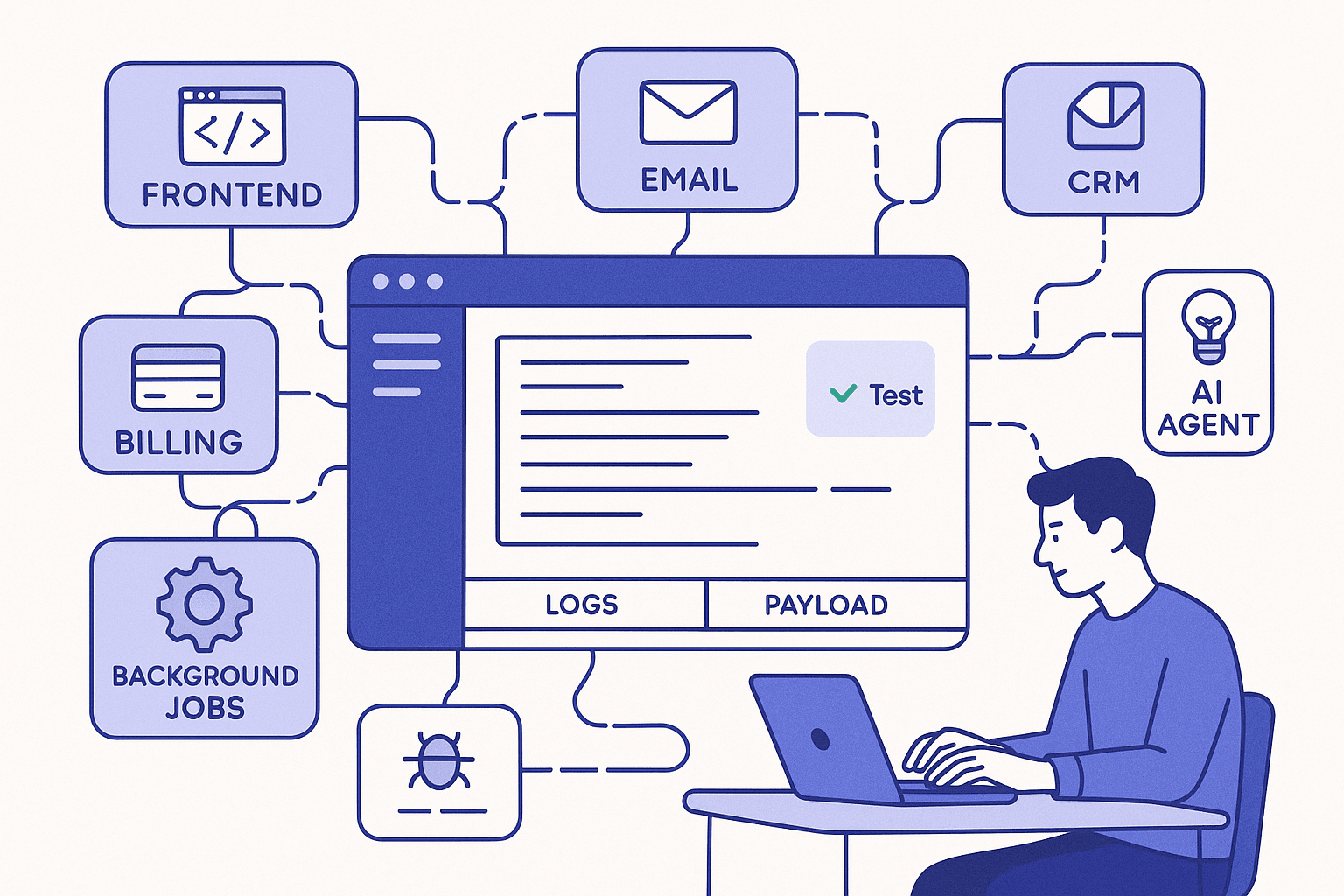
Frontend to API. App to email provider. Checkout to fulfillment. Form submit to CRM. Auth to billing. Ticket creation to background jobs.
These are workflow boundaries: the points where one system declares success and assumes another system will do the right thing. That assumption is now one of the weakest parts of modern software.
Traditional testing does not cover this well. Unit tests validate functions. Integration tests validate a service or database interaction. End-to-end tests validate that a user can click through a flow and see the next screen. Even mature QA processes tend to validate visible outcomes in one environment at one point in time.
What they often do not validate is whether the right downstream actions actually happened, in the right order, with the right payload, exactly once.
That is the new failure surface.
The problem is not that testing stopped working
Most teams do have tests. Many teams have good tests. The problem is that the tests were designed for an older failure model.
In the old model, a bug was usually local:
- a function returned the wrong value
- a form validation branch was incorrect
- a route crashed
- a migration broke a query
- a button stopped rendering
Those are still real bugs. But they are no longer the whole story.
Modern products are stitched together from APIs, queues, SaaS platforms, webhooks, internal services, and asynchronous jobs. A single user action can fan out into half a dozen side effects:
- write application state
- enqueue a background job
- send analytics
- create a CRM lead
- provision an account
- issue an invoice
- trigger an email
- notify another internal system
Each step may be retried, transformed, delayed, deduplicated, or rejected by a downstream system with different rules and timing. The user sees one workflow. Engineering operates many interacting systems.
That difference matters. A green test can confirm that the user got to the “Success” page. It says nothing about whether the CRM contact was created, whether the billing customer was attached to the right tenant, whether the email provider rejected the template data, or whether the fulfillment event was published before the transaction committed.
This is why teams keep seeing incidents that feel impossible:
- “How did the test pass if the email never sent?”
- “Why was the user billed but not provisioned?”
- “Why do we have duplicate tickets from one form submission?”
- “Why did the background job run with stale state?”
Because the test covered the interaction, not the handoff.
AI-generated changes amplify handoff failures
This is where AI changes the economics of debugging and testing.
AI coding tools are very good at producing plausible implementations that satisfy local requirements. They can update a controller, add a field to a payload, refactor a workflow into a queue, rename an event, or swap one SDK call for another. In a code review, the changes can look clean. The tests can be updated. CI can go green.
But workflow boundaries are where “plausible” breaks.
Agent-written PRs often introduce one of four classes of handoff bugs:
1. Contract drift
A field is renamed in one layer but not another. A timestamp format changes. A nested object becomes optional. A webhook payload shape shifts slightly. The producer and consumer are both “valid” in isolation, but no longer agree.
2. Sequencing bugs
A side effect fires before a transaction commits. An email is sent before billing succeeds. A background job reads state before it is finalized. A webhook is emitted before related records exist.
3. Retry and idempotency bugs
The new code retries on timeout but does not preserve idempotency keys. A job reruns after a partial failure and duplicates the ticket, invoice, or shipment. The user only clicked once; the system acted twice.
4. Silent downstream rejection
The app reports success because the local action succeeded, but the downstream system quietly drops or rejects the request: invalid metadata, rate limits, unknown enum value, missing template variable, stale token, unsupported state transition.
These bugs are common even in manually written code. AI-assisted development increases the frequency because more changes are made faster, often across layers, and often by applying patterns that are syntactically correct but operationally naive.
This is not an argument against AI coding tools. It is an argument against pretending our existing CI/CD signals are enough.
Why CI/CD gives false confidence here
CI/CD pipelines are optimized to answer a narrow question: does this change meet the checks we decided to run?
That sounds obvious, but teams regularly confuse green pipelines with reliable workflows.
A typical pipeline might run:
- linting
- type checks
- unit tests
- integration tests
- browser automation
- build verification
Useful? Absolutely.
Sufficient for workflow boundaries? Often not.
Here’s why.
CI validates the artifact, not the real-world chain of effects
Most CI environments mock or stub external systems. That is sensible for speed and determinism. But it means the hardest part of the workflow is replaced by fakes.
The browser clicks “Submit.” The app returns success. The mocked email provider says “accepted.” The mocked CRM says “created.” The test passes.
In production, the CRM may reject the payload because a required custom field is missing in one region. The email provider may accept the request but drop the send later because of template validation. Fulfillment may process an event before inventory reservation completes.
CI never saw any of that.
CI usually checks immediate state, not eventual outcomes
Workflow bugs are often temporal. Something eventually happens, or fails to happen, after the main request finishes.
Most test suites assert immediate conditions:
- response code is 200
- page navigates to confirmation
- row exists in database
- job was enqueued
But the workflow boundary bug lives in eventual behavior:
- was the job actually processed?
- did the downstream side effect happen?
- did it happen exactly once?
- did it happen after prerequisite state was committed?
If you only assert the enqueue and not the effect, you are testing intent, not outcome.
CI favors component correctness over cross-system truth
Teams build tests around repository boundaries because they are easier to own:
- frontend tests belong to frontend
- API tests belong to backend
- queue tests belong to platform
- SaaS integration tests are often sparse or mocked
But users do not experience repositories. They experience workflows. Reliability problems show up in the gaps between team boundaries and system boundaries.
That is why a system can be locally well-tested and globally unreliable.
Why unit, integration, and end-to-end tests all miss this
It is easy to say “just add E2E tests.” In practice, that still misses a lot.
Unit tests
Unit tests are good at logic isolation. They are bad at validating distributed side effects.
A unit test might prove that:
buildFulfillmentPayload(order)returns the expected objectshouldSendWelcomeEmail(user)returnstrue- retry logic stops after 3 attempts
That does not prove the payload is accepted downstream, or that the retries do not duplicate side effects, or that the email was sent after account creation rather than before.
Integration tests
Integration tests usually validate one service plus one or two dependencies.
For example:
- API writes order to database
- webhook handler transforms payload
- worker consumes queue message
That is useful, but still narrow. The failure may happen after the tested integration point, or because of ordering between multiple integrations.
End-to-end tests
This is the most misunderstood category.
A browser E2E test is often treated as the top of the pyramid, the final authority. But many browser tests only validate visible progression:
- the user can log in
- the user can complete checkout
- the user sees a confirmation screen
Those tests verify that the UI flow works under test conditions. They do not automatically verify the downstream workflow. If the browser lands on /success, the test frequently stops there.
That is exactly where many real failures begin.
The core insight: test actions, not screens
The practical shift is this:
Stop treating workflow completion as “the browser rendered the next page.”
Treat workflow completion as “the expected real-world actions occurred across systems, in the correct order, with the correct payloads, and without unintended duplicates.”
That means adding action-level verification to your testing strategy.
Instead of only asserting:
- user saw success page
- API returned 200
- job was queued
also assert:
- order record reached the expected state
- fulfillment request was emitted once with the right items and shipping details
- billing customer was created and linked to the same tenant
- confirmation email send was accepted with the right template variables
- CRM contact was created or updated exactly once
- background job completed after transaction commit
- no duplicate side effects were triggered on retry
This is a different mindset. You are no longer testing whether code paths executed. You are testing whether business actions actually happened.
That is much closer to how incidents happen in production.
A concrete failure: checkout succeeded, fulfillment failed
Consider a simplified checkout flow.
The app does this after payment authorization:
- create order record
- capture payment
- publish
order.created - worker sends fulfillment request
- email service sends receipt
A refactor generated by an AI assistant moves event publication earlier in the request lifecycle. All tests still pass.
Here is the kind of bug that slips through.
js// Node/Express pseudo-code
app.post('/checkout', async (req, res) => {
  const { cart, paymentMethod, userId } = req.body;

  const payment = await payments.authorize(paymentMethod, cart.total);

  const order = await db.transaction(async (trx) => {
    const created = await trx.orders.insert({
      user_id: userId,
      total: cart.total,
      status: 'pending'
    });

    // Bug: event published before transaction fully commits and before status finalized
    await eventBus.publish('order.created', {
      orderId: created.id,
      userId,
      total: cart.total
    });

    await trx.orders.update(created.id, {
      status: 'paid',
      payment_id: payment.id
    });

    return created;
  });

  res.status(200).json({ success: true, orderId: order.id });
});
A worker consumes order.created and loads the order:
jsworker.on('order.created', async ({ orderId }) => {
  const order = await db.orders.find(orderId);

  if (order.status !== 'paid') {
    // silently skip, assuming another event will come later
    logger.warn({ orderId }, 'Order not paid yet, skipping fulfillment');
    return;
  }

  await fulfillment.createShipment({
    orderId: order.id,
    items: order.items,
    total: order.total
  });
});
What happens?
- checkout API returns 200
- UI shows success
- browser E2E test passes
- event was published
- worker ran
- fulfillment did not happen
The handoff failed because the event fired before the state transition was durable.
A traditional E2E test probably never notices.
What action-level verification looks like in practice
A better test does not stop at the success page. It verifies downstream actions.
Here is a Playwright example.
tsimport { test, expect } from '@playwright/test';

async function waitForOrderState(apiBase: string, orderId: string, expected: string) {
  const deadline = Date.now() + 15000;

  while (Date.now() < deadline) {
    const res = await fetch(`${apiBase}/test/orders/${orderId}`);
    const json = await res.json();
    if (json.status === expected) return json;
    await new Promise(r => setTimeout(r, 500));
  }

  throw new Error(`Order ${orderId} never reached state ${expected}`);
}

async function waitForFulfillment(apiBase: string, orderId: string) {
  const deadline = Date.now() + 15000;

  while (Date.now() < deadline) {
    const res = await fetch(`${apiBase}/test/fulfillment/${orderId}`);
    if (res.status === 200) {
      return await res.json();
    }
    await new Promise(r => setTimeout(r, 500));
  }

  throw new Error(`Fulfillment was never created for order ${orderId}`);
}

test('checkout completes full workflow', async ({ page }) => {
  await page.goto('/checkout');
  await page.fill('[name=email]', 'buyer@example.com');
  await page.fill('[name=cardNumber]', '4242424242424242');
  await page.click('button[type=submit]');

  await expect(page.getByText('Thanks for your order')).toBeVisible();

  const orderId = await page.locator('[data-order-id]').textContent();
  expect(orderId).toBeTruthy();

  const order = await waitForOrderState(process.env.TEST_API_BASE!, orderId!, 'paid');
  expect(order.payment_id).toBeTruthy();

  const fulfillment = await waitForFulfillment(process.env.TEST_API_BASE!, orderId!);
  expect(fulfillment.orderId).toBe(orderId);
  expect(fulfillment.status).toBe('created');
  expect(fulfillment.items.length).toBeGreaterThan(0);
});
This still is not enough for every case, but it is directionally right. It moves the assertion from “screen rendered” to “workflow completed.”
Verify payloads and idempotency, not just existence
Existence checks are a start. They are not sufficient.
You also need to verify:
- the payload shape and values sent downstream
- side effect order
- duplicate prevention
- reconciliation after retries
For example, if a support ticket should be created once after a failed onboarding workflow, assert that exactly one ticket was created even if the job retried.
python# Python pseudo-test

def test_failed_onboarding_creates_one_ticket(client, workflow_probe):
    response = client.post('/api/onboarding/complete', json={
        'user_id': 'u_123',
        'simulate_downstream_timeout': True
    })
    assert response.status_code == 202

    workflow_probe.wait_for_job('onboarding.finalize', user_id='u_123')

    tickets = workflow_probe.get_tickets(user_id='u_123')
    assert len(tickets) == 1
    assert tickets[0]['type'] == 'onboarding_failure'

    attempts = workflow_probe.get_job_attempts('onboarding.finalize', user_id='u_123')
    assert len(attempts) >= 2

    idempotency_keys = {ticket['idempotency_key'] for ticket in tickets}
    assert len(idempotency_keys) == 1
This is the kind of testing that catches retry behavior that would otherwise look fine in CI.
You need observability in test environments, not just production
A lot of teams cannot write these tests because they cannot see side effects clearly enough.
That is the real blocker.
If your test environment cannot answer questions like these, workflow boundary testing will stay weak:
- what events were emitted?
- in what order?
- what payload did each downstream system receive?
- which jobs ran, retried, failed, or were deduplicated?
- what final state did each system reach?
This is where debugging and testing converge. Good workflow tests depend on lightweight observability designed for automated verification.
Useful patterns include:
- test-only inspection endpoints
- event capture stores
- fake but stateful external service adapters
- message bus recording
- outbox tables that can be queried in tests
- correlation IDs propagated through the workflow
- structured logs accessible to tests
For example, adding a simple workflow probe service can dramatically improve developer productivity.
js// Example test-only endpoint idea
app.get('/test/events', async (req, res) => {
  const { correlationId } = req.query;
  const events = await db.test_event_log.find({ correlation_id: correlationId });
  res.json(events);
});
Then your Playwright or API test can tie a user action to every downstream event through a correlation ID.
Implement the outbox pattern if ordering matters
A large class of handoff bugs comes from publishing side effects directly inside request handling or database transactions.
If reliability matters, use the outbox pattern for state changes that must produce downstream effects.
Instead of:
- write application state
- immediately call external system or publish event
do this:
- commit application state and an outbox record atomically
- asynchronously deliver outbox records
- mark delivery status and retry safely
- make downstream consumers idempotent
Simplified example:
jsasync function createPaidOrder(trx, orderInput) {
  const order = await trx.orders.insert({
    ...orderInput,
    status: 'paid'
  });

  await trx.outbox.insert({
    topic: 'order.paid',
    key: order.id,
    payload: JSON.stringify({ orderId: order.id }),
    status: 'pending'
  });

  return order;
}
Outbox worker:
jsasync function publishOutboxBatch() {
  const records = await db.outbox.getPendingBatch(100);

  for (const record of records) {
    try {
      await eventBus.publish(record.topic, JSON.parse(record.payload), {
        idempotencyKey: record.key
      });
      await db.outbox.markSent(record.id);
    } catch (err) {
      await db.outbox.incrementAttempt(record.id, err.message);
    }
  }
}
Now the event only exists after the state is durable. That does not solve every issue, but it removes an entire category of sequencing failures.
And it becomes testable.
CI/CD should include workflow checks, not just test suites
Most pipelines need a new stage or at least a new class of checks.
Not every PR needs full cross-system workflow validation against every dependency. That would be slow and expensive. But critical workflows need targeted action-level checks somewhere in the delivery path.
A practical CI/CD layout might look like this:
yamlname: ci

on:
  pull_request:
  push:
    branches: [main]

jobs:
  unit-and-integration:
    runs-on: ubuntu-latest
    steps:
      - uses: actions/checkout@v4
      - uses: actions/setup-node@v4
        with:
          node-version: 20
      - run: npm ci
      - run: npm run lint
      - run: npm run test:unit
      - run: npm run test:integration

  browser-e2e:
    runs-on: ubuntu-latest
    needs: unit-and-integration
    steps:
      - uses: actions/checkout@v4
      - run: npm ci
      - run: npx playwright install --with-deps
      - run: npm run test:e2e

  workflow-verification:
    runs-on: ubuntu-latest
    needs: browser-e2e
    steps:
      - uses: actions/checkout@v4
      - run: docker compose up -d
      - run: npm ci
      - run: npm run test:workflow
The point is not the exact YAML. The point is that workflow verification is treated as a distinct concern.
You may choose to run:
- critical workflow checks on every PR touching boundary code
- broader workflow suites on main
- smoke workflow verification post-deploy in staging or ephemeral environments
- scheduled contract checks against key downstream integrations
The right split depends on system risk and team maturity.
Tools comparison: where common testing tools help and where they stop
No single tool solves workflow boundary reliability. You need to understand the limits.
Unit test frameworks: Jest, Vitest, Pytest
Strengths:
- fast feedback
- good for business logic
- easy to enforce payload builders, retry logic, state transitions
Weaknesses:
- cannot prove cross-system actions happened
- heavy mocking tends to hide contract drift
- sequencing bugs are often abstracted away
Use for:
- deterministic logic
- validation rules
- idempotency helper behavior
- contract serialization snapshots with caution
Integration test frameworks
Strengths:
- verify service-level behavior against real database, queue, or local dependency
- useful for event handlers, job processors, webhook consumers
Weaknesses:
- often still stop at one boundary
- easy to miss chain-of-effects failures
Use for:
- worker behavior
- outbox publisher behavior
- webhook parsing and persistence
Playwright
Strengths:
- excellent at validating user workflows from the browser
- can coordinate browser actions with API assertions
- strong fit for action-level verification if extended beyond UI checks
Weaknesses:
- UI-only tests create false confidence
- not enough on its own without workflow observability
Use for:
- full user-initiated workflow tests
- browser + backend verification combinations
- post-action assertions against state and side effects
Contract testing tools
Strengths:
- useful for explicit producer/consumer agreements
- can reduce payload drift between services
Weaknesses:
- contracts are narrower than workflows
- passing contracts do not validate ordering, retries, or side-effect completion
Use for:
- API payload compatibility
- event schema enforcement
Production observability tools
Strengths:
- reveal real incidents and downstream behavior
- essential for debugging workflow failures
Weaknesses:
- often disconnected from pre-production verification
- expensive if used as the only safety net
Use for:
- correlation tracing
- retry/duplication analysis
- identifying high-risk boundaries to test earlier
The pattern is consistent: existing tools are useful, but none automatically verifies the handoff layer unless you intentionally design for it.
Actionable practices for teams shipping AI-assisted changes
If you only do one thing, stop letting important tests end at the success screen.
If you want a fuller operating model, do this.
1. Identify your critical workflow boundaries
List user flows where a broken handoff causes revenue loss, customer trust damage, or operational pain.
Usually this includes:
- signup to provisioning
- auth to billing entitlement
- checkout to fulfillment
- form submit to CRM
- cancellation to access removal
- incident creation to notification/job processing
Do not start by trying to cover everything. Start with the flows that hurt when they break.
2. Define workflow completion in business terms
For each critical flow, write down what “done” means.
Not “button click succeeded.”
Instead:
- account exists and is provisioned
- invoice customer is attached to correct tenant
- receipt email accepted with expected metadata
- fulfillment request created once
- CRM lead visible with required fields
This becomes the basis for testing and debugging.
3. Add correlation IDs end-to-end
Every critical workflow should carry a correlation ID across:
- frontend request
- API logs
- database events
- queue messages
- external API calls
- worker logs
Without this, debugging boundary failures stays slow and mostly manual.
With it, tests can also validate the chain of actions.
4. Record side effects in testable ways
Make side effects inspectable in non-production environments.
Examples:
- capture outbound email requests
- persist outbound webhook/event attempts
- expose queue/job execution status
- surface external adapter requests in a test log
This is not “test pollution.” It is infrastructure for reliable systems.
5. Test idempotency explicitly
Any workflow with retries, background jobs, or external APIs should have tests that simulate:
- timeout after partial success
- duplicate event delivery
- worker retry after downstream 500
- browser refresh/resubmit
Then assert that side effects happen once, or converge safely.
6. Separate contract tests from workflow tests
Both matter, but they solve different problems.
- contract tests answer: do these systems still speak the same language?
- workflow tests answer: did the business action actually complete correctly?
Do not confuse one for the other.
7. Gate high-risk changes differently
An AI-generated copy update should not trigger the same checks as a refactor touching payment, webhooks, background jobs, and email sequencing.
Use path-based or component-based CI/CD rules to run workflow verification when boundary-sensitive code changes.
8. Review PRs for side effects, not just logic
Code review habits need to change.
Ask:
- what downstream systems does this action affect?
- what is the ordering requirement?
- what happens on retry?
- what is the idempotency key?
- how would we verify this in a test?
- what if the downstream system accepts late, rejects silently, or processes twice?
These are better review questions than “does the happy path work?”
A simple mental model for debugging these failures
When a workflow boundary incident happens, debug it as a chain, not a component.
For any user action, reconstruct:
- triggering action
- local state write
- emitted events/messages
- downstream requests
- retries and timing
- final external state
- customer-visible outcome
Then ask four questions:
- Was the contract correct?
- Was the ordering correct?
- Was the action idempotent?
- Did the downstream system actually accept and apply the change?
This framing speeds up debugging because it aligns with how the failure actually occurred.
The strategic point: workflow reliability is now a developer productivity issue
This is not only about correctness. It is also about speed.
Teams that ignore workflow boundaries pay for it repeatedly:
- flaky incident patterns
- long debugging sessions across multiple teams
- green CI but broken staging/prod behavior
- low confidence in AI-generated changes
- manual QA cycles that still miss the real issue
Teams that invest in action-level verification move faster because they shorten the distance between a code change and the real effect of that code.
That is real developer productivity: not generating more code, but spending less time guessing why apparently working code failed in production.
Conclusion
The most dangerous failures in modern software increasingly happen at the handoff layer, where one system says “done” and another system quietly disagrees.
AI-assisted development makes this impossible to ignore. When more code is written faster, the cost of boundary mistakes goes up: contract drift, sequencing errors, duplicate side effects, silent downstream rejection. Traditional testing can still all pass because it validates components and screens, not cross-system truth.
The answer is not to abandon unit tests, integration tests, or Playwright. The answer is to extend them with workflow-aware verification.
Test what actually happened.
Did the order reach fulfillment? Did the email really send? Did billing and auth agree on state? Did the CRM record get created once? Did the background job run after the transaction committed?
If your tests cannot answer those questions, your CI/CD pipeline is giving you partial information dressed up as confidence.
Workflow boundaries are the new failure surface. Treat them like first-class test targets, and a lot of “impossible” production bugs stop being mysterious.
They become visible, reproducible, and preventable.