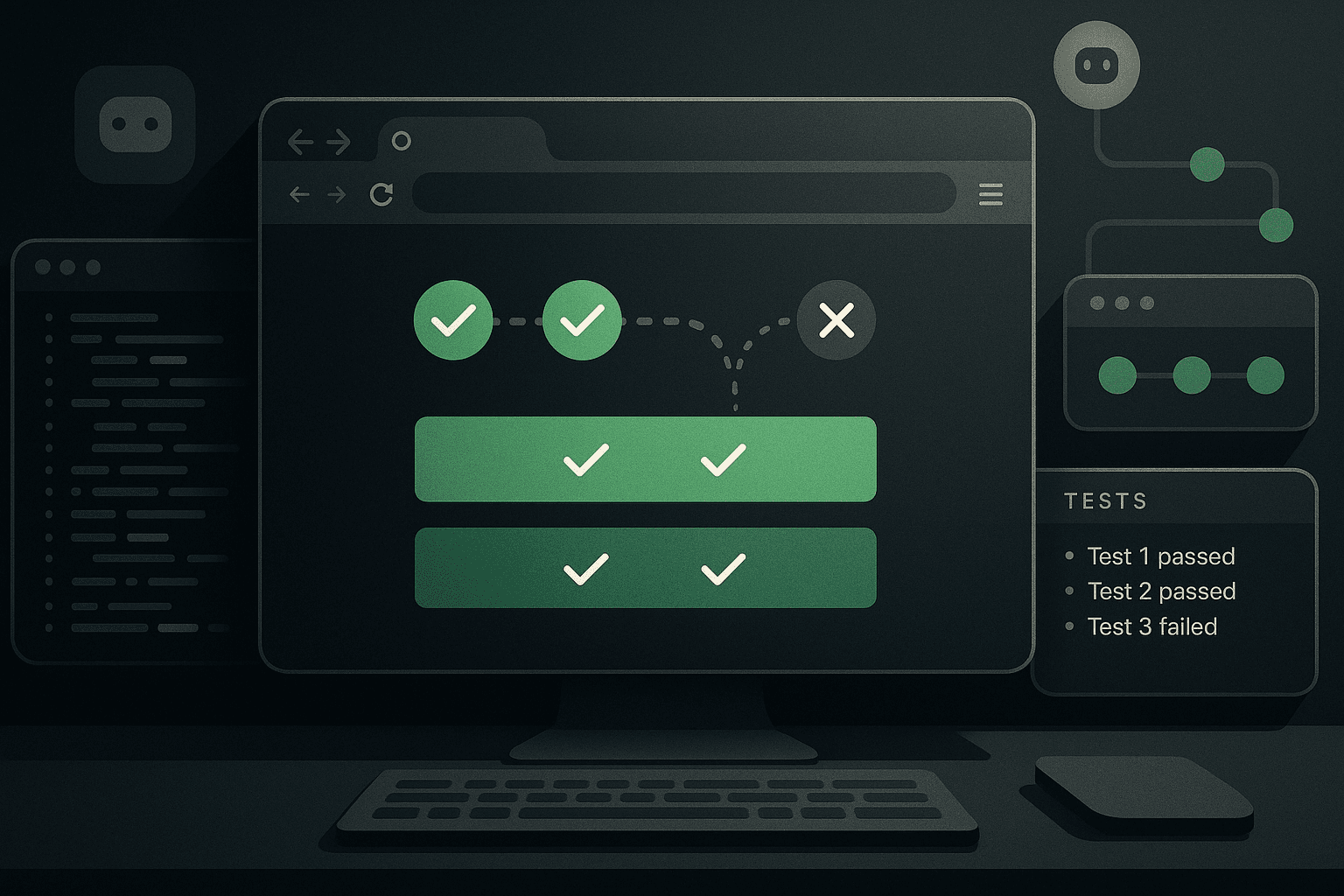
A checkout button can be perfectly aligned, the dashboard can render without visual regressions, and every snapshot in CI can glow green—while the release still breaks the business.
That sounds dramatic until you’ve lived it. A user updates billing information, the form submits, the success toast appears, and the UI looks exactly like it did yesterday. But the webhook that updates account entitlements never fires because a backend permission changed. Or the entitlement updates correctly, but the cached session in the frontend doesn’t refresh, so the user still can’t access the feature they just paid for. Or the feature becomes available in the app, but the automation that provisions their workspace in a third-party system silently fails on a retry edge case. Every screenshot passes. The release still fails.
This is the uncomfortable reality of modern software delivery: most pipelines are optimized to detect whether software looks right and whether isolated logic still returns expected values. Far fewer are designed to verify whether a real user can complete a meaningful workflow across state transitions, permissions, async boundaries, service handoffs, and failure recovery paths.
That gap matters more now because code is being produced faster, and increasingly by AI-assisted workflows. The problem is not that AI writes uniquely bad code. The problem is that it writes changes across layers—frontend, backend, test harnesses, API clients, automation glue, permission checks, event handling—faster than most teams can validate them with traditional testing. When a single pull request touches a React component, an API schema, a background job, and a Playwright helper, static correctness signals are not enough. You need evidence that the product still works as a product.
The real problem: correctness is being mistaken for reliability
Teams often talk about testing as if all passing tests are created equal. They aren’t.
A passing unit test says a specific function behaved as expected in a controlled context. A passing visual snapshot says the rendered output matched a previous baseline. A passing API contract check says a request and response met a predefined shape. All of those can be useful. None of them, by themselves, prove that a customer can complete an important task.
Reliability is not “the code compiled,” “the DOM matched,” or “the response was 200.” Reliability is whether a user can do something that matters and whether the system produces the intended result under realistic conditions.
That distinction gets lost because CI/CD systems flatten all test evidence into the same primitive: green or red. Ten thousand shallow assertions can create more organizational confidence than three deep end-to-end checks, even when the three deep checks map directly to revenue-critical workflows.
This is how teams end up shipping regressions like:
- Login works for standard users but fails for SSO users after an auth callback timing change.
- A CSV import page renders correctly, but jobs hang because the queue worker lost permission to write import results.
- Admins can invite users in staging with mocks, but production invites fail because an email provider webhook changed signature validation.
- A support agent can click “refund” and see a success state, but the accounting sync fails and no refund is actually issued.
- A generated code change updates frontend field names and unit tests but misses the backend serializer, so the workflow dies after form submission.
In every one of these cases, there may be dozens or hundreds of passing tests. The failure is not due to zero testing. It is due to testing the wrong thing.
Why screenshot testing creates false confidence
Visual testing is attractive because it scales nicely with modern UI development. Generate screenshots, compare against a baseline, fail if pixels change. It’s fast to understand and easy to wire into CI/CD. When used correctly, it catches layout drift, broken styles, accidental removals, z-index bugs, theme issues, and rendering inconsistencies.
The problem is not screenshot testing itself. The problem is what teams infer from it.
A screenshot can only tell you what the interface looked like at a particular moment. It cannot tell you:
- whether clicking the button triggered the right side effect,
- whether the user had permission to perform the action,
- whether a background job completed,
- whether retries behaved correctly,
- whether state propagated to downstream services,
- whether optimistic UI hid a server failure,
- whether the page recovered after a slow response,
- whether the toast message was true.
That last one matters a lot. Modern UIs are full of “success theater”: loading spinners, skeletons, success badges, and optimistic updates that make flows look healthy while the underlying state is broken.
Consider a common anti-pattern:
javascript// frontend action
async function saveSettings(payload) {
  setSaving(true);
  try {
    await api.post('/settings', payload);
    showToast('Settings saved');
    invalidateCache('settings');
  } catch (e) {
    showToast('Settings saved'); // bug introduced during refactor
  } finally {
    setSaving(false);
  }
}
A screenshot test can easily confirm that the success toast appeared. A component test can mock api.post and assert that the button transitions from disabled to enabled. But neither validates whether settings were actually persisted, whether the cache was refreshed, or whether a subsequent session sees the change.
Visual diffs are useful for detecting unintended UI changes. They are weak evidence for user-visible correctness and almost useless evidence for workflow integrity.
Why unit tests pass while systems break
Unit tests fail to represent reality in ways engineers often underestimate.
By design, unit tests isolate behavior. That isolation is exactly what makes them fast and maintainable. But the same isolation strips away many of the conditions where production failures actually happen: environment mismatches, race conditions, stale state, permission boundaries, network jitter, retries, serialization gaps, and incompatible assumptions between layers.
Here is a simple example:
python# backend service
class EntitlementService:
    def enable_feature(self, account_id: str, feature: str) -> bool:
        account = self.repo.get_account(account_id)
        if not account:
            return False
        account.features.add(feature)
        self.repo.save(account)
        self.events.publish("feature.enabled", {
            "account_id": account_id,
            "feature": feature,
        })
        return True
A unit test for this might pass:
pythondef test_enable_feature_publishes_event(repo, events):
    svc = EntitlementService(repo, events)
    repo.get_account.return_value = Account("acct_123")

    assert svc.enable_feature("acct_123", "advanced_reports") is True
    repo.save.assert_called_once()
    events.publish.assert_called_once_with(
        "feature.enabled",
        {"account_id": "acct_123", "feature": "advanced_reports"}
    )
Looks fine. But production can still fail if:
- the event bus topic name changed in another service,
- the consumer requires
feature_nameinstead offeature, - the database save commits after the event publish, creating a race,
- the frontend depends on a cache invalidation event that no longer fires,
- the user role initiating the action lacks the required scope,
- the downstream workspace provisioning system rejects the request.
The unit test proves local logic. It does not prove integrated behavior.
This is where teams get trapped by quantity. They keep adding more unit tests because unit tests are easy to write, cheap to run, and politically safe. Few people object to “more tests.” But if the tests all validate local implementation details instead of user outcomes, you get a very clean report about a very dirty system.
Why QA and manual spot checks no longer scale
The usual response to testing gaps is, “QA will catch it.” Sometimes QA does catch it. Often QA catches enough to preserve the illusion that the process works.
But manual QA struggles with the exact kinds of issues modern teams generate:
- combinatorial permissions and plan entitlements,
- asynchronous workflows with delayed side effects,
- flaky external integrations,
- environment-specific configuration drift,
- event-driven flows that require waiting, polling, retries, or observability,
- large blast radius changes merged continuously.
AI-assisted development amplifies this problem. Changes arrive faster and often span multiple domains. A code agent may update a frontend form, an API client, an enum definition, a backend route, and a test fixture in one pass. The resulting diff may look coherent. The product may still fail at the seam between layers.
No manual QA team can exhaustively validate every meaningful workflow variant under those conditions, especially if releases happen daily or continuously. Human testing is best used for exploration, edge-case discovery, UX judgment, and validating unclear risk areas—not as the primary control for regression detection in a fast-moving delivery system.
The core insight: test workflows as actions plus outcomes
If you want better reliability, stop treating rendered components and isolated assertions as the center of your test strategy.
The center should be workflows.
A workflow test is not just “load page, click button, expect text.” It is an executable representation of a user action sequence plus the observable outcomes that matter to the business and the system.
That means a useful workflow test validates:
- The actor — who is performing the action, with what permissions or account state.
- The sequence — what the user actually does across pages, forms, or tools.
- The state transitions — what changes in the database, cache, queue, or application state.
- The side effects — what events, jobs, emails, webhooks, or downstream calls occur.
- The final observable outcome — what the user, admin, or external system can verify afterward.
This is a different verification model.
Instead of asking, “Did the component render correctly?” ask:
- Can a user upgrade their plan and immediately access the new feature?
- Can an admin revoke access and does that removal propagate everywhere it must?
- Can a support agent trigger a refund and is the refund reflected in the ledger, email confirmation, and account status?
- Can a developer connect a GitHub repo and does the webhook arrive, the project sync begin, and the status update correctly?
This model is much better aligned with how systems actually fail.
What workflow testing looks like in practice
Let’s make this concrete with Playwright.
A weak UI test often looks like this:
javascriptimport { test, expect } from '@playwright/test';

test('settings page renders', async ({ page }) => {
  await page.goto('/settings');
  await expect(page.locator('h1')).toHaveText('Settings');
  await expect(page).toHaveScreenshot('settings-page.png');
});
This can be useful as a smoke check. It is not a meaningful reliability test.
A stronger workflow test might look like this:
javascriptimport { test, expect } from '@playwright/test';

test('owner upgrades plan and receives feature access', async ({ page, request }) => {
  const email = `owner-${Date.now()}@example.com`;

  // Create account in known state
  const setup = await request.post('/test-api/accounts', {
    data: {
      email,
      plan: 'starter',
      role: 'owner'
    }
  });
  const { accountId, password } = await setup.json();

  // Login as real user
  await page.goto('/login');
  await page.fill('[name=email]', email);
  await page.fill('[name=password]', password);
  await page.click('button[type=submit]');
  await expect(page).toHaveURL(/dashboard/);

  // Verify feature is unavailable before upgrade
  await page.goto('/reports/advanced');
  await expect(page.locator('[data-test=upgrade-gate]')).toBeVisible();

  // Perform upgrade flow
  await page.goto('/billing');
  await page.click('[data-test=upgrade-button]');
  await page.fill('[name=cardNumber]', '4242424242424242');
  await page.fill('[name=expiry]', '12/30');
  await page.fill('[name=cvc]', '123');
  await page.click('[data-test=confirm-upgrade]');

  // Wait for visible confirmation
  await expect(page.locator('[data-test=success-toast]')).toContainText('Plan updated');

  // Verify capability changed in product, not just billing UI
  await page.goto('/reports/advanced');
  await expect(page.locator('h1')).toHaveText('Advanced Reports');

  // Verify backend state
  const accountResp = await request.get(`/test-api/accounts/${accountId}`);
  const account = await accountResp.json();
  expect(account.plan).toBe('pro');
  expect(account.features).toContain('advanced_reports');

  // Verify async provisioning finished
  await expect
    .poll(async () => {
      const provisionResp = await request.get(`/test-api/provisioning/${accountId}`);
      const status = await provisionResp.json();
      return status.reportsWorkspace;
    }, { timeout: 15000 })
    .toBe('ready');
});
This test still isn’t perfect, but it validates something real:
- a specific user role,
- a before/after permission transition,
- a payment-triggered workflow,
- a product capability change,
- backend state persistence,
- async downstream provisioning.
That is much closer to the shape of production truth.
Add observability to tests, not just assertions
Many end-to-end tests become flaky because they rely exclusively on UI timing. Engineers respond by adding sleeps, retries, or looser assertions. That usually makes things worse.
The better pattern is to make workflows observable.
If your system does meaningful async work, expose test-safe ways to inspect that work. For example:
- status endpoints for jobs,
- event audit streams,
- delivery records for emails/webhooks,
- test-only introspection APIs,
- correlation IDs surfaced in logs and responses.
A good workflow test should be able to ask: not just “did the button disappear?” but “did the system produce the expected side effect?”
In Python, you might build a helper that polls for a domain outcome instead of sleeping blindly:
pythonimport time
import requests


def wait_for_job(base_url: str, job_id: str, timeout: int = 20):
    deadline = time.time() + timeout
    while time.time() < deadline:
        resp = requests.get(f"{base_url}/test-api/jobs/{job_id}", timeout=2)
        resp.raise_for_status()
        data = resp.json()
        if data["status"] in {"completed", "failed"}:
            return data
        time.sleep(0.5)
    raise TimeoutError(f"Job {job_id} did not complete in time")


def test_csv_import_workflow(base_url, session):
    # upload CSV through public API
    resp = session.post(
        f"{base_url}/api/imports",
        files={"file": open("fixtures/users.csv", "rb")},
        timeout=10,
    )
    resp.raise_for_status()
    job_id = resp.json()["job_id"]

    result = wait_for_job(base_url, job_id)
    assert result["status"] == "completed"
    assert result["rows_processed"] == 25
    assert result["rows_failed"] == 0

    users = session.get(f"{base_url}/test-api/import-results/{job_id}", timeout=5).json()
    assert any(u["email"] == "alice@example.com" for u in users)
This is still automated testing, but it is workflow-oriented rather than implementation-oriented.
CI/CD is over-optimized for speed and under-optimized for truth
Most CI/CD pipelines were built around a reasonable principle: fail fast. Run linting, unit tests, build checks, maybe a few integration tests, then ship.
The issue is not that fast feedback is bad. It’s that many pipelines optimize heavily for cheap signals and barely invest in high-truth signals.
A typical pipeline might look like this:
yamlname: ci

on:
  pull_request:
  push:
    branches: [main]

jobs:
  test:
    runs-on: ubuntu-latest
    steps:
      - uses: actions/checkout@v4
      - uses: actions/setup-node@v4
        with:
          node-version: 20
      - run: npm ci
      - run: npm run lint
      - run: npm run typecheck
      - run: npm run test:unit
      - run: npm run test:snapshots
This tells you the codebase is internally consistent. It does not tell you the release is safe.
A more mature pipeline separates test classes by purpose:
yamlname: delivery

on:
  pull_request:
  push:
    branches: [main]

jobs:
  fast-feedback:
    runs-on: ubuntu-latest
    steps:
      - uses: actions/checkout@v4
      - uses: actions/setup-node@v4
        with:
          node-version: 20
      - run: npm ci
      - run: npm run lint
      - run: npm run typecheck
      - run: npm run test:unit

  deploy-preview:
    needs: fast-feedback
    runs-on: ubuntu-latest
    steps:
      - uses: actions/checkout@v4
      - run: ./scripts/deploy-preview.sh

  workflow-tests:
    needs: deploy-preview
    runs-on: ubuntu-latest
    steps:
      - uses: actions/checkout@v4
      - uses: actions/setup-node@v4
        with:
          node-version: 20
      - run: npm ci
      - run: npx playwright install --with-deps
      - run: PREVIEW_URL=${{ secrets.PREVIEW_URL }} npm run test:workflows

  promote:
    if: github.ref == 'refs/heads/main'
    needs: workflow-tests
    runs-on: ubuntu-latest
    steps:
      - uses: actions/checkout@v4
      - run: ./scripts/promote-release.sh
The crucial difference is that promotion depends on workflow verification in a deployed environment. That environment should have enough realism to exercise auth, background jobs, integrations, and state transitions.
Not every PR needs the full suite. But every release candidate needs meaningful evidence.
Why AI-generated changes make the problem worse
AI changes the economics of code generation, not the physics of software behavior.
An agent can quickly refactor call sites, rename fields, add tests, update selectors, and satisfy static analyzers. It can even produce plausible integration code. But it does not inherently know whether the end-to-end workflow still works in your environment with your state model, your permissions, your retries, your secrets, and your third-party dependencies.
In fact, AI often increases the risk of false confidence because it is good at repairing local consistency.
That means after a broad change, you may see:
- updated TypeScript types,
- updated unit tests,
- fixed selectors,
- clean builds,
- green snapshots,
- passing mocks.
The diff feels “complete.” But the missing validation is usually at the seam:
- the backend emits a field the frontend no longer reads,
- the frontend assumes synchronous completion but the backend now queues work,
- a test mock still returns the old shape,
- a role check moved from UI to API and breaks only for certain users,
- an automation step requires a token scope not present in preview environments.
AI-generated changes should push teams toward deeper workflow verification, not away from it.
A practical test pyramid for 2026
The old “test pyramid” is still directionally useful, but most teams need a sharper framing.
Use at least four layers:
1. Local correctness tests
These include linting, type checks, unit tests, and narrow component tests.
Use them to catch:
- syntax and type issues,
- pure logic regressions,
- edge cases in isolated functions,
- obvious UI state bugs.
They are essential for developer productivity. They are weak evidence of release safety.
2. Contract and boundary tests
These validate schemas, API assumptions, serialization, and compatibility at service boundaries.
Use them to catch:
- request/response mismatches,
- event payload drift,
- versioning issues,
- integration assumptions between teams.
They are stronger than unit tests, but still incomplete.
3. Workflow tests
These validate user actions and observable outcomes across the real system.
Use them for:
- signup,
- checkout and upgrade,
- permissions changes,
- onboarding,
- imports/exports,
- support operations,
- integration setup,
- recovery from async processing.
These are your highest-value release checks.
4. Production verification
This includes canaries, feature-flag rollouts, synthetic checks, trace-based monitors, and post-deploy workflow probes.
Use them because even a strong pre-release pipeline cannot perfectly simulate production.
The mistake is not having too few unit tests. The mistake is treating unit tests as if they substitute for layers 3 and 4.
Tools comparison: what each testing approach is actually good for
Here’s the blunt version.
| Approach | Good for | Bad at | Confidence level |
|---|---|---|---|
| Visual snapshots | Layout drift, CSS regressions, render differences | Workflow integrity, side effects, async behavior, permissions | Low for release safety |
| Unit tests | Isolated logic, fast feedback, edge-case computation | Integration seams, real state transitions, environment issues | Low to medium |
| Component tests | UI state logic, interaction in controlled scope | Cross-system workflows, backend truth | Low to medium |
| API integration tests | Service behavior, contracts, backend flows | Frontend wiring, complete user journey | Medium |
| Mock-heavy E2E tests | Basic navigation, deterministic path coverage | Real integrations, realistic failure modes | Medium at best |
| Workflow E2E tests in deployed env | User-critical journeys, auth, state transitions, async outcomes | Exhaustive coverage of all variants | High |
| Production synthetic probes | Real deployment verification, regressions after release | Deep debugging context, exhaustive branching | High after deploy |
No single tool wins. The point is to stop asking weak tools to provide strong guarantees.
Playwright is powerful not because browser automation is magical, but because it can anchor workflow tests in realistic user behavior. Pair it with backend introspection, production-like environments, and good test data controls, and it becomes a serious reliability instrument.
Actionable practices that improve reliability fast
You do not need to boil the ocean. Most teams can materially improve release confidence by making a handful of changes.
1. Identify your top 10 workflows
List the actions that matter most to revenue, activation, retention, and support burden.
Examples:
- sign up and verify email,
- create workspace,
- connect integration,
- upgrade plan,
- invite teammate,
- import data,
- generate report,
- reset password,
- cancel subscription,
- issue refund.
If a workflow matters to the business, it deserves executable verification.
2. Define observable outcomes for each workflow
For every critical workflow, specify what “done” means beyond UI feedback.
For example, “Invite teammate succeeds” might mean:
- invite appears in UI,
- invitation record exists,
- email was queued,
- recipient can accept,
- recipient gets expected default role.
This is the difference between testing screens and testing systems.
3. Add test-only introspection endpoints
This is one of the highest leverage moves teams avoid because it feels inelegant. Do it anyway, carefully.
Provide secure test-environment mechanisms to inspect:
- job state,
- event deliveries,
- email outbox,
- created entities,
- audit logs,
- provisioning status.
Without observability, workflow tests become timing games.
4. Use realistic auth and permissions in tests
A shocking number of “end-to-end” tests bypass login, skip permission boundaries, or use god-mode accounts. That hides real failure modes.
Create workflows for:
- owner,
- admin,
- member,
- support operator,
- SSO user,
- trial user,
- suspended account.
Permissions are where many production bugs live.
5. Test transitions, not just states
Most failures happen during change:
- trial to paid,
- active to canceled,
- member to admin,
- disconnected to connected,
- queued to completed,
- pending to expired.
Rendered states are easy. Transitions are where reliability breaks.
6. Reduce mocks in release-gating tests
Mocks have a place, especially for local speed. But if a test decides whether a release ships, it should exercise as many real boundaries as practical.
Mock only what is too expensive, unsafe, or uncontrollable. Everything else should be real enough to fail honestly.
7. Run workflow tests after deploy to preview or staging
Don’t only run them against local containers if the release artifact is different in the deployed environment.
You want to catch:
- bad environment variables,
- missing secrets,
- network policies,
- webhook routing issues,
- asset/config mismatches,
- infrastructure drift.
8. Collect artifacts for debugging
When workflow tests fail, the team should get:
- browser trace,
- video or screenshots,
- console logs,
- network logs,
- relevant backend logs,
- job/event traces tied by correlation ID.
Good debugging is part of good testing. Otherwise teams will disable high-value tests because they are painful to diagnose.
9. Treat flaky workflow tests as production incidents in miniature
Flake is often dismissed as “test instability.” Sometimes it is. Often it is your system telling you timing, idempotency, or state management is brittle.
Don’t just add retries and move on. Investigate the cause. Flaky tests often reveal flaky products.
10. Measure confidence by workflow coverage, not raw test count
A suite with 5,000 unit tests and zero verification of signup, billing, and provisioning is not safer than a suite with 800 unit tests and strong coverage of business-critical journeys.
Executives and engineering leaders should ask:
- Which critical workflows are release-gated?
- Which roles are exercised?
- Which integrations are verified?
- Which state transitions are tested?
- What evidence do we have that the product actually works?
Those are much better questions than “How many tests do we have?”
A debugging mindset for modern delivery
Better testing is not just about writing more scenarios. It requires a different debugging mindset.
When a workflow breaks, avoid reducing the incident to the nearest visible symptom. “The button failed” is rarely the true problem. Trace the workflow through:
- actor identity,
- request path,
- permission check,
- database write,
- event publication,
- background job,
- external handoff,
- cache update,
- final UI read model.
This is the map your test strategy should reflect.
If your system architecture is event-driven, your tests and debugging tools need to be event-aware. If your product relies on third-party integrations, your release validation needs integration-aware checks. If your app has role-based access, your tests need role-aware coverage.
Testing strategy should follow failure topology.
Conclusion
The screenshot passed because the interface looked fine. The release failed because the product is more than an interface.
That is the central mistake many teams are making in 2026: over-indexing on static correctness and under-investing in workflow verification. Visual snapshots, unit tests, and mock-heavy happy paths are all useful tools. But they become dangerous when they are mistaken for evidence that real users can complete real tasks.
Modern software fails in transitions, permissions, async timing, integration seams, and downstream side effects. AI-assisted development increases the pace at which those seams get modified. That means the old comfort blanket of green CI/CD checks is getting thinner.
The answer is not to abandon fast tests. It is to rebalance your confidence model.
Keep the unit tests. Keep the snapshots. Keep the linting and type checks. But put business-critical workflow tests at the center of release validation. Test actions plus outcomes. Verify state transitions. Observe side effects. Exercise real permissions. Run checks in deployed environments. Add the instrumentation needed to debug failures quickly.
Because customers do not experience your architecture as separate layers of frontend, backend, and automation. They experience a workflow that either works or doesn’t.
And when it doesn’t, nobody cares that the screenshot passed.