A team merges a pull request on Friday afternoon. The checks are clean. Unit tests passed. Type checks passed. The Playwright smoke suite passed. The preview environment loaded. The diff looked small: a refactor around session handling, a change to callback URLs, and a helper generated by an AI coding assistant to “simplify” the login flow.
An hour later, users can no longer sign in with Google.
Not because the app was down. Not because the OAuth provider was unreachable. Not because a unit test was missing. The break happened in the seam between systems: a browser redirect dropped a state parameter in one environment, a cookie flag changed under HTTPS termination, and the callback worked only when the app stayed on one subdomain. The PR validated the code. It never validated the journey.
That is the real problem with modern testing in a lot of teams. CI/CD gives confidence about artifacts, syntax, and local invariants. It does not automatically give confidence about behavior that spans browsers, environments, third-party systems, redirects, tabs, cookies, sessions, and user intent. And now that AI tools generate more implementation code, more glue code, and more “harmless” refactors, these failures are becoming more common, not less.
The issue is not that engineers forgot to write another unit test. The issue is that the thing users actually do is often absent from CI entirely.
The gap between code validity and workflow reliability
Most pull request pipelines are optimized for diffs.
They answer questions like:
- Does the code compile?
- Did any obvious regressions hit known test cases?
- Did linting, formatting, and static analysis pass?
- Do mocked integration tests still behave as expected?
- Did a happy-path smoke check render the main page?
Those are useful checks. They catch real problems. But they do not model how critical workflows fail in production.
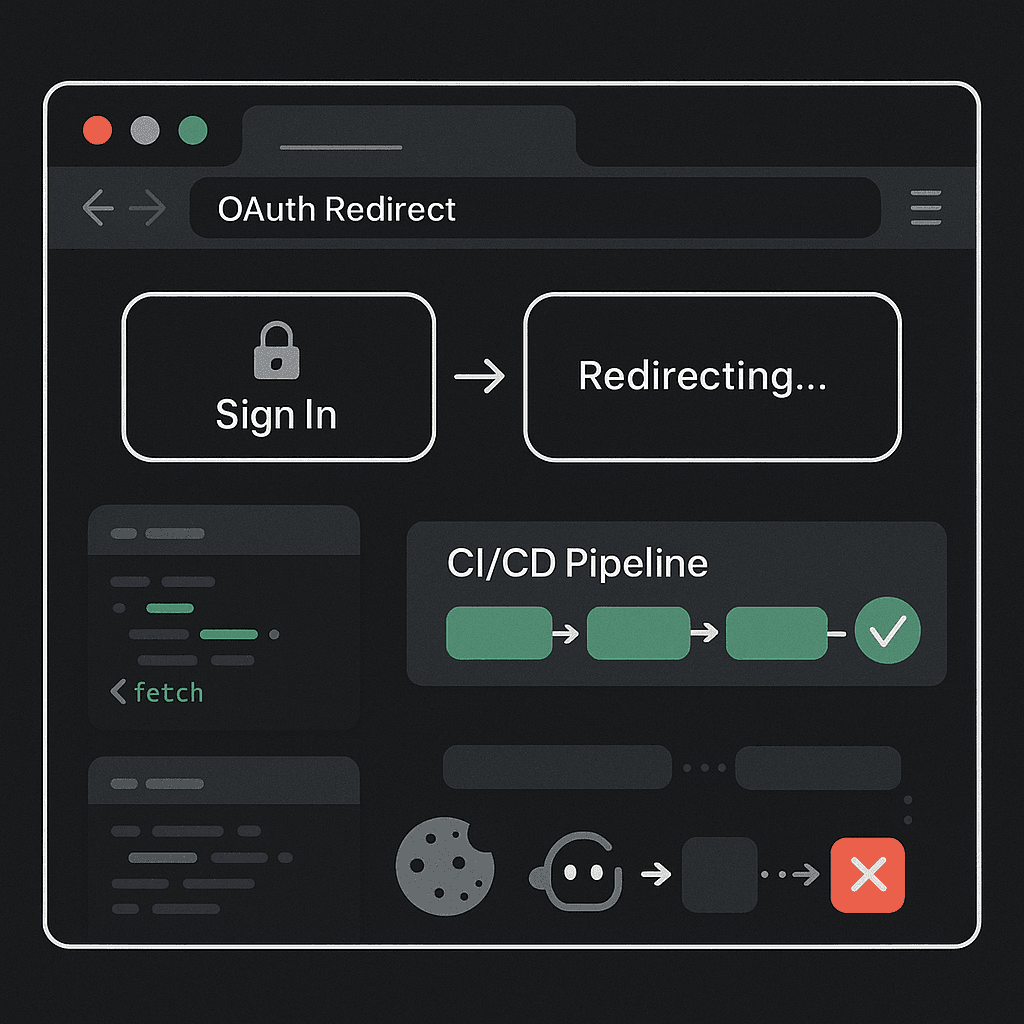
A user logging in with OAuth is not executing a function. They are traversing a distributed state machine:
- Open app in a browser.
- Click “Continue with Google.”
- Leave your domain.
- Carry state, nonce, and redirect metadata across systems.
- Return through a callback endpoint.
- Rehydrate session and browser state.
- Land on the correct post-login page.
- Possibly open a second tab or continue from an email deep link.
- Hit middleware, feature flags, CSRF checks, and environment-specific cookie rules.
That workflow depends on much more than your code diff.
The same is true for:
- Stripe checkout and return URLs
- Invite acceptance links
- Password reset emails
- SSO login flows
- 2FA enrollment and recovery
- Team switching across subdomains
- File upload and signed URL flows
- Magic links
- “Open in app” deep-link transitions
- Admin impersonation with audit logging
These are action-level systems. They only work if state survives transitions between pages, tabs, domains, services, and time.
Traditional testing often collapses that complexity into mocks, fixtures, and isolated assertions. That makes the suite fast, deterministic, and pleasant to maintain. It also makes it blind to exactly the class of failures users hit after merge.
Why green CI/CD pipelines produce false confidence
A green pipeline is often interpreted as “safe to merge.” In practice, it usually means “safe relative to the test model we chose.” That distinction matters.
If your test model excludes real redirects, real cookies, real browser storage, real callback URLs, or real third-party handshakes, then the pipeline cannot tell you whether the workflow works. It can only tell you whether your mocks still agree with your assumptions.
This is where teams get trapped. They build a testing pyramid designed for code correctness, then expect it to prove workflow reliability.
It won’t.
Unit tests verify local logic, not distributed behavior
Unit tests are valuable. They are the cheapest way to validate parsing, transformation, authorization branches, retry logic, validation rules, reducers, utility functions, and error handling.
But a passing unit test for your OAuth callback handler does not prove:
- the browser preserved the right cookie attributes
- SameSite settings behave correctly in your deployment topology
- redirects use the correct origin in preview, staging, and production
- a popup or secondary tab can complete the flow
- provider configuration matches environment variables
- reverse proxies preserve protocol and host headers correctly
- your app handles the provider returning users to a route that now requires middleware
You can have 100% unit coverage on the callback code and still ship a broken login flow.
Mocked integration tests verify your mocks
A lot of “integration tests” are really local service tests with fake dependencies. Again, that is not useless. But it changes what is being verified.
When you stub the OAuth provider response, fake Stripe webhooks, or hardcode an invite token exchange, you eliminate the exact unstable boundaries where production failures happen.
Mock-heavy tests tend to assume:
- network timing is clean
- redirects always return expected parameters
- cookies appear where expected
- domains are consistent
- provider payloads remain stable
- sessions survive transitions
- asynchronous side effects complete in order
Those assumptions are usually the bug.
QA can find workflow issues, but too late and too inconsistently
Manual QA still catches some of the most important bugs because humans naturally test workflows. They click links from email. They log in on weird browsers. They retry. They open new tabs. They back-button. They interrupt sequences.
But manual QA has hard limits:
- it does not scale with deployment frequency
- it is inconsistent across runs
- it tends to focus on release windows, not every PR
- it is expensive to keep exhaustive
- it is hard to reproduce subtle environment-specific state issues
In fast-moving teams, QA often becomes a final safety net over a pipeline that was never designed to validate real user behavior.
Preview environments are often demos, not proofs
Teams love preview environments because they make changes visible. That is good for review. But visibility is not verification.
A preview URL loading successfully says very little about whether:
- auth callbacks point to the right hostname
- third-party provider allowlists include ephemeral domains
- secure cookie flags behave the same behind the preview proxy
- webhooks can reach the environment
- email links route back to the same deployment
- subdomain-based sessions still work
Previews are great for seeing UI diffs. They are not automatically suitable for stateful end-to-end testing.
Why AI-generated code makes this worse
AI coding tools are excellent at producing plausible local implementations. They are weaker at preserving cross-system invariants that are not explicit in the prompt, type system, or nearby code.
That is not a criticism. It is a predictable property of the tools.
If an agent rewrites session middleware, extracts auth helpers, updates route handlers, or “cleans up” redirect logic, it may produce code that is syntactically correct, idiomatic, and well-tested at the function level while still breaking the actual user journey.
Common failure patterns in AI-assisted changes include:
- normalizing URLs incorrectly across environments
- changing default cookie options
- removing “redundant” state handling that was required by a provider
- consolidating auth callbacks in ways that break one provider edge case
- generating tests against mocks instead of reality
- preserving return values but not side effects
- assuming a single-tab flow where the product uses email/popup/deep-link loops
The bigger problem is social, not technical: AI-generated code often increases apparent throughput while reducing the amount of human scrutiny applied to boring glue logic. Engineers review the diff, see passing tests, and trust the implementation because everything looks disciplined.
But workflow-critical bugs usually hide in disciplined-looking code.
The core insight: test the user action, not just the implementation
If a business-critical workflow can break only when a user performs a sequence of actions across real browser state and multiple systems, then the primary test should execute that sequence.
Not simulate it vaguely.
Not assert pieces of it in isolation.
Execute it.
This is the shift teams need to make: from code-path testing to action-level verification.
For workflow-critical paths, the test artifact should read more like a runbook of user intent:
- create an account
- accept invite from email
- authenticate through provider
- complete payment
- return to app
- verify role and state
- open a second tab
- continue the flow
- ensure the right team or resource is available
That is what reliability means in modern web apps.
You do not need to run full browser workflow tests for every edge case in the product. That would be slow and painful. But you absolutely need them for the handful of flows where a green build otherwise means nothing.
What breaks in real browser workflows
Here are the classes of bugs that frequently survive conventional testing and show up only after merge.
Cookies and session propagation
A refactor changes cookie options from:
js{
  httpOnly: true,
  secure: true,
  sameSite: 'none'
}
to:
js{
  httpOnly: true,
  secure: true,
  sameSite: 'lax'
}
Locally, maybe nothing obvious breaks. In production, an OAuth callback coming from a different site no longer carries session state correctly.
Environment-specific callback URLs
An implementation assumes APP_URL is always present and canonical. In preview or staging, the host differs. Redirect URIs mismatch, state verification fails, or users land on the wrong origin.
Cross-tab and popup behavior
The login flow uses a popup window or opens a second tab from email. Session state gets written in one context and read in another. Your local integration test never exercised that boundary.
Reverse proxy and TLS termination assumptions
Your app constructs callback URLs from request protocol and host. Behind a proxy, forwarded headers differ. The result is an HTTP callback generated under an HTTPS deployment or the wrong host entirely.
Time and ordering issues
A payment provider redirect returns before the webhook finishes processing. Your UI assumes billing state is active immediately after the return URL. The mocked tests always process synchronously, so the race never appears.
Data coupling across systems
An invite acceptance flow depends on a token in email, a pending org membership in the database, an auth session created midway, and a redirect to the correct workspace. Any mismatch leaves the user authenticated but not onboarded.
These are not weird edge cases. These are normal SaaS workflows.
A better testing model for workflow-critical paths
The right model is not “replace unit tests with end-to-end tests.” That is lazy advice.
The right model is layered testing with explicit ownership:
- unit tests for local correctness
- service/integration tests for internal contracts
- browser workflow tests for critical user actions
- production observability for real-world confirmation
The missing layer in many teams is the third one.
Define a small set of critical journeys
Start with workflows where failure has outsized impact:
- sign up
- login with primary auth methods
- password reset or magic link
- invite acceptance
- checkout and subscription activation
- account creation from SSO
- logout/login session transitions
- critical admin workflows
If one of these breaks, users cannot start, pay, collaborate, or recover access. These deserve action-level CI verification.
Test against realistic dependencies where it matters
You do not need every provider in every PR. But you do need a strategy that avoids pure fantasy.
Practical options include:
- dedicated test tenants with OAuth providers
- Stripe test mode with real redirects and webhooks
- local mail capture for invite/reset links
- ephemeral environments with routable callback URLs
- contract fixtures only where true external execution is impossible
The question is simple: what parts of this workflow must be real for the test to prove anything?
Answer that honestly.
Example: a brittle OAuth implementation that passes conventional tests
Here is a simplified Node/Express handler pair that can look fine in review and still fail in deployment.
jsimport express from 'express';
import crypto from 'crypto';

const app = express();

app.get('/auth/google/start', (req, res) => {
  const state = crypto.randomUUID();

  res.cookie('oauth_state', state, {
    httpOnly: true,
    secure: true,
    sameSite: 'lax',
  });

  const redirectUri = `${process.env.APP_URL}/auth/google/callback`;
  const authUrl = new URL('https://accounts.google.com/o/oauth2/v2/auth');
  authUrl.searchParams.set('client_id', process.env.GOOGLE_CLIENT_ID);
  authUrl.searchParams.set('redirect_uri', redirectUri);
  authUrl.searchParams.set('response_type', 'code');
  authUrl.searchParams.set('scope', 'openid email profile');
  authUrl.searchParams.set('state', state);

  res.redirect(authUrl.toString());
});

app.get('/auth/google/callback', async (req, res) => {
  const { code, state } = req.query;
  const expectedState = req.cookies.oauth_state;

  if (!code || !state || state !== expectedState) {
    return res.status(400).send('Invalid OAuth state');
  }

  // exchange code, load/create user, issue session
  res.redirect('/app');
});
This can pass unit tests that verify:
- state is generated
- callback rejects mismatched state
- redirect URI uses
APP_URL - successful callback redirects to
/app
And yet it may fail for real because sameSite: 'lax' is wrong for your flow, APP_URL is incorrect in preview, or cookies are not preserved the same way behind your edge infrastructure.
What action-level verification looks like in Playwright
For browser workflow testing, Playwright is a strong fit because it understands pages, tabs, storage, network, and user actions, not just DOM snapshots.
Below is a realistic pattern for validating a critical auth journey. In many teams, the actual provider step is split into two suites:
- a PR suite using a controlled test IdP or staging auth service
- a scheduled or pre-merge suite against the real third-party path
Even when you cannot fully automate the external provider UI, you can still verify the browser transitions and session outcomes around it.
tsimport { test, expect } from '@playwright/test';

test('user can sign in and land in the correct workspace', async ({ page, context }) => {
  await page.goto(process.env.APP_URL!);

  await page.getByRole('button', { name: 'Continue with Google' }).click();

  // Depending on implementation, auth may redirect current page or open a popup.
  const popupPromise = context.waitForEvent('page').catch(() => null);
  const popup = await popupPromise;

  const authPage = popup ?? page;

  // Example for a test IdP page you control.
  await authPage.getByLabel('Email').fill('e2e-user@example.com');
  await authPage.getByLabel('Password').fill(process.env.E2E_TEST_PASSWORD!);
  await authPage.getByRole('button', { name: 'Sign in' }).click();

  const appPage = popup ? page : authPage;
  await appPage.waitForURL(/\/app|\/workspace/);

  await expect(appPage.getByText('Welcome back')).toBeVisible();
  await expect(appPage.getByTestId('workspace-name')).toHaveText('Acme Inc');

  const cookies = await context.cookies();
  const sessionCookie = cookies.find(c => c.name === 'session');
  expect(sessionCookie).toBeTruthy();
  expect(sessionCookie?.secure).toBeTruthy();
});
Notice what this validates that unit tests do not:
- a real browser initiated the journey
- redirects completed
- the final URL is correct
- session cookies exist in the browser context
- the user landed in the expected post-auth state
Now extend that to invite acceptance.
tsimport { test, expect } from '@playwright/test';

async function fetchLatestInviteLink() {
  const res = await fetch(`${process.env.MAIL_API_URL}/messages/latest?tag=invite`);
  const json = await res.json();
  return json.link as string;
}

test('invited user can accept invite and join the team', async ({ page }) => {
  const inviteLink = await fetchLatestInviteLink();

  await page.goto(inviteLink);
  await expect(page.getByText('You were invited to join Acme Inc')).toBeVisible();

  await page.getByLabel('Full name').fill('Taylor Example');
  await page.getByLabel('Password').fill('SuperSecret123!');
  await page.getByRole('button', { name: 'Create account and join' }).click();

  await page.waitForURL(/\/workspace/);
  await expect(page.getByTestId('workspace-name')).toHaveText('Acme Inc');
  await expect(page.getByText('Member')).toBeVisible();
});
That one flow verifies email delivery integration, token routing, account creation, membership binding, redirect behavior, and workspace hydration in one test.
That is much closer to what users need.
Example: payment flow verification with asynchronous backend state
Payments are another classic green-build trap. The redirect succeeds, but the account is not actually upgraded because the webhook handling lags or fails.
A robust workflow test should verify both browser completion and backend state convergence.
Application-side polling example in JavaScript
jsexport async function waitForSubscriptionActive(fetchBillingStatus, timeoutMs = 15000) {
  const started = Date.now();

  while (Date.now() - started < timeoutMs) {
    const status = await fetchBillingStatus();
    if (status === 'active') return true;
    await new Promise(r => setTimeout(r, 500));
  }

  throw new Error('Subscription did not become active in time');
}
Equivalent helper in Python for backend verification
pythonimport time


def wait_for_subscription_active(fetch_status, timeout_seconds=15, interval_seconds=0.5):
    started = time.time()

    while time.time() - started < timeout_seconds:
        status = fetch_status()
        if status == 'active':
            return True
        time.sleep(interval_seconds)

    raise TimeoutError('Subscription did not become active in time')
Playwright test sketch
tsimport { test, expect } from '@playwright/test';

test('checkout upgrades the workspace', async ({ page }) => {
  await page.goto(`${process.env.APP_URL}/billing`);
  await page.getByRole('button', { name: 'Upgrade to Pro' }).click();

  // Complete test checkout flow.
  await page.waitForURL(/checkout|billing-provider/);
  // Fill provider-specific test inputs here.

  await page.waitForURL(/\/billing\?checkout=success/);
  await expect(page.getByText('Processing your upgrade')).toBeVisible();

  await expect.poll(async () => {
    const res = await page.request.get(`${process.env.APP_URL}/api/test/billing-status`);
    const json = await res.json();
    return json.status;
  }).toBe('active');

  await expect(page.getByText('Pro plan')).toBeVisible();
});
This is the difference between “the redirect worked” and “the workflow completed.”
CI configuration: run critical journeys as a first-class gate
If these workflows matter, they cannot live as optional nightly tests no one trusts. The most important ones need to be part of merge criteria, with environment support designed around them.
A GitHub Actions example:
yamlname: ci

on:
  pull_request:
  push:
    branches: [main]

jobs:
  unit-and-integration:
    runs-on: ubuntu-latest
    steps:
      - uses: actions/checkout@v4
      - uses: actions/setup-node@v4
        with:
          node-version: 20
      - run: npm ci
      - run: npm run lint
      - run: npm run typecheck
      - run: npm run test:unit
      - run: npm run test:integration

  critical-workflows:
    runs-on: ubuntu-latest
    needs: unit-and-integration
    env:
      APP_URL: ${{ secrets.E2E_APP_URL }}
      E2E_TEST_PASSWORD: ${{ secrets.E2E_TEST_PASSWORD }}
      MAIL_API_URL: ${{ secrets.MAIL_API_URL }}
    steps:
      - uses: actions/checkout@v4
      - uses: actions/setup-node@v4
        with:
          node-version: 20
      - run: npm ci
      - run: npx playwright install --with-deps
      - run: npm run test:e2e:critical
The details vary, but the principle is fixed:
- separate fast correctness checks from slower workflow verification
- gate merges on a minimal critical workflow suite
- keep the suite intentionally small and high-signal
- use stable test data and dedicated external accounts
Tool comparison: what each approach is good for
No single tool solves this. You need to know what each layer buys you.
| Approach | Strengths | Weaknesses | Best use |
|---|---|---|---|
| Unit tests | Fast, precise, cheap, great for debugging local logic | No real browser or cross-system state | Business logic, parsing, auth rules, utilities |
| Mocked integration tests | Good internal contract coverage, deterministic | False confidence at external boundaries | Service interactions you control |
| Component tests | Great for UI states and edge rendering | Not enough for redirects, cookies, sessions | Complex UI logic in isolation |
| Manual QA | Strong workflow intuition, catches weird human behavior | Slow, inconsistent, expensive | Exploratory validation, release signoff |
| Playwright/Cypress E2E | Real browser behavior, action-level testing | Slower, more infra/setup cost | Critical user journeys |
| Synthetic monitoring in prod | Detects real failures continuously | Detects after deployment, not before | Ongoing verification of key workflows |
If your company depends on auth, billing, invites, or account recovery, and your testing strategy stops at unit plus mocked integration coverage, you have a reliability blind spot.
Practical patterns that improve developer productivity without exploding maintenance
Engineers often resist browser workflow tests because they remember flaky, slow end-to-end suites that tried to cover everything.
That resistance is justified. Bad E2E testing is miserable.
The answer is not to avoid workflow testing. The answer is to scope it correctly.
1. Keep the suite tiny and business-critical
Do not automate every click path.
Automate the handful of workflows that:
- generate revenue
- create accounts
- grant access
- recover access
- establish collaboration
- mutate entitlements
Five to ten critical tests can eliminate a huge class of post-merge incidents.
2. Design for observability in tests
Add test IDs where useful. Expose test-only status endpoints for asynchronous state. Log redirect steps and session metadata in lower environments. Capture browser traces and videos.
Good observability improves both debugging and test reliability.
3. Create stable test environments for external flows
Do not point critical workflow tests at random preview URLs with ad hoc secrets. Use dedicated environments and provider configurations built for automation.
That means:
- stable callback domains
- test tenants for auth/payment providers
- predictable seeded data
- inbox capture for email-based flows
- cleanup scripts for test state
4. Assert outcomes, not implementation details
A brittle test says:
- callback endpoint returned 302
exchangeCodeForToken()was called- a cookie setter was invoked
A useful workflow test says:
- user is authenticated
- lands in the correct workspace
- can access protected resources
- billing is active
- invited role is applied
Outcomes survive refactors better and map to actual reliability.
5. Treat workflow failures as product incidents, not just test noise
If the login test fails in CI, that should carry the same seriousness as a broken deployment. These are not decorative tests. They represent the minimum viable functioning of the product.
6. Pair action-level tests with production synthetics
CI can verify before merge. Synthetic monitoring can verify after deploy and catch provider drift, expired secrets, infrastructure regressions, and configuration rot.
Run both.
A debugging mindset for workflow failures
When these tests fail, the debugging approach needs to change too. Engineers often drop immediately into application code, when the failure may be in state transition or environment behavior.
A better debugging checklist:
- What exact user action sequence was executed?
- Which boundaries were crossed: domain, provider, email, webhook, tab, session?
- What state was expected to survive each step?
- Did cookies change attributes across environments?
- Did callback URLs or forwarded headers differ in CI?
- Was there asynchronous backend work not complete at the moment of assertion?
- Did the browser end in the wrong URL, wrong identity, wrong team, or wrong entitlement?
This is where Playwright traces, HAR captures, server logs, and environment metadata pay off. Workflow bugs are often obvious once you can see the whole path. They are invisible when reduced to function-level assertions.
What teams should change this quarter
If your current CI/CD pipeline gives you green checks but auth and invite flows still break after merge, do this:
- List the top 5 workflow-critical user journeys.
- Mark which ones are currently tested only with mocks or isolated component coverage.
- Add one real browser action-level test for the highest-impact flow first.
- Build or stabilize a test environment that supports realistic redirects, sessions, and callbacks.
- Gate merges on that small critical suite.
- Add production synthetic checks for the same flows.
- Review AI-generated code touching auth, billing, redirects, cookies, and session middleware with extra suspicion.
This is not glamorous engineering. It is reliability work. It usually pays for itself almost immediately because these are exactly the bugs that create urgent Slack threads, support escalations, incident writeups, and weekend rollbacks.
Conclusion
“The PR passed” has become one of the most misleading sentences in modern software delivery.
It usually means the diff looks acceptable under a narrow test model. It does not mean the product works the way users experience it.
For stateful browser workflows like OAuth, payments, invite links, redirects, and account recovery, the real failure is rarely “we forgot a unit test.” The real failure is that CI never executed the journey that mattered.
That gap gets more dangerous as implementation volume rises and AI tools generate more of the connecting code. More code can pass more checks while still violating the real-world sequence of actions that makes the product usable.
If you care about debugging, testing, CI/CD, and developer productivity in a serious way, then stop asking whether the code path is covered and start asking whether the user workflow was proven.
Because users do not interact with your mocks.
They click the button, follow the link, switch the tab, complete the redirect, and expect the system to still remember who they are.