
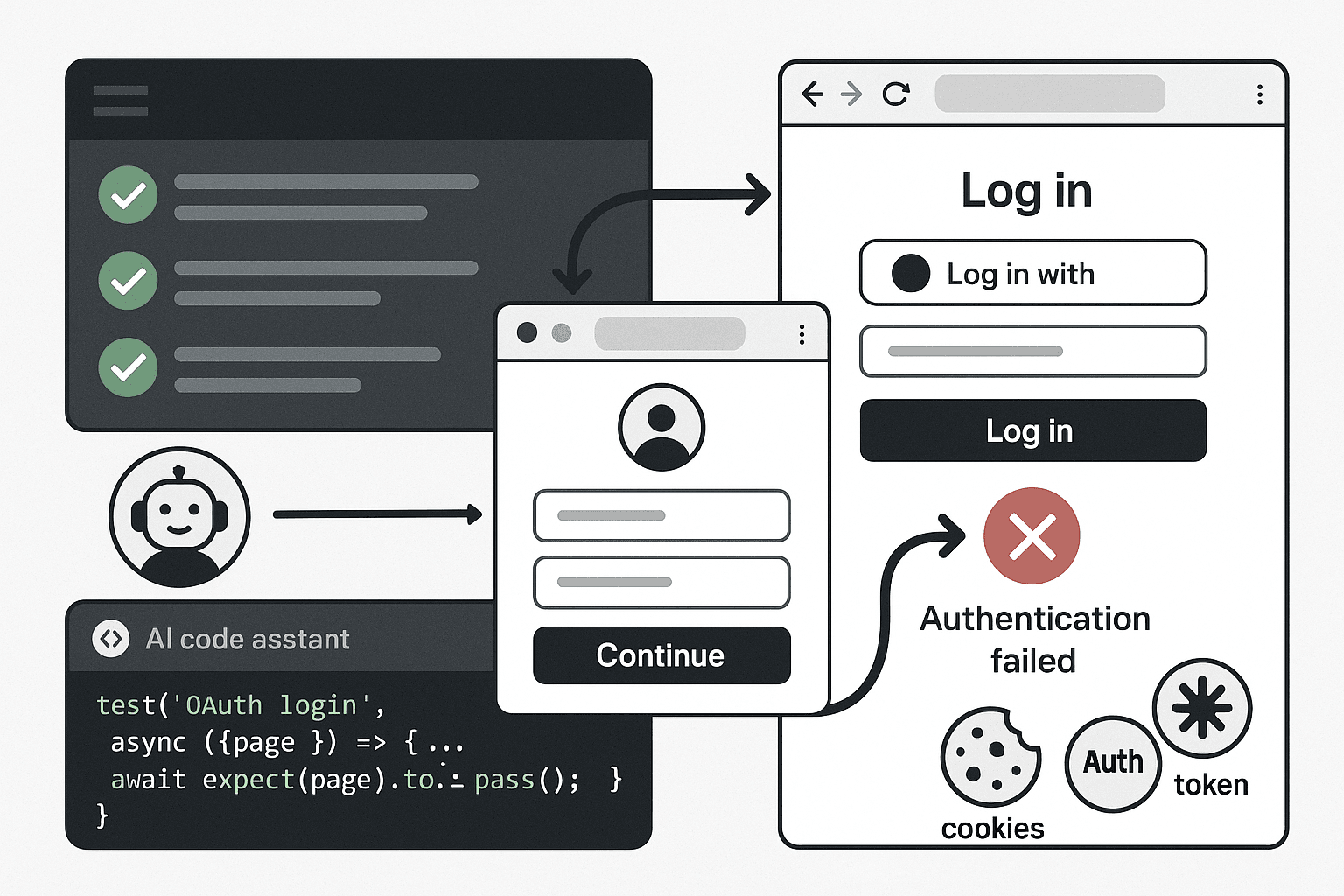
A team merges a harmless-looking pull request on Friday afternoon. CI is green. Unit tests pass. Integration tests pass. Staging smoke checks pass. By evening, users start reporting they can’t sign in with Google.
Nothing obvious is broken. The OAuth client ID is still valid. The callback endpoint still returns 200. The auth library still initializes. The redirect URL looks right in logs. But in the browser, the login journey is dead: a SameSite cookie doesn’t survive the handoff, a state parameter gets regenerated after a retry, and Safari behaves differently than Chrome. The application didn’t fail in code. It failed in a workflow.
That distinction matters more now than it did a few years ago. AI-assisted development is accelerating how quickly integration code gets written, refactored, and shipped. That’s good for developer productivity, but it also increases the volume of small auth-related changes landing in production: middleware rewrites, environment variable changes, callback route refactors, reverse proxy tweaks, SDK upgrades, CSP updates, cookie policy changes, bot defense settings, and “harmless” frontend routing fixes. Each one can preserve code-level correctness while breaking the login journey users actually depend on.
This is why green PR checks have become a dangerous source of false confidence. Modern CI/CD is excellent at validating code paths. It is much worse at validating identity handoffs across domains, browsers, sessions, redirects, and third-party defenses. If nobody verifies that a real user can still sign in, complete OAuth, resume a session, and recover from a failure in a browser, then the most business-critical path in your product may be effectively untested.
The problem: auth failures live between systems, not inside one function
Most engineering teams don’t misunderstand testing in theory. They know authentication is important. They know OAuth is complicated. They know browsers are weird. The issue is more practical: the systems that enforce quality are optimized around artifacts that are easy to automate in CI.
That means:
- unit tests against functions and modules
- integration tests against APIs and local mocks
- contract checks against expected request/response shapes
- deploy previews and static analysis
- occasional manual QA before large releases
These are all useful. None of them are sufficient for modern authentication.
OAuth, SSO, passwordless login, magic links, enterprise identity providers, and session resumption are not single-system features. They are cross-system workflows with failure modes that often appear only when all of these variables interact at once:
- browser cookie behavior
- top-level navigation vs embedded contexts
- redirect chaining across origins
- environment-specific callback URLs
- CDN or reverse proxy headers
- anti-bot challenges and rate limits
- stale sessions and token refresh timing
- mobile viewport or WebView constraints
- user retries, back button behavior, and tab recovery
- third-party identity provider quirks
In other words, authentication is not just “does the callback handler work?” It’s “can a real browser complete the full journey under realistic conditions?”
CI pipelines are not naturally built for that question.
Why PR checks miss the failures that matter
Teams trust green checks because green checks represent discipline. But with auth, a green pipeline often means only that isolated parts of the system still behave as expected under controlled assumptions.
Those assumptions are exactly what break in production.
Unit tests validate logic, not browser truth
Unit tests are good at verifying state validation, token parsing, URL building, and middleware branching. They can tell you whether your callback handler rejects a missing state parameter or whether your session middleware renews expiration dates correctly.
They cannot tell you whether the browser actually sends the cookie that your middleware depends on after returning from an identity provider.
A simple example in JavaScript:
jsimport { buildOAuthRedirectUrl } from './auth'

test('builds redirect with state and scope', () => {
  const url = buildOAuthRedirectUrl({
    provider: 'google',
    state: 'abc123',
    redirectUri: 'https://app.example.com/auth/callback',
    scope: ['openid', 'email', 'profile'],
  })

  expect(url).toContain('state=abc123')
  expect(url).toContain('scope=openid%20email%20profile')
  expect(url).toContain('redirect_uri=https%3A%2F%2Fapp.example.com%2Fauth%2Fcallback')
})
This test is fine. It proves almost nothing about whether sign-in works.
The real failure may be that your oauth_state cookie is set with the wrong domain or SameSite attribute, so when the provider redirects back to your app, the state comparison fails. Your unit tests still pass because they never model the browser.
API integration tests validate handlers, not handoffs
A lot of teams write “integration tests” that call auth endpoints directly. These tests post to /login, hit /callback, inspect session state, and assert 200s or redirects.
Again: useful, but incomplete.
Consider a Python example with Flask:
pythonfrom app import create_app

def test_oauth_callback_sets_session(client):
    response = client.get(
        "/auth/callback?code=test-code&state=abc123",
        headers={"Cookie": "oauth_state=abc123"}
    )

    assert response.status_code == 302
    assert response.headers["Location"] == "/dashboard"
This test proves your callback handler works if the cookie arrives exactly as expected. It says nothing about whether the cookie survives:
- a cross-site redirect
- a protocol upgrade through a load balancer
- a subdomain mismatch
- a browser privacy policy
- a path scoping mistake
- an accidental
Securemisconfiguration in non-prod or preview environments
The gap is not academic. This is where many real incidents live.
CI/CD pipelines reward speed and determinism, not realism
The shape of CI/CD itself pushes teams toward tests that are stable, cheap, and fast. Browser auth tests are often the opposite:
- slower than unit tests
- harder to parallelize
- brittle if poorly designed
- dependent on external providers or complex mocks
- annoying to debug in headless environments
So teams do what rational systems encourage: they test the portions easiest to codify and defer the rest.
A typical GitHub Actions workflow might look like this:
yamlname: ci

on:
  pull_request:
  push:
    branches: [main]

jobs:
  test:
    runs-on: ubuntu-latest
    steps:
      - uses: actions/checkout@v4
      - uses: actions/setup-node@v4
        with:
          node-version: 20
      - run: npm ci
      - run: npm run lint
      - run: npm run test
      - run: npm run test:integration
      - run: npm run build
This pipeline might be excellent by conventional standards. It can still completely miss a broken login journey.
Why? Because CI here verifies software components, not the user workflow that crosses browser, app, provider, and session boundaries.
Manual QA happens too late or not at all
Manual QA can catch login failures, but most teams either don’t have dedicated QA for every PR or reserve manual verification for major releases. Auth regressions often arrive through tiny infrastructure or frontend changes that nobody flags as risky.
Examples:
- changing an app domain from
wwwto apex - adjusting Nginx forwarded headers
- enabling stricter cookie defaults in a framework upgrade
- moving callback routes under a new path prefix
- introducing middleware for bot detection
- changing CSP or frame ancestor policies
- migrating to edge runtime behavior
- updating a third-party auth SDK version
None of these necessarily scream “critical auth risk” during review. But they can absolutely break login.
The core insight: authentication must be tested as a user workflow
If the business depends on users being able to sign in, then sign-in is not a backend function. It is a product workflow.
That means the primary artifact you need to validate is not just:
- token exchange success
- callback response correctness
- library-level API compliance
It is this:
- User starts from a real page.
- User initiates login.
- Browser navigates across domains.
- Session continuity and state survive redirects.
- Third-party provider interaction completes.
- App rehydrates authenticated state correctly.
- Failure cases are recoverable.
- Logout and re-login do not create dead states.
This is not philosophical. It changes how you build your testing strategy.
Once you accept that auth is a workflow, several things follow:
- browser automation becomes mandatory, not optional
- session lifecycle testing matters as much as first-time login
- failure-path testing is as important as happy-path testing
- production-like environments matter more than mocks alone
- observability for redirects, cookies, and browser storage becomes part of debugging
The failure modes teams routinely miss
Let’s be specific about the classes of bugs that green PR checks often miss.
Redirect URI drift
A callback URL can be correct in code but wrong in deployment.
Common causes:
- preview environment hostnames not whitelisted at the provider
- reverse proxy changing scheme or host
- app generating callback URLs from the wrong origin header
- trailing slash or path prefix mismatches
- region-specific or tenant-specific callback rules
The endpoint still exists. Your callback handler still works. OAuth still breaks.
Cookie scope and SameSite issues
This is one of the most common categories.
Typical failures include:
- state cookie set on
api.example.combut callback lands onapp.example.com - session cookie scoped to
/authinstead of/ SameSite=LaxorSameSite=Strictbehavior misunderstood during redirects- secure cookies silently failing in mixed or misdetected environments
- browser-specific privacy behavior affecting third-party contexts
These failures rarely show up in unit tests because the browser is the thing enforcing the rules.
Expired or partially stale sessions
A user doesn’t always log in from a clean slate. They return with old cookies, half-expired sessions, stale refresh tokens, invalid local storage flags, and tabs opened yesterday.
Bugs appear when:
- refresh token rotation races with page load
- frontend thinks the user is authenticated while backend rejects the session
- expired sessions bounce users between login and callback pages
- stale state in storage causes duplicate auth attempts
- logout doesn’t clear all relevant auth artifacts
These are workflow bugs. The backend can be technically “correct” while the product experience is broken.
Bot defenses and anti-automation controls
Modern auth flows increasingly intersect with bot management, WAFs, fraud systems, and provider-side heuristics.
A deployment can accidentally trigger:
- CAPTCHA on legitimate login attempts
- suspicious redirect blocking
- provider throttling after too many test logins
- UA or IP reputation checks in CI runners
- JavaScript challenges that only appear in headless or cloud environments
This is one reason teams avoid auth E2E in CI. It’s also why they ship regressions.
Third-party provider edge cases
Every provider has quirks.
Google, Microsoft, Okta, Auth0, GitHub, Apple, and enterprise SAML bridges all have slightly different assumptions around prompts, consent, domain restrictions, reauthentication, popup behavior, MFA, and callback timing.
If your test strategy assumes all providers behave like a local mock, then you’re not really testing your login workflow. You’re testing your interpretation of it.
Why AI-assisted shipping increases auth risk
AI code generation is not the problem by itself. The issue is volume and confidence.
Teams can now produce integration code much faster:
- scaffold auth middleware
- swap SDKs
- generate callback handlers
- refactor routing
- add feature flags
- wire analytics or consent layers
- modify CI configs and preview environments
A lot of this code looks plausible and often is plausible. But auth systems are full of latent assumptions that generated code won’t necessarily preserve:
- exact cookie attributes
- proxy header trust
- nuanced browser redirect behavior
- race conditions during hydration
- provider-specific requirements
- recovery from interrupted flows
AI can generate code that is syntactically valid, type-correct, and locally tested while still being wrong in production workflow terms.
That means teams need stronger validation around the edges where generated code interacts with the messy real world. Authentication is one of those edges.
What better testing looks like
The goal is not to replace unit tests or API tests. It’s to put them in the right place and add workflow validation where it matters.
A practical strategy has three layers:
- Fast component and handler tests for logic correctness
- Browser workflow tests for critical auth journeys
- Production observability and synthetic checks for ongoing verification
Layer 1: Keep the fast tests, but stop overselling them
Test the logic you own.
Examples:
- state and nonce generation
- callback parameter validation
- token parsing and error handling
- session store behavior
- retry and logout logic
- auth middleware authorization branches
These tests catch real bugs and improve developer productivity. Just don’t mistake them for proof that login works.
Layer 2: Add browser-based auth workflow tests
For critical providers and user journeys, use Playwright or equivalent browser automation to validate the actual flow.
The best browser auth tests usually avoid testing the provider’s UI in every PR while still testing your application’s browser behavior realistically.
There are a few patterns.
Pattern A: Stub provider responses, but keep full browser redirects
This is often the best default. Run a controlled fake OAuth provider that behaves like a real external IdP enough to validate:
- redirects
- cookies
- state preservation
- callback handling
- session establishment
- post-login app hydration
Playwright example:
tsimport { test, expect } from '@playwright/test'

test('user can sign in and reach dashboard', async ({ page, context }) => {
  await page.goto('https://staging.example.com')

  await page.getByRole('button', { name: 'Sign in with Google' }).click()

  await page.waitForURL(/fake-idp\.internal\/authorize/)
  await page.getByRole('button', { name: 'Approve' }).click()

  await page.waitForURL('https://staging.example.com/dashboard')

  await expect(page.getByText('Welcome back')).toBeVisible()

  const cookies = await context.cookies()
  const sessionCookie = cookies.find(c => c.name === 'session')
  expect(sessionCookie).toBeTruthy()
  expect(sessionCookie?.httpOnly).toBeTruthy()
})
This test exercises the browser and your auth flow without relying on a live third-party provider in every CI run.
Pattern B: Run scheduled tests against real providers
For top providers, add nightly or scheduled checks in a controlled environment with dedicated test tenants.
These tests catch issues that mocks never will:
- provider policy changes
- consent screen changes
- new anti-bot behavior
- tenant misconfiguration
- real callback domain drift
Because they are slower and less deterministic, they don’t need to gate every commit. They do need ownership and alerting.
Pattern C: Test failure recovery, not just success
Most teams test successful login once and stop there. That misses the scenarios users actually hit during incidents.
Add workflows for:
- expired session on page refresh
- invalid state parameter recovery
- revoked or expired refresh token
- blocked third-party cookie scenario if relevant
- logout then re-login
- opening login in multiple tabs
- interrupted login and back-button recovery
Example Playwright test for session expiry handling:
tsimport { test, expect } from '@playwright/test'

test('expired session redirects cleanly to login and recovers', async ({ page, context }) => {
  await page.goto('https://staging.example.com/dashboard')

  await context.addCookies([
    {
      name: 'session',
      value: 'expired-session-token',
      domain: 'staging.example.com',
      path: '/',
      httpOnly: true,
      secure: true,
      sameSite: 'Lax'
    }
  ])

  await page.reload()

  await page.waitForURL(/\/login/)
  await expect(page.getByText('Your session has expired')).toBeVisible()

  await page.getByRole('button', { name: 'Sign in' }).click()
  await page.waitForURL(/\/dashboard/)
  await expect(page.getByText('Welcome back')).toBeVisible()
})
That’s much closer to reality than asserting a callback handler returns 302.
CI/CD should include workflow gates for auth-critical changes
If authentication matters, then your pipeline should treat auth workflows as a deployment risk category.
That does not mean running every expensive auth test for every docs update. It means being more intentional.
A stronger pipeline often looks like this:
yamlname: ci

on:
  pull_request:
  push:
    branches: [main]
  schedule:
    - cron: '0 * * * *'

jobs:
  unit_and_integration:
    runs-on: ubuntu-latest
    steps:
      - uses: actions/checkout@v4
      - uses: actions/setup-node@v4
        with:
          node-version: 20
      - run: npm ci
      - run: npm run lint
      - run: npm run test
      - run: npm run test:integration

  auth_workflow_smoke:
    if: contains(join(github.event.pull_request.changed_files || ''), 'auth')
    runs-on: ubuntu-latest
    steps:
      - uses: actions/checkout@v4
      - uses: actions/setup-node@v4
        with:
          node-version: 20
      - run: npm ci
      - run: npx playwright install --with-deps
      - run: npm run test:auth-workflows

  nightly_real_provider_checks:
    if: github.event_name == 'schedule'
    runs-on: ubuntu-latest
    steps:
      - uses: actions/checkout@v4
      - uses: actions/setup-node@v4
        with:
          node-version: 20
      - run: npm ci
      - run: npx playwright install --with-deps
      - run: npm run test:auth-real-provider
The exact if conditions will vary, and GitHub Actions changed-files handling often requires a dedicated step or action. The important point is the model:
- fast tests always run
- targeted auth workflow tests run on relevant changes
- real-provider tests run on a schedule
This is more honest than pretending unit tests provide full coverage.
Debugging broken OAuth requires better artifacts
When auth breaks, logs from the callback handler are not enough.
You need debugging artifacts that reconstruct the browser journey.
Useful things to capture:
- redirect chain with full URLs and status codes
- cookie set/delete events and attributes
- browser console output
- storage state snapshots
- screenshots and video on failure
- HAR/network traces
- correlation IDs carried through redirects
- proxy headers (
X-Forwarded-Proto,Host, etc.)
Playwright makes some of this straightforward:
tsimport { test } from '@playwright/test'

test.use({ trace: 'retain-on-failure', video: 'retain-on-failure', screenshot: 'only-on-failure' })

test('oauth redirect trace', async ({ page }) => {
  page.on('response', async response => {
    const url = response.url()
    const status = response.status()
    if (url.includes('/auth') || url.includes('/callback')) {
      console.log('AUTH RESPONSE', status, url)
    }
  })

  await page.goto('https://staging.example.com/login')
  await page.getByRole('button', { name: 'Sign in' }).click()
})
The point isn’t just automation. It’s inspectability. Good debugging depends on replayable evidence.
Tools comparison: what each category catches and misses
No single tool solves auth reliability. You need the right mix.
Unit test frameworks: Jest, Vitest, Pytest
Best for:
- pure auth logic
- middleware branching
- helper utilities
- parsing and validation
Misses:
- browser cookies
- redirects across origins
- provider interactions
- hydration and client-side auth state
Verdict: essential but insufficient.
API integration tests: Supertest, Flask test client, framework harnesses
Best for:
- endpoint correctness
- callback error handling
- session store interactions
- auth service contracts
Misses:
- real browser behavior
- cookie policy enforcement
- navigation timing
- front-end handoff issues
Verdict: useful lower-level confidence, not workflow validation.
Browser E2E: Playwright, Cypress
Best for:
- login workflows
- redirect/cookie/session behavior
- user-visible auth regressions
- debugging with traces, screenshots, and network artifacts
Tradeoffs:
- slower
- can be brittle if poorly designed
- requires thoughtful handling of external providers
Verdict: the most important missing layer for most teams.
Synthetic monitoring: Checkly, Datadog Synthetic, custom Playwright cron jobs
Best for:
- production or staging drift detection
- ongoing login verification
- scheduled checks against real environments
Misses:
- granular root-cause debugging unless well instrumented
- broad code-level coverage
Verdict: necessary if auth is business-critical.
Local mocks and fake IdPs
Best for:
- deterministic CI
- fast auth workflow testing
- exercising your redirect/session logic
Misses:
- provider-specific edge cases
- external anti-bot behavior
- real tenant misconfigurations
Verdict: great baseline, but not the whole story.
Actionable practices that actually reduce auth regressions
If you want fewer “CI was green but login was broken” incidents, start here.
1. Define sign-in as a release-blocking user journey
Treat authentication like checkout, not like a helper library. If users can’t log in, nothing else matters. Put it on the same reliability tier as payments or core data access.
2. Maintain a short list of critical auth workflows
Not everything needs full coverage immediately. Start with the few journeys that matter most:
- new user sign-in with primary provider
- returning user with existing session
- expired session recovery
- logout and re-login
- enterprise SSO if it drives revenue
- mobile browser or Safari path if that’s common for your users
3. Test one realistic browser journey per critical provider
You don’t need fifty flaky end-to-end tests. You need a small number of stable, meaningful workflow tests that actually reflect user behavior.
4. Separate fake-provider CI from real-provider scheduled checks
This balance is practical.
- fake-provider browser tests give fast confidence in your app behavior
- scheduled real-provider checks catch external drift and tenant issues
Trying to force everything into PR gating usually leads teams to abandon workflow testing entirely.
5. Instrument cookies and redirects explicitly
Most auth incidents get resolved faster when teams can answer:
- what cookies were set?
- on which domain/path?
- with which attributes?
- what exact redirects occurred?
- what origin did the app think it was on?
Make these visible in logs, traces, and test artifacts.
6. Review auth-related changes as workflow risks
In code review, changes involving these areas should trigger extra caution:
- domains, routing, rewrites, and callbacks
- cookie/session config
- auth SDK upgrades
- proxies, CDN, edge runtime, ingress config
- CSP/security header changes
- bot defense or WAF changes
- frontend hydration/auth state refactors
The diff may look small. The workflow risk may be huge.
7. Add post-deploy auth smoke checks
A deployment is not complete until a browser verifies login in the target environment.
Even a simple synthetic check that signs in and lands on a dashboard will catch entire classes of issues faster than waiting for user reports.
8. Test failure paths intentionally
A mature auth strategy tests recovery, not just success.
Ask:
- What happens when state is invalid?
- What happens when the session is expired?
- What happens when the provider denies consent?
- What happens if callback completes but frontend auth state fails to hydrate?
- What happens if a user retries in another tab?
These are the scenarios that turn small bugs into support incidents.
9. Don’t let AI-generated integration code bypass workflow validation
If AI helps your team move faster, great. But generated auth-adjacent code should raise the bar for workflow verification, not lower it.
The right question is not “does the generated code compile?” It’s “did we verify the user can still complete sign-in in a real browser?”
10. Track auth reliability as an operational metric
Measure:
- login success rate
- callback failure rate
- session refresh failure rate
- auth-related support tickets
- browser/provider-specific error clusters
- time to detect and time to resolve auth regressions
If you don’t measure auth as a workflow, you’ll keep managing it like a code module.
A concrete implementation approach for teams starting from scratch
If your current state is “unit tests only,” don’t overengineer the fix.
Week 1:
- identify one primary sign-in journey
- create one Playwright test using a fake or controlled provider
- capture traces, screenshots, cookies, and redirect logs on failure
- run it in CI on main branch at minimum
Week 2:
- add expired-session recovery test
- add logout/re-login test
- add post-deploy synthetic check in staging or production
Week 3:
- create a nightly real-provider check with a dedicated test tenant
- add alerts to the owning team
- document known provider quirks and environment assumptions
Week 4:
- gate auth-sensitive changes on workflow smoke tests
- add code review checklist items for cookies, redirects, callback URLs, and proxy headers
- instrument login success/failure metrics in production
That alone will put you ahead of most teams who still confuse green CI with product reliability.
Conclusion
“The PR passed” is not meaningful if the user can’t sign in.
That sounds obvious, but many teams still operate as though green checks on unit and integration suites are proof that the product works. They aren’t. Not for authentication. Not for OAuth. Not for session recovery. Not for cross-domain login handoffs in a real browser.
Modern software delivery, especially with AI speeding up integration work, produces more auth-adjacent changes than many teams realize. Middleware gets regenerated. SDKs get swapped. Routes get reorganized. Infra headers change. Cookie behavior shifts. Preview environments diverge. The code path remains valid while the user journey quietly breaks.
That is the real lesson behind so many production auth incidents: reliability does not live in the callback handler alone. It lives in the full workflow.
If you want better debugging, better testing, more honest CI/CD, and stronger developer productivity, stop treating sign-in like a narrow implementation detail. Treat it like the critical business workflow it is.
Because users do not experience your auth system as a set of passing tests. They experience it as one simple question:
Can I log in and use the product?
Your testing strategy should be built to answer that question directly.