
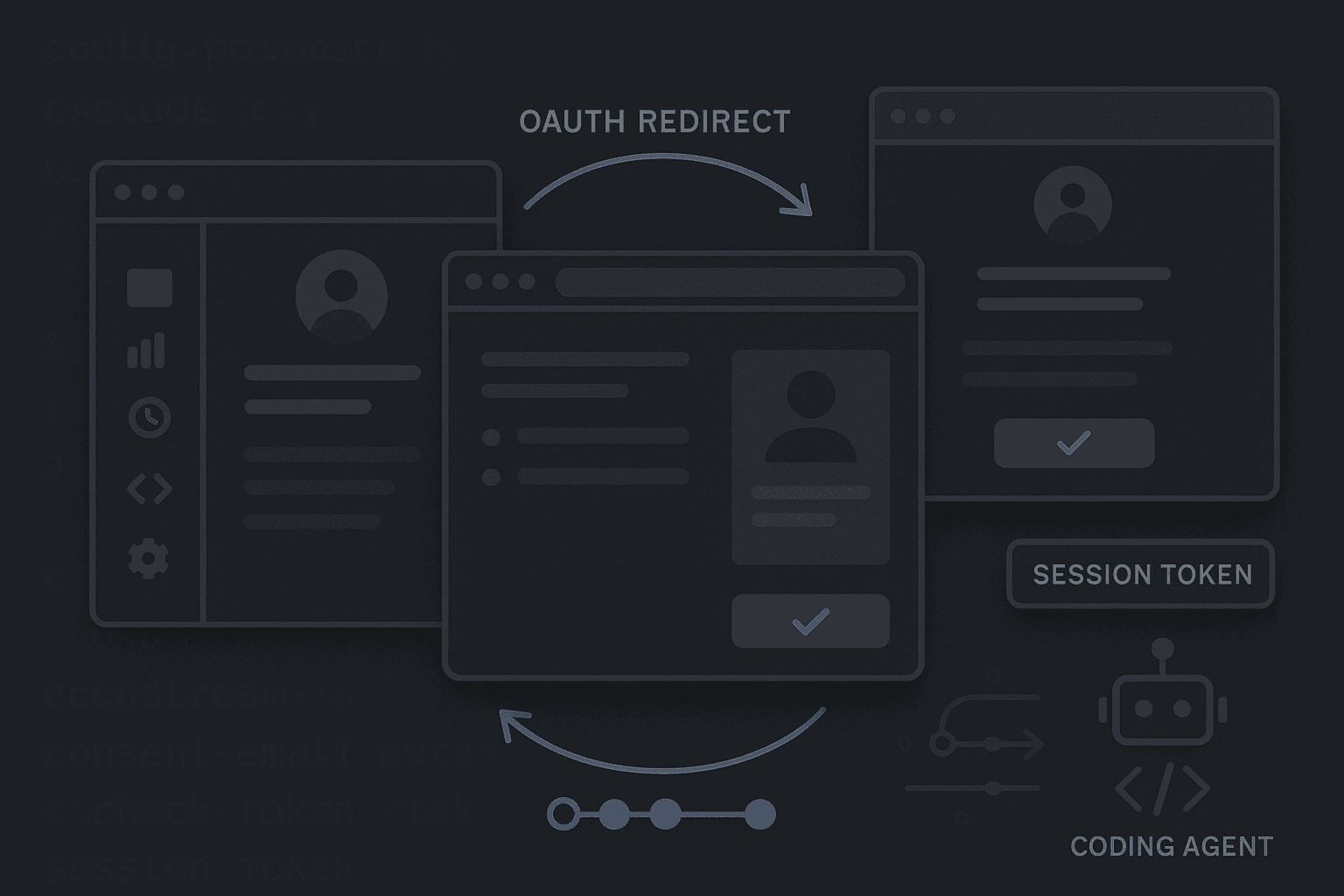
A pull request can look completely reasonable, pass review, go green in CI, and still break the first time a real user clicks “Sign in with Google.” That is not a weird edge case anymore. It is a normal failure mode in modern software.
The reason is simple: the most fragile part of many products now lives outside the code you own. Authentication, authorization, billing confirmation, embedded integrations, organization switching, role activation, email verification, and session recovery often depend on browser-mediated workflows that leave your app, cross trust boundaries, and come back carrying state. Traditional testing rarely exercises those seams honestly.
This is where teams get false confidence. Unit tests mock the auth client. Integration tests stub the token exchange. End-to-end tests bypass login entirely with a fixture or injected cookie. CI/CD reports success. The PR merges. Then production users hit a redirect loop, lose their session after consent, get assigned the wrong post-login role, or land in an impossible state because third-party cookies were blocked in the browser your team did not test.
This gap matters more now because teams are shipping faster, often with AI-generated code mixed into human-written systems. More code is being produced. More refactors touch auth wrappers, middleware, callback handlers, front-end route guards, and API assumptions. Review quality has not scaled with the volume. And auth flows are exactly where seemingly harmless changes become production failures.
The problem is not that engineers are careless. The problem is that our testing model is still built around code paths inside the application boundary, while many of the highest-risk failures happen when the product leaves that boundary and returns with state.
The failure pattern nobody sees in review
Imagine a standard SaaS flow:
- User visits
/dashboardwhile logged out. - App redirects to an identity provider.
- User chooses an account.
- User completes consent.
- Provider redirects back with code and state.
- App exchanges code for tokens.
- Session is stored.
- Backend loads org membership and role.
- Frontend renders tenant-specific onboarding.
- A subsequent API call requires a fresh access token.
A PR can break this flow in dozens of ways without making anything look obviously wrong:
- A callback route now strips a
stateparameter. - A cookie was changed to
SameSite=Laxand no one noticed the effect on the return trip. - An auth middleware race causes a redirect before session hydration finishes.
- A token refresh path works in mocked tests but fails after a real idle delay.
- A front-end route assumes role data is available before the backend completes org lookup.
- A consent screen adds an extra redirect step your automation never traverses.
- Browser privacy settings block a storage mechanism your SDK relied on.
- Logging out of one tenant preserves state in another tab.
None of this sounds exotic. Most of it sounds like ordinary software. That is exactly why it slips through.
Reviewers do not inspect browser cookie policy interactions by reading diffs. CI does not reveal race conditions in a login flow it never actually performs. QA often validates a happy path using one account in one browser with a warm session. Everyone did their job. The product still fails.
Why mocked authentication gives you a fake sense of safety
Most teams mock auth because real identity flows are inconvenient in tests. That tradeoff is understandable. It is also the source of the blind spot.
A mocked auth setup usually does one of these things:
- Injects a fake user object into application state.
- Sets a session cookie directly.
- Bypasses the login screen with a test helper.
- Stubs the identity SDK.
- Mocks backend token validation.
Those techniques are useful for testing application logic after authentication. They are not useful for validating the actual authentication journey.
When you mock auth, you eliminate the exact conditions that create real failures:
- Cross-origin redirects
- Callback URL handling
- State and nonce verification
- Session cookie creation after browser navigation
- Consent and account-picker screens
- Token refresh after elapsed time
- Browser storage behavior
- Role and tenant resolution after identity assertion
- Return-to URL preservation
- Interaction between frontend guards and backend authorization
In other words, mocked authentication does not just simplify the flow. It removes the risky part of the system.
That is acceptable if you are honest about what the tests prove. The problem starts when teams treat those tests as end-to-end verification. They are not. They are post-auth application tests.
This distinction matters operationally. If your test starts with “user is already authenticated,” then it cannot tell you whether a real user can become authenticated, stay authenticated, recover authentication, or complete an action after auth state changes.
CI/CD is optimized for throughput, not truth
CI/CD pipelines are good at one thing: rapidly evaluating deterministic checks in controlled environments. That is valuable. It is also not enough.
Most pipelines reward tests that are:
- Fast
- Isolated
- Parallelizable
- Deterministic
- Independent of external systems
Real OAuth and identity workflows are often the opposite:
- Slower because they involve navigation and remote providers
- Stateful across multiple requests and pages
- Sensitive to browser behavior
- Dependent on external trust boundaries
- Variable based on user consent, account status, roles, and security policies
So teams do what pipelines incentivize: they strip away the parts that make the flow real. They mock the provider, short-circuit the callback, or seed a session. The resulting tests are stable, fast, and misleading.
This is why CI/CD can produce false confidence. The pipeline proves your code works in a synthetic environment where identity is simplified and state transitions are compressed. Production operates in a real browser with real redirects and real persistence constraints.
The issue gets worse when AI-assisted development accelerates change volume. More generated code means more wrappers, middleware edits, SDK usage changes, and copy-pasted auth handling patterns. CI may stay green because the tests only confirm that components render for an already-authenticated user. Meanwhile, the real system breaks at the identity boundary.
That is not a tooling failure alone. It is a verification design failure.
Why QA misses these bugs too
Many teams assume manual QA will catch what automated tests miss. Sometimes it does. Often it does not.
The reason is not that QA lacks skill. It is that modern auth failures are conditional, temporal, and environment-specific.
Examples:
- The bug only appears after a 45-minute idle period when the refresh token path is exercised.
- The issue only occurs in Safari with stricter cookie behavior.
- The problem only affects users with two org memberships and a pending role change.
- The redirect loop happens only when returning from an external consent screen in a new tab.
- The callback succeeds for admins but fails for read-only users because post-login data fetches diverge.
- Logout appears correct in one tab but leaves a stale privileged session in another.
A manual pass on a happy path usually will not cover these conditions. QA can validate surface functionality, but without instrumentation and journey-focused automation, they are still sampling reality. The most dangerous auth bugs hide in transitions, not screens.
The core insight: test user actions across trust boundaries
The industry still talks too much about testing code and not enough about testing actions.
Users do not care whether your token parser is covered. They care whether they can sign in, consent, land in the right account, complete a task, come back after idle time, and stay authorized only where they should be. Those are action-level outcomes.
The right verification model for modern software is this:
Test complete user journeys that cross trust boundaries and return with state.
That means verifying flows like:
- Sign in with a real browser and a real identity provider test tenant
- Complete consent and return to the intended page
- Switch organizations and preserve correct authorization
- Recover from expired tokens during an in-progress action
- Use a role-limited account and verify denied actions are actually denied
- Log out and confirm session invalidation across tabs and routes
- Resume a saved deep link after authentication
- Complete a workflow that depends on both app state and identity state
This is not “more end-to-end tests” in the vague sense. It is a different testing target. You are no longer checking whether internal logic branches behave. You are checking whether the system preserves user intent across boundaries it does not fully control.
That is where reliability now lives.
A realistic example of how teams accidentally test the wrong thing
Here is a common Playwright pattern that looks useful but avoids the real problem.
tsimport { test, expect } from '@playwright/test';

test('authenticated user can create a project', async ({ page, context }) => {
  await context.addCookies([{
    name: 'session',
    value: 'fake-test-session',
    domain: 'localhost',
    path: '/',
    httpOnly: true,
    secure: false,
  }]);

  await page.goto('http://localhost:3000/dashboard');
  await page.getByRole('button', { name: 'New Project' }).click();
  await page.getByLabel('Project name').fill('Auth Migration');
  await page.getByRole('button', { name: 'Create' }).click();
  await expect(page.getByText('Project created')).toBeVisible();
});
This test tells you an already-authenticated browser can create a project. Fine. It tells you nothing about whether authentication actually works.
A better test validates the real journey. In practice, teams should use a dedicated test identity provider tenant and test accounts with known states.
tsimport { test, expect } from '@playwright/test';

test('user can sign in via OAuth and create a project', async ({ page }) => {
  await page.goto('https://app.example.com/dashboard');

  await page.getByRole('link', { name: 'Sign in with Google' }).click();

  await page.waitForURL(/accounts\.google\.com/);
  await page.getByLabel('Email or phone').fill(process.env.E2E_USER_EMAIL!);
  await page.getByRole('button', { name: /next/i }).click();

  await page.getByLabel('Enter your password').fill(process.env.E2E_USER_PASSWORD!);
  await page.getByRole('button', { name: /next/i }).click();

  // If the consent screen appears for this account, handle it.
  const consentButton = page.getByRole('button', { name: /continue|allow/i });
  if (await consentButton.isVisible().catch(() => false)) {
    await consentButton.click();
  }

  await page.waitForURL('https://app.example.com/dashboard');
  await expect(page.getByText('Welcome back')).toBeVisible();

  await page.getByRole('button', { name: 'New Project' }).click();
  await page.getByLabel('Project name').fill('Auth Migration');
  await page.getByRole('button', { name: 'Create' }).click();
  await expect(page.getByText('Project created')).toBeVisible();
});
This is still only a start. A truly useful auth-gated journey should verify callback completion, session establishment, authorized API access, and behavior after a state change.
For example, you can explicitly assert that the app is not just rendering optimistically while backend calls are failing.
tsimport { test, expect } from '@playwright/test';

test('post-login session can access authorized data', async ({ page }) => {
  const apiResponses: Array<{ url: string; status: number }> = [];

  page.on('response', async (response) => {
    const url = response.url();
    if (url.includes('/api/organizations') || url.includes('/api/projects')) {
      apiResponses.push({ url, status: response.status() });
    }
  });

  await page.goto('https://app.example.com/dashboard');
  await page.getByRole('link', { name: 'Sign in with Google' }).click();

  // Login helper steps omitted for brevity.

  await page.waitForURL('https://app.example.com/dashboard');
  await expect(page.getByText('Welcome back')).toBeVisible();

  expect(apiResponses.some(r => r.url.includes('/api/organizations') && r.status === 200)).toBeTruthy();
  expect(apiResponses.some(r => r.url.includes('/api/projects') && r.status === 200)).toBeTruthy();
});
Now you are validating that the identity round trip resulted in a usable application session, not just a superficially successful redirect.
Testing token expiry and session persistence
One of the most common blind spots is token refresh. Teams verify login and maybe logout, but not what happens after the session ages.
You want to know:
- Does the app silently refresh tokens?
- Does a background refresh failure surface correctly?
- Does an in-progress action survive refresh?
- Does the user get redirected unexpectedly?
- Does session persistence differ across browsers or tabs?
A Playwright test can simulate time passage imperfectly, but in many cases the better approach is using a short-lived token configuration in a test tenant.
tsimport { test, expect } from '@playwright/test';

test('user can continue action after access token expiry', async ({ page }) => {
  await page.goto('https://app.example.com/dashboard');
  await page.getByRole('link', { name: 'Sign in with Google' }).click();

  // Perform real login here.

  await page.waitForURL('https://app.example.com/dashboard');
  await page.getByRole('button', { name: 'New Project' }).click();
  await page.getByLabel('Project name').fill('Long Running Flow');

  // In test environment, access tokens expire quickly.
  await page.waitForTimeout(70_000);

  await page.getByRole('button', { name: 'Create' }).click();
  await expect(page.getByText('Project created')).toBeVisible();
  await expect(page.getByText('Session expired')).not.toBeVisible();
});
This is the kind of test that catches real-world failures caused by bad refresh logic, stale auth context, and backend/frontend disagreement over session state.
Role-based state is part of the auth flow, not a separate concern
A major mistake in test design is treating authentication and authorization as separate layers that can be validated independently. In architecture diagrams that sounds neat. In production they are entangled.
Identity returns a subject. Your product then maps that subject into orgs, teams, roles, flags, entitlements, and onboarding state. The user experience after login depends on that mapping being correct and timely.
So if you only test that a callback succeeds, you are still missing the dangerous part: whether the returned identity becomes the right effective permissions in the app.
Test accounts should cover states like:
- Single-org admin
- Multi-org member
- Read-only user
- User pending invitation acceptance
- User with revoked access but valid IdP account
- User with role updated during active session
Example:
tsimport { test, expect } from '@playwright/test';

test('read-only user cannot access billing after OAuth login', async ({ page }) => {
  await page.goto('https://app.example.com/settings/billing');
  await page.getByRole('link', { name: 'Sign in with Google' }).click();

  // Login as read-only test user.

  await page.waitForURL(/app\.example\.com/);
  await expect(page.getByText('Access denied')).toBeVisible();
  await expect(page.getByRole('button', { name: 'Update payment method' })).not.toBeVisible();
});
This test validates the full chain: deep-link intent, authentication, redirect return, session, role resolution, and restricted UI behavior.
A Python example for backend callback verification
Browser journeys matter, but you should also have targeted backend tests around the callback and state handling. These do not replace browser tests. They support them.
Here is a simple Python example using pytest and httpx for a callback exchange path.
pythonimport pytest
from unittest.mock import patch
from app.auth import handle_oauth_callback


def test_oauth_callback_persists_session_and_user_role(client):
    code = 'test-auth-code'
    state = 'expected-state'

    token_response = {
        'access_token': 'access-123',
        'refresh_token': 'refresh-123',
        'id_token': 'id-123',
        'expires_in': 3600,
        'token_type': 'Bearer'
    }

    userinfo_response = {
        'sub': 'user-1',
        'email': 'reader@example.com'
    }

    with patch('app.auth.exchange_code_for_token', return_value=token_response), \
         patch('app.auth.fetch_userinfo', return_value=userinfo_response), \
         patch('app.auth.resolve_membership', return_value={'org_id': 'org-1', 'role': 'reader'}):

        response = client.get(f'/auth/callback?code={code}&state={state}')

        assert response.status_code == 302
        assert response.headers['location'] == '/dashboard'
        assert response.cookies.get('session') is not None
This test is useful, but keep the scope clear: it verifies callback logic under controlled conditions. It does not prove that your browser, identity provider, cookie policy, and real redirect chain work together.
That proof requires a browser journey.
CI configuration that reflects reality better
You do not need to run every auth journey on every commit exactly the same way. You do need a CI/CD strategy that acknowledges risk.
A practical pattern is layered verification:
- Fast unit and integration tests on every PR
- Post-auth application journeys with seeded sessions on every PR
- Real browser-mediated auth journeys for critical paths on protected branches and pre-release
- Scheduled cross-browser auth regression runs against staging
- Production smoke verification for a narrow set of safe action-level journeys
Example GitHub Actions setup:
yamlname: verify

on:
  pull_request:
  push:
    branches: [main]
  schedule:
    - cron: '0 */6 * * *'

jobs:
  unit-and-integration:
    runs-on: ubuntu-latest
    steps:
      - uses: actions/checkout@v4
      - uses: actions/setup-node@v4
        with:
          node-version: 20
      - run: npm ci
      - run: npm run test

  post-auth-e2e:
    runs-on: ubuntu-latest
    steps:
      - uses: actions/checkout@v4
      - uses: microsoft/playwright-github-action@v1
      - run: npm ci
      - run: npx playwright test tests/post-auth

  real-auth-critical-paths:
    if: github.ref == 'refs/heads/main'
    runs-on: ubuntu-latest
    environment: staging-auth
    steps:
      - uses: actions/checkout@v4
      - uses: microsoft/playwright-github-action@v1
      - run: npm ci
      - run: npx playwright test tests/real-auth
        env:
          E2E_USER_EMAIL: ${{ secrets.E2E_USER_EMAIL }}
          E2E_USER_PASSWORD: ${{ secrets.E2E_USER_PASSWORD }}
          BASE_URL: https://staging.example.com

  scheduled-cross-browser-auth:
    if: github.event_name == 'schedule'
    runs-on: ubuntu-latest
    strategy:
      matrix:
        project: [chromium, firefox, webkit]
    steps:
      - uses: actions/checkout@v4
      - uses: microsoft/playwright-github-action@v1
      - run: npm ci
      - run: npx playwright test tests/real-auth --project=${{ matrix.project }}
        env:
          E2E_USER_EMAIL: ${{ secrets.E2E_USER_EMAIL }}
          E2E_USER_PASSWORD: ${{ secrets.E2E_USER_PASSWORD }}
          BASE_URL: https://staging.example.com
This kind of setup recognizes that not every test belongs in the same feedback loop. Fast checks preserve developer productivity. Real journey checks preserve trust.
Tools comparison: what each layer is good for
No single tool solves this. You need a stack with clear responsibilities.
Unit test frameworks
Examples: Jest, Vitest, pytest, JUnit
Good for:
- Token parsing logic
- Callback handler branches
- Permission evaluation functions
- Edge-case business rules
Bad for:
- Real redirect flows
- Browser storage behavior
- Third-party cookie constraints
- Session persistence under navigation
Verdict: Necessary, but low truth for auth journeys.
Integration test frameworks
Examples: Supertest, pytest + test client, contract tests
Good for:
- Callback endpoints
- Session creation logic
- API authorization behavior
- Role resolution under controlled inputs
Bad for:
- IdP-mediated consent
- Browser navigation issues
- Frontend/backend auth timing races
Verdict: Useful support layer, still insufficient alone.
Browser automation
Examples: Playwright, Cypress
Good for:
- Real navigation and redirects
- UI-state plus network-state validation
- Browser-specific auth behavior
- Multi-step action journeys
Potential limitations:
- External auth flows can be brittle if poorly isolated
- Test account management becomes operational work
- Cross-origin handling requires care
Verdict: Best foundation for real verification of auth-gated workflows.
Synthetic monitoring / production checks
Examples: Checkly, Datadog Synthetic, Grafana Synthetic Monitoring
Good for:
- Repeated validation in production-like or production environments
- Detecting external-provider drift
- Catching expired secrets, broken callbacks, and certificate/config issues
Bad for:
- Deep product assertions unless carefully designed
- Rich local debugging compared to full dev test runs
Verdict: Essential for ongoing confidence once critical journeys are defined.
Feature flag and observability tools
Examples: LaunchDarkly, OpenTelemetry, Sentry, Honeycomb
Good for:
- Limiting blast radius
- Tracing redirect and callback failures
- Correlating auth breakage with deploys
- Inspecting session and role resolution failures in production
Verdict: Not testing tools by themselves, but indispensable for debugging and safe rollout.
Practical testing patterns that actually reduce auth failures
If you want fewer production incidents in auth-gated flows, adopt patterns that match where the failures occur.
1. Define critical user journeys, not just components
List the top workflows where identity state matters to business outcomes.
Examples:
- New user signs in and completes onboarding
- Existing user signs in and lands in correct org
- Admin signs in and updates billing
- Read-only user signs in and is denied privileged action
- User returns after token expiry and completes save
- User logs out and session is removed everywhere that matters
These are your highest-value verification assets.
2. Maintain dedicated test identities with controlled states
Do not rely on one generic test account. Create a matrix of users and org memberships that reflect real authorization states.
You need accounts for:
- Fresh consent required
- Consent already granted
- Single-role and multi-role states
- Active and revoked membership
- Different browser/session persistence expectations if your environment varies
This takes effort. It is still cheaper than auth incidents in production.
3. Separate post-auth app tests from true auth journey tests
Keep seeded-session tests. They are fast and useful. Just label them honestly.
Suggested taxonomy:
post-auth: assumes authenticated browser, tests app functionalityreal-auth: performs genuine IdP-mediated login and validates session creationauth-resilience: token expiry, logout, tab persistence, role changes
This alone improves decision-making because people stop over-claiming what green tests mean.
4. Test deep links and return intent
A lot of auth bugs only appear when login starts from a protected destination rather than the homepage.
Verify flows like:
- User requests
/settings/billingwhile logged out - User authenticates externally
- User returns to
/settings/billing, not/dashboard - Authorization is then enforced for that exact route
Deep-link correctness is one of the easiest ways to catch bad state handling.
5. Run cross-browser checks where cookie and storage behavior differs
If you only validate Chromium, you are not validating the browser ecosystem. Safari and WebKit-derived behavior in particular can expose assumptions around cookies, storage access, and session continuity.
You do not need exhaustive matrices for every PR. You do need scheduled or release-gated coverage on the flows that matter.
6. Instrument auth transitions for debugging
If a real-auth test fails, the debugging experience is often terrible unless you instrument the journey.
Log and trace at least:
- Redirect start
- Callback receipt
- State/nonce validation outcome
- Token exchange result
- Session persistence success/failure
- Role/org resolution
- First authorized API call after login
- Refresh attempts and failures
- Logout invalidation events
Without this, debugging auth issues becomes guesswork spread across frontend logs, backend logs, IdP dashboards, and browser traces.
7. Use trace artifacts in CI
For Playwright, enable screenshots, video, and traces on failure. Auth bugs are often timing-sensitive. A trace gives you the sequence across redirects, requests, storage, and UI changes.
tsimport { defineConfig } from '@playwright/test';

export default defineConfig({
  use: {
    screenshot: 'only-on-failure',
    video: 'retain-on-failure',
    trace: 'retain-on-failure',
  },
});
This is not luxury tooling. It is essential debugging support when failures involve multiple systems.
8. Treat auth changes as high-risk regardless of diff size
A one-line cookie config change can be riskier than a 500-line feature PR. So can a small SDK version bump. So can an AI-generated “cleanup” of middleware.
Your review and verification policy should reflect that reality. Tag auth-adjacent changes automatically. Require critical journey runs when callback routes, cookie settings, auth middleware, session logic, route guards, or identity SDK versions change.
9. Add production-safe synthetic checks
Critical auth journeys should not only run in staging. They should also run in production in a constrained, safe way where feasible.
Examples:
- Sign in with a dedicated monitoring account
- Load dashboard
- Verify one non-destructive API call succeeds
- Log out
This catches issues that staging may miss: expired production secrets, callback misconfiguration, provider-side changes, DNS/cert problems, and real browser policy shifts.
10. Measure the right thing
Do not report only test pass rates. Track:
- Failed logins by browser/provider
- Callback error rates
- Post-login first API failure rate
- Token refresh failures
- Unauthorized errors immediately after login
- Time to detect auth regressions
- Time to debug auth regressions
Those metrics reveal whether your testing strategy is improving actual reliability and developer productivity.
The bigger shift teams need to make
For years, engineering organizations treated testing as proof that code behaved according to local expectations. That model still works for pure business logic. It breaks down for workflows that rely on state crossing system boundaries.
Authentication is the clearest example because the flow literally leaves your product, enters another trust domain, and returns carrying identity and session implications. But the same lesson applies to payments, email verification, SSO provisioning, embedded third-party apps, and any workflow where your product depends on external state transitions.
The important change is mental, not just technical:
Stop asking, “Did we test the auth code?”
Start asking, “Can a real user complete the action when identity is established, refreshed, restricted, revoked, and returned through a real browser?”
That is a much harder question. It is also the one production keeps answering for you if your pipeline does not.
Conclusion
“The PR looked fine” is not a serious defense when the broken behavior sits at the boundary between your app, the browser, and an identity provider. Modern teams, especially those shipping quickly with AI-assisted development, need to accept that the highest-risk failures increasingly happen in flows no unit test can honestly represent.
Mocked authentication is useful. Fast CI is useful. Human review is useful. Manual QA is useful. None of them, alone or combined, reliably validate auth-gated, multi-step production journeys that cross trust boundaries and come back with state.
If you care about reliability, your testing strategy has to move up a level. Test actions, not just code. Verify full browser-mediated identity flows, not just local auth assumptions. Include redirects, consent, token ageing, session persistence, role resolution, and browser differences. Build CI/CD layers that preserve speed without pretending speed is truth.
Because the bugs hurting teams now are not always in the lines you changed. They are in the state transitions your product depends on after it leaves your codebase and returns.
And that is exactly why the PR looked fine until OAuth entered the loop.