A two-line change shipped on a Thursday afternoon. It looked harmless in review: a renamed field in a frontend payload and a tiny backend fallback cleanup. CI passed. Unit tests passed. The PR diff was narrow, the reviewer count was high, and everyone moved on.
By Friday morning, new users could sign up, but they couldn’t complete onboarding. Returning users could edit settings, but saving silently failed if they had a legacy preference flag. Sales demos worked in staging because the seed data was clean. Production broke because real accounts had history.
Nothing about the diff looked scary. Everything about the behavior was.
This is the failure mode modern teams keep repeating: we review changed lines, but users experience changed workflows. Those are not the same thing.
AI is making this gap worse. It can generate small, plausible patches that satisfy a ticket, make tests green, and preserve local correctness, while still breaking the larger user journey. That is not because AI is uniquely bad. It is because most engineering systems were already optimized for code-local validation, not behavior-level reliability. AI just increases the volume and speed of changes flowing through that weak point.
If you care about reliability, debugging, testing, CI/CD, and developer productivity, you have to stop treating a small diff as a small risk. Risk lives in connected behavior, not line count.
The Real Problem: Review Is Scoped to Code, But Failures Are Scoped to Workflows
A pull request is a representation of text changes. A production failure is a disruption to user intent.
That mismatch matters.
Reviewers are trained to ask:
- Does this code look reasonable?
- Are naming, style, and boundaries acceptable?
- Do the tests cover the changed function?
- Does this fit the architecture?
Users never ask those questions. They ask:
- Can I sign up?
- Can I check out?
- Can I reset my password?
- Can I invite my team?
- Can I finish the thing I came here to do?
A PR can be tiny and still affect:
- state transitions across multiple services
- frontend/backend contract assumptions
- cached data behavior
- feature flag interactions
- role- or account-specific permissions
- migration paths for legacy records
- async timing in multi-step flows
- side effects triggered only after a sequence of actions
The bigger your product gets, the less likely it is that a reviewer can infer all downstream behavioral consequences from a diff alone.
That does not mean code review is useless. It means code review has the wrong unit of confidence. It tells you whether a change looks locally sane. It does not prove that the user journey still works.
This is where teams get false confidence. They confuse “nothing in the diff looks dangerous” with “the system behavior is safe.”
Those statements are only loosely related.
Why Small Diffs Are Especially Dangerous
Large changes trigger suspicion. Small changes often get waved through.
That is backwards in an important way.
Large rewrites at least announce themselves as risky. Teams schedule extra testing, add reviewers, run smoke checks, and watch the rollout. Tiny diffs often bypass that scrutiny because humans use line count as a proxy for blast radius.
But blast radius comes from dependency position, not visual size.
A one-line change to any of these can be catastrophic:
- auth middleware
- request/response serialization
- form field naming
- feature flag defaults
- retry logic
- idempotency handling
- analytics/event hooks that gate downstream automations
- permission checks
- queue routing keys
- schema validation
For example, consider a frontend payload rename that looks completely safe:
js// Before
await api.post('/api/profile', {
  marketingOptIn: form.marketingOptIn,
})

// After
await api.post('/api/profile', {
  marketingConsent: form.marketingOptIn,
})
If the backend still expects marketingOptIn, several outcomes are possible:
- the backend ignores the unknown field and silently preserves stale data
- validation rejects the request for some users but not others
- the save succeeds, but downstream onboarding logic checks the old field
- analytics or CRM sync depends on the original key
The PR diff shows a rename. The user experiences a broken workflow.
Or consider a backend “cleanup”:
python# Before
plan = payload.get("plan") or account.default_plan or "free"

# After
plan = payload.get("plan") or account.default_plan
That looks like removing an unnecessary fallback. In production, it may break self-serve trial activation for old accounts created before default_plan was backfilled. Unit tests using fresh fixtures pass. The onboarding journey for real users fails.
The smaller the diff, the easier it is for everyone to believe the impact must also be small.
That belief is one of the most expensive lies in software delivery.
Why CI/CD Often Gives False Confidence
CI/CD is essential. It is also frequently misinterpreted.
A green pipeline means the checks you chose have passed in the environment you defined. It does not mean the product works.
That sounds obvious, but teams behave as if “green CI” is a reliability verdict instead of a narrow signal.
Typical CI pipelines are dominated by:
- unit tests
- linting
- type checks
- build validation
- static analysis
- a small integration test suite
All useful. None sufficient.
Here is a very normal GitHub Actions pipeline:
yamlname: ci

on:
  pull_request:
  push:
    branches: [main]

jobs:
  test:
    runs-on: ubuntu-latest
    strategy:
      matrix:
        node-version: [20]
        python-version: [3.11]

    steps:
      - uses: actions/checkout@v4

      - name: Setup Node
        uses: actions/setup-node@v4
        with:
          node-version: ${{ matrix.node-version }}

      - name: Setup Python
        uses: actions/setup-python@v5
        with:
          python-version: ${{ matrix.python-version }}

      - name: Install frontend deps
        run: npm ci

      - name: Install backend deps
        run: pip install -r requirements.txt

      - name: Lint
        run: npm run lint

      - name: Typecheck
        run: npm run typecheck

      - name: Frontend unit tests
        run: npm test -- --run

      - name: Backend tests
        run: pytest

      - name: Build
        run: npm run build
There is nothing wrong with this pipeline. The problem is what it cannot see.
It cannot tell you whether:
- a user can sign up and verify email
- an invited admin can accept an invitation and reach the dashboard
- a user can add an item to cart, apply a coupon, and pay
- a legacy account can update billing without losing entitlements
- a multi-role workflow still works after a field rename
CI is often optimized for speed and determinism, which pushes teams toward isolated tests and away from behavior-rich checks. That tradeoff makes sense operationally, but it creates a blind spot: pipelines validate code properties better than user journeys.
Worse, many orgs use CI pass rate as a cultural shortcut for quality. Once that happens, teams stop asking the harder question: what important behaviors are still unverified?
Why Unit Tests Miss the Breakages That Matter Most
Unit tests are great at proving local logic. They are bad at proving end-to-end intent.
That is not a criticism. It is just scope.
A unit test can prove:
- a function transforms input correctly
- a component renders a branch as expected
- a validator rejects malformed data
- a service returns the right value when dependencies are mocked
It cannot reliably prove:
- that the browser sends the right payload after a sequence of user interactions
- that the backend interprets that payload correctly for old and new records
- that side effects fire in the right order
- that redirects, async jobs, and permissions still align across services
Teams often accumulate dense unit coverage in exactly the wrong places. They test helpers, utilities, and components in isolation, then assume the workflow is covered because its parts are covered.
But workflows fail in the seams.
Take a signup flow split across frontend and backend.
Frontend unit test:
jsimport { render, screen, fireEvent } from '@testing-library/react'
import SignupForm from './SignupForm'

test('submits email and company name', async () => {
  const submit = vi.fn()
  render(<SignupForm onSubmit={submit} />)

  fireEvent.change(screen.getByLabelText(/email/i), {
    target: { value: 'user@example.com' },
  })

  fireEvent.change(screen.getByLabelText(/company/i), {
    target: { value: 'Acme' },
  })

  fireEvent.click(screen.getByRole('button', { name: /create account/i }))

  expect(submit).toHaveBeenCalledWith({
    email: 'user@example.com',
    company: 'Acme',
  })
})
Backend unit test:
pythondef test_creates_account_with_valid_payload(client):
    response = client.post("/signup", json={
        "email": "user@example.com",
        "company": "Acme"
    })

    assert response.status_code == 201
Both tests pass. Still, the real flow may fail because:
- the browser now submits
companyNameinstead ofcompany - the API gateway strips a field
- CSRF handling changed in the actual browser context
- email verification redirect is broken
- onboarding requires a background job that silently fails
The tests prove isolated assumptions. The user experiences the integrated system.
That gap is where expensive debugging starts.
Why Manual QA Doesn’t Save You Either
Many teams respond to these issues by saying, “QA will catch it.” Usually, it won’t. Not consistently.
Manual QA is constrained by time, environment quality, checklist drift, and human pattern matching. It is good for exploratory testing and weird edge detection. It is not a scalable guarantee that every critical workflow is checked on every meaningful change.
Common failure patterns:
- QA tests the happy path on fresh accounts, while production failures affect old state
- testers validate pages, not end-to-end outcomes
- staging lacks production-like integrations or data shape
- release pressure shortens regression depth
- knowledge of critical paths lives in people’s heads
- AI-generated PR volume outpaces manual verification capacity
The most dangerous phrase in software delivery is not “ship it.” It is “someone probably tested that.”
If a workflow is business-critical, “probably” is not a testing strategy.
AI-Generated Patches Amplify the Blind Spot
AI did not invent shallow validation. It industrialized it.
AI coding tools are optimized to produce locally plausible code. They are very good at making narrow edits that:
- satisfy the prompt
- match surrounding style
- silence type errors
- update nearby tests
- preserve superficial consistency
That is exactly why they are risky in workflow-heavy systems.
An AI assistant can rename a field across three files, update one unit test, and leave untouched:
- the analytics event consumer
- the webhook mapper
- the migration compatibility branch
- the admin-only edit flow
- the mobile client contract
- the background job that reads the old shape
The generated patch looks clean because it is internally coherent within the local context window. The system fails because production behavior extends beyond that window.
This matters operationally because AI increases:
- PR volume
- speed of code generation
- confidence in cosmetically complete changes
- reviewer fatigue
- the temptation to trust green CI as enough
In other words, AI boosts throughput into a review and testing model that was already biased toward line-level correctness over behavior-level validation.
If your team is adopting AI aggressively without upgrading workflow testing, you are not increasing developer productivity. You are borrowing it from your future debugging budget.
The Core Insight: Test Actions, Not Just Functions
The unit of confidence should be the user action sequence that produces business value.
Not the function. Not the component. Not the diff.
The workflow.
Ask a different question before merge:
What real user journey could this change affect, and do we have executable proof that the journey still works?
That framing changes how you design tests.
Instead of only asking whether a serializer maps fields correctly, you verify:
- a new user can sign up
- confirm email
- complete onboarding
- create the first resource
- invite a teammate
- log out and back in
That is a meaningful slice of product behavior.
Instead of only testing a billing utility, you verify:
- a trial user can upgrade
- payment succeeds
- entitlement changes propagate
- invoice view updates
- downgrade restrictions still apply
These are action-level checks. They map to business outcomes, support load, churn risk, and production reliability far better than line coverage ever will.
What Action-Level Testing Looks Like in Practice
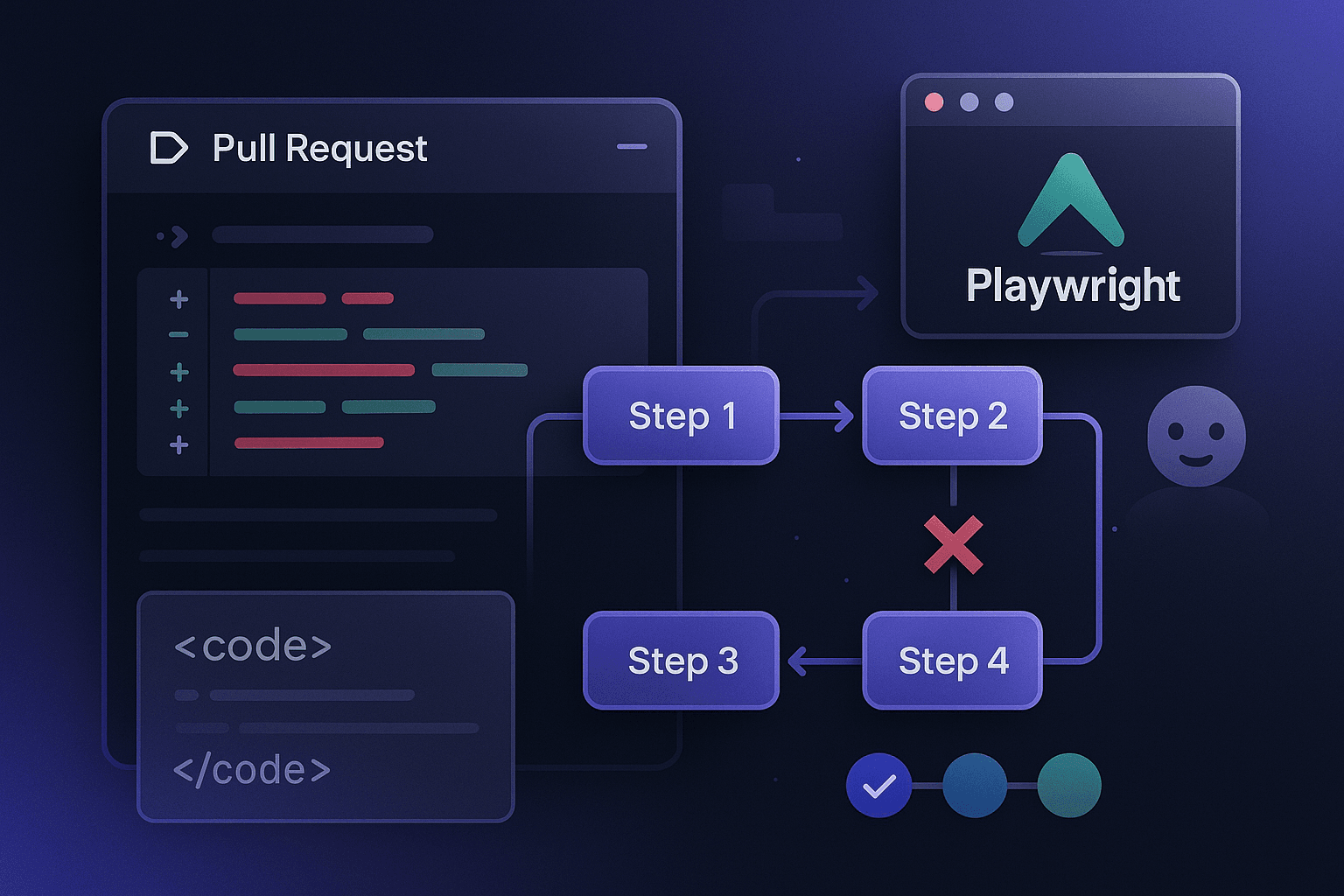
A practical way to capture workflow reliability is end-to-end browser and API testing around critical paths. Playwright is a strong fit because it exercises the real browser, lets you model multi-step interactions, and integrates well with CI/CD.
Here is a simple Playwright example for onboarding:
tsimport { test, expect } from '@playwright/test'

test('new user can complete onboarding', async ({ page }) => {
  const email = `test+${Date.now()}@example.com`

  await page.goto('http://localhost:3000/signup')
  await page.getByLabel('Email').fill(email)
  await page.getByLabel('Password').fill('StrongPassword123!')
  await page.getByRole('button', { name: 'Create account' }).click()

  await expect(page).toHaveURL(/verify-email/)

  // In test environments, shortcut verification through a test helper.
  await page.goto(`http://localhost:3000/test/verify?email=${encodeURIComponent(email)}`)

  await page.goto('http://localhost:3000/onboarding')
  await page.getByLabel('Company name').fill('Acme Inc')
  await page.getByLabel('Team size').selectOption('11-50')
  await page.getByRole('button', { name: 'Continue' }).click()

  await page.getByLabel('Use case').selectOption('Support')
  await page.getByRole('button', { name: 'Finish setup' }).click()

  await expect(page.getByText('Welcome to your dashboard')).toBeVisible()
})
Notice what this verifies that unit tests often do not:
- real form interaction
- actual payload construction
- route transitions
- email verification state handling
- onboarding sequence integrity
- final user-visible outcome
For backend-centric workflows, use API-level journey tests as well:
pythonimport requests
import uuid

BASE_URL = "http://localhost:8000"

def test_invited_user_can_accept_invite_and_access_workspace():
    owner_email = f"owner-{uuid.uuid4()}@example.com"
    member_email = f"member-{uuid.uuid4()}@example.com"

    owner = requests.post(f"{BASE_URL}/test/create-user", json={
        "email": owner_email,
        "password": "Secret123!",
        "role": "owner"
    }).json()

    workspace = requests.post(f"{BASE_URL}/workspaces", json={
        "name": "Demo Workspace"
    }, headers={"Authorization": f"Bearer {owner['token']}"}).json()

    invite = requests.post(
        f"{BASE_URL}/workspaces/{workspace['id']}/invites",
        json={"email": member_email, "role": "admin"},
        headers={"Authorization": f"Bearer {owner['token']}"}
    )
    assert invite.status_code == 201

    accepted = requests.post(f"{BASE_URL}/test/accept-invite", json={
        "email": member_email,
        "workspace_id": workspace["id"]
    })
    assert accepted.status_code == 200

    member = requests.post(f"{BASE_URL}/login", json={
        "email": member_email,
        "password": "Secret123!"
    })
    assert member.status_code == 200

    access = requests.get(
        f"{BASE_URL}/workspaces/{workspace['id']}",
        headers={"Authorization": f"Bearer {member.json()['token']}"}
    )
    assert access.status_code == 200
This is not about replacing unit tests. It is about adding workflow assertions where the business actually bleeds.
Add Workflow Checks to CI/CD Without Making It Miserable
The usual objection is speed: “We can’t run full end-to-end coverage on every PR.” Correct. You should not try to run everything all the time.
The answer is layered testing, with a small but serious workflow suite gating merges.
A better CI/CD setup looks like this:
- fast unit, lint, and type checks on every PR
- a focused critical-path workflow suite on every PR
- broader end-to-end coverage nightly or on main
- environment-specific smoke tests after deploy
- production observability to validate real outcomes
Example GitHub Actions config with Playwright:
yamlname: ci

on:
  pull_request:
  push:
    branches: [main]

jobs:
  fast-checks:
    runs-on: ubuntu-latest
    steps:
      - uses: actions/checkout@v4
      - uses: actions/setup-node@v4
        with:
          node-version: 20
      - run: npm ci
      - run: npm run lint
      - run: npm run typecheck
      - run: npm test -- --run

  critical-workflows:
    runs-on: ubuntu-latest
    needs: fast-checks
    steps:
      - uses: actions/checkout@v4
      - uses: actions/setup-node@v4
        with:
          node-version: 20
      - run: npm ci
      - run: npx playwright install --with-deps
      - run: docker compose up -d
      - run: npm run db:migrate
      - run: npm run test:e2e:critical
      - if: failure()
        run: npx playwright show-report
And a Playwright config that separates critical tests from the rest:
tsimport { defineConfig } from '@playwright/test'

export default defineConfig({
  testDir: './e2e',
  timeout: 60_000,
  fullyParallel: false,
  retries: process.env.CI ? 1 : 0,
  use: {
    baseURL: 'http://127.0.0.1:3000',
    trace: 'on-first-retry',
    screenshot: 'only-on-failure',
    video: 'retain-on-failure',
  },
  projects: [
    {
      name: 'critical',
      grep: /@critical/,
    },
    {
      name: 'full',
      grepInvert: /@critical/,
    },
  ],
})
Then tag the workflows that truly matter:
tstest('@critical checkout flow completes with valid card', async ({ page }) => {
  // ...
})

test('@critical invited admin can join workspace', async ({ page }) => {
  // ...
})
That gives you a merge gate based on behavior, not just syntax and local logic.
What to Verify Before Merge: A Better Review Checklist
Before merging any PR, especially one generated or heavily edited by AI, ask behavior-level questions.
Here is the checklist that actually matters:
1. Which user journeys could this touch?
Do not stop at the files changed. Think through:
- entry points
- upstream data producers
- downstream consumers
- permission and role variants
- account state differences
- integration boundaries
If a form field changed, what creates it, transports it, stores it, reads it later, and depends on it indirectly?
2. What old data or legacy state could break?
Fresh fixtures are liars.
Verify against:
- pre-migration records
- partially completed onboarding
- feature-flagged users
- users with old settings shapes
- accounts created before schema backfills
Most real production bugs are not “feature fails on happy path.” They are “feature fails for the messy users who already exist.”
3. Is there executable proof for the critical path?
Not “someone tested it.” Not “there’s a unit test nearby.”
Executable proof means:
- a browser test
- an API workflow test
- a smoke test in deploy
- an assertion on the final business outcome
4. Did the PR change behavior without changing interfaces obviously?
These are the dangerous ones:
- default value changes
- optional field assumptions
- cleanup refactors
- renamed properties
- changed event timing
- stricter validation
- reordered side effects
Reviewers should treat these as high risk even if the diff is tiny.
5. What observable signal will tell us if this is broken in production?
If the flow matters, monitor it.
Examples:
- signup completion rate
- invite acceptance conversion
- checkout success rate
- settings-save error rate
- onboarding step drop-off
Testing catches known failure modes. Observability catches reality.
Tools Comparison: What Each Layer Is Good For
No single testing tool solves reliability. You need a stack with explicit roles.
Unit tests
Best for:
- local logic correctness
- edge cases in pure functions
- fast feedback during development
- preventing regressions in isolated modules
Weak at:
- integrated workflows
- browser behavior
- data compatibility across system boundaries
Integration tests
Best for:
- service boundaries
- database interactions
- contract validation
- narrower slices of behavior
Weak at:
- full user journeys
- real browser interactions
- production-like sequencing across multiple steps
End-to-end tests with Playwright
Best for:
- critical workflows
- UI plus backend behavior
- regression detection for user-visible breakages
- debugging with traces, screenshots, and videos
Weak at:
- exhaustive branch coverage
- very fast execution at large scale
- replacing lower-level tests
Manual QA
Best for:
- exploratory testing
- visual issues
- weird edge cases humans notice
- release candidate validation
Weak at:
- consistency
- scale
- every-PR regression guarantees
Production observability
Best for:
- detecting real-world failures
- measuring outcome degradation
- validating deployment health
Weak at:
- preventing breakage before merge
- pinpointing root cause without supporting tests and traces
The right model is not tool replacement. It is coverage by intent.
Use unit tests for code confidence. Use workflow tests for behavioral confidence. Use observability for operational confidence.
Practical Debugging Habits for Workflow Failures
When a tiny PR breaks a large journey, debugging often goes badly because the team starts at the diff instead of the workflow.
A better debugging sequence is:
- Reproduce the full journey exactly as the user did.
- Identify the first step where expected state diverges.
- Capture browser network traffic, backend logs, and database changes.
- Compare fresh-account behavior versus legacy-account behavior.
- Inspect defaults, conditional branches, and side effects, not just the visible failing line.
Playwright traces are especially useful here because they show action-by-action context:
tsimport { test, expect } from '@playwright/test'

test('debug failing settings save', async ({ page }) => {
  await page.goto('/settings')
  await page.getByLabel('Display name').fill('New Name')
  await page.getByRole('button', { name: 'Save changes' }).click()

  await expect(page.getByText('Settings saved')).toBeVisible()
})
With trace capture enabled, you can inspect:
- DOM state before and after click
- exact request payload
- response codes and bodies
- timing and redirect behavior
- console errors
This shortens debugging dramatically compared with trying to infer behavior from logs after the fact.
If you care about developer productivity, this matters. The fastest team is not the one that merges the most code. It is the one that spends the least time in ambiguous production debugging.
Actionable Practices Teams Should Adopt Now
If you want fewer “safe-looking” PRs that break real workflows, make these changes.
Maintain a critical journey inventory
List the workflows that directly map to revenue, activation, retention, and support burden.
Examples:
- signup and onboarding
- login and password reset
- checkout and billing update
- invite and team join
- core create/edit/delete flows
- export/import flows
If it hurts the business when broken, it belongs on the list.
Gate merges on a small critical-path suite
Do not wait for a perfect end-to-end pyramid. Start with 5 to 10 workflows that absolutely must work.
This alone eliminates a surprising number of embarrassing regressions.
Tag high-risk tiny changes
Create a lightweight label or checklist for PRs involving:
- contracts
- defaults
- validation
- auth
- permissions
- async jobs
- migrations
- event schemas
These changes deserve workflow verification even when the diff is microscopic.
Require behavior notes in PR descriptions
Add a section:
- What user behavior changes?
- What workflows could be affected?
- What action-level checks were run?
This forces authors and reviewers to think beyond files changed.
Test against realistic state
Use fixtures or seeded environments that include:
- old accounts
- mixed entitlements
- partial setup states
- unusual but valid data
A clean-room test environment is comforting and misleading.
Treat AI-assisted changes as throughput, not trust
AI can help write tests, scaffold flows, and accelerate implementation. Fine. But it should increase the demand for behavioral verification, not lower it.
If AI generated the patch, ask more aggressively:
- what did it not see?
- what system boundaries are outside its context?
- what workflow proof do we have?
Monitor workflow outcomes in production
Track outcome metrics, not just technical errors.
Examples:
- percentage of signups that reach activation
- percentage of invites that lead to successful login
- payment attempts to successful subscription ratio
- settings update attempts versus success confirmations
This closes the loop between testing and reality.
Conclusion
The PR diff lied because it was never designed to tell the truth about behavior.
A diff shows text changes. A user journey reveals system correctness.
Modern teams keep getting burned because code review, unit tests, and CI/CD are all strongest at local validation. Meanwhile, the failures that matter most happen across boundaries: browser to API, new state to old state, sync action to async side effect, one tiny patch to a long chain of user intent.
AI-generated code makes this more urgent, not less. When more code ships faster, the cost of behavior-blind review goes up. A narrow patch can still be a wide failure.
If you want real reliability, stop asking whether the changed lines look safe. Ask whether the user can still complete the journey.
That is the standard that matters.
That is the level where debugging becomes cheaper, testing becomes meaningful, CI/CD becomes honest, and developer productivity stops being measured by merge speed alone.
Because the product is not the diff.
The product is what the user was trying to do before your “small change” got in the way.