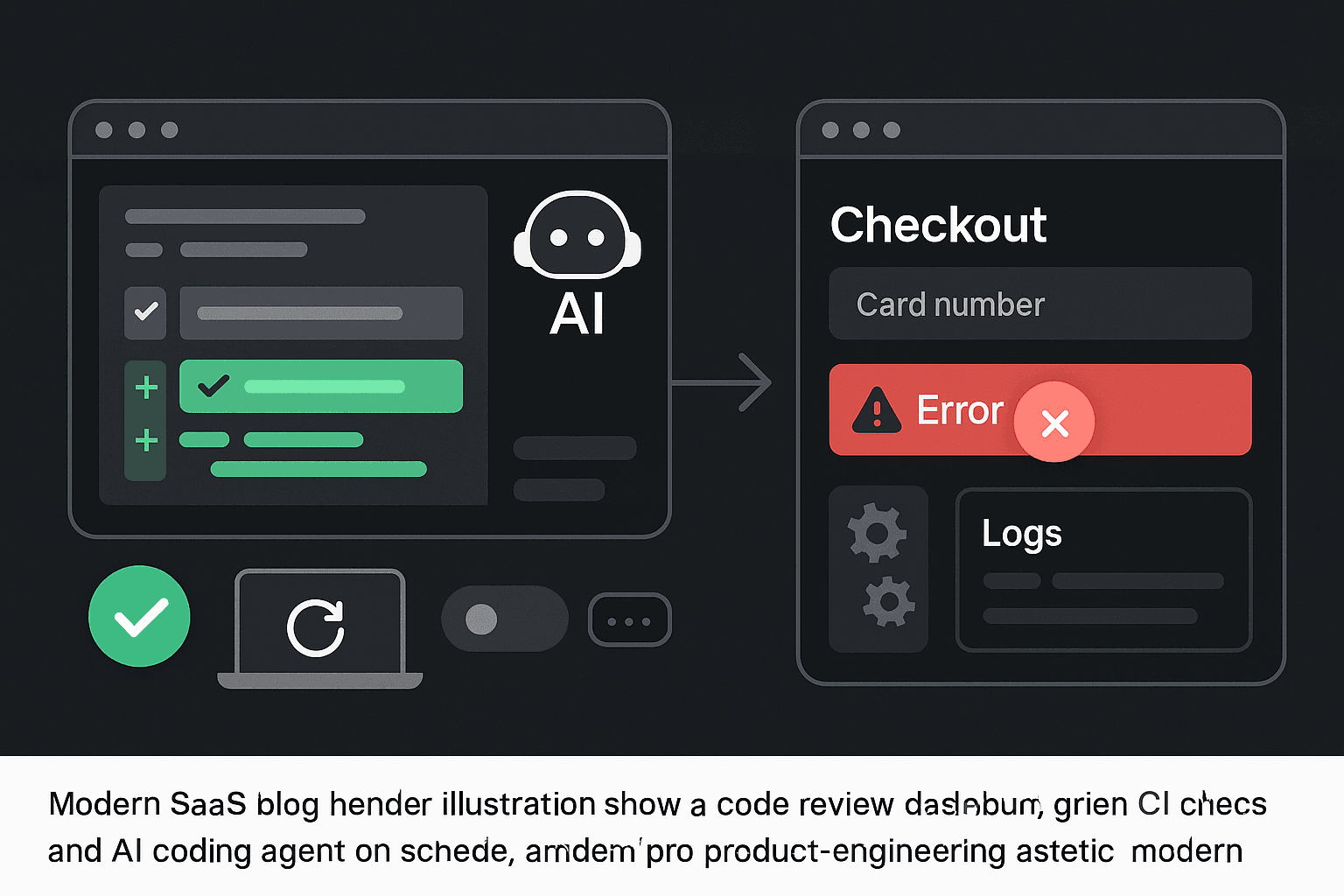
A checkout bug that costs revenue rarely starts as an obvious red test.
It starts with a pull request that looked clean.
The diff was small. The review was thoughtful. CI passed. The preview environment worked. Someone clicked through the happy path in the PR demo, saw the button render correctly, watched the payment form open, and approved the merge.
Then the code landed in the shared branch.
Now the discount service is using a different feature flag state than the preview environment. The auth token generated in staging expires one redirect earlier than expected. A fixture created by another test run has mutated shared inventory. The payment provider callback URL differs slightly between the branch environment and the integrated one. The shipping step reads from data that only exists when a previous onboarding task has completed. Suddenly, checkout fails for one real workflow that nobody tested after merge.
This is the blind spot most teams still live with: we validate pull requests in isolation, then assume production-like behavior will emerge automatically once changes are integrated.
That assumption was weak before. It is worse now.
AI tools are increasing code volume, speeding up refactors, generating tests, and helping teams ship more changes with less friction. But verification has not caught up. We still run most testing against synthetic conditions: isolated branches, mocked dependencies, curated fixtures, and deterministic happy paths. The result is false confidence. More code moves faster, but the checks still answer the wrong question.
The question is not "does this PR work by itself?"
The question is "after merge, in the shared reality users actually hit, do the critical workflows still complete?"
That is a different testing problem. It requires different debugging habits, different CI/CD design, and different ideas about what reliability means.
The problem is not code quality alone
Teams often treat post-merge failures as if they are just bugs that slipped through normal testing. That framing is too shallow.
Many merge-time failures are not failures of implementation. They are failures of interaction.
A PR can be locally correct and still globally dangerous. In modern systems, especially SaaS products with external integrations, a feature does not live inside its own code path. It exists inside a mesh of runtime dependencies:
- feature flags with environment-specific targeting
- shared databases with mutable state
- third-party auth and payment redirects
- background jobs with timing assumptions
- caches that survive deploys
- analytics or anti-fraud scripts that alter page timing
- browser session behavior across subdomains
- webhooks that arrive late, twice, or out of order
- data created by previous workflows rather than clean setup scripts
These are workflow-level concerns, not function-level concerns.
That distinction matters because most teams still overinvest in proving code correctness and underinvest in proving workflow continuity.
You can have excellent unit coverage and still break checkout. You can have strict PR review and still break auth. You can have a green pipeline and still break onboarding.
Why? Because the thing users experience is not your function. It is the sequence.
Users log in, accept an invite, complete profile setup, apply a discount, get redirected to a payment provider, return to your app, confirm shipping, and wait for a background event to update the order status. Reliability lives or dies in that chain.
Why current approaches fail
Most engineering organizations rely on some combination of unit tests, integration tests, manual QA, preview environments, and CI/CD gates. None of these are useless. The issue is that teams mistake them for complete coverage.
They are not.
CI/CD gives you confidence about artifacts, not reality
A standard CI/CD pipeline is good at answering narrow questions:
- Does the code compile?
- Do unit tests pass?
- Do contracts still match expectations?
- Can the app boot?
- Does the container build?
- Do a few browser tests pass in a clean environment?
Those are valuable checks. But the hardest failures happen in the gap between artifact validation and integrated behavior.
A typical pipeline creates ideal conditions:
- fresh database state
- deterministic fixtures
- limited concurrency
- mocked or sandboxed third parties
- ephemeral environments with no historical contamination
- no competing branch changes landing at the same time
That is not how shared environments behave after merge.
The merged branch picks up neighboring changes, long-lived state, environment drift, stale caches, flag configuration, queued jobs, and integration timing. CI/CD often proves that your code works in a lab. Users fail in traffic.
Here is a typical GitHub Actions workflow that looks responsible but still misses the real risk:
yamlname: ci

on:
  pull_request:
    branches: [main]

jobs:
  test:
    runs-on: ubuntu-latest
    services:
      postgres:
        image: postgres:15
        env:
          POSTGRES_PASSWORD: postgres
        ports:
          - 5432:5432
    steps:
      - uses: actions/checkout@v4
      - uses: actions/setup-node@v4
        with:
          node-version: 20
      - run: npm ci
      - run: npm run lint
      - run: npm run test:unit
      - run: npm run test:integration
      - run: npx playwright test --project=chromium
This pipeline is not wrong. It is incomplete.
It tells you the PR is sane in isolation. It says almost nothing about whether the merged application still supports a real checkout flow in the environment where multiple systems and recent changes coexist.
Unit tests prove local behavior, not system continuity
Unit tests are excellent for protecting logic. They are especially useful when AI-assisted development increases the volume of code churn. If agents are rewriting functions, generating edge-case branches, or touching serialization logic, strong unit coverage matters.
But unit tests cannot tell you whether a user can actually complete a workflow across services, redirects, retries, and shared state.
Example:
jsimport { calculateTotal } from './pricing';

test('applies 10 percent discount', () => {
  const result = calculateTotal({ subtotal: 100, discountCode: 'SAVE10' });
  expect(result.total).toBe(90);
});
This test is good. Keep it.
It does not tell you:
- whether the discount code is available under the active feature flag
- whether the pricing API and checkout session agree on totals
- whether tax recalculation after address entry invalidates the payment intent
- whether the redirect back from the payment provider preserves cart state
- whether another merged change altered the currency or locale assumptions
Unit tests are not supposed to answer those questions. The mistake is organizational: pretending they do.
Manual QA is too narrow, too late, and too inconsistent
Manual QA still catches real issues. But for post-merge workflow validation, it often fails for structural reasons.
- It is sampled, not continuous.
- It tends to focus on visible changes, not cross-system interactions.
- It depends on individual memory and tribal knowledge.
- It is difficult to repeat exactly.
- It is hard to scale with deployment frequency.
- It usually happens before merge, not after integration.
A QA engineer may verify that a new promo code UI appears and can be clicked. They may not discover that, after merge, an unrelated auth change causes the return-from-payment step to lose session context for users created via invite flow.
That is not a QA failure. It is a systems failure. The workflow under test changed only when multiple assumptions met each other.
Preview environments lie by omission
Preview environments are useful. They make PRs visible, improve collaboration, and support faster debugging. But they create a dangerous illusion: because they feel realistic, teams assume they are representative.
They are usually not.
Preview environments differ from integrated environments in subtle but critical ways:
- they often have branch-specific config
- they may not share traffic, queues, or caches
- third-party redirect URLs are commonly configured differently
- feature flag targeting may not match staging or production
- data is seeded cleanly instead of accumulated through real workflows
- they usually contain only the PR’s changes, not concurrent merges
The PR demo works because the world around it is simplified.
The merge breaks checkout because users do not operate inside the PR demo.
The core insight: test actions after merge, not just code before merge
If reliability depends on workflows, then testing should revolve around actions users take in integrated environments.
Not pages. Not components. Not functions.
Actions.
That means your critical verification strategy should answer questions like:
- Can a new user sign up from an invite and reach the dashboard?
- Can an existing customer add an item, apply a code, complete checkout, and see the order confirmed?
- Can a user log in with SSO, switch organizations, and access billing?
- Can onboarding create the expected records and trigger the next step?
- Can a password reset initiated on mobile complete successfully in the browser?
This is not generic end-to-end testing as theater. This is action-level validation of revenue-critical and trust-critical workflows in the environment that matters after code integrates.
The target is not broad UI coverage. The target is a small number of high-value workflows executed continuously after merge, against shared reality.
That is the shift.
The failure patterns that isolated PR validation misses
Let’s make this concrete.
1. Feature flag collisions
One PR introduces a new checkout summary behind a flag. Another PR modifies discount handling and assumes the old summary schema. Each PR passes independently because each preview environment has a clean flag state. After merge, the staging environment enables the new summary for internal users, and the combined path breaks total calculation.
This class of bug is common because feature flags are often treated as safety mechanisms when they are really state multipliers. Every flag combination creates another runtime condition.
A simple debug log in the wrong place can reveal it:
jsapp.post('/api/checkout/confirm', async (req, res) => {
  req.log.info({
    userId: req.user.id,
    flags: req.flags,
    cartVersion: req.body.cartVersion,
  }, 'confirming checkout');

  const order = await checkoutService.confirm(req.user, req.body, req.flags);
  res.json(order);
});
When debugging merge-only failures, always capture the configuration context around the action, not just the exception.
2. Stale fixtures and data assumptions
A PR test creates a perfect cart, seeded customer record, and valid address. Real shared environments contain partially completed profiles, expired discounts, old carts, duplicate organizations, and imported users missing optional fields that stopped being optional three months ago.
Your fixture says checkout starts from a normalized state. Real users arrive from history.
In Python, this is the difference between isolated setup and workflow-derived setup:
pythondef create_clean_checkout_state(db):
    user = User(email="test@example.com", country="US", verified=True)
    cart = Cart(user=user, items=[CartItem(sku="sku_123", qty=1)])
    db.session.add_all([user, cart])
    db.session.commit()
    return user, cart
This is easy to test. It is also where false confidence comes from.
A more realistic workflow harness creates state by performing prior actions:
pythondef create_checkout_state_via_workflow(client):
    invite = client.post("/api/invites", json={"email": "test@example.com"}).json()
    token = invite["token"]

    client.post("/api/accept-invite", json={"token": token, "name": "Test User"})
    client.post("/api/login", json={"email": "test@example.com"})
    client.post("/api/profile", json={"country": "US", "address": "1 Main St"})
    client.post("/api/cart/items", json={"sku": "sku_123", "qty": 1})

    return client
It is slower. It is also closer to reality.
3. Shared-state bugs
Two tests run fine alone but interfere in staging because they use the same merchant account, the same inventory pool, or the same promo code usage limits.
This is where debugging becomes painful because reruns may pass. The system is flaky only in the presence of accumulated state.
The right response is not “flaky tests are bad.” The right response is “shared workflows need state-aware test design.”
Use unique identifiers, isolate external side effects where possible, and validate cleanup. But also accept that some failures are symptoms of real product fragility, not just test noise.
4. Third-party redirect failures
Payments, SSO, tax providers, fraud checks, identity verification, and email deep links all introduce redirect and callback complexity.
PR environments often use substitute callback domains, special tunnels, or stubbed providers. After merge, integrated environments use the real redirect chain and reveal assumptions nobody covered.
A Playwright test that actually follows the action boundary matters more than ten component tests here:
tsimport { test, expect } from '@playwright/test';

test('user can complete checkout after merge', async ({ page }) => {
  await page.goto(process.env.APP_URL!);
  await page.getByRole('link', { name: 'Login' }).click();
  await page.getByLabel('Email').fill('buyer@example.com');
  await page.getByRole('button', { name: 'Continue' }).click();

  await page.getByRole('link', { name: 'Store' }).click();
  await page.getByText('Premium Plan').click();
  await page.getByRole('button', { name: 'Add to cart' }).click();
  await page.getByLabel('Discount code').fill('SAVE10');
  await page.getByRole('button', { name: 'Apply' }).click();
  await expect(page.getByText('$90.00')).toBeVisible();

  await page.getByRole('button', { name: 'Checkout' }).click();

  await page.waitForURL(/payment-provider/);
  await page.getByLabel('Card number').fill('4242424242424242');
  await page.getByLabel('Expiry').fill('12/34');
  await page.getByLabel('CVC').fill('123');
  await page.getByRole('button', { name: 'Pay' }).click();

  await page.waitForURL(/order-confirmation/);
  await expect(page.getByText('Thank you for your purchase')).toBeVisible();
});
The value here is not that browser automation is fashionable. The value is that this test validates the actual user action across redirects and integrated systems.
5. Sequence dependencies
A user who signs up directly works fine. A user who arrives through a sales-created invite hits a different code path. A user who changes locale during onboarding breaks billing. A customer with an existing subscription cannot buy an add-on because entitlement refresh lags behind checkout confirmation.
These are sequence bugs. They are common in products that grew quickly and accumulated path-specific assumptions.
Sequence bugs almost never show up in isolated PR checks unless the tests model the actual order of events.
What good post-merge testing looks like
A strong strategy is not “run all end-to-end tests all the time.” That becomes slow, brittle, and ignored.
Instead, build a layered system where post-merge workflow checks focus on a small set of actions that matter most.
Good post-merge testing has these properties:
- runs after integration into the shared branch or environment
- exercises critical workflows from the user’s perspective
- uses realistic configuration, flags, redirects, and services
- creates or derives state through workflows where practical
- captures rich logs, traces, screenshots, and network events for debugging
- gates release decisions or alerts owners quickly
- stays intentionally narrow and high signal
Think of it as synthetic production verification for your most important business actions.
A practical CI/CD pattern: pre-merge isolation, post-merge workflow validation
You do not need to abandon pre-merge checks. You need to stop pretending they are enough.
A healthier pipeline looks like this:
- Pre-merge: lint, unit, integration, contract tests, a few PR smoke tests.
- Post-merge to main: deploy to shared staging or an integrated environment.
- Immediately run critical action tests: checkout, auth, onboarding, billing, invite acceptance.
- Block production promotion or page the owning team if those fail.
- Persist artifacts for debugging: traces, logs, API transcripts, screenshots.
Example GitHub Actions setup:
yamlname: post-merge-workflows

on:
  push:
    branches: [main]

jobs:
  deploy-staging:
    runs-on: ubuntu-latest
    steps:
      - uses: actions/checkout@v4
      - run: ./scripts/deploy-staging.sh

  validate-critical-workflows:
    runs-on: ubuntu-latest
    needs: deploy-staging
    env:
      APP_URL: https://staging.example.com
    steps:
      - uses: actions/checkout@v4
      - uses: actions/setup-node@v4
        with:
          node-version: 20
      - run: npm ci
      - run: npx playwright test tests/critical --reporter=line
      - uses: actions/upload-artifact@v4
        if: always()
        with:
          name: playwright-artifacts
          path: |
            playwright-report/
            test-results/
The point is not just execution. It is policy. If post-merge workflow validation is informational only, teams will ignore it under schedule pressure. For revenue-critical flows, it should influence release progression.
Debugging post-merge failures without losing a day
When a merged workflow fails, the worst outcome is spending hours reproducing it from vague evidence.
You need observability designed for action-level debugging.
Capture these by default:
- the exact commit SHA and deployment version
- feature flag values for the session
- test account or entity IDs
- network timeline across redirects
- backend request IDs linked to browser traces
- screenshots and video at each action boundary
- webhook delivery logs
- queue/job processing events
- database identifiers for records created during the flow
In Playwright, enable tracing aggressively for critical flows:
tsimport { defineConfig } from '@playwright/test';

export default defineConfig({
  use: {
    trace: 'retain-on-failure',
    screenshot: 'only-on-failure',
    video: 'retain-on-failure',
  },
  retries: 1,
});
And in your backend, propagate correlation IDs:
jsapp.use((req, res, next) => {
  req.correlationId = req.headers['x-correlation-id'] || crypto.randomUUID();
  res.setHeader('x-correlation-id', req.correlationId);
  next();
});
Then include that ID in outbound provider calls, logs, queue jobs, and webhook handling. Debugging gets dramatically easier when the browser failure can be stitched to backend events and third-party callbacks.
Tools comparison: what each layer is good for
No single tool solves this. You need a stack with clear jobs.
Unit test frameworks: Jest, Vitest, Pytest
Best for:
- business logic correctness
- edge-case coverage
- fast feedback during development
- AI-generated code validation at the function/module layer
Weak for:
- redirect chains
- shared-state failures
- integrated workflow continuity
Verdict: essential, but not sufficient.
API integration tests
Best for:
- service contracts
- backend sequence validation without UI overhead
- debugging specific state transitions
Weak for:
- browser session issues
- front-end/back-end coordination bugs
- third-party UI redirects and cookie behavior
Verdict: high value, especially as a bridge between unit and browser testing.
Browser automation: Playwright
Best for:
- critical workflow validation
- auth, checkout, onboarding, billing flows
- post-merge smoke tests in real environments
- capturing debugging artifacts
Weak for:
- broad coverage at massive scale if poorly scoped
- teams that treat every path as an end-to-end test
Verdict: the right default for action-level post-merge testing if you keep scope tight.
Traditional manual QA
Best for:
- exploratory validation
- visual issues
- unusual edge cases humans notice well
- release readiness for high-risk changes
Weak for:
- consistency
- speed
- repeatability
- continuous protection of shared workflows
Verdict: still useful, but should not be your only defense against integrated failures.
Synthetic monitoring in production
Best for:
- detecting real-world regressions after release
- verifying availability and key actions continuously
- alerting on business-critical workflow breakage
Weak for:
- catching issues before users see them
- debugging root cause without deeper artifacts
Verdict: necessary final layer, but too late if it is your first signal.
Actionable practices for teams shipping faster with AI
If AI is increasing developer productivity by making code changes cheaper, your verification strategy must become more selective and more reality-based.
Do these things.
1. Define five critical workflows
Start small. Pick the workflows that matter most to revenue, activation, and trust.
For most SaaS products, that list is something like:
- sign up / invite acceptance
- login / SSO
- onboarding completion
- checkout / upgrade
- password reset or account recovery
If these are not continuously validated after merge, your reliability posture is weaker than your CI dashboard suggests.
2. Run them after merge in a shared environment
Not only in PR previews. Not only against mocks. Not only overnight.
Run them immediately after main is updated and deployed to an integrated environment. This is where merge-time interaction bugs show up.
3. Prefer workflow-derived test state over static fixtures
Static fixtures are fast and brittle. They hide sequence assumptions.
Whenever possible, create the required state by performing the preceding user or system actions. Yes, it costs time. It also reduces the difference between test reality and user reality.
4. Make feature flags observable in tests
Every critical workflow run should log the active flag set. If your system depends heavily on flags, define explicit test scenarios for key combinations. Otherwise, debugging becomes guesswork.
5. Test third-party boundaries honestly
Do not fully mock payments, SSO, and callback flows in your most important validation path. Use sandbox providers or realistic test modes where you can. The redirect boundary is where many merge-only bugs hide.
6. Treat flaky workflow tests as product signals first
Sometimes the test is bad. Often the product is timing-sensitive, state-sensitive, or order-sensitive in ways users can also trigger.
Investigate before dismissing. Flakiness in checkout is frequently production fragility wearing a test disguise.
7. Connect browser artifacts to backend observability
A failed click without backend context wastes time. A 500 log without the user action wastes time. Join them with correlation IDs, trace capture, and environment metadata.
This is where debugging maturity pays off more than another hundred unit tests.
8. Separate broad coverage from release blockers
Do not make a giant unstable end-to-end suite your release gate. Keep blockers narrow:
- can users log in?
- can users sign up?
- can users pay?
- can users recover accounts?
Everything else can run in supporting suites. Critical action tests should be few, durable, and non-negotiable.
9. Audit your CI/CD for false confidence
Look at every green check and ask: what real user action does this protect?
If the answer is vague, the check may still be useful, but it is not evidence that the business workflow works.
This reframing is important for technical leaders. A healthy pipeline is not one with the most tests. It is one where each layer protects a distinct kind of failure.
10. Design for debugging, not just detection
Teams love detection and underinvest in diagnosis. But if post-merge verification fails and nobody can localize the problem quickly, the suite becomes resented and bypassed.
Every critical workflow harness should make root-cause analysis easier:
- explicit steps
- strong assertions at transition points
- trace artifacts
- backend log correlation
- human-readable failure messages
- stable test accounts and cleanup rules
The goal is not just to know that checkout broke. The goal is to know where, under what conditions, and with which recent change.
This matters more in the AI-assisted development era
AI is not the root problem here. It just amplifies it.
When teams can generate code, tests, migrations, and refactors faster, they create more opportunities for interaction failures. The bottleneck shifts from writing code to verifying behavior. If verification stays isolated and synthetic while change volume rises, your apparent developer productivity goes up while your operational confidence quietly goes down.
That is the trap.
You do not solve it by rejecting AI tools. You solve it by updating what you mean by testing.
Testing should not be a ceremony that blesses diffs. It should be a system that verifies user outcomes.
The stronger your automation gets, the more this distinction matters.
Conclusion
“The PR demo worked” is not evidence that the product works.
It only proves the change survived a controlled presentation.
Real failures emerge after merge, when code enters shared conditions shaped by flags, history, third parties, queues, redirects, and neighboring changes. Checkout, auth, onboarding, and billing do not fail because one line was obviously wrong. They fail because the workflow reality was never exercised where it actually lives.
That is the blind spot modern teams need to close.
Keep your unit tests. Keep your integration tests. Keep your PR previews. Keep your CI/CD discipline.
But stop asking those systems to answer a question they were not designed to answer.
If you care about reliability, debugging speed, and real developer productivity, test the actions that matter after merge, in the shared environment, under realistic conditions.
Because users do not experience your pull request.
They experience the merged workflow.