A deploy can be technically correct and still be operationally wrong.
That’s the uncomfortable lesson behind a lot of “how did this reach production?” incidents. The pull request was reviewed. The unit tests were green. Integration checks passed. CI/CD reported success. The merge looked safe.
And then the release went out and users couldn’t complete checkout, reset their password, connect their calendar, or finish onboarding.
Nothing “crashed” in the way engineering teams usually imagine failure. The app loaded. Health checks were green. Logs were noisy but not alarming. The failure was higher up the stack: a real user workflow, executed in a real environment, with real auth state, real timing, real third-party behavior, and real deployment configuration.
That’s the blind spot. Merge-time validation proves that code changed safely according to the checks you defined. It does not prove that the shipped product still works the way users need it to.
The gap has always existed, but AI-generated code makes it worse. Teams can now produce and merge changes faster than ever. That sounds like developer productivity until you realize verification depth usually does not increase with change volume. You get more PRs, more surface area, more interaction effects, and more confidence theater from passing checks.
The core mistake is treating software quality as a property of code paths rather than user actions.
The failure pattern teams keep repeating
A common postmortem goes something like this:
- A seemingly isolated change lands safely behind green PR checks.
- The release includes a config change, a feature flag update, or an infra dependency bump.
- The deployment succeeds.
- A user path fails only in the deployed environment.
- The failure was invisible to unit tests, API tests, and static checks.
- Engineers scramble to reproduce a stateful, environment-specific bug under release pressure.
This is not an edge case. It is normal modern software behavior.
Consider a few failures that happen all the time:
- Checkout works locally and in CI, but a production-only tax provider response shape breaks payment confirmation.
- Sign-in succeeds for test users, but SSO users on a flagged tenant hit a redirect loop.
- A background job that finalizes uploads is delayed in production, so the UI times out waiting on data that was instant in test.
- A redesign passes visual review, but a permission-controlled button disappears only for users with legacy account state.
- An onboarding flow works in staging, but production analytics consent gates block the next step event.
- A settings page saves in tests, but a region-specific feature flag hides the confirmation modal in one market.
Every one of these can pass a normal CI pipeline.
That’s because CI mostly answers: “Did the code behave as expected in a controlled validation environment?”
Users need an answer to a different question: “Does the released product still let me accomplish the thing I came here to do?”
Those are not the same question.
Why merge-time confidence is often false confidence
Most engineering teams overinvest in pre-merge validation because it feels objective.
You can count tests. You can measure coverage. You can block merges. You can put green checks in GitHub. It fits the operational model of modern software teams.
But green PR status is easy to misinterpret. It usually reflects the health of your testing strategy, not the health of the release.
Here’s the problem in direct terms:
- Unit tests verify implementation details and local contracts.
- Integration tests verify bounded interactions under simplified conditions.
- CI environments are curated, resettable, and unnaturally stable.
- Manual QA is sparse, inconsistent, and often too late.
- None of these reliably cover post-deploy workflow correctness.
Engineers know this in theory, but delivery systems are still optimized around merge gating rather than release validation.
CI validates snapshots, not deployed reality
CI/CD pipelines are very good at deterministic checks:
- linting
- type safety
- unit tests
- component tests
- API contract checks
- build integrity
- security scanning
All useful. None sufficient.
What they struggle with is environmental truth:
- production feature flag combinations
- real identity provider behavior
- race conditions with async jobs
- external API latency or schema drift
- cache invalidation timing
- CDN or edge behavior
- tenant-specific data shape
- permissions accumulated over account history
- browser state created by real usage patterns
The deeper issue is that CI creates an abstract world where the system is cleaner than it is in production. Databases are seeded neatly. Queues are empty. auth state is idealized. Third-party responses are mocked. Time behaves. Users don’t arrive mid-migration. Flags are set intentionally instead of historically.
In that world, software appears more reliable than it is.
Unit tests prove code, not outcomes
Unit tests answer narrow questions well:
- Does this function return the correct value?
- Does this component render expected UI for a given prop set?
- Does this handler call the right service under a mocked condition?
Those are useful debugging tools. They are not release guarantees.
A user does not care whether calculatePlanPrice() still returns a valid number if the actual upgrade workflow fails because the billing portal callback URL differs in production.
An engineer may have 90% coverage and still ship a broken subscription flow.
Coverage is not meaningless. It’s just routinely asked to prove something it cannot prove.
Integration tests flatten reality
Integration tests are often described as the practical middle ground. In many teams, they are the highest-value automated checks after unit tests. But they still flatten the world.
Typical simplifications include:
- replacing third-party services with fixtures
- bypassing real browser behavior
- skipping email/SMS links and token exchange
- short-circuiting background work
- using privileged test users that don’t reflect real permission models
- asserting API responses instead of user-visible outcomes
The result is a system that “integrates” in a technical sense while still failing in the way the business experiences failure.
QA cannot scale to modern release velocity
The standard fallback is manual QA. That worked better when teams shipped less often, product surfaces changed slowly, and failure modes were easier to enumerate.
That is not today.
Today, teams deploy continuously, depend on dozens of external systems, and use configuration as heavily as code. Add AI-assisted development and the number of changes rises further. Manual test plans do not scale to this. They arrive too late, cover too little, and rarely reproduce the exact state users hit after rollout.
The bigger issue is not that QA is bad. It’s that manual verification is a weak control against dynamic, stateful, environment-specific failures.
The hidden complexity lives at release time
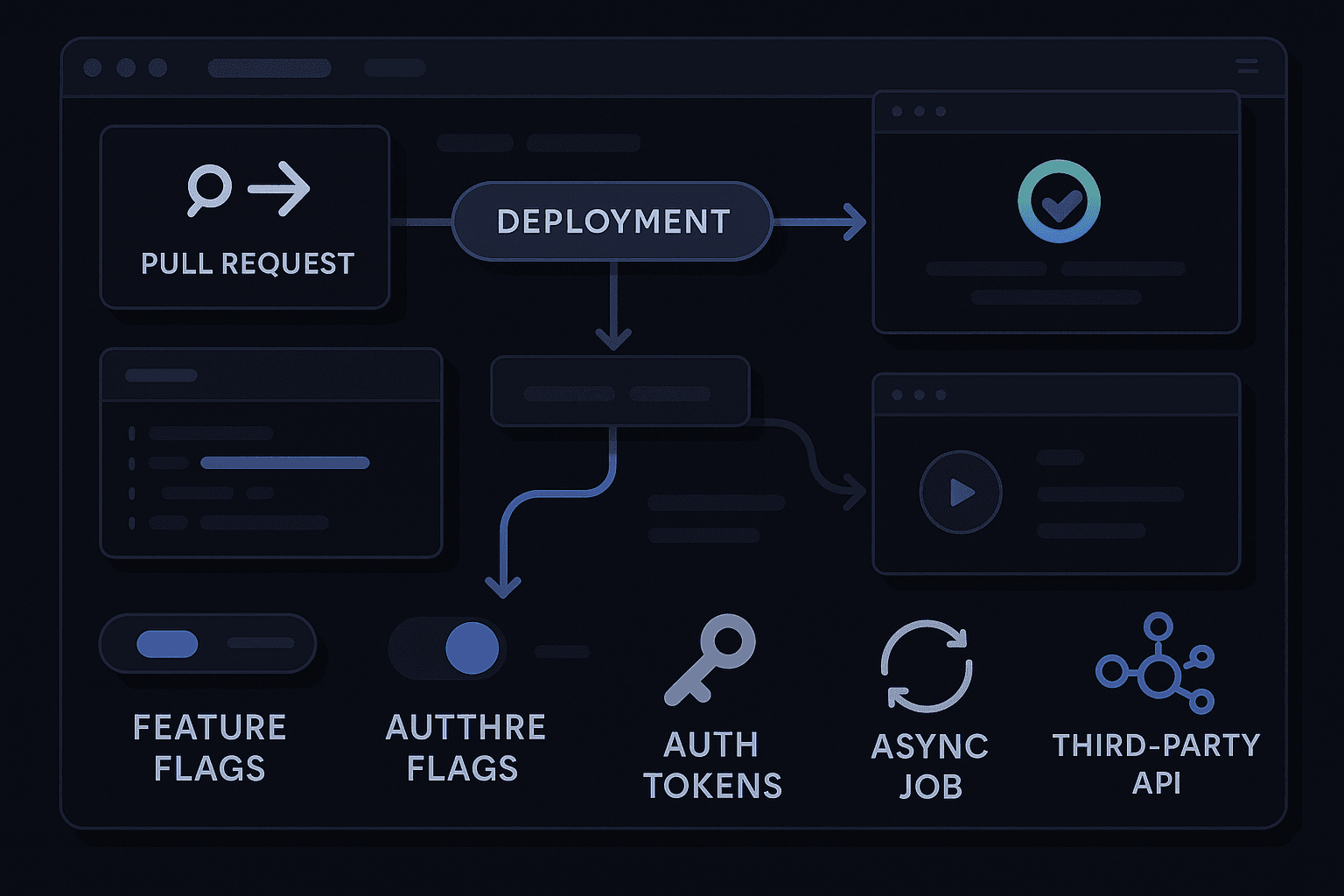
A release is where independent “safe” changes combine into unsafe behavior.
Not because any single engineer made a reckless change, but because software behavior emerges from more than code diffs. By release time, you are dealing with:
- application code
- deployment configuration
- feature flags
- secrets and credentials
- data migrations
- worker queues
- caches
- browser storage
- auth providers
- third-party APIs
- region or tenant differences
- previous user history
This is why teams get surprised by production breakage after uneventful merges. The release is a systems event, not a code event.
A checkout button disappearing for one segment of users might depend on:
- a feature flag default
- a stale account entitlement
- an experiment bucket
- a delayed pricing sync job
- a browser locale
- a production-only payment capability response
No single unit test sees that. No normal PR review sees that. Even a solid integration suite may not see it.
A user sees it immediately.
AI-generated code increases the gap between change volume and verification depth
This is where the current conversation around AI and developer productivity goes off track.
AI absolutely helps teams write more code, refactor faster, scaffold tests, and move through boilerplate. That part is real.
But AI does not automatically improve verification quality. In fact, it often degrades signal if teams mistake generated tests for meaningful coverage.
A few patterns are showing up already:
- More code changes per engineer per week
- Larger diffs accepted because the implementation “looks standard”
- More generated unit tests that mirror implementation instead of protecting workflows
- Faster PR throughput without stronger release-stage validation
- More hidden interaction risk spread across frontends, backends, config, and automation
The result is simple: more opportunities to break user workflows without a proportional increase in confidence.
If one engineer can now ship 3x the amount of change, and the team’s validation model is still dominated by merge-time checks, then the system becomes less trustworthy even while local productivity improves.
This is why AI makes release-stage testing more important, not less.
When change volume increases, action-level verification has to become the control point.
The core insight: test actions, not just assertions
If you want release confidence, stop asking only whether code is correct. Start asking whether users can still complete critical actions in the shipped environment.
That means testing workflows like:
- sign up
- sign in
- reset password
- invite teammate
- create project
- upload file
- connect integration
- start trial
- upgrade plan
- complete checkout
- export report
- submit support request
Not as mocked abstractions. As real actions executed against a deployed build with realistic state.
This is a different philosophy of testing.
Instead of:
- “Does the pricing form submit a valid payload?”
Ask:
- “Can a trial user on a flagged plan in region X upgrade successfully after release?”
Instead of:
- “Does the callback handler return 200?”
Ask:
- “Can a user actually connect Google Calendar and see synced events appear?”
This is not an argument against lower-level tests. You still need unit and integration tests for fast feedback and debugging. But they should support release confidence, not be mistaken for it.
The right model looks more like this:
- Unit tests: protect logic and speed up debugging
- Integration tests: protect subsystem contracts
- CI/CD: prevent obviously unsafe merges
- Release-stage workflow tests: validate shipped user outcomes before rollout expands
That last layer is where many teams are weak.
What release-stage, action-level testing actually looks like
This is usually best implemented as browser-driven workflow validation against a deployed environment, with supporting hooks for state setup and observability.
The key properties:
- It runs against the actual release candidate or freshly deployed environment.
- It uses realistic auth, flags, and tenant configuration.
- It executes end-to-end user actions through the interface or public boundaries.
- It validates outcomes users care about, not only internal responses.
- It runs before full rollout or immediately after deploy within a guarded release process.
Playwright is a strong fit here because it gives deterministic browser automation, network visibility, trace capture, and parallelization without turning the suite into pure UI theater.
Example: a brittle login flow hidden by CI
A lot of teams test login in CI by mocking auth or posting directly to an API. That can hide redirect issues, cookie scope problems, tenant routing bugs, and feature-flagged onboarding behavior.
Here’s a realistic Playwright workflow test in JavaScript:
jsimport { test, expect } from '@playwright/test';

test('SSO user can sign in and reach dashboard', async ({ page }) => {
  await page.goto(process.env.APP_URL);
  await page.getByRole('button', { name: 'Continue with SSO' }).click();

  await page.fill('input[name="email"]', process.env.TEST_SSO_EMAIL);
  await page.click('button[type="submit"]');

  // Depending on your IdP, this may route through a dedicated test tenant.
  await page.fill('input[name="password"]', process.env.TEST_SSO_PASSWORD);
  await page.click('button[type="submit"]');

  await page.waitForURL('**/dashboard');
  await expect(page.getByRole('heading', { name: /dashboard/i })).toBeVisible();
  await expect(page.getByText('Welcome back')).toBeVisible();
});
That still isn’t enough if your release risk depends on flags or migrated users. So make state explicit.
jsimport { test, expect, request } from '@playwright/test';

test('legacy tenant admin can sign in and invite teammate', async ({ page, baseURL }) => {
  const api = await request.newContext({ baseURL, extraHTTPHeaders: {
    'x-test-admin-token': process.env.TEST_ADMIN_TOKEN,
  }});

  const setup = await api.post('/test/setup-tenant', {
    data: {
      tenantType: 'legacy',
      flags: {
        newMembersPage: true,
        enforceSCIMBanner: false,
      },
      userRole: 'admin',
    },
  });

  const { email, password } = await setup.json();

  await page.goto('/login');
  await page.fill('input[name="email"]', email);
  await page.fill('input[name="password"]', password);
  await page.click('button[type="submit"]');

  await page.waitForURL('**/dashboard');
  await page.goto('/settings/members');
  await page.getByRole('button', { name: 'Invite member' }).click();
  await page.fill('input[name="inviteEmail"]', 'new.person@example.com');
  await page.getByRole('button', { name: 'Send invite' }).click();

  await expect(page.getByText('Invitation sent')).toBeVisible();
});
This is the pattern that matters: set up realistic state, perform the action, verify the user-visible result.
Example: async jobs are where “works on merge” goes to die
A huge class of release bugs comes from asynchronous processing. CI environments often run with low latency, synchronous shortcuts, or overpowered infrastructure. Production does not.
Suppose your app lets users upload CSVs, then a worker validates and imports the records. The PR tests may confirm that the upload endpoint returns 202 and that the parser works. Users need the import to actually finish and appear in the UI.
pythonfrom playwright.sync_api import sync_playwright, expect
import os


def test_csv_import_workflow():
    with sync_playwright() as p:
        browser = p.chromium.launch()
        page = browser.new_page()

        page.goto(os.environ["APP_URL"] + "/login")
        page.fill('input[name="email"]', os.environ["TEST_EMAIL"])
        page.fill('input[name="password"]', os.environ["TEST_PASSWORD"])
        page.click('button[type="submit"]')

        page.goto(os.environ["APP_URL"] + "/imports")
        page.set_input_files('input[type="file"]', 'fixtures/customers.csv')
        page.get_by_role('button', name='Upload').click()

        expect(page.get_by_text('Import started')).to_be_visible()
        expect(page.get_by_text('Completed')).to_be_visible(timeout=90000)
        expect(page.get_by_text('42 records imported')).to_be_visible()

        page.goto(os.environ["APP_URL"] + "/customers")
        expect(page.get_by_text('Acme Industries')).to_be_visible()

        browser.close()
This kind of test catches queue misconfiguration, worker deployment mismatch, storage permissions, and event processing lag that merge-time checks routinely miss.
Example: third-party integrations need real boundary validation
Mocking Stripe, Slack, Google, or Salesforce is fine for local debugging. It is a weak proxy for release confidence.
You do not need every automated test to hit real vendors, but you do need some release-stage validation at the actual integration boundary. That might involve sandbox accounts, test tenants, or provider simulators that preserve the real protocol and redirect behavior.
For example, validating a Slack connection flow:
jsimport { test, expect } from '@playwright/test';

test('workspace owner can connect Slack and receive success state', async ({ page }) => {
  await page.goto('/integrations/slack');
  await page.getByRole('button', { name: 'Connect Slack' }).click();

  await page.waitForURL('**slack.com/**');
  await page.getByRole('button', { name: 'Allow' }).click();

  await page.waitForURL('**/integrations/slack?connected=true');
  await expect(page.getByText('Slack connected')).toBeVisible();
  await expect(page.getByText(/last synced/i)).toBeVisible();
});
If this feels too “end-to-end heavy,” that is exactly the point. Certain failures only exist at the workflow boundary.
Put release-stage tests in the delivery path
A workflow suite no one runs before release is just another folder in the repo.
These tests need to sit in the actual deployment decision path. Not necessarily as a giant, flaky blocker for every commit, but as a controlled release gate.
A practical pattern looks like this:
- Run fast merge-time checks on every PR.
- Deploy a release candidate to a production-like environment.
- Execute a focused critical workflow suite.
- Expand rollout only if those workflows pass.
- Capture traces, screenshots, and logs for fast debugging when they fail.
For example, a GitHub Actions workflow:
yamlname: release-validation

on:
  workflow_dispatch:
  push:
    branches: [main]

jobs:
  deploy-release-candidate:
    runs-on: ubuntu-latest
    steps:
      - uses: actions/checkout@v4
      - name: Deploy candidate
        run: ./scripts/deploy_candidate.sh

  validate-critical-workflows:
    needs: deploy-release-candidate
    runs-on: ubuntu-latest
    env:
      APP_URL: ${{ secrets.RELEASE_CANDIDATE_URL }}
      TEST_EMAIL: ${{ secrets.TEST_EMAIL }}
      TEST_PASSWORD: ${{ secrets.TEST_PASSWORD }}
      TEST_ADMIN_TOKEN: ${{ secrets.TEST_ADMIN_TOKEN }}
    steps:
      - uses: actions/checkout@v4
      - uses: actions/setup-node@v4
        with:
          node-version: 20
      - run: npm ci
      - run: npx playwright install --with-deps
      - name: Run critical workflow suite
        run: npx playwright test tests/release --reporter=line,html
      - name: Upload traces
        if: always()
        uses: actions/upload-artifact@v4
        with:
          name: playwright-release-artifacts
          path: |
            playwright-report
            test-results

  progressive-rollout:
    needs: validate-critical-workflows
    runs-on: ubuntu-latest
    steps:
      - name: Roll out to 10%
        run: ./scripts/rollout.sh 10
The point is not to create another giant test pyramid diagram. The point is to put action-level validation where rollout decisions happen.
Debugging gets easier when tests speak the language of failures
One underappreciated benefit of workflow testing is better debugging.
When a unit test fails, you usually learn that an assumption in code changed. When a release-stage workflow test fails, you learn that a user outcome is broken.
That changes incident response in a good way.
Instead of:
- “Something is wrong around auth.”
You get:
- “SSO users on legacy tenants cannot reach dashboard after deploy.”
Instead of:
- “Upload service may be unhealthy.”
You get:
- “CSV import starts but never completes in release candidate.”
This is much closer to the language product, support, and engineering all need during a release incident.
Good tooling helps here. Capture:
- browser traces
- screenshots
- video when needed
- network logs
- console errors
- request IDs tied to backend logs
- feature flag state at test time
- seeded user and tenant metadata
Now your testing system is not just blocking bad releases. It is accelerating debugging.
That matters for developer productivity more than another dashboard full of synthetic green checks.
Tools comparison: what each layer is good for
Teams often argue about testing tools as if one category should win. That is the wrong framing. Different tools answer different questions.
Unit test frameworks: Jest, Vitest, Pytest
Best for:
- logic correctness
- fast feedback
- regression protection at function/module level
- isolating bugs during debugging
Weak for:
- deployment-specific behavior
- real auth or browser flows
- async distributed system outcomes
- third-party integration confidence
API/integration testing tools: Supertest, Pytest + requests, Postman/Newman
Best for:
- service contract validation
- backend endpoint behavior
- auth/token scenarios at protocol level
- integration checks for internal systems
Weak for:
- UI state transitions
- browser storage/cookie behavior
- redirect and consent flows
- validating visible user success
Browser automation: Playwright, Cypress
Best for:
- user workflow validation
- release-stage critical path testing
- cross-page actions and assertions
- debugging with traces and screenshots
Weak for:
- replacing all lower-level tests
- broad coverage if used carelessly
- poorly designed suites with brittle selectors and no state control
Playwright tends to fit release validation especially well because of isolation, parallelism, robust tracing, and multi-browser support. Cypress can also work, but many teams doing serious release gating lean toward Playwright for flexibility and CI ergonomics.
Monitoring and synthetic checks
Best for:
- post-release detection
- ongoing production visibility
- uptime and response monitoring
- regression detection after rollout
Weak for:
- blocking bad releases before exposure
- controlled state setup
- deterministic verification of flagged flows
Monitoring is necessary. It is not a substitute for pre-rollout workflow validation.
What to actually test before rollout
Most teams make the suite too large or too vague. Start with business-critical actions.
A good release-stage suite usually covers 10 to 30 workflows, not hundreds.
Prioritize by revenue, activation, retention, and support load.
Examples:
- User can sign in with each major auth method
- New user can complete onboarding
- Existing customer can upgrade or purchase
- Admin can invite and manage members
- User can connect a major third-party integration
- File upload/import completes end to end
- Report/export is generated successfully
- Core creation flow works: create project, publish page, send message, etc.
- Password reset and email verification paths work
- Region/plan/role-specific high-risk workflows work
Then add targeted coverage for known failure multipliers:
- feature-flagged experiences
- old tenants or migrated accounts
- async jobs
- external callbacks/webhooks
- environment-specific config
- permissions and entitlements
If a workflow breaking would trigger executive escalation or a flood of support tickets, it probably belongs in the release suite.
Practical implementation patterns that reduce flakiness
People resist browser-driven release tests because they remember brittle UI suites from years ago. That concern is valid. Bad end-to-end suites are expensive.
But most flakiness comes from poor design, not the category itself.
A few practical rules:
1. Test outcomes, not animation timing
Use stable selectors and assert meaningful states.
Bad:
- wait 5 seconds
- click random CSS selector
- assert a class changed
Better:
- wait for URL or role-based element
- assert visible confirmation text
- assert resulting record exists
2. Control setup through APIs where appropriate
Do not force every test to create all state through the UI if that is not the thing under validation.
It is usually better to seed:
- tenants
- users
- flags
- entitlements
- test data
Then validate the action that matters through the product surface.
3. Keep the suite narrow and critical
Release-stage tests are not your entire test strategy. They are the final confidence layer for high-value workflows.
If you try to cover everything, you will build a slow, noisy blocker and teams will bypass it.
4. Run against realistic environments
If the environment does not include the same auth flows, worker topology, flags, callbacks, and external connectivity as production, you are only partly testing the release.
Perfection is not required. Similarity is.
5. Capture artifacts by default
When a workflow fails, you should have enough context to debug immediately. Traces and request correlation should not be optional.
6. Align ownership with product risk
The team owning billing should own billing release workflows. The team owning onboarding should own onboarding validation. Reliability improves when workflow ownership is explicit.
A minimal maturity model for teams adopting this
If your current process is mostly PR checks plus occasional QA, do not overcomplicate the transition.
Stage 1: Identify critical workflows
List the top 10 user actions that must work after every release.
Stage 2: Automate them in Playwright
Use realistic seeded state and verify user-visible outcomes.
Stage 3: Run them on every release candidate
Make them part of your CI/CD release path, not an optional side exercise.
Stage 4: Gate rollout expansion
Use workflow pass/fail as an input to canary progression or feature rollout.
Stage 5: Add coverage for failure-prone variants
Legacy tenants, flagged users, async-heavy paths, third-party integrations.
This is not glamorous engineering work. It is operationally serious engineering work.
The real shift: from code confidence to workflow confidence
The strongest teams are moving away from a simplistic idea of testing where enough pre-merge checks equal safety.
They understand something more important:
Software reliability is not proven when code merges cleanly. It is proven when users can still complete the actions the business depends on after the release is deployed.
That means testing has to move closer to reality.
Not abandoning unit tests. Not mocking less for ideological reasons. Not replacing CI/CD. But acknowledging the actual blind spot between merge-time validation and post-deploy behavior.
That blind spot is where expensive failures live.
AI-generated code will widen it unless teams respond by strengthening release verification at the workflow level. More code without better action-level testing just means faster delivery of unverified behavior.
The merge can be fine. The release can still be broken.
If you care about debugging less in production, improving developer productivity in ways that matter, and making CI/CD mean something beyond “the branch is green,” then validate what users actually do before rollout.
Test the release, not just the diff.