A checkout button worked in staging. The pull request was green. Unit tests passed, contract tests passed, lint passed, type checks passed, and the deployment pipeline proudly stamped the build as safe.
Then production users clicked “Upgrade,” saw the success screen, and nothing actually happened.
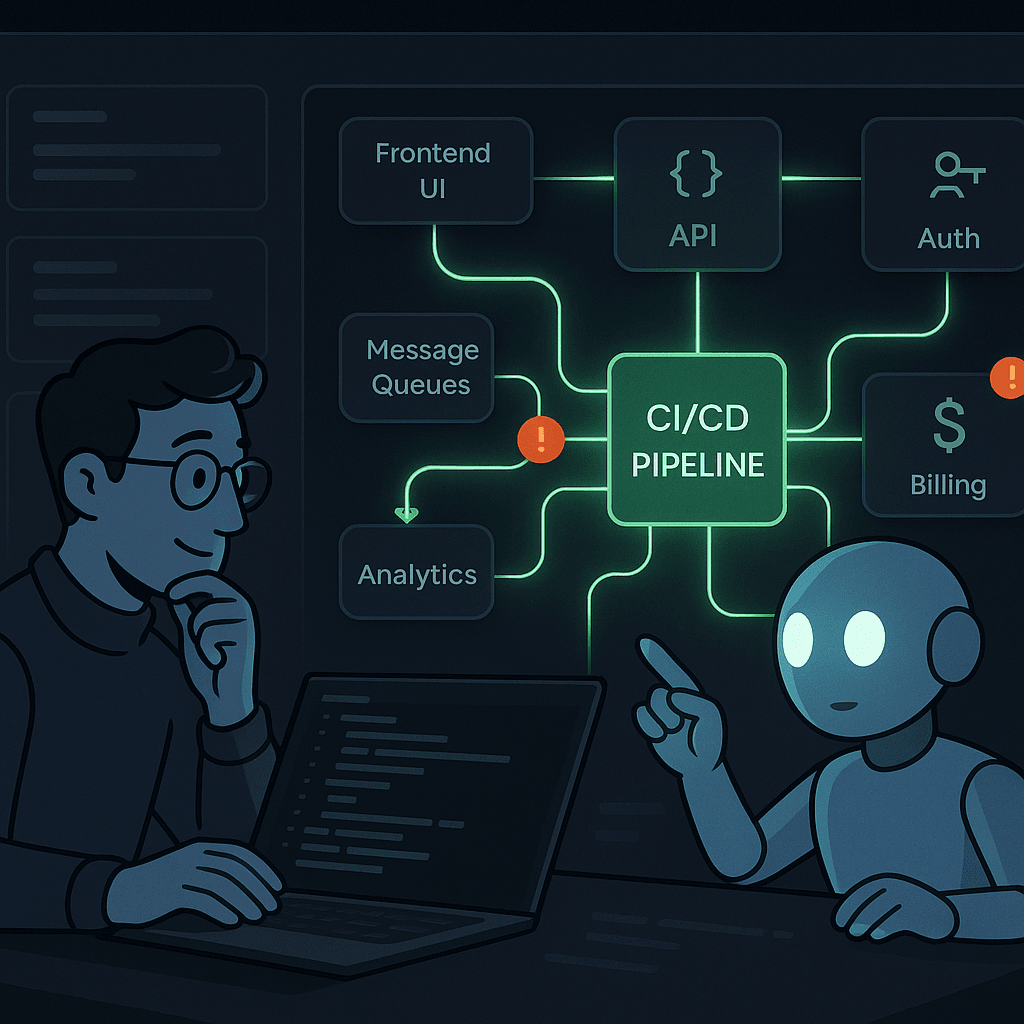
The frontend emitted the event. The API accepted the request. The billing service created a pending subscription. A background worker waited for a webhook that never got processed because the queue consumer had a schema mismatch with a field renamed by an AI-generated refactor. Analytics still recorded the conversion. Support got the first ticket 11 minutes later. Finance found the issue two days later.
This is what modern failure looks like.
It rarely happens inside a single function. It often doesn’t show up in a unit test. It can slip past CI/CD with a perfect green build because every isolated check is technically correct while the user-facing workflow is still broken.
That gap is getting worse as AI writes more code.
AI-assisted development increases output, but it also increases the rate of cross-service change. A developer asks for a feature, the agent updates the React component, adjusts an API handler, modifies a serializer, tweaks an event payload, adds a retry branch, and edits the infrastructure config in one pass. Each individual change may look plausible. The problem is not that AI always writes bad code. The problem is that it often changes more system boundaries than a human would touch manually, and those seams are where your release risk lives.
If your release process still treats passing CI as proof of reliability, you are optimizing for local correctness while users experience distributed failure.
The problem is not broken code. It is broken workflows.
Most production incidents are not caused by one obviously defective line of code. They come from workflow breakage across boundaries:
- A frontend event shape no longer matches what the backend expects.
- An auth token contains a claim that one service depends on and another stopped issuing.
- A queue message version changes but a downstream consumer still parses the old schema.
- A webhook arrives, but idempotency logic suppresses it because a new key format collides with existing data.
- Billing succeeds, but entitlement propagation fails, so the user pays and still cannot access the feature.
- The action completes, but analytics double-count or miss the conversion entirely.
- A third-party API times out differently in production than in mocks, and your retry logic amplifies the failure.
None of these are strange edge cases anymore. They are normal distributed-system failure modes.
Yet many teams still validate changes as if software were mostly a set of independent modules. They run unit tests, maybe some integration tests per service, maybe a QA checklist, and they call it done. That approach was already incomplete. Under AI-assisted development, it becomes actively misleading.
A green build tells you that the checks you wrote passed. It does not tell you that the user journey still works from click to side effect to final state.
That distinction matters.
If a user upgrades a plan, the thing you need confidence in is not “the billing service unit tests passed.” It is “a signed-in user on the current frontend can trigger an upgrade that successfully charges, updates entitlements, records analytics, and reflects the new state in the product within the expected time window.”
That is a workflow assertion, not a code-path assertion.
Why green CI/CD often creates false confidence
CI/CD pipelines are useful. They catch regressions, enforce standards, and shorten feedback loops. But teams routinely assign them a level of authority they do not deserve.
A green pipeline usually proves four things:
- The repository builds.
- The known tests passed in the test environment.
- The code satisfies current static checks.
- The deployment artifact is internally consistent enough to publish.
That is not the same as proving release readiness.
The problem is not CI/CD itself. The problem is the shape of what gets tested in CI/CD.
CI validates components. Users trigger systems.
Most pipelines execute test suites at the service or package level. Frontend tests verify component behavior. Backend tests verify route handlers. Worker tests verify message processing. Infrastructure checks verify templates. These are necessary but local.
The user, however, does not interact with local components. They trigger a chain of behavior across boundaries. The build can stay green while the chain is broken in the middle.
Test environments are usually too clean
CI environments are simplified by design:
- Fake credentials
- Stubbed third-party APIs
- In-memory queues
- Reduced concurrency
- Synthetic seed data
- No production-like latency
- No realistic auth and permission drift
That simplification is often required to keep tests fast and deterministic. But it means the environment strips away exactly the conditions that cause many release failures.
When teams say, “It passed in CI,” they often mean, “It passed in a highly controlled environment where the hardest parts of the workflow were simulated.”
Pipelines optimize for speed, not workflow truth
A modern engineering org wants pull requests merged quickly. So test suites get tuned for speed:
- Heavy use of mocks
- Parallel execution
- Service isolation
- Narrow fixture scopes
- Aggressive test selection
Those choices improve developer productivity, but they also reduce your ability to detect cross-service workflow breakage. Faster feedback is good. False confidence is not.
Success criteria are too shallow
Many checks assert that an API returned 200, an event was emitted, or a database write occurred. But distributed workflows need deeper success criteria:
- Did the downstream consumer process the event?
- Did retries create duplicate effects?
- Did the user-visible state converge?
- Did analytics match the actual business outcome?
- Did side effects happen in the right order?
- Did the action succeed under realistic auth, rate limit, and network conditions?
If your test stops at “request accepted,” it is not verifying the user workflow. It is verifying the first hop.
Why unit tests, isolated integration tests, and QA are not enough
Every mature team already knows unit tests matter. The issue is scope.
Unit tests catch logic regressions, not system behavior
A unit test can verify tax calculation, payload mapping, retry backoff logic, or permission branching. That is valuable. But no set of unit tests can prove that a real browser action eventually creates the right distributed outcome across services.
You can have 95% coverage and still ship a broken upgrade flow.
Coverage is not workflow confidence.
Mock-heavy integration tests hide the seams
Teams often call something an integration test when it integrates one module with a mocked dependency. That is useful for debugging and testing, but it is not true workflow verification.
Mocks are dangerous when they become idealized versions of real systems:
- They always return the expected shape.
- They never introduce latency spikes.
- They do not enforce auth quirks.
- They do not evolve independently.
- They do not replay webhooks oddly.
- They do not emit duplicate messages.
- They do not impose realistic pagination, throttling, or eventual consistency.
A mocked Stripe call proves your code can handle your mock. It does not prove your release can handle the real billing lifecycle.
Manual QA cannot keep up with change volume
Traditional QA can find obvious failures, especially in critical flows. But AI-generated PRs increase the amount and breadth of change. One engineer can produce many more code modifications per day, often spanning multiple repositories or layers.
Manual QA struggles because:
- It is sampled, not exhaustive.
- It usually focuses on visible UI behavior, not hidden side effects.
- It cannot trace every event across queues, workers, and third-party callbacks.
- It does not scale with AI-driven throughput.
- It often runs too late to provide useful feedback before release.
QA still matters, but it cannot be the primary defense against distributed workflow regressions.
AI-generated changes amplify integration drift
This is the part many teams underestimate.
AI-generated code does not just increase output. It changes the failure profile of the codebase.
AI modifies more surfaces per task
A human making a cautious change might update one handler and leave adjacent systems alone. An agent is more likely to “complete the pattern” across the stack:
- Rename a field in the frontend
- Update the API DTO
- Change the ORM model
- Adjust the analytics event
- Touch the worker logic
- Add a fallback branch
- Revise the test fixtures
That broadness can be helpful. It can also introduce integration drift when one dependent surface was missed or updated incorrectly.
AI is locally consistent, not globally reliable
Models are good at producing code that looks internally coherent. They are much worse at understanding the operational truth of your production environment:
- Which queue consumers are lagging behind on schema versions
- Which analytics fields finance actually depends on
- Which third-party webhook ordering assumptions are false in production
- Which auth claims are optional in docs but required by one old service
- Which environment variable naming quirk exists for historical reasons
The code can be elegant and still be wrong in the only way that matters: the workflow breaks after deployment.
AI can overfit to tests that do not represent reality
If your existing suite is mock-heavy and service-local, the agent will optimize for passing that suite. In effect, the tests teach the model what correctness looks like. If the tests only encode isolated correctness, the generated code will often satisfy isolated correctness while drifting from real system behavior.
This is why teams feel surprised after a green build ships a broken flow. The pipeline did exactly what it was designed to do. It just was not designed to verify the thing the user depends on.
The core insight: verify actions, not just components
The practical shift is simple to state and hard to institutionalize:
Before release, verify the real user action and trace it across service boundaries until the final expected outcome is observed.
Not “the frontend called the API.”
Not “the API returned success.”
Not “the event was published.”
Verify the action end to end.
For a paid upgrade flow, that means asserting something like:
- A real browser session for a real test tenant initiates the upgrade.
- Auth is exercised through the real identity path.
- The API accepts and records the request.
- Billing interaction occurs in a production-like environment or controlled real provider sandbox.
- The queue receives and processes downstream messages.
- Entitlements update.
- The user-visible product state reflects access.
- Analytics emits the expected event exactly once.
- The system reaches the expected terminal state within a defined timeout.
That is a workflow verification contract.
It is slower than a unit test and narrower than broad regression suites. That is fine. You do not need thousands of these. You need them for high-value workflows where distributed failure hurts users and the business.
What cross-service workflow verification looks like in practice
The goal is not to replace unit tests or service-level integration tests. The goal is to add a release gate for critical user actions.
A useful pattern has four properties:
- Action-level: starts from a user action, not an internal API call.
- Environment-aware: runs in an environment that preserves real boundaries.
- Traceable: follows correlation IDs or workflow IDs across services.
- Outcome-based: asserts final state, not intermediate success.
Example workflow: plan upgrade
Let’s say your system has:
- React frontend
- Node API gateway
- Python billing worker
- Postgres
- Kafka or SQS queue
- Auth provider
- Analytics pipeline
- Stripe-like billing provider
A user clicks Upgrade to Pro. The release question is not whether each service passes its tests. It is whether this sequence works.
Frontend-triggered verification with Playwright
Here is a simplified Playwright example that starts with the real UI and carries a correlation ID through the workflow.
tsimport { test, expect } from '@playwright/test';
import { randomUUID } from 'crypto';

const BASE_URL = process.env.APP_BASE_URL!;
const API_URL = process.env.INTERNAL_API_URL!;

test('user can upgrade plan across services', async ({ page, request }) => {
  const correlationId = randomUUID();
  const testEmail = `workflow-${Date.now()}@example.com`;

  // Create a test user/tenant through a setup API
  const setup = await request.post(`${API_URL}/test/setup-tenant`, {
    data: {
      email: testEmail,
      plan: 'free',
      correlationId,
    },
  });
  expect(setup.ok()).toBeTruthy();

  // Login through the real auth UI or a production-like test identity flow
  await page.goto(`${BASE_URL}/login`);
  await page.fill('[name=email]', testEmail);
  await page.fill('[name=password]', 'TestPassword123!');
  await page.click('button[type=submit]');

  await expect(page).toHaveURL(/dashboard/);

  // Inject correlation ID so backend/services can trace the workflow
  await page.evaluate((cid) => {
    localStorage.setItem('x-correlation-id', cid);
  }, correlationId);

  await page.goto(`${BASE_URL}/settings/billing`);
  await page.click('button[data-testid="upgrade-pro"]');

  await expect(page.locator('[data-testid="upgrade-success"]')).toBeVisible();

  // Poll internal verification endpoint that checks cross-service convergence
  await expect.poll(async () => {
    const res = await request.get(
      `${API_URL}/test/verify-upgrade-workflow?correlationId=${correlationId}`
    );
    const body = await res.json();
    return body;
  }, {
    timeout: 60_000,
    intervals: [1000, 2000, 5000],
  }).toMatchObject({
    apiAccepted: true,
    billingCustomerUpdated: true,
    billingChargeRecorded: true,
    queueMessageProcessed: true,
    entitlementsUpdated: true,
    analyticsEventEmitted: true,
    analyticsEventCount: 1,
    finalPlan: 'pro',
  });
});
The important part is not the exact tool. It is the shape of the test:
- It starts from the browser.
- It uses a correlation ID.
- It verifies final distributed outcomes.
- It waits for convergence rather than assuming synchronous completion.
Verification endpoint design
Teams often resist workflow checks because they think they need to assert every internal detail from the test runner. That usually leads to brittle tests.
A better pattern is an internal verification endpoint or job that inspects system state and reports workflow completion.
For example, in a Node service:
jsapp.get('/test/verify-upgrade-workflow', async (req, res) => {
  const { correlationId } = req.query;

  const apiRequest = await db('upgrade_requests')
    .where({ correlation_id: correlationId })
    .first();

  const entitlement = await db('entitlements')
    .where({ correlation_id: correlationId, feature: 'pro_access' })
    .first();

  const analyticsEvents = await analyticsStore.count({
    correlationId,
    eventName: 'plan_upgraded',
  });

  const billingRecord = await billingDb('subscriptions')
    .where({ correlation_id: correlationId, status: 'active' })
    .first();

  const queueProcessing = await db('workflow_audit')
    .where({ correlation_id: correlationId, stage: 'billing_webhook_processed' })
    .first();

  res.json({
    apiAccepted: !!apiRequest,
    billingCustomerUpdated: !!billingRecord,
    billingChargeRecorded: !!billingRecord,
    queueMessageProcessed: !!queueProcessing,
    entitlementsUpdated: !!entitlement,
    analyticsEventEmitted: analyticsEvents > 0,
    analyticsEventCount: analyticsEvents,
    finalPlan: entitlement ? 'pro' : 'free',
  });
});
In production you may not expose this directly, but the pattern matters: make workflows observable and queryable.
Worker-side audit hooks in Python
If your async processing lives in Python, emit workflow audit signals as side effects complete.
pythonfrom datetime import datetime

def process_billing_webhook(event, db, audit_store):
    correlation_id = event["metadata"].get("correlation_id")

    subscription_id = event["data"]["subscription_id"]
    tenant_id = event["data"]["tenant_id"]

    activate_subscription(db, tenant_id, subscription_id)
    grant_entitlements(db, tenant_id, ["pro_access"])

    audit_store.record({
        "correlation_id": correlation_id,
        "stage": "billing_webhook_processed",
        "timestamp": datetime.utcnow().isoformat(),
        "tenant_id": tenant_id,
        "subscription_id": subscription_id,
    })
This is not just for testing. It improves debugging in production too. A workflow audit trail makes it obvious where execution stopped.
Why tracing and correlation IDs are non-negotiable
Without correlation, cross-service verification becomes guesswork.
If a user action touches frontend logs, gateway requests, queue messages, worker jobs, billing records, and analytics events, you need a stable identifier that follows the action.
That can be:
x-correlation-idworkflow_id- Distributed tracing headers like
traceparent - A synthetic test run ID attached to metadata
The exact format matters less than consistency.
With correlation IDs, you can:
- Debug failures quickly
- Verify convergence in release environments
- Distinguish duplicate processing from missing processing
- Build workflow dashboards
- Alert on partial completion states
Without them, “the test failed” turns into hours of log archaeology.
CI/CD should gate on workflow verification for critical paths
This does not mean every PR must run every full-system check. That would be expensive and slow. It means the release path for critical workflows needs a second layer of confidence beyond code-local tests.
A practical approach is tiered verification.
Tier 1: fast PR checks
Run on every PR:
- Lint
- Type checking
- Unit tests
- Service-level integration tests
- Contract/schema tests
- Static analysis
These protect developer productivity and catch obvious regressions quickly.
Tier 2: targeted workflow checks
Run when relevant code changes, on merge to main, or before release candidate promotion:
- Browser-driven workflow tests
- Real queue and worker processing
- Real auth path
- Third-party sandbox interactions where possible
- Final state verification across services
This is where you catch “green build, broken release” problems.
Tier 3: post-deploy canary verification
After deploying to a staging or canary environment:
- Execute synthetic user workflows
- Trace them across services
- Block full rollout if convergence fails
This is especially important if environment drift exists between CI and runtime.
Example GitHub Actions workflow
Here is a simplified CI/CD split:
yamlname: ci

on:
  pull_request:
  push:
    branches: [main]

jobs:
  fast-checks:
    runs-on: ubuntu-latest
    steps:
      - uses: actions/checkout@v4
      - uses: actions/setup-node@v4
        with:
          node-version: 20
      - run: npm ci
      - run: npm run lint
      - run: npm run typecheck
      - run: npm test

  workflow-verification:
    if: github.event_name == 'push' && github.ref == 'refs/heads/main'
    runs-on: ubuntu-latest
    needs: fast-checks
    steps:
      - uses: actions/checkout@v4
      - uses: actions/setup-node@v4
        with:
          node-version: 20
      - run: npm ci
      - run: npx playwright install --with-deps
      - run: npm run verify:critical-workflows
        env:
          APP_BASE_URL: ${{ secrets.STAGING_APP_BASE_URL }}
          INTERNAL_API_URL: ${{ secrets.STAGING_INTERNAL_API_URL }}

  deploy-canary:
    if: github.event_name == 'push' && github.ref == 'refs/heads/main'
    runs-on: ubuntu-latest
    needs: workflow-verification
    steps:
      - run: ./scripts/deploy-canary.sh

  canary-smoke-workflows:
    if: github.event_name == 'push' && github.ref == 'refs/heads/main'
    runs-on: ubuntu-latest
    needs: deploy-canary
    steps:
      - uses: actions/checkout@v4
      - run: npm ci
      - run: npm run verify:canary-workflows
        env:
          APP_BASE_URL: ${{ secrets.CANARY_APP_BASE_URL }}
          INTERNAL_API_URL: ${{ secrets.CANARY_INTERNAL_API_URL }}
The release gate is no longer “tests passed.” It becomes “critical workflows converged in a real environment.”
Tools comparison: what each category gives you and what it misses
There is no single tool that solves this. You need to understand tradeoffs.
Unit test frameworks: Jest, Vitest, Pytest
Good for:
- Business logic correctness
- Fast feedback
- Isolated debugging
- Refactoring safety
Weak for:
- Cross-service behavior
- Async workflow convergence
- Environment-specific failure modes
Use these heavily, but do not confuse them with release verification.
API/integration tools: Supertest, REST Assured, service test harnesses
Good for:
- Route and handler behavior
- Contract validation
- Database interactions per service
- Faster integration feedback than browser tests
Weak for:
- Real user entry points
- Multi-hop distributed verification
- Browser/auth/session behavior
Useful middle layer, but still incomplete for critical workflows.
Browser automation: Playwright, Cypress
Good for:
- Real user actions
- UI plus network behavior
- Auth/session validation
- Entry-point realism
Weak for:
- Internal state introspection unless you build it
- Observing async downstream completion without extra instrumentation
Playwright is particularly strong for release verification because it works well as a programmable user agent and supports good debugging artifacts.
Observability/tracing: OpenTelemetry, Datadog, Honeycomb, Grafana Tempo
Good for:
- Correlating workflow spans
- Finding where distributed actions fail
- Production debugging
- Building verification dashboards
Weak for:
- They observe; they do not define correctness by themselves
These tools become far more valuable when tied to explicit workflow assertions.
Synthetic monitoring/check platforms
Good for:
- Repeated post-deploy verification
- Environment-aware checks
- Catching regressions after infrastructure or dependency changes
Weak for:
- Often shallow unless connected to backend state verification
- May stop at UI-level success
Strong complement to CI/CD gates, not a replacement.
Actionable practices teams can implement now
You do not need a six-month reliability program to start fixing this. A few disciplined changes go a long way.
1. Define your top 5 critical user workflows
Do not start with broad regression ambition. Start with business-critical actions:
- Sign up
- Login
- Upgrade plan
- Invite teammate
- Complete checkout
- Submit order
- Export report
Write each workflow as a terminal outcome, not just an interaction.
Bad:
- “User can click upgrade button”
Good:
- “Free user upgrades to Pro, billing activates, entitlements propagate, and product access updates within 60 seconds.”
2. Add correlation IDs to every critical path
If you cannot trace an action across services, you cannot verify or debug it efficiently. Make correlation part of your platform, not an ad hoc test hack.
3. Build workflow audit checkpoints
Record meaningful stage transitions:
- request_received
- payment_session_created
- webhook_received
- webhook_processed
- entitlement_granted
- analytics_emitted
- user_state_updated
These checkpoints support both testing and production debugging.
4. Replace some mocks with controlled real dependencies
Especially for critical workflows, prefer:
- Real queues
- Real auth flows
- Provider sandboxes
- Production-like databases
Keep fast mocked tests for developer velocity, but do not let them be the final release signal.
5. Assert final state, not just intermediate acknowledgments
A 200 OK is not success if the user cannot use the feature afterward.
For each workflow, define:
- Start condition
- Expected side effects
- Terminal user-visible state
- Acceptable convergence time
- Idempotency expectations
6. Run workflow verification based on change impact
You do not need every workflow on every PR. Trigger them when relevant areas change:
- Billing code changed → run upgrade/checkout workflows
- Auth code changed → run login/invite/access workflows
- Event schema changed → run downstream workflow set
- Analytics instrumentation changed → run conversion verification workflows
This keeps cost manageable while preserving reliability.
7. Add canary workflow gates before full rollout
A merge-to-main green build should not imply full production confidence. Run synthetic cross-service workflows in canary and block rollout if they fail.
8. Treat workflow failures as first-class debugging signals
When a workflow verification test fails, the output should help engineers answer:
- Which stage did the workflow reach?
- Which service boundary failed?
- Was the failure deterministic or timeout-based?
- Did the user-visible state diverge from backend state?
- Were side effects duplicated, missing, or delayed?
This is where good debugging design meets good testing design.
9. Keep the suite small and consequential
The answer is not to create 500 flaky end-to-end tests. That just recreates the same trust problem in a different layer.
Maintain a compact suite of high-value workflow verifications that map directly to real business risk.
10. Measure false-green rate
Track incidents or escaped defects where:
- PR passed all checks
- Release deployed
- Critical workflow failed
If that number is nontrivial, your current CI/CD model is overstating confidence.
Common objections, and why they are usually wrong
“These tests are too slow.”
Yes, they are slower than unit tests. That is not a compelling argument against using them as release gates for critical workflows. The cost of shipping a broken billing, auth, or signup path is usually much higher than a few extra minutes in release verification.
“End-to-end tests are flaky.”
Many are flaky because they assert superficial UI conditions without controlling data, traceability, or final state. Workflow verification is more reliable when it is built around deterministic setup, correlation IDs, explicit convergence checks, and environment-aware assertions.
“We already have observability.”
Observability helps you inspect failures. It does not guarantee you executed a known-good workflow before release. You need both.
“We have contract tests.”
Contract tests are useful for API compatibility. They do not prove that a full user action reaches the correct terminal business outcome across queues, workers, and external systems.
“Our QA team covers this.”
QA can catch some of it, but manual verification does not scale to the volume and spread of AI-assisted change. Also, most hidden side effects are invisible without deliberate instrumentation.
The real shift: from code coverage to workflow confidence
Engineering teams often talk about quality in terms of code coverage, test counts, or pipeline status. Those are process metrics. Users experience outcome quality.
The release question is not:
- Did enough tests pass?
The release question is:
- Will the most important user actions still work across the real system we are about to ship?
That is a different standard. It requires different instrumentation, different debugging habits, and different CI/CD gates.
The good news is that this is achievable without slowing the organization to a crawl. Keep fast local tests. Keep unit coverage high. Keep service contracts healthy. But stop pretending those checks alone represent release truth.
As AI-generated code becomes normal, the number of cross-boundary changes per PR will keep rising. That means the seams matter more, not less. The organizations that adapt will treat workflow verification as a core part of shipping software, especially in areas tied to money, access, identity, and irreversible side effects.
Conclusion
The green build trap is simple: your pipeline reports local success while the user experiences distributed failure.
AI PRs make this more dangerous because they accelerate change across service boundaries, where most modern incidents actually happen. Mock-heavy testing, isolated integration checks, and manual QA all have value, but none of them reliably prove that a real user action still works from start to finish before release.
If you want real reliability, verify workflows, not just code paths.
Start small. Pick a few critical actions. Run them in a production-like environment. Trace them with correlation IDs. Assert final outcomes across services. Gate release on convergence, not optimism.
That is how you turn testing from ceremony into actual release confidence. And it is how you improve developer productivity without letting CI/CD green lights fool the team into shipping broken behavior.