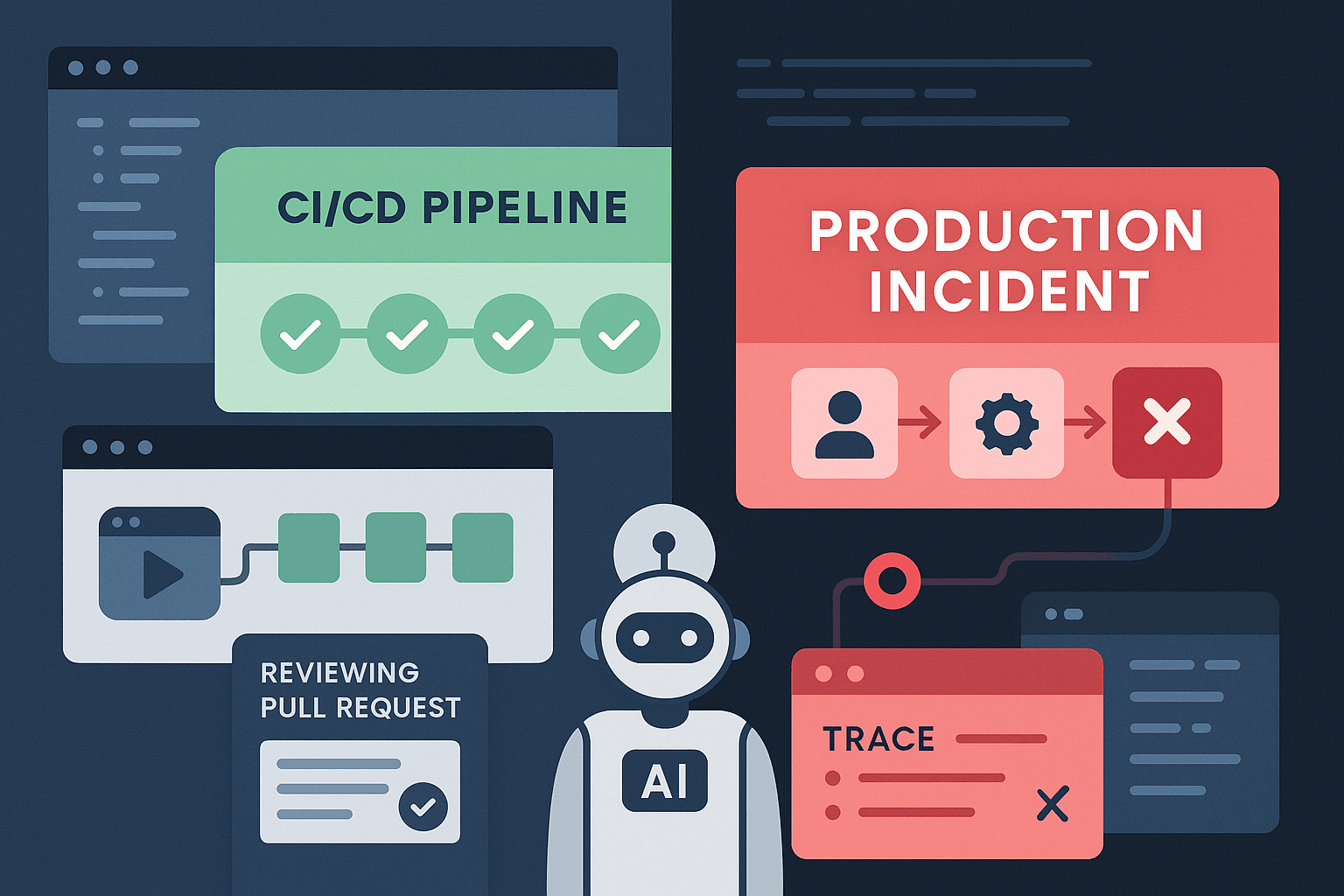
A team ships a harmless-looking pull request on a Thursday afternoon. CI is green. Unit tests are green. Linting is green. The staging link works. A reviewer clicks through the changed page, sees the updated button, approves, and merges.
Thirty minutes later, sales can’t create quotes.
Nothing crashed in the obvious way. The app loads. The new UI renders. Authentication works. But the real workflow is broken: create customer, attach pricing plan, generate quote, confirm tax calculation, submit for approval. One handler changed shape, one selector drifted, one background dependency returned a slightly different payload, and one optimistic UI state hid the failure until the final step. The pull request passed every check because none of those checks replayed what a user actually does.
This is the uncomfortable truth behind a lot of modern debugging and testing work: most PR validation proves your code changed consistently, not that your product still works. And as AI-assisted teams generate more code, touch more files, and move faster than humans can deeply review, that gap gets wider. Agents can refactor a handler, rename an event, update a schema, and rewrite a selector in one pass. Your CI/CD system will happily report success if the tests still match the assumptions baked into the repo. Production will not care.
The problem is not that unit tests are useless. The problem is that we’ve confused local correctness with operational reality. We validate code paths. Users execute workflows. Those are not the same thing.
The green build illusion
Most engineering teams have built their delivery confidence around the pull request. A PR has become the unit of trust. If checks pass, reviewers approve, and staging looks fine, the change feels safe.
That model worked better when systems were simpler, release velocity was lower, and humans wrote and reviewed most changes line by line. It works much worse when applications are assembled from frontend frameworks, API gateways, queues, feature flags, managed auth, third-party billing, analytics scripts, and internal services evolving at different speeds.
A modern PR pipeline usually answers questions like these:
- Does the code compile?
- Do unit tests pass?
- Do static checks pass?
- Does the changed component render?
- Did the API contract test still match a mock?
- Can we deploy this branch to a preview environment?
Those are useful questions. They are not the same as:
- Can a customer complete checkout?
- Can an admin approve a refund?
- Can a support rep escalate a ticket?
- Can a salesperson convert a lead into a signed order?
- Can a user recover from a failed payment and still finish onboarding?
The second set is what the business actually depends on.
This is why teams get surprised by incidents that feel impossible in retrospect. “How did this pass staging?” Because staging validated deployability, not behavioral reality. “How did CI miss this?” Because CI tested functions and fragments, not the sequence of actions that make up a business workflow.
PR checks validate diffs, not outcomes
Most CI/CD systems are optimized around the code diff. That is rational: the diff is small, reviewable, and tied to ownership. But production failures rarely respect diff boundaries.
A business workflow crosses files, services, state transitions, retries, async jobs, browser behavior, permissions, and timing. A PR might only touch one of those. The incident appears when all of them interact.
Imagine a change like this:
- Frontend updates a button selector from
data-testid="submit-order"todata-testid="confirm-order" - Backend changes the order submission endpoint to return
202 Acceptedinstead of200 OK - A worker queue now processes inventory checks asynchronously
- A feature flag changes the confirmation modal only for enterprise accounts
- A retry path logs the error but keeps the UI in a pending state
Each change may be individually valid. Each may even be tested. But the workflow “enterprise customer places order with low inventory and receives confirmation” may now be broken end to end.
Traditional PR checks won’t catch this unless a test explicitly replays that scenario.
That matters even more in AI-assisted teams. When a coding agent updates multiple layers at once, reviewers tend to validate intent at a high level. They ask, “Does this implementation make sense?” rather than “What user journey did we prove still works?” The volume and speed of changes pushes teams toward coarse confidence signals. Green CI becomes a psychological substitute for truth.
It is not truth.
Why staging creates false confidence
Staging has value. The problem is the mythology around it.
Teams often talk about staging as if it were a faithful rehearsal of production. In practice, staging is usually a partial simulation with enough differences to hide exactly the failures you care about.
Here’s how staging lies.
1. Environment drift
Your staging environment is almost never production in miniature. It differs in configuration, traffic shape, seeded data, auth providers, queue depth, caching behavior, feature flags, rate limits, and third-party credentials.
Common examples:
- Different webhook endpoints
- Smaller databases with unrealistically clean data
- Disabled retries or background jobs
- Shared test accounts with broad permissions
- Missing integrations for billing, fraud, tax, or identity
- Different CDN and caching rules
- Lower concurrency and no realistic contention
A workflow that passes in staging may fail in production because production is not just “the same app with more users.” It is a different operating condition.
2. Mocked dependencies hide integration failures
Staging often depends on mocks, stubs, or sandbox accounts for external services. That makes testing easier, but it also strips away failure modes that shape real workflows.
A payment sandbox may approve transactions the real processor would challenge. A mocked tax service may always return instantly. A fake email provider may never rate-limit. A stubbed identity service may not enforce edge-case validation.
If the business workflow depends on those behaviors, your staging pass is incomplete by definition.
3. Preview environments validate pages, not sequences
Preview deployments are great for visual review and isolated verification. But they’re usually exercised in the shallowest way possible: click page, inspect component, maybe submit a happy-path form.
That’s not enough.
Many production failures only emerge after a chain of stateful actions:
- Sign in as the right role
- Create a record with specific attributes
- Trigger an async process
- Wait for a status transition
- Navigate to another page
- Perform a second dependent action
- Observe a result derived from both frontend and backend state
A preview environment rarely gets tested that deeply for every PR, especially under delivery pressure.
4. Humans don’t replay edge timing consistently
Manual QA in staging is valuable, but humans are inconsistent at reproducing exact action sequences, timing windows, and state combinations. They skip steps. They unconsciously adapt to UI changes. They know where the app “should” work and steer around failure.
Automation is not valuable because humans are lazy. It is valuable because real workflows are precise, repeatable, and brittle in ways humans don’t systematically verify.
Why unit tests, integration tests, and QA still miss workflow breakage
Every team says some version of: “But we already have tests.” Usually they do. The issue is where those tests sit relative to user reality.
Unit tests prove local behavior
Unit tests answer: given this function, component, reducer, serializer, or class, does it behave as expected?
Great. Keep them.
But a passing unit test suite says almost nothing about whether a user can complete a workflow spanning browser interactions, API boundaries, async jobs, auth context, and side effects.
A submit handler can be perfectly tested while the form is disconnected from the real backend response shape. A pricing function can be correct while the workflow fails because the tax estimate never persists. A button component can render while the wrong role no longer sees it.
Integration tests often stop at service boundaries
Integration tests are better, but many teams define them narrowly. They test service-to-service calls, API routes against a database, or UI components against mocked APIs.
That catches more than unit tests, but still may not cover the lived sequence of user actions.
The phrase to watch for is “with mocks.” Mocks are useful. They are also how teams accidentally test their assumptions instead of their product.
Manual QA doesn’t scale to change volume
Manual QA can catch issues no automated suite anticipated. But in high-change environments, especially with AI-generated code, the number of potentially affected workflows grows faster than humans can reliably exercise.
If an agent can modify ten files across frontend and backend in minutes, the burden on reviewers and QA goes up immediately. Without automated replay of critical workflows, teams either slow down dramatically or accept growing blind spots.
Most choose the blind spots, then call the outcome “unexpected production issues.”
The core insight: reliability lives at the action level
The missing layer in most CI/CD pipelines is action-level verification.
Not “did this function return the expected value?”
Not “did this route respond with 200?”
Not “did the component render correctly?”
But: did the application still support the sequence of actions a user takes to accomplish a business outcome?
That is the level where reliability actually matters.
A user does not care that your reducer passed. They care that they could submit payroll. A customer does not care that the API contract matched a mock. They care that checkout completed. A support agent does not care that the page loaded. They care that they could issue the refund.
Action-level verification means encoding those workflows into repeatable tests that run before merge, against environments and dependencies realistic enough to expose breakage.
This is where browser automation tools like Playwright become important. Not because browser tests are fashionable, but because the browser is where user workflows become observable, replayable, and enforceable.
What action-level PR verification looks like
A strong PR verification system should answer a different question:
“If we merged this right now, would our critical user workflows still work?”
That requires a few practical shifts.
Identify business-critical workflows
Start with the journeys that directly affect revenue, operations, compliance, or support load.
Examples:
- User signs up and completes onboarding
- Customer adds items and finishes checkout
- Admin reviews and approves a refund
- Sales rep creates and sends a quote
- Subscriber updates payment method after failure
- Support agent escalates a case and notifies customer
These are not broad “test everything” ambitions. They are a shortlist of workflows the business cannot tolerate breaking.
Encode them as executable sequences
Write tests that perform the real actions in order. Use realistic roles, data setup, assertions, and waits around actual state transitions.
Example in Playwright:
tsimport { test, expect } from '@playwright/test';

test('enterprise admin can create and approve a quote', async ({ page }) => {
  await page.goto('/login');
  await page.fill('[name="email"]', 'enterprise-admin@example.com');
  await page.fill('[name="password"]', process.env.E2E_PASSWORD!);
  await page.click('button[type="submit"]');

  await expect(page).toHaveURL(/dashboard/);

  await page.goto('/customers/new');
  await page.fill('[name="companyName"]', 'Acme Logistics');
  await page.selectOption('[name="plan"]', 'enterprise');
  await page.click('[data-testid="create-customer"]');

  await expect(page.locator('[data-testid="customer-status"]')).toHaveText('Active');

  await page.click('[data-testid="generate-quote"]');
  await page.fill('[name="seats"]', '250');
  await page.click('[data-testid="request-tax-calculation"]');

  await expect(page.locator('[data-testid="tax-status"]')).toHaveText('Calculated');

  await page.click('[data-testid="submit-for-approval"]');
  await expect(page.locator('[data-testid="quote-status"]')).toHaveText('Pending Approval');

  await page.click('[data-testid="approve-quote"]');
  await expect(page.locator('[data-testid="quote-status"]')).toHaveText('Approved');
});
This test is not checking a component. It is checking whether a real business task still completes.
Validate observable outcomes, not implementation details
Avoid tests coupled to internal functions or brittle UI details where possible. Assert outcomes the user or business cares about.
Bad assertion:
tsawait expect(response.status()).toBe(200);
Better assertion:
tsawait expect(page.locator('[data-testid="quote-status"]')).toHaveText('Approved');
Best often combines both visible state and backend side effects.
Use backend verification where it matters
For critical workflows, verify that the action not only looked successful but also persisted correctly.
Example with API verification in Playwright:
tstest('checkout creates a paid order', async ({ page, request }) => {
  await page.goto('/cart');
  await page.click('[data-testid="checkout"]');
  await page.fill('[name="cardNumber"]', '4242424242424242');
  await page.fill('[name="expiry"]', '12/28');
  await page.fill('[name="cvc"]', '123');
  await page.click('[data-testid="pay-now"]');

  await expect(page.locator('[data-testid="order-confirmation"]')).toBeVisible();

  const orderId = await page.locator('[data-testid="order-id"]').textContent();
  const response = await request.get(`/api/internal/orders/${orderId}`);
  const order = await response.json();

  expect(order.status).toBe('paid');
  expect(order.fulfillmentState).toBe('queued');
});
That catches cases where the UI reports success while the system state is wrong.
A realistic JavaScript workflow test setup
Here’s a practical Playwright config for PR verification:
tsimport { defineConfig } from '@playwright/test';

export default defineConfig({
  testDir: './e2e',
  timeout: 60_000,
  retries: process.env.CI ? 1 : 0,
  use: {
    baseURL: process.env.BASE_URL || 'http://localhost:3000',
    trace: 'on-first-retry',
    screenshot: 'only-on-failure',
    video: 'retain-on-failure',
    headless: true,
  },
  projects: [
    {
      name: 'chromium',
      use: { browserName: 'chromium' },
    },
  ],
  webServer: {
    command: 'npm run start:test',
    url: 'http://localhost:3000',
    reuseExistingServer: !process.env.CI,
    timeout: 120_000,
  },
});
The important part is not the syntax. It’s the intent:
- run against something close to the deployed app
- capture traces for debugging
- keep artifacts when failures happen
- make failures diagnosable, not just red
Developer productivity depends on this. Teams tolerate flaky or opaque E2E suites for a while, then stop trusting them. The answer is not to remove workflow testing. The answer is to make failures actionable.
A Python example for backend workflow seeding
End-to-end testing often requires deterministic setup. Python is commonly used for test fixtures, admin scripts, or internal tooling.
Here’s a simple backend seed helper using FastAPI-style admin endpoints:
pythonimport os
import requests

BASE_URL = os.getenv("ADMIN_API_URL", "http://localhost:8000")
TOKEN = os.getenv("ADMIN_API_TOKEN")

headers = {
    "Authorization": f"Bearer {TOKEN}",
    "Content-Type": "application/json",
}


def create_enterprise_customer(name: str):
    payload = {
        "company_name": name,
        "plan": "enterprise",
        "billing_country": "US",
        "seats": 250,
    }
    response = requests.post(
        f"{BASE_URL}/test-support/customers",
        json=payload,
        headers=headers,
        timeout=30,
    )
    response.raise_for_status()
    return response.json()


def approve_quote(quote_id: str):
    response = requests.post(
        f"{BASE_URL}/test-support/quotes/{quote_id}/approve",
        headers=headers,
        timeout=30,
    )
    response.raise_for_status()
    return response.json()


if __name__ == "__main__":
    customer = create_enterprise_customer("Acme Logistics")
    print("Created customer", customer["id"])
This kind of support tooling reduces brittleness. Good workflow testing is not just browser scripting. It is controlled data setup, cleanup, and observability.
CI/CD example: gate merges on critical workflow replay
A GitHub Actions workflow might look like this:
yamlname: pr-verification

on:
  pull_request:
    branches: [main]

jobs:
  unit-and-lint:
    runs-on: ubuntu-latest
    steps:
      - uses: actions/checkout@v4
      - uses: actions/setup-node@v4
        with:
          node-version: 20
      - run: npm ci
      - run: npm run lint
      - run: npm run test:unit

  critical-workflows:
    runs-on: ubuntu-latest
    needs: unit-and-lint
    steps:
      - uses: actions/checkout@v4
      - uses: actions/setup-node@v4
        with:
          node-version: 20
      - run: npm ci
      - run: npx playwright install --with-deps
      - run: npm run db:migrate:test
      - run: npm run test:e2e:critical
        env:
          BASE_URL: ${{ secrets.PR_PREVIEW_URL }}
          E2E_PASSWORD: ${{ secrets.E2E_PASSWORD }}
      - uses: actions/upload-artifact@v4
        if: failure()
        with:
          name: playwright-artifacts
          path: |
            playwright-report/
            test-results/
This still won’t catch everything. But it changes the merge contract from “the diff seems valid” to “the critical business workflows still execute.” That is a much stronger signal.
What makes workflow verification effective instead of miserable
Plenty of teams hear “more E2E tests” and immediately think “flaky, slow, impossible.” That reaction is understandable because many browser suites are badly designed.
Workflow verification only works if you treat it like production infrastructure, not a side project.
Keep the suite narrow and high-value
Do not automate every path in the product before merge. That creates noise and drag.
Instead, maintain a short set of merge-blocking critical workflows. Think of them as revenue and operations guards.
Examples:
- signup
- checkout
- core admin approval flow
- account recovery
- billing update
Everything else can run in broader nightly or post-merge coverage.
Invest in test data control
A huge percentage of E2E pain comes from bad data setup. If tests depend on shared records, old state, or manual reset, they will become flaky and expensive to debug.
Use factories, seed APIs, isolated accounts, or ephemeral environments wherever possible.
Eliminate arbitrary waits
This is one of the most important testing practices for stability.
Bad:
tsawait page.waitForTimeout(5000);
Better:
tsawait expect(page.locator('[data-testid="tax-status"]')).toHaveText('Calculated');
Wait on observable system state, not guessed timing.
Make failures debuggable
If a workflow test fails in CI/CD, the engineer should be able to answer why quickly.
Use:
- browser traces
- screenshots
- console logs
- network logs
- server correlation IDs
- test step annotations
A failing workflow test that cannot be debugged will be ignored. A failing workflow test with replayable evidence becomes a productivity tool.
Tag tests by business criticality
A simple pattern:
critical: blocks mergeextended: runs on main or nightlyexperimental: runs manually or on demand
That preserves fast PR cycles without abandoning meaningful verification.
Tools comparison: where each layer fits
No single testing tool solves this. The point is to use each layer for what it is good at.
Unit testing frameworks: Jest, Vitest, Pytest
Best for:
- business logic
- helpers
- parsers
- validation
- state transitions in isolation
Strengths:
- fast
- cheap to run
- precise failures
- good developer productivity during implementation
Weaknesses:
- poor representation of user reality
- no confidence in cross-system workflows
Verdict: essential but insufficient.
Integration testing frameworks
Best for:
- API/database interactions
- service contracts
- repository layers
- event publishing and consumption in constrained scenarios
Strengths:
- catches more realistic failures than unit tests
- valuable for backend correctness
Weaknesses:
- often relies on mocks or controlled assumptions
- rarely covers user action sequences end to end
Verdict: useful middle layer, still not enough on its own.
Browser automation: Playwright, Cypress
Best for:
- user workflows
- UI plus backend state verification
- pre-merge action replay
- debugging production-like failures
Strengths of Playwright in particular:
- strong cross-browser support
- built-in tracing
- robust waiting model
- API testing support alongside browser actions
- good fit for CI/CD artifacts and debugging
Weaknesses:
- slower than lower-level tests
- requires disciplined data setup
- can become brittle if over-scoped
Verdict: the right layer for action-level PR verification.
Manual QA
Best for:
- exploratory testing
- visual nuance
- odd edge cases
- validating new concepts before they are automated
Strengths:
- intuition
- flexibility
- catches the unmodeled
Weaknesses:
- inconsistent
- not scalable for every PR
- weak as a merge gate in high-volume delivery
Verdict: important complement, not primary proof.
Practical adoption plan for teams
If your current pipeline mostly relies on unit tests and staging clicks, do not try to revolutionize everything in one quarter. Start with the breakage that hurts most.
Step 1: audit recent incidents
Look at your last ten production issues. Ask:
- Which ones would unit tests never catch?
- Which ones involved multi-step user behavior?
- Which ones passed staging?
- Which ones involved environment drift or mocked assumptions?
You will probably find patterns quickly.
Step 2: define five critical workflows
Pick the workflows where breakage is most expensive. Not the most common. The most costly.
Step 3: automate replay before merge
Implement those five as stable, deterministic Playwright tests. Add them as a required PR check.
Step 4: add observability for debugging
Store traces, screenshots, logs, and relevant backend state. Treat this as part of the testing product.
Step 5: reduce staging-specific assumptions
Move away from unrealistic mocks for the workflows that matter most. Use production-like dependencies or carefully instrumented test doubles that preserve real behavior.
Step 6: review PRs in workflow terms
Change code review culture. Ask:
- Which workflow could this break?
- What action sequence proves it still works?
- Is that replayed automatically?
This is a much better review lens than staring harder at the diff.
AI-assisted development makes this urgent, not optional
AI coding tools amplify both output and surface area.
That is not inherently bad. They are useful. But they produce a lot of code that is locally plausible and globally unverified. They can modify handlers, selectors, validations, event names, schema shapes, and retry logic quickly. Humans reviewing those changes often focus on whether the code looks coherent.
The failure mode is subtle: every local change appears reasonable, but the workflow spanning them no longer holds.
In other words, AI increases the need for testing systems that validate behavior instead of implementation fragments.
If your organization is increasing code throughput without increasing action-level verification, you are not going faster. You are borrowing reliability from the future.
That debt gets paid during incidents, rollback drills, support escalations, and debugging sessions nobody wanted.
What to stop doing
A few blunt recommendations.
Stop treating a green unit suite as proof that the app works.
Stop calling staging “production-like” if it does not exercise the real dependencies and workflow state.
Stop writing E2E tests that verify page load and one click, then declaring coverage.
Stop relying on humans to remember the exact business-critical action sequences for every PR.
Stop measuring testing health by the number of tests. Measure whether the workflows that matter are protected.
What to start doing
Start defining merge confidence in terms of user outcomes.
Start building a thin, high-signal layer of workflow replay in CI/CD.
Start debugging incidents by asking which user action sequence failed, then encode that sequence as a regression test.
Start aligning developer productivity with reliability. The goal is not more gates. It is better gates.
A good workflow verification system does something powerful: it lets teams move quickly without pretending that local code correctness equals product correctness.
Conclusion
“Staging passed” is one of the most dangerous sentences in software delivery because it often means almost nothing about whether the business still works.
Your PR checks probably validate diffs, syntax, contracts, and isolated logic. That is necessary. It is not sufficient. Production failures happen when real user sequences cross boundaries your tests never replayed.
That gap is getting worse, not better. AI-assisted development increases change volume, cross-layer edits, and reviewer abstraction. Green CI/CD signals become easier to produce and easier to trust for the wrong reasons.
The fix is not more ceremony. It is more reality.
Take the workflows your business depends on. Encode them as executable user actions. Run them before merge. Make failures easy to debug. Use staging and preview environments as substrates for replay, not as symbolic reassurance.
If a pull request never replays reality, a green checkmark is just a polite guess.