
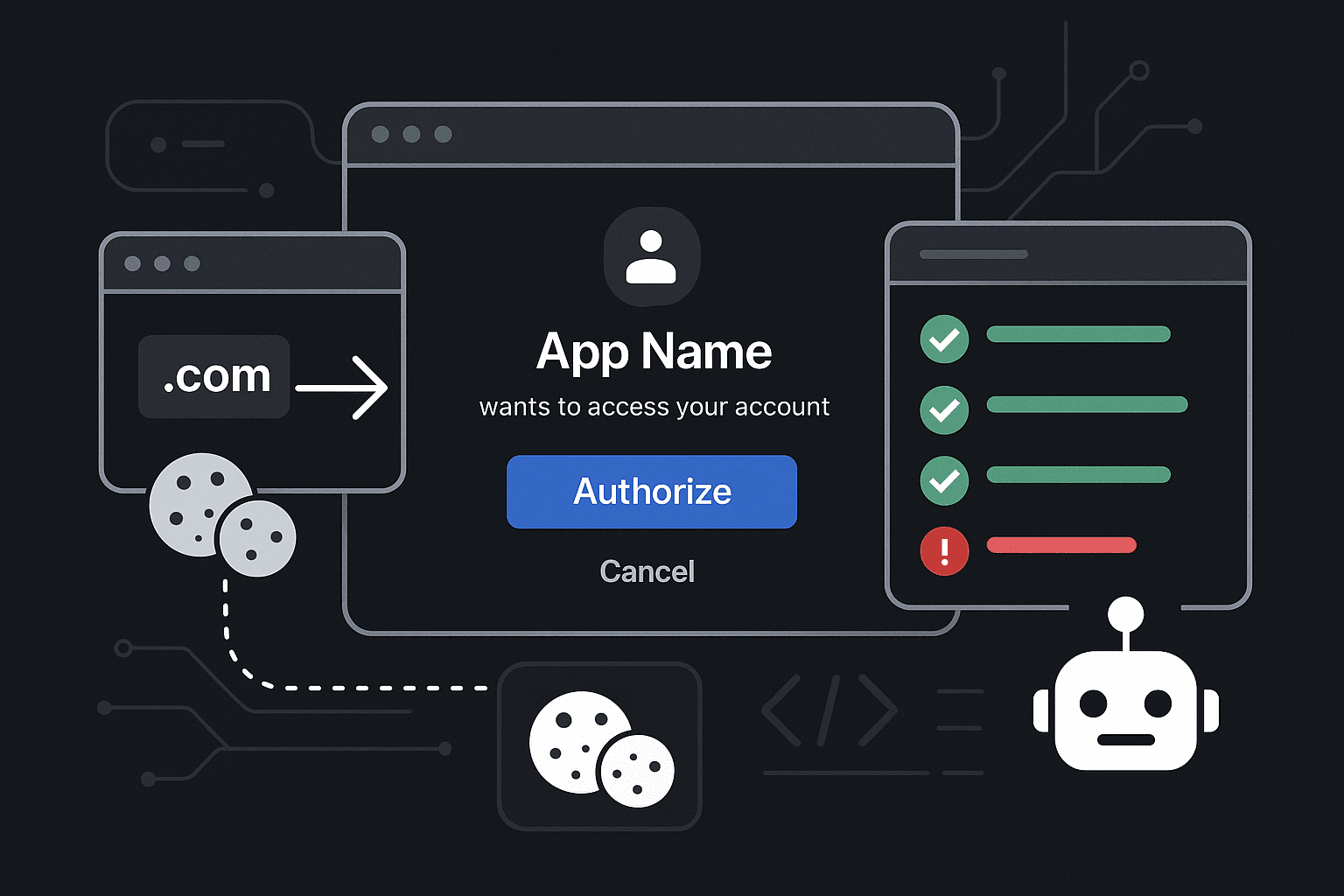
A deploy can be green across every environment that matters to engineering and still fail at the only moment the business cares about: when a real user clicks “Sign in with Google” and gets bounced into a broken redirect loop.
That is not a theoretical edge case. It is one of the most common classes of “everything passed, production is broken” failures in modern software delivery. The pattern repeats across startups and large teams alike: unit tests are healthy, integration tests are healthy, PR checks are fast, staging looked fine in a demo, and then production authentication fails because the cookie domain changed, the callback URL was mis-registered, a consent screen behaves differently for an unapproved scope, Safari blocks a cross-site cookie, or the identity provider returns a branch of the flow nobody modeled.
This gap is getting wider, not smaller. AI-assisted development is increasing output. More code ships, more quickly, across more services, with more generated glue code around auth libraries, reverse proxies, edge middleware, and frontend routing. The speed is useful. The side effect is brutal: humans now review less behavior per unit of code shipped. Traditional testing gives teams confidence in code paths they control, while production failures increasingly happen in the action-level workflows they do not.
OAuth is where this illusion breaks hardest. Not because OAuth is uniquely bad, but because it crosses every boundary that brittle testing tends to avoid: browser behavior, redirects, third-party UI, cookies, domains, environment configuration, scope approvals, timing, consent state, and session handoffs. If your testing strategy stops before the login actually completes in a browser-like environment, you are not testing login. You are testing your assumptions about login.
The failure is rarely in the code you wrote
Engineers usually start from the wrong question after an auth outage. They ask, “What code changed?” That is understandable and often useful, but it can blind the team to the actual class of failures.
A lot of OAuth breakage is not a bug in your core application logic. It is a mismatch across systems:
- The callback URI in the identity provider does not match the current production hostname.
- A load balancer or proxy rewrites
X-Forwarded-Proto, so your app generateshttp://redirects from behind TLS. - The
SameSitesetting on a session cookie blocks it during a cross-site navigation. - Your staging identity app has looser redirect rules than production.
- A new scope requires consent screen approval in production but not in test tenants.
- A browser-specific privacy control strips storage or partition cookies differently.
- Your test user has already granted consent, hiding a branch that first-time users hit.
- The login flow works only if your app and auth domain share a relationship that exists in staging but not prod.
- The provider rate-limits, delays, or intermittently alters UI text in a way your brittle flow does not survive.
In other words, production auth failures happen at the seams. CI and conventional test suites mostly validate the internals.
That distinction matters. You can have excellent code coverage and still have terrible coverage of user-critical workflows. A green build says, at best, that a collection of isolated assumptions held true in a controlled environment. It does not mean your customer can complete sign-in from a fresh browser session on a real domain with a real identity provider.
Why CI/CD gives false confidence on auth journeys
CI/CD pipelines are optimized for speed, determinism, and isolation. OAuth flows are slow, stateful, and cross-system. Those incentives collide.
Most teams quietly trim auth testing in CI for practical reasons:
- They mock identity providers because third-party calls are flaky.
- They stub token exchanges to keep tests deterministic.
- They bypass UI login and inject a session for speed.
- They use local test doubles that skip consent screens.
- They run against ephemeral environments with fake domains.
- They avoid multi-domain redirects because browser automation gets harder.
- They mark “real login” tests as too brittle for pull requests.
Each decision is defensible. Together they remove the exact parts of the flow most likely to fail in production.
The result is a dangerous testing pyramid inversion. Teams think they have end-to-end coverage because a browser opened a page and reached a dashboard. But the login state was pre-seeded, the provider was mocked, the redirect happened inside one origin, and no browser policy or provider behavior was exercised. That is not an end-to-end test of auth. It is a post-auth smoke test.
This is especially common in modern frontend stacks where middleware, edge routing, and auth SDKs abstract away complexity. The app code becomes thinner, so teams assume auth is “handled.” But abstraction does not remove risk. It moves risk into configuration, integration, and runtime environment.
And CI/CD amplifies the blind spot because green checks are persuasive. A pipeline with hundreds of passing tests creates social confidence. Shipping pressure rises. Engineers merge faster. Founders believe quality is under control. Then one production-only auth bug wipes out conversion for six hours.
Why unit tests, integration tests, and manual QA still miss it
It is easy to criticize CI in the abstract. The more useful question is why existing layers of testing systematically miss auth failures.
Unit tests validate logic, not journeys
Unit tests are good at things like:
- generating a PKCE verifier correctly
- parsing token payloads
- rejecting expired sessions
- mapping provider claims to application roles
- ensuring callback handlers branch correctly on error parameters
All of that matters. None of it proves the browser can actually complete the flow.
A unit test cannot tell you whether Safari will drop your cookie after a cross-site redirect. It cannot tell you whether your configured redirect URI differs by one trailing slash from the provider registration. It cannot tell you whether a consent screen added a new prompt that breaks a brittle selector.
Integration tests usually stop at your system boundary
Most integration tests cover your backend and database interactions, or maybe your app plus a mocked auth provider. Again, useful. But the production failure often sits beyond the mocked boundary.
Mocked providers are particularly deceptive. They tend to implement the happy path exactly as your app expects. Real providers do not. They add intermediate screens, preserve or mutate state differently, vary behavior by tenant policy, reject unusual parameters, or require prior approval for scopes.
Your mock provider is optimized to help your tests pass. A real identity provider is optimized to enforce policy.
Manual QA is inconsistent and often pre-authenticated
Teams rely on QA or release checks to catch what automated suites miss. In practice, auth still slips through because the checks are informal:
- testers reuse an existing logged-in browser profile
- consent was already granted weeks ago
- cookies persist from previous builds
- only one browser is tried
- nobody tests first-login versus returning-login
- no one verifies logout and re-login across domains
- staging domains differ from production cookie and redirect behavior
Manual testing can catch auth problems, but only if treated as a deliberate workflow with clean browser state, representative tenants, and environment realism. Most teams do not have time for that on every change. That is exactly why the workflow should be automated.
The core insight: auth must be tested as a user workflow, not a code path
This is the shift that matters.
Authentication, OAuth, SSO, and third-party integration flows should be treated as action-level workflow tests. Not mocked API checks. Not partial UI smoke tests. Not “session injection” shortcuts. Workflow tests.
A workflow test asks:
- Can a new user start from the public app URL?
- Can they choose a provider?
- Can the browser survive all redirects?
- Does consent work for the scopes we actually request?
- Does the callback land on the right host and protocol?
- Is session state persisted correctly after cross-domain navigation?
- Does the app load in an authenticated state after the handoff?
- Does logout clear the right cookies and allow re-authentication?
Notice how little of that is about your internal code. That is the point. The user does not care which function was correct. They care whether the journey completed.
This is the same mental model teams already apply to checkout, onboarding, and upgrade flows. Auth deserves the same treatment because it is the front door to every valuable action.
If AI agents are shipping more code, this matters even more. Generated code often composes libraries correctly enough to satisfy static checks and local tests, but it is weaker at anticipating real-world environment and browser edge cases. Faster shipping increases the need for high-signal workflow validation.
What a real auth workflow test actually looks like
A meaningful OAuth workflow test should include as many of these properties as possible:
- A real browser engine
- A fresh profile or isolated browser context
- Real redirects across real domains or production-like domains
- No session injection
- No provider mocking for the core login path
- Explicit assertions on callback URL, cookies, and authenticated state
- Coverage for first-time consent and returning-user flows
- Coverage for logout and re-login
- Execution in an environment whose hostnames, TLS, and cookie behavior match production closely
Playwright is a strong fit here because it handles browser contexts, tracing, network inspection, and cross-page workflows well. But the tool is secondary. The principle is what matters.
Here is a simplified Playwright example for a real OAuth login flow.
tsimport { test, expect } from '@playwright/test';

test('user can sign in with Google and reach dashboard', async ({ browser }) => {
  const context = await browser.newContext({
    storageState: undefined,
  });

  const page = await context.newPage();

  await page.goto('https://app.example.com');
  await page.getByRole('button', { name: 'Sign in with Google' }).click();

  // You may land on Google's auth page in a popup or same tab depending on implementation.
  await page.waitForURL(/accounts\.google\.com|auth\.example-idp\.com/);

  await page.getByLabel('Email or phone').fill(process.env.E2E_GOOGLE_USER!);
  await page.getByRole('button', { name: /next/i }).click();

  await page.getByLabel('Enter your password').fill(process.env.E2E_GOOGLE_PASSWORD!);
  await page.getByRole('button', { name: /next/i }).click();

  // Optional: handle consent if this is a first-time login.
  const consentButton = page.getByRole('button', { name: /continue|allow/i });
  if (await consentButton.isVisible().catch(() => false)) {
    await consentButton.click();
  }

  await page.waitForURL('https://app.example.com/dashboard');

  await expect(page.getByRole('heading', { name: /dashboard/i })).toBeVisible();

  const cookies = await context.cookies();
  const sessionCookie = cookies.find(c => c.name === 'session');
  expect(sessionCookie).toBeTruthy();
  expect(sessionCookie?.secure).toBe(true);

  await context.close();
});
This is not production-ready by itself, but it demonstrates the difference between “I faked auth” and “I tested auth.”
A stronger version would:
- capture tracing and screenshots on failure
- validate callback parameters and redirect chain
- run in Chromium and WebKit at minimum
- test fresh-consent users and pre-consented users separately
- isolate secrets and test accounts securely
- use provider-specific stable selectors or approved test tenants
Testing redirect integrity and cookie scope explicitly
Many auth bugs are not apparent from the final page alone. The dashboard may fail to load because the session was never persisted, or because one redirect changed origin in a way that dropped state.
You should assert on the mechanics, not just the end result.
Here is a more detailed Playwright snippet that inspects redirect behavior and cookies.
tsimport { test, expect } from '@playwright/test';

test('oauth callback sets session cookie on correct domain', async ({ page, context }) => {
  const redirects: string[] = [];

  page.on('framenavigated', frame => {
    if (frame === page.mainFrame()) {
      redirects.push(frame.url());
    }
  });

  await page.goto('https://app.example.com/login');
  await page.getByRole('button', { name: 'Continue with Okta' }).click();

  await page.waitForURL(/okta\.com|id\.example\.com/);
  await page.getByLabel(/username/i).fill(process.env.E2E_OKTA_USER!);
  await page.getByLabel(/password/i).fill(process.env.E2E_OKTA_PASSWORD!);
  await page.getByRole('button', { name: /sign in/i }).click();

  await page.waitForURL(/app\.example\.com\/auth\/callback/);
  await page.waitForURL(/app\.example\.com\/dashboard/);

  expect(redirects.some(url => url.includes('/auth/callback'))).toBeTruthy();

  const cookies = await context.cookies('https://app.example.com');
  const session = cookies.find(c => c.name === '__Host-session');

  expect(session).toBeTruthy();
  expect(session?.domain).toBe('app.example.com');
  expect(session?.path).toBe('/');
  expect(session?.secure).toBe(true);
  expect(session?.sameSite).toBe('Lax');
});
This style of test catches issues that a simpler “dashboard visible” check might hide.
The hidden auth failures that show up only in production-like environments
If you want to make these failures real for your team, enumerate them explicitly. These are the bugs that PR checks commonly miss.
1. Redirect URI drift
Your app generates https://www.example.com/auth/callback, but the provider only allows https://example.com/auth/callback.
Staging passes because its app registration is permissive. Production fails because the registration is strict.
2. Protocol mismatch behind proxies
The app thinks it is running on HTTP internally and constructs callback URLs incorrectly because proxy headers are not trusted or forwarded consistently.
3. Cookie domain and SameSite issues
The session cookie is set for api.example.com instead of app.example.com, or cross-site redirect behavior breaks because SameSite=None; Secure was required but not configured.
4. First-time consent behavior
Your regular test account has already approved requested scopes. A new customer sees an additional consent step or admin approval requirement that your tests never touch.
5. Browser-specific storage restrictions
Safari and privacy-focused browsers behave differently with third-party or partitioned storage. Chromium-only testing misses it.
6. Third-party UI variation
Provider login pages change labels, add account chooser screens, or trigger MFA. Brittle selectors or unrealistic assumptions collapse.
7. Tenant or environment policy differences
Your development identity tenant allows weaker settings, fewer restrictions, broader redirect patterns, or test scopes that are not available in production.
8. Session handoff after subdomain changes
The flow authenticates on auth.example.com but the app session is expected on app.example.com, and the handoff fails silently.
9. Logout does not really log out
Cookies remain on one domain, silent re-authentication happens unexpectedly, or users cannot switch accounts.
10. Time and expiry behavior
Short-lived state parameters or clock skew cause intermittent failures that do not reproduce locally.
All of these are workflow failures. Most are weakly coupled to application code. That is why conventional testing misses them so often.
A practical Playwright strategy for auth without turning CI into a mess
The pushback is predictable: real auth tests are flaky, slow, and hard to maintain.
Correct. They are also necessary.
The answer is not to avoid them. The answer is to run the right set at the right stage.
A practical strategy looks like this:
Layer 1: Fast PR checks
Keep unit tests, component tests, mocked integration tests, linting, and basic browser smoke tests here. These protect developer productivity and catch obvious regressions quickly.
But do not pretend these validate production auth.
Layer 2: Post-merge workflow tests in a stable environment
Run a smaller suite of real-browser workflow tests against a persistent environment with production-like domains and identity configuration. This is where real OAuth flows belong.
Layer 3: Pre-release or continuous production checks
For critical login paths, run synthetic checks continuously in production or a mirrored environment using test tenants and tightly controlled accounts. Alert on failure like any other reliability signal.
This is the important mindset change: auth workflow tests are not just QA artifacts. They are operational checks. Login is infrastructure.
Here is an example GitHub Actions workflow that separates fast CI from auth workflow validation.
yamlname: test-and-auth-workflows

on:
  pull_request:
  push:
    branches: [main]
  schedule:
    - cron: '*/15 * * * *'

jobs:
  unit-and-smoke:
    runs-on: ubuntu-latest
    steps:
      - uses: actions/checkout@v4
      - uses: actions/setup-node@v4
        with:
          node-version: 20
      - run: npm ci
      - run: npx playwright install --with-deps chromium
      - run: npm run lint
      - run: npm test
      - run: npm run test:smoke

  auth-workflows:
    if: github.event_name != 'pull_request'
    runs-on: ubuntu-latest
    environment: e2e-auth
    steps:
      - uses: actions/checkout@v4
      - uses: actions/setup-node@v4
        with:
          node-version: 20
      - run: npm ci
      - run: npx playwright install --with-deps chromium webkit
      - run: npx playwright test tests/auth --reporter=line
        env:
          E2E_BASE_URL: ${{ secrets.E2E_BASE_URL }}
          E2E_GOOGLE_USER: ${{ secrets.E2E_GOOGLE_USER }}
          E2E_GOOGLE_PASSWORD: ${{ secrets.E2E_GOOGLE_PASSWORD }}
          E2E_OKTA_USER: ${{ secrets.E2E_OKTA_USER }}
          E2E_OKTA_PASSWORD: ${{ secrets.E2E_OKTA_PASSWORD }}
      - uses: actions/upload-artifact@v4
        if: failure()
        with:
          name: playwright-auth-artifacts
          path: |
            playwright-report
            test-results
This setup does a few important things:
- keeps PR checks fast
- runs real auth workflows after merge or on schedule
- stores traces and reports for debugging
- treats auth as a continuously validated path, not a one-time release ritual
Python example for backend redirect validation
Browser tests are necessary, but they are not the only layer. You should also validate redirect and callback correctness from the backend side, especially around generated URLs and proxy handling.
Here is a lightweight Python example that verifies callback URL construction under different forwarded header scenarios.
pythonfrom urllib.parse import urlparse

def build_callback_url(headers, host, path='/auth/callback'):
    proto = headers.get('x-forwarded-proto', 'https')
    forwarded_host = headers.get('x-forwarded-host', host)
    return f"{proto}://{forwarded_host}{path}"


def test_callback_url_uses_forwarded_headers():
    headers = {
        'x-forwarded-proto': 'https',
        'x-forwarded-host': 'app.example.com',
    }
    url = build_callback_url(headers, 'internal-service:8080')
    parsed = urlparse(url)

    assert parsed.scheme == 'https'
    assert parsed.netloc == 'app.example.com'
    assert parsed.path == '/auth/callback'


def test_callback_url_does_not_leak_internal_host():
    headers = {
        'x-forwarded-proto': 'https',
        'x-forwarded-host': 'www.example.com',
    }
    url = build_callback_url(headers, 'auth-service.default.svc.cluster.local')

    assert 'cluster.local' not in url
    assert url == 'https://www.example.com/auth/callback'
These tests will not replace browser-level workflow coverage, but they reduce the probability of obvious environment-induced mistakes.
Tools comparison: where each approach fits
There is no single perfect tool for auth reliability. The mistake is expecting one layer to do all the work.
Unit test frameworks: Jest, Vitest, Pytest
Best for:
- token parsing
- state validation logic
- callback handler behavior
- session expiration rules
- authorization mapping
Weak at:
- browser redirects
- cookie persistence behavior
- provider UI and consent
- cross-domain session handoffs
Verdict: mandatory but insufficient.
API integration tests
Best for:
- token exchange handlers
- provider webhook consumption
- backend session creation
- refresh token rotation logic
Weak at:
- real browser storage behavior
- redirect chains
- first-user interaction paths
Verdict: useful, but cannot prove login works for a user.
Cypress
Best for:
- frontend test ergonomics
- broad app interaction coverage
- many teams already use it successfully
Weak at:
- some cross-origin and multi-domain auth flows can be awkward depending on implementation and policy
- teams often end up bypassing auth for practicality
Verdict: good general app testing tool, but teams need discipline to use it for true auth workflows.
Playwright
Best for:
- multi-browser execution
- browser contexts and isolated state
- tracing and debugging
- realistic workflow automation across redirects and origins
Weak at:
- real auth tests still require careful account and secret management
- third-party UI can still be brittle
Verdict: one of the strongest choices for action-level auth workflow testing.
Mock identity providers / local auth emulators
Best for:
- fast development feedback
- deterministic contract testing
- offline workflows
Weak at:
- production realism
- provider-specific consent and policy behavior
- browser restrictions across real domains
Verdict: useful support tools, dangerous as your only auth validation.
Synthetic monitoring platforms
Best for:
- scheduled production login checks
- alerting on user-visible failures
- catching certificate, DNS, redirect, and provider outages
Weak at:
- deeper debugging context unless integrated well
- handling sensitive credentials requires care
Verdict: essential for critical auth paths once you have stable workflow scripts.
Actionable practices that actually reduce auth surprises
If you only do a few things after reading this, do these.
1. Stop calling session injection an end-to-end auth test
Be precise. If your test starts authenticated, it is not validating login. It may still be valuable, but label it honestly.
2. Maintain at least one real login workflow per critical provider
If customers use Google, Microsoft, Okta, GitHub, or SAML-based SSO, test the real path for each important one. Not every permutation on every commit, but definitely on a regular cadence.
3. Test first-time and returning-user flows separately
Consent state hides failures. Use distinct accounts or reset consent regularly.
4. Run auth tests on production-like domains with TLS
Cookie and redirect behavior changes across localhost, fake domains, and real HTTPS origins. Test where the browser behaves like production.
5. Cover multiple browsers, especially WebKit
A login that works only in Chromium is not a solved login.
6. Assert on cookies, callback URLs, and final state
Do not just check that a page loaded. Verify the machinery that made it possible.
7. Capture traces, screenshots, and redirect logs on failure
Auth bugs are painful to reproduce. Make debugging easier by collecting evidence automatically.
8. Separate fast CI from high-signal workflow validation
Protect developer productivity without dropping the checks that matter. Not every test belongs in the PR loop.
9. Treat auth workflow tests as reliability monitors
Run them after deploy and on schedule. A broken login is an outage, even if your API latency dashboard is green.
10. Audit environment drift intentionally
Keep a checklist for:
- allowed redirect URIs
- cookie domain and
SameSitesettings - proxy header forwarding
- auth client IDs and secrets
- approved scopes
- tenant policies
- logout URLs
- post-login redirect hosts
A surprising number of production auth incidents are config drift incidents wearing a testing label.
11. Make AI-generated auth changes earn extra scrutiny
When code around middleware, edge config, reverse proxies, auth SDKs, or callback routing is generated quickly, require workflow validation before broad rollout. AI accelerates implementation, not verification.
12. Keep test identities realistic but tightly controlled
Use dedicated tenants, provider-approved test apps, and accounts configured to surface consent and policy behavior safely. Reliability should not depend on a founder’s personal Google account.
Debugging auth failures when the workflow test catches one
A good workflow test does more than fail. It narrows the blast radius.
When a real login test breaks, debug in this order:
- Where did the redirect chain diverge? Compare expected and actual URLs.
- Did the provider reject the request? Check query params, scopes, and redirect URI mismatches.
- Did the callback hit the expected host and protocol? Look for proxy/header issues.
- Was session state created server-side? Check application logs around callback handling.
- Was the cookie actually set and accepted by the browser? Inspect attributes and domain.
- Did a browser policy block persistence or handoff? Compare Chromium vs WebKit behavior.
- Was there an unhandled consent, MFA, or account chooser step? Review traces and screenshots.
- Is this environment-specific drift? Compare tenant config and app registrations across staging and production.
This is where tools like Playwright tracing earn their keep. A screenshot alone often is not enough. You want navigation timing, DOM snapshots, console logs, network activity, and storage state.
The broader lesson for modern software teams
OAuth is not the only workflow that suffers from fake confidence, but it is one of the clearest examples of a larger delivery problem.
Modern engineering organizations have become very good at validating code in isolation and less good at validating user outcomes across system boundaries. AI-assisted development increases the urgency because more implementation detail moves faster than human behavioral review can keep up with.
That does not mean teams should slow to a crawl. It means the definition of “tested” has to mature.
If a workflow depends on redirects, third parties, browser rules, environment configuration, and stateful handoffs, then reliability comes from testing the workflow as users experience it. Not just the functions. Not just the endpoints. Not just the green CI badge.
This is fundamentally a developer productivity issue as much as a quality issue. Engineers lose days debugging incidents that better workflow tests would have caught in minutes. Founders lose revenue when sign-in fails silently after an otherwise successful deploy. Teams lose trust in staging, in test suites, and eventually in delivery itself.
The fix is not glamorous. It is disciplined. Keep the fast tests. Keep CI efficient. But add action-level workflow tests where the business is actually exposed.
Because “staging passed” is irrelevant if OAuth didn’t.
And in a world where software ships faster every week, the workflows that matter most are exactly the ones you can no longer afford to fake.