
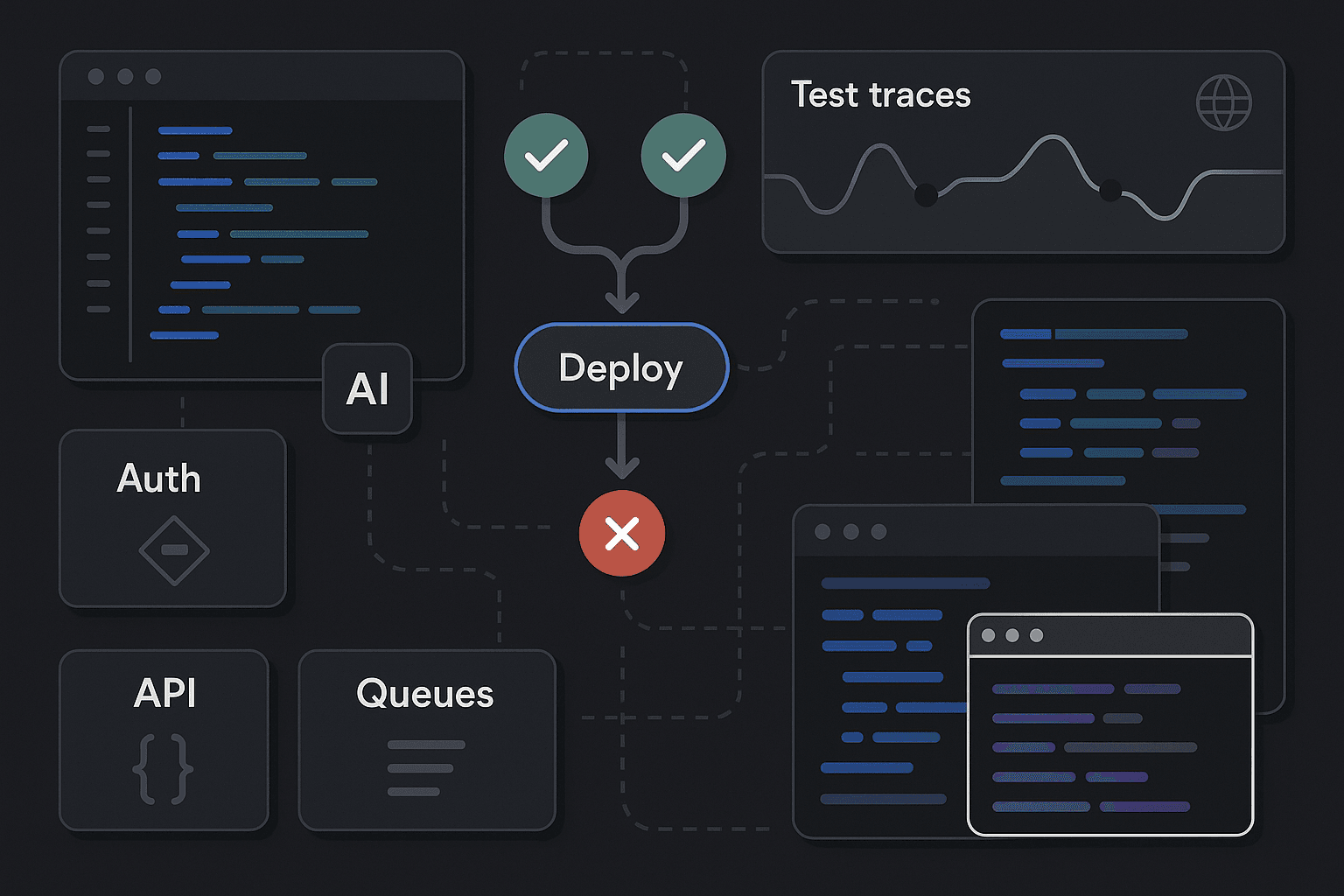
The Semantic Merge Mirage: Why AI-Generated PRs Need Post-Merge Workflow Verification, Not Just Pre-Merge CI
A team ships twelve pull requests before lunch. Every one of them is green.
Unit tests pass. Integration tests pass. Preview environments look fine. The merge queue is healthy. The deploy rolls out cleanly.
Two hours later, support starts seeing tickets:
- New users can sign up, but don’t receive onboarding emails.
- Admins can refund orders, but analytics no longer records the action.
- A background job processes invoices, but the customer portal shows stale status.
- A “Save” button works in preview, yet fails in production only for SSO accounts.
Nobody made an obviously bad change. No single PR introduced a catastrophic bug. In isolation, each change was plausible, tested, and approved.
The failure happened between PRs.
That’s the new reliability problem AI-assisted delivery makes much worse.
Not because AI writes uniquely broken code. Not because tests are suddenly useless. And not because CI/CD is dead.
The problem is that AI dramatically increases the number of semantically risky but locally reasonable changes entering your system. More copy updates that affect selectors. More refactors that subtly change event timing. More schema updates that preserve types but shift meaning. More auth defaults that look correct in one code path and wrong in a merged workflow. More background job tweaks that are safe alone and wrong in combination.
Traditional pre-merge CI was not designed to catch this class of failure.
It validates changes per PR, largely in isolation. But users experience software after merge, as end-to-end workflows crossing services, queues, permissions, browser state, emails, analytics, and admin operations. If you only verify before merge, you’re testing a world your customers never actually use.
That’s the semantic merge mirage: a collection of green PRs creating a red system.
The missing layer is post-merge, action-level workflow verification: continuously replaying critical user and operator workflows against the actual merged branch or deploy candidate, and validating not just page state but side effects across your stack.
If AI is going to write more of your code, you need a better definition of “done” than “CI passed on the PR.”
The real failure mode: locally correct, globally broken
Most engineering teams are still set up to catch one of two categories:
- Code-level regressions: logic errors, broken functions, exceptions, incorrect outputs.
- Environment-level issues: bad config, prod-only secrets, scaling failures, flaky infrastructure.
AI-generated PRs often create a third category that sits awkwardly between them:
- Cross-PR semantic regressions: each change is acceptable on its own, but merged behavior breaks real workflows.
These aren’t classic merge conflicts. Git merges the files fine. Types compile. Tests are green. The issue is that the meaning of the product shifted across multiple small changes that were never exercised together as a workflow.
Examples:
- One PR changes button text from
ContinuetoCreate accountand a test locator in preview still works because it uses role-based matching loosely. - Another PR introduces a delayed auth token refresh after sign-up.
- A third PR changes onboarding email sending from synchronous to queued.
- A fourth PR renames an analytics event property from
plantotierwhile keeping the event name stable.
None of these necessarily fail unit tests. None obviously break staging preview. But the merged experience can now become:
- user signs up,
- redirect happens before token propagation,
- email job enqueues without tenant context,
- frontend retries once,
- analytics shows successful signup,
- admin dashboard never reflects onboarding completion,
- support gets the ticket.
This is not a flaky test story. It’s a workflow verification gap.
Why AI accelerates this problem
AI coding tools increase throughput. That’s the headline everyone sees. The more important detail is what kind of changes they make quickly.
AI is very good at producing code that is:
- syntactically valid,
- locally consistent,
- idiomatic enough to pass review,
- testable at the component or function level,
- plausible within the immediate context window.
AI is much less reliable at reasoning about:
- hidden workflow dependencies,
- side effects across services,
- operational assumptions,
- event ordering,
- permission boundaries,
- “tribal knowledge” invariants no type system encodes.
That mismatch matters because modern products fail less often from one giant mistake and more often from many small, legitimate-looking changes colliding.
When humans write less code, teams naturally batch fewer semantic experiments. When AI helps generate and update many PRs per day, you get more of these changes landing faster:
- selector changes,
- copy updates,
- default value changes,
- serialization tweaks,
- payload shape drift,
- retries and timeout adjustments,
- queue/job behavior changes,
- “minor” auth cleanup,
- event instrumentation edits,
- admin panel logic changes.
Individually: reasonable.
Collectively: dangerous.
AI increases the merge surface area of your system. It creates more opportunities for interactions no isolated PR check can expose.
Why pre-merge CI gives false confidence
Pre-merge CI is still necessary. It just isn’t sufficient.
The issue is structural. CI pipelines usually answer questions like:
- Does this branch compile?
- Do unit tests pass?
- Do service-level integration tests pass?
- Does the app render in a preview environment?
- Can reviewers click through the changed area?
These are useful filters. But they mostly validate branch-local correctness, not merged-system behavior.
Problem 1: PR environments are isolated by design
Preview environments are fantastic for feedback and terrible for discovering integration collisions between independently green PRs.
Why? Because every preview isolates one change set from another. That’s the whole point.
If PR A updates checkout selectors, PR B changes payment confirmation timing, and PR C modifies order-created event payloads, no single preview environment contains the actual merged state unless you explicitly build one. Reviewers see “works on my branch” three times, then the merged app fails.
Preview environments hide exactly the class of issue you now need to find.
Problem 2: unit and integration tests validate code paths, not user outcomes
A unit test can prove sendOnboardingEmail(user) is called.
An integration test can prove the API returns 202 Accepted.
Neither proves the user received the correct email after signup, with the right tenant branding, after auth completed, after the job queue processed, and after the admin dashboard reflected the state transition.
Software is not a tree of code paths. It is a graph of actions and side effects.
Users don’t care whether your branch achieved line coverage. They care whether the workflow completed.
Problem 3: CI checks stop at service boundaries
A lot of “integration” tests are really intra-service tests. They hit a database, maybe a mocked dependency, perhaps a test container. Useful, but incomplete.
Real failures cross boundaries:
- frontend → API
- API → queue
- queue → worker
- worker → email provider
- worker → analytics
- auth provider → callback → session store
- admin action → audit log → downstream sync
If your tests don’t observe those boundaries end to end, they are measuring a narrower reality than production.
Problem 4: merge queues solve ordering, not semantics
Merge queues reduce broken main branches by serializing and retesting candidate merge groups. Good.
But merge queues mostly answer: “Can these branches merge and still pass the suite?”
They do not answer: “Do the merged workflows still accomplish meaningful user outcomes?”
A merge queue is not a workflow queue.
If the underlying suite doesn’t replay critical actions against the merged artifact and validate side effects, a merge queue just gives you better-organized false confidence.
QA can’t save you here either
Manual QA is often treated as the catch-all backup for CI blind spots. In this failure mode, that’s unrealistic.
Why manual QA falls short:
- It samples a tiny subset of behavior.
- It rarely validates cross-service side effects deeply.
- It often runs against pre-release branches, not the exact merged candidate.
- It doesn’t scale with AI-driven PR velocity.
- It depends on humans remembering fragile, implicit invariants.
If your delivery velocity rises while your validation model remains “maybe QA clicks around later,” reliability will decline. That’s not cynicism. That’s queueing theory.
Core insight: test workflows after merge, not just changes before merge
The missing CI/CD layer is simple to describe and surprisingly rare in practice:
Continuously replay critical user and operator workflows against the actual merged branch or deploy candidate, and validate both visible outcomes and system side effects.
This is not just “run end-to-end tests.”
It is a specific philosophy:
- The unit of verification is an action sequence, not a code change.
- The target under test is the merged system, not an isolated PR branch.
- The assertions include side effects, not just UI state.
- The invariants are business-semantic, not implementation-specific.
Examples of workflows worth verifying post-merge:
- user sign-up with SSO and onboarding completion,
- checkout and refund,
- password reset and session invalidation,
- invite teammate and accept invite,
- create report and receive export email,
- admin suspend account and propagate permissions,
- API key creation and first successful request,
- webhook delivery retry and idempotent processing.
For each workflow, you validate not just that the button clicked, but that the system behaved correctly:
- email was sent,
- queue job executed,
- audit log recorded,
- analytics event emitted with expected schema,
- permission changed across boundaries,
- data visible in downstream UI,
- no unexpected retries or silent drops.
That is what production reliability actually looks like.
Contract tests vs action traces
Contract tests still matter. But they’re not enough.
A contract test can tell you:
- this API returns fields
id,status,tier - this webhook payload matches a schema
- this event structure is backward compatible
Good. Keep them.
But contract tests verify interfaces. Many post-merge failures come from sequences.
What you need in addition is an action trace: a reproducible record of a meaningful workflow and the expected effects it should trigger.
Think of an action trace as:
- Actor performs action.
- System enters state.
- Secondary processes fire.
- External and internal side effects occur.
- Observable invariants hold.
For example, “admin refunds order” is not just one API contract. It’s a trace:
- admin logs in with elevated role,
- opens order detail,
- initiates refund,
- API authorizes action,
- payment provider receives refund request,
- order state updates,
- customer gets email,
- analytics event fires,
- audit entry appears,
- reporting pipeline reflects refund within expected delay.
You do not need every workflow to be fully exhaustive. But for critical business paths, contracts without traces are too weak.
What post-merge workflow verification looks like in practice
A practical setup has three layers:
1. Fast pre-merge checks
Keep:
- linting,
- types,
- unit tests,
- focused integration tests,
- smoke E2E on PRs.
These are your cheap filters.
2. Merged-branch or deploy-candidate workflow replay
On every merge to main, or on every deploy candidate:
- stand up the actual merged artifact,
- run critical workflows end to end,
- validate UI + APIs + queues + side effects,
- block promotion if invariants fail.
3. Continuous post-deploy verification
After deployment:
- replay a smaller canary set continuously,
- detect drift from real dependencies and configs,
- alert on workflow degradation, not just uptime.
This is the difference between “the app is up” and “the product works.”
Example: Playwright workflow verification with side effects
A standard Playwright test often stops at page assertions. That’s not enough here.
Below is a more useful pattern: perform a user workflow, then verify downstream effects via APIs or admin interfaces.
ts// tests/workflows/signup-onboarding.spec.ts
import { test, expect } from '@playwright/test';

async function poll(fn: () => Promise<boolean>, timeout = 30000, interval = 1000) {
  const start = Date.now();
  while (Date.now() - start < timeout) {
    if (await fn()) return true;
    await new Promise(r => setTimeout(r, interval));
  }
  return false;
}

test('new user signup triggers onboarding workflow end-to-end', async ({ page, request }) => {
  const email = `workflow-${Date.now()}@example.test`;
  const password = 'S3curePass!123';

  await page.goto(process.env.APP_URL!);
  await page.getByRole('link', { name: /sign up/i }).click();
  await page.getByLabel(/work email/i).fill(email);
  await page.getByLabel(/password/i).fill(password);
  await page.getByRole('button', { name: /create account|sign up/i }).click();

  await expect(page).toHaveURL(/onboarding/);
  await page.getByLabel(/company name/i).fill('Acme Workflow Inc');
  await page.getByRole('button', { name: /continue/i }).click();
  await expect(page.getByText(/welcome/i)).toBeVisible();

  // Verify backend user state
  const userResp = await request.get(`${process.env.ADMIN_API_URL}/test/users`, {
    params: { email },
    headers: { 'x-test-token': process.env.TEST_ADMIN_TOKEN! }
  });
  expect(userResp.ok()).toBeTruthy();
  const user = await userResp.json();
  expect(user.status).toBe('active');
  expect(user.onboardingCompleted).toBe(true);

  // Verify email side effect
  const emailDelivered = await poll(async () => {
    const resp = await request.get(`${process.env.ADMIN_API_URL}/test/emails`, {
      params: { to: email, template: 'welcome' },
      headers: { 'x-test-token': process.env.TEST_ADMIN_TOKEN! }
    });
    if (!resp.ok()) return false;
    const data = await resp.json();
    return data.delivered === true;
  }, 45000);
  expect(emailDelivered).toBeTruthy();

  // Verify analytics schema/invariant
  const analyticsResp = await request.get(`${process.env.ADMIN_API_URL}/test/analytics/events`, {
    params: { email, event: 'user_signed_up' },
    headers: { 'x-test-token': process.env.TEST_ADMIN_TOKEN! }
  });
  const analytics = await analyticsResp.json();
  expect(analytics.properties.tier).toBeDefined();
  expect(analytics.properties.plan).toBeUndefined(); // ensure drift is intentional
});
This test is still finite and maintainable. But it verifies a workflow, not just a page.
Example: validating background job behavior in Python
Many semantic failures hide in asynchronous systems. A button click returns 200, but the actual outcome fails later.
Post-merge verification must inspect async side effects.
python# tests/workflows/test_report_export.py
import os
import time
import requests

BASE_URL = os.environ["APP_URL"]
ADMIN_URL = os.environ["ADMIN_API_URL"]
TOKEN = os.environ["TEST_ADMIN_TOKEN"]


def wait_for(predicate, timeout=60, interval=2):
    start = time.time()
    while time.time() - start < timeout:
        if predicate():
            return True
        time.sleep(interval)
    return False


def test_report_export_workflow():
    session = requests.Session()

    # Create export job through app-facing API
    create = session.post(
        f"{BASE_URL}/api/reports/exports",
        json={"type": "revenue", "range": "last_30_days"},
        headers={"Authorization": f"Bearer {os.environ['USER_TOKEN']}"},
        timeout=10,
    )
    create.raise_for_status()
    export_id = create.json()["id"]

    # Verify job reaches completed state
    def export_completed():
        r = session.get(
            f"{BASE_URL}/api/reports/exports/{export_id}",
            headers={"Authorization": f"Bearer {os.environ['USER_TOKEN']}"},
            timeout=10,
        )
        r.raise_for_status()
        return r.json()["status"] == "completed"

    assert wait_for(export_completed, timeout=90)

    # Verify email notification was sent
    email_resp = requests.get(
        f"{ADMIN_URL}/test/emails",
        params={"template": "report_ready"},
        headers={"x-test-token": TOKEN},
        timeout=10,
    )
    email_resp.raise_for_status()
    messages = email_resp.json()["results"]
    assert any(str(export_id) in m["metadata"].get("export_id", "") for m in messages)

    # Verify audit log exists
    audit_resp = requests.get(
        f"{ADMIN_URL}/test/audit",
        params={"entity_type": "report_export", "entity_id": export_id},
        headers={"x-test-token": TOKEN},
        timeout=10,
    )
    audit_resp.raise_for_status()
    audit_entries = audit_resp.json()["results"]
    assert any(entry["action"] == "report.export.completed" for entry in audit_entries)
Again, the point is not more testing theater. The point is validating that the merged system actually completed the business action.
CI/CD example: GitHub Actions for post-merge workflow verification
A simple model is to run workflow verification on main after merge, before promotion.
yamlname: post-merge-workflow-verification

on:
  push:
    branches: [main]

jobs:
  deploy_candidate:
    runs-on: ubuntu-latest
    outputs:
      candidate_url: ${{ steps.deploy.outputs.url }}
    steps:
      - uses: actions/checkout@v4
      - name: Build artifact
        run: |
          docker build -t app:${{ github.sha }} .
      - name: Deploy candidate environment
        id: deploy
        run: |
          URL=$(./scripts/deploy-candidate.sh ${{ github.sha }})
          echo "url=$URL" >> $GITHUB_OUTPUT

  verify_workflows:
    needs: deploy_candidate
    runs-on: ubuntu-latest
    strategy:
      fail-fast: false
      matrix:
        suite: [auth, billing, onboarding, admin_ops, exports]
    steps:
      - uses: actions/checkout@v4
      - uses: actions/setup-node@v4
        with:
          node-version: 20
      - name: Install dependencies
        run: npm ci
      - name: Run workflow verification
        env:
          APP_URL: ${{ needs.deploy_candidate.outputs.candidate_url }}
          ADMIN_API_URL: ${{ secrets.ADMIN_API_URL }}
          TEST_ADMIN_TOKEN: ${{ secrets.TEST_ADMIN_TOKEN }}
        run: |
          npx playwright test tests/workflows/${{ matrix.suite }}

  promote:
    needs: verify_workflows
    if: success()
    runs-on: ubuntu-latest
    steps:
      - name: Promote candidate to production
        run: ./scripts/promote.sh ${{ github.sha }}
That’s the key shift: post-merge verification is part of CI/CD, not an optional afterthought.
Merge queues vs workflow queues
This distinction matters.
Merge queue
Purpose:
- serialize branch integration,
- avoid main-branch breakage,
- ensure required checks pass on the merged result.
Workflow queue
Purpose:
- continuously validate critical action traces,
- against the merged branch or deploy candidate,
- with side-effect assertions,
- prioritized by business criticality and change risk.
You probably need both.
A mature delivery system says:
- merge queue decides whether code can land,
- workflow queue decides whether the product can ship.
That is a much healthier split than expecting one test suite to solve both concerns.
How to define workflow invariants that survive rapid AI-written change
If you write brittle end-to-end tests that assert every CSS class and every piece of copy, you’ll create noise and people will ignore the system.
The answer is to define workflow invariants: durable truths about business behavior that should survive implementation churn.
Bad assertion:
- the button says “Create account”
Better invariant:
- a new user can create an account and reach an authenticated onboarding state
Bad assertion:
- analytics payload exactly equals this giant snapshot
Better invariant:
- a
user_signed_upevent is emitted with required identity and plan/tier fields, and no deprecated critical fields remain
Bad assertion:
- queue job executes in under 700 ms
Better invariant:
- report export completes within acceptable SLA and emits completion notification
Good workflow invariants tend to be:
- business meaningful,
- implementation tolerant,
- observable across boundaries,
- stable over time,
- precise enough to fail usefully.
A good template is:
When actor performs action under conditions X, then outcome Y happens, and side effects A/B/C occur, within time bound Z, without violating constraint K.
For example:
- When an admin suspends a user with active sessions, then future API requests are denied, existing browser session is invalidated within 2 minutes, an audit event is recorded, and no billing state is altered.
That’s testable. And it survives refactors.
Practical patterns for reducing brittleness
If you want post-merge workflow verification to increase developer productivity instead of destroying it, use these patterns.
Use stable locators
Prefer:
- accessibility roles,
- test IDs for key actions,
- semantic selectors.
Avoid fragile CSS and copy matching unless copy itself is the requirement.
Add test-visible observability endpoints
In non-production candidate environments, expose controlled ways to inspect:
- sent emails,
- emitted analytics events,
- queue/job states,
- audit logs,
- webhook deliveries.
You cannot verify side effects if they are invisible.
Build idempotent test data flows
Workflow tests should create and clean up their own data. Use unique identifiers and test tenants. Avoid shared fixtures that collapse under parallelism.
Separate smoke workflows from deep workflows
Run a small, fast critical set on every merge candidate. Run larger coverage suites on a schedule or on high-risk changes.
Prioritize by revenue and operational risk
Start with workflows tied to:
- sign-up,
- login,
- checkout,
- billing changes,
- account recovery,
- admin operations,
- reporting/export,
- integrations/webhooks.
Don’t start by automating obscure settings pages.
Add change-aware selection
If a PR touches auth, admin actions, analytics schema, queue workers, or checkout, expand the post-merge workflow set automatically.
AI-generated code makes broad changes quickly. Your verification scope should react accordingly.
Tool comparison: what each layer is good at
Here’s the blunt version.
Unit tests
Best for:
- fast logic validation,
- edge cases,
- deterministic debugging,
- local developer productivity.
Bad at:
- cross-service behavior,
- async workflows,
- semantic interactions after merge.
Integration tests
Best for:
- API/database behavior,
- service contracts,
- repository and persistence logic.
Bad at:
- full user outcomes,
- external side effects,
- merged workflow collisions.
Preview environments
Best for:
- design review,
- stakeholder feedback,
- branch-local QA,
- validating obvious regressions quickly.
Bad at:
- catching interactions between multiple green PRs,
- validating merged production semantics.
Contract tests
Best for:
- schema compatibility,
- API safety,
- provider/consumer coordination.
Bad at:
- sequencing,
- end-to-end business outcomes,
- multi-step side effects.
Manual QA
Best for:
- exploratory debugging,
- subjective UX feedback,
- uncommon edge discovery.
Bad at:
- repeatability,
- scale,
- keeping up with agent-driven throughput.
Post-merge workflow verification
Best for:
- merged-system confidence,
- real workflow reliability,
- side-effect validation,
- detecting semantic cross-PR regressions.
Bad at:
- replacing lower-level tests,
- ultra-fast feedback loops if you overbuild it.
This is not about picking one tool. It’s about fixing the missing layer.
A debugging advantage people overlook
Post-merge workflow verification is not just about prevention. It dramatically improves debugging.
Why? Because failures are captured as action traces tied to a known merged artifact.
Instead of getting a support ticket saying “refund emails seem weird sometimes,” you get:
- merged SHA,
- workflow name,
- exact action transcript,
- screenshots/traces,
- API/network logs,
- queue timing,
- missing side-effect assertion.
That compresses time-to-understanding.
In AI-heavy codebases, that matters even more. When more code is generated quickly, debugging becomes the bottleneck. The winning teams are not the ones generating the most code. They’re the ones reducing uncertainty after it lands.
Actionable adoption plan
If you want to implement this without boiling the ocean, do it in five steps.
1. Identify your top 10 critical workflows
Ask:
- What breaks revenue?
- What creates support load?
- What creates silent data corruption?
- What would wake up an operator at 2 a.m.?
List workflows, not pages.
Examples:
- self-serve signup,
- paid checkout,
- team invite acceptance,
- password reset,
- export generation,
- refund,
- account suspension,
- webhook ingestion.
2. Define invariants for each workflow
For each one, write:
- actor,
- trigger action,
- expected visible outcome,
- expected side effects,
- timing/SLA bounds,
- forbidden outcomes.
This becomes your verification spec.
3. Make side effects observable in candidate environments
Create safe test interfaces for:
- email inspection,
- analytics inspection,
- audit logs,
- job queue status,
- webhook history.
Without observability, workflow verification degrades into UI theater.
4. Run a minimal set on every merge to main
Do not wait for a giant test platform initiative. Start with 5–10 workflows on merged main or deploy candidates.
Gate promotion on them.
5. Expand based on incident history
Every escaped regression should produce one of two outcomes:
- a new workflow check,
- or a better invariant on an existing workflow.
Reliability should compound from real failures.
The strategic takeaway
AI-assisted delivery changes the economics of software creation. It becomes cheaper to produce code and more expensive to trust it.
That means the constraint shifts.
Not “How do we generate more PRs?”
But “How do we verify the merged product still works as a system?”
If your process still assumes branch-level CI is the primary proof of safety, you are optimizing for an older world where fewer changes landed more slowly and human authors carried more cross-cutting context in their heads.
That world is gone.
Now you need verification that matches the actual shape of failure:
- semantic,
- cross-PR,
- workflow-level,
- side-effect-heavy,
- often invisible in isolated previews.
This is why the semantic merge mirage matters. AI can help produce many individually sensible changes that together break the product in ways no single PR environment exposed.
The answer is not panic, and it’s not abandoning CI/CD. It’s building the missing layer.
Test critical workflows after merge. Validate action traces, not just code paths. Verify side effects, not just pages. Treat merged-system behavior as the release artifact that matters.
Because customers do not use your pull requests.
They use your software after everything has been merged together.