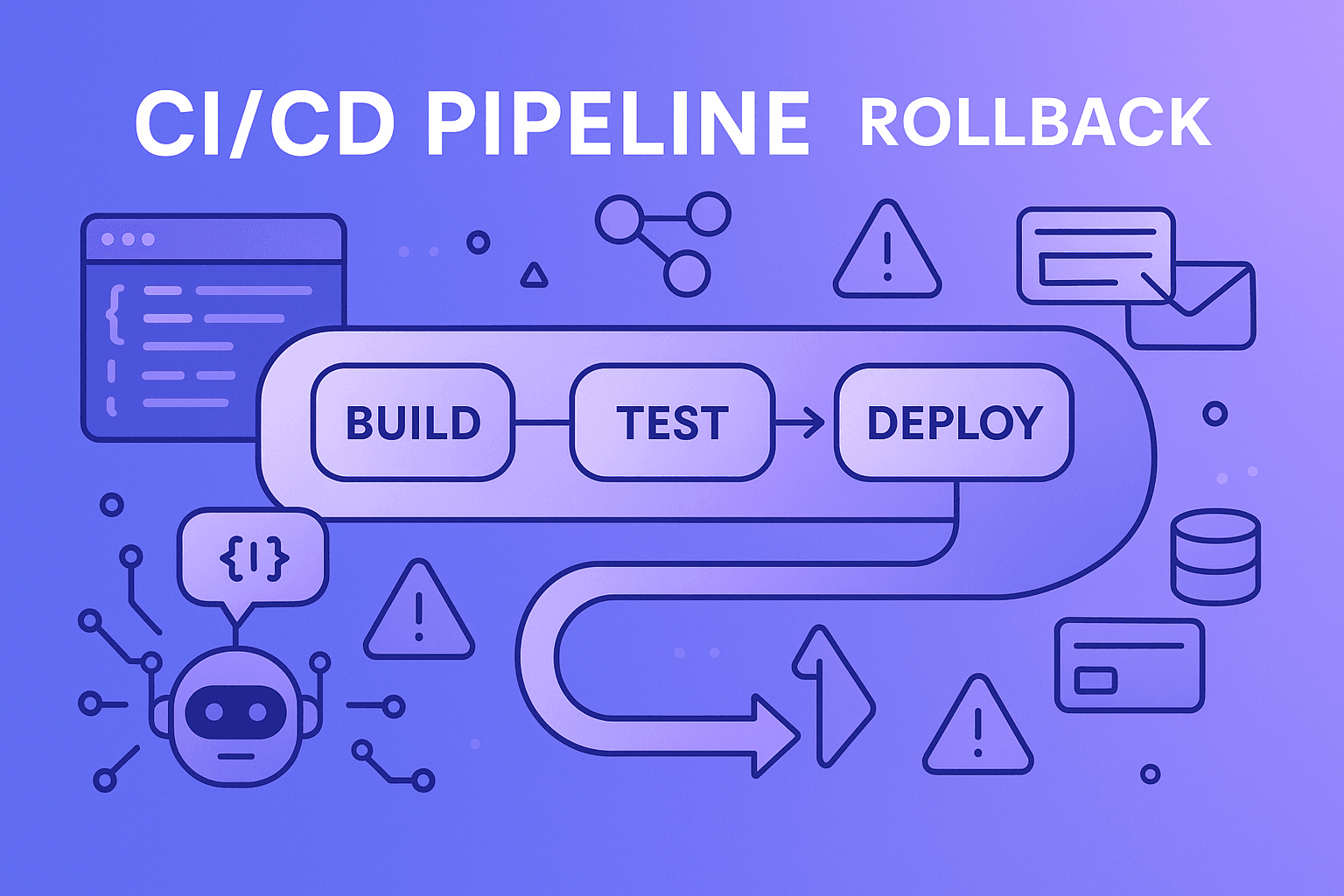
A team ships a bad change on Friday. Monitoring catches an error spike within minutes. Someone hits revert. The build goes green. The deployment rolls back cleanly. Slack fills with relief emojis.
Then support tickets start arriving.
Customers were charged twice. Trial users got cancellation emails after successfully upgrading. A fulfillment partner received duplicate order events. Several carts were emptied by a migration path that only ran once. One background worker retried against a third-party API until rate limits kicked in, and now account state is inconsistent across two systems. The deploy is gone, but the damage is still live.
This is the rollback blind spot.
A lot of modern engineering culture treats fast reverts as the final safety net. If a bad pull request makes it through review, through CI, through staging, and into production, at least we can roll it back quickly. That belief was always incomplete, but AI-assisted delivery makes it much more dangerous. When more code is generated faster, more changes touch business logic, side effects, and integration boundaries at a higher rate. The volume goes up, the confidence signals stay shallow, and rollback starts looking like a stronger protection than it really is.
The uncomfortable truth is simple: reverting code is not the same as reversing behavior.
In systems that send emails, write records, trigger webhooks, mutate subscriptions, enqueue jobs, settle payments, or sync with third-party APIs, many failures outlive the deploy that created them. CI/CD can tell you whether a build passes. Unit tests can tell you whether a function returns the expected output. Even a clean rollback can tell you whether the previous version is running again. None of those guarantees tell you whether the workflow that already executed can be safely unwound.
That is now the real reliability problem. Not just “can we detect bad code before merge?” but “can we prove that critical workflows are safe before and after they execute?”
The new failure mode: software that reverts cleanly but leaves a mess
Most rollback thinking comes from code-centric systems. A deploy introduces a bug. You switch traffic back to the old version. The bug disappears. That model works best when the blast radius is mostly confined to request-time logic and stateless behavior.
But production systems are not just code paths. They are action graphs.
A single user workflow might:
- validate input
- create or update local records
- enqueue background jobs
- charge a card
- write an audit trail
- provision access in another system
- send email or SMS
- emit analytics events
- notify internal systems through Kafka, SQS, or webhooks
- trigger retries, reconciliation jobs, and downstream automations
Once those actions happen, you no longer have a pure deploy problem. You have a state problem.
And state does not magically roll back because Git does.
This is exactly where AI-shipped changes become risky. AI tools are good at generating plausible code that fits local patterns. They are much worse at understanding hidden invariants across workflows, side effects, and cleanup paths. An agent can confidently refactor a checkout flow, subscription update handler, or webhook processor in a way that passes unit tests and even integration tests, while quietly breaking the reversibility of the workflow.
Examples are painfully common:
- A generated “idempotency improvement” changes a request key format, so retries create duplicate payment intents instead of reusing existing ones.
- An agent moves an email send earlier in the flow, before downstream persistence succeeds. Rollback restores the old code, but duplicate or contradictory customer emails are already delivered.
- A background worker gets a new exception path that retries forever on a 4xx response from a partner API.
- Subscription cancellation now updates the local database before the vendor API call succeeds. Reverting the code does not restore customer access in the vendor system.
- A cleanup step is removed as “unused” because static analysis cannot see its role in compensating for partial failures.
These are not edge cases. They are ordinary workflow regressions that become more likely when delivery speed increases faster than system understanding.
Why CI/CD gives false confidence here
CI/CD is great at answering narrow questions quickly:
- Does the code compile?
- Do tests pass?
- Can we build the artifact?
- Can we deploy it?
- Can we roll back to a prior version?
Those are useful questions. They are not reliability guarantees.
The deeper issue is that CI/CD mostly evaluates code before it mutates the real world. But many production failures only become visible after actions are executed against systems with memory: databases, queues, payment processors, email platforms, CRMs, and vendors.
A pipeline cannot infer reversibility from green checks.
Consider a typical GitHub Actions setup:
yamlname: ci

on:
  pull_request:
  push:
    branches: [main]

jobs:
  test:
    runs-on: ubuntu-latest
    steps:
      - uses: actions/checkout@v4
      - uses: actions/setup-node@v4
        with:
          node-version: 20
      - run: npm ci
      - run: npm run lint
      - run: npm test
      - run: npm run build

  deploy:
    if: github.ref == 'refs/heads/main'
    needs: test
    runs-on: ubuntu-latest
    steps:
      - run: ./scripts/deploy.sh
This pipeline can be excellent by conventional standards and still completely miss the actual risk. There is no step here asking:
- If checkout fails after charging but before order creation, what cleans up the payment intent?
- If a webhook is processed twice, what duplicate side effects happen?
- If a deploy is reverted after 10 minutes, what state changes remain externally visible?
- If retries fire during an outage, do they amplify damage?
- If a workflow partially succeeds across systems, is there a compensating action and has it been tested?
You can add more tests, more coverage, more staging deploys, and still avoid the question that matters: what happens after the user workflow has already changed external state?
That is why teams often discover rollback blind spots only in incident review. The code was reversible. The behavior was not.
Why unit tests and mock-heavy integration tests miss it
Unit tests are designed to isolate behavior. That is their strength. It is also why they routinely miss workflow reversibility.
A unit test for a subscription service might look like this:
javascriptit('cancels a subscription', async () => {
  billing.cancel.mockResolvedValue({ ok: true });
  repo.updateStatus.mockResolvedValue(true);

  await cancelSubscription({ userId: 'u_123', subId: 'sub_123' });

  expect(billing.cancel).toHaveBeenCalledWith('sub_123');
  expect(repo.updateStatus).toHaveBeenCalledWith('sub_123', 'canceled');
});
This test verifies call ordering and expected function interaction. It does not tell you:
- what happens if
repo.updateStatussucceeds butbilling.canceltimes out after actually canceling remotely - whether the operation is idempotent on retry
- whether a rollback reintroduces logic that interprets the partial state incorrectly
- whether downstream systems receive duplicate cancellation events
- whether the subscription can be restored or reconciled after failure
Mock-heavy integration tests have a similar issue. By replacing real external behavior with predictable stubs, they erase the hard parts: delayed consistency, duplicate events, rate limiting, eventual retries, partial success, and conflicting truth across systems.
This is especially dangerous in AI-assisted development because generated code often looks structurally correct under mocks. The code calls the right functions. The tests pass. But the semantic guarantees that matter in production are missing.
Why QA and staging environments don’t save you either
A lot of teams respond by saying, “That’s what staging is for.” In practice, staging is usually a reduced copy of production with cleaner data, fewer integrations, and almost none of the operational noise that exposes rollback problems.
Staging rarely reproduces:
- real concurrency
- real retry pressure
- real partner API behavior
- real duplicate webhook delivery
- real timeout patterns
- real race conditions from user activity and background jobs
- real historical data weirdness
- real cleanup failures after partial execution
Manual QA is even weaker against these issues because the damage often appears after the “happy path” looks correct. A tester can complete checkout successfully while a hidden duplicate fulfillment event is queued in the background. They can cancel a subscription in staging and see the UI update, while production would have created conflicting vendor state under retry.
The user-facing workflow can look fine at the screen layer while the system beneath it becomes harder to reconcile.
That is the gap. Traditional testing asks, “Did the feature work?” Reliability requires asking, “What happened to every side effect, especially when things only partly worked?”
The core insight: test actions, not just code paths
The fix is not “more testing” in the abstract. The fix is shifting the test target.
Instead of validating only code paths and output assertions, teams need action-level verification:
- Test the user workflow as it actually executes across system boundaries.
- Observe every side effect the workflow creates.
- Intentionally inject failures at different points.
- Verify whether the system is safely reversible, compensatable, or at least reconcilable after execution.
This is a very different posture from conventional CI.
You are no longer just checking that checkout returns 200. You are checking things like:
- Was exactly one payment created?
- Was exactly one order emitted to fulfillment?
- Were emails sent only after durable success?
- If the workflow failed halfway, what cleanup happened automatically?
- If no cleanup happened, is there a deterministic reconciliation path?
- If the deploy is rolled back, does any new state become unreadable or unmanaged by the prior version?
- Are retries safe, bounded, and idempotent?
This is what matters in a world where AI can generate ten plausible changes to a workflow before lunch.
The question is not whether the code compiles. The question is whether the workflow can survive execution and reversal.
A concrete example: checkout with irreversible side effects
Take a simplified checkout flow in Node.js:
javascriptexport async function checkout({ cartId, userId, paymentMethodId }) {
  const cart = await carts.get(cartId);
  if (!cart || cart.status !== 'open') {
    throw new Error('invalid_cart');
  }

  const payment = await payments.charge({
    userId,
    paymentMethodId,
    amount: cart.total,
    idempotencyKey: `cart:${cartId}`,
  });

  const order = await orders.create({
    cartId,
    userId,
    paymentId: payment.id,
    items: cart.items,
  });

  await email.sendReceipt({ userId, orderId: order.id });
  await carts.markCompleted(cartId);
  await events.publish('order.created', { orderId: order.id });

  return order;
}
It looks reasonable. It may even be covered by tests. But it contains rollback blind spots everywhere:
payments.chargeis externally visible and not automatically undone by code revert.- If
orders.createfails after charge succeeds, you now have a charged user with no order. - If
email.sendReceiptsucceeds butcarts.markCompletedfails, retries may duplicate receipts. - If
events.publishsucceeds twice under retry, fulfillment may duplicate shipment. - If an AI-generated refactor changes the idempotency key, repeated checkout attempts may create multiple charges.
Now imagine this deploy goes out, runs for seven minutes, then gets reverted. The old code is back. None of the side effects are gone.
That means the test you need is not just “checkout works.” The test is “checkout remains correct and recoverable under partial execution and rollback conditions.”
What action-level verification looks like in practice
You need test harnesses that can observe and validate workflow side effects end to end. That often means using browser or API-level workflow runners like Playwright for execution, plus controllable fake or sandbox integrations for payments, email, queues, and vendor APIs.
Here is a Playwright example that checks more than UI success:
javascriptimport { test, expect } from '@playwright/test';

test('checkout creates exactly one charge, one order, and one receipt', async ({ page, request }) => {
  const cartId = await seedOpenCart(request);
  const userId = await seedUser(request);

  await page.goto(`/checkout/${cartId}`);
  await page.fill('[name="cardNumber"]', '4242424242424242');
  await page.click('button[type="submit"]');

  await expect(page.getByText('Order confirmed')).toBeVisible();

  const effects = await request.get(`/test-support/workflows/checkout/${cartId}/effects`);
  const body = await effects.json();

  expect(body.payments).toHaveLength(1);
  expect(body.orders).toHaveLength(1);
  expect(body.emails).toHaveLength(1);
  expect(body.events.filter(e => e.type === 'order.created')).toHaveLength(1);
  expect(body.cart.status).toBe('completed');
});
That is better, but still not enough. We also need failure injection.
javascripttest('checkout compensates when order creation fails after payment', async ({ page, request }) => {
  const cartId = await seedOpenCart(request);
  await request.post('/test-support/failpoints', {
    data: {
      target: 'orders.create',
      mode: 'fail_once_after_payment_charge'
    }
  });

  await page.goto(`/checkout/${cartId}`);
  await page.fill('[name="cardNumber"]', '4242424242424242');
  await page.click('button[type="submit"]');

  await expect(page.getByText(/something went wrong/i)).toBeVisible();

  const effects = await (await request.get(`/test-support/workflows/checkout/${cartId}/effects`)).json();

  expect(effects.orders).toHaveLength(0);
  expect(effects.payments[0].status).toBe('voided');
  expect(effects.emails).toHaveLength(0);
  expect(effects.cart.status).toBe('open');
});
Now you are testing a real business invariant: if payment happened but order creation failed, the system must compensate safely.
That is much closer to production reliability than another hundred unit tests.
Verifying rollback characteristics explicitly
The missing habit in most teams is testing not only forward execution, but rollback characteristics.
That means for each critical workflow, classify every action:
- reversible: can be cleanly undone automatically
- compensatable: cannot be undone, but there is a follow-up action that restores acceptable business state
- reconcilable: cannot be immediately fixed, but the inconsistency is detectable and repairable deterministically
- irreversible: once executed, damage is externally visible and cannot be withdrawn
Examples:
- Database insert in a transaction: reversible
- Payment capture with void window: compensatable or reversible depending on provider
- Email send: irreversible
- SMS send: irreversible
- Webhook to partner with no delete API: irreversible or reconcilable
- Access provisioning in external SaaS: compensatable if deprovision exists and is reliable
- Ledger write: usually reconcilable, sometimes append-only and intentionally irreversible
Once you classify actions this way, your testing strategy becomes much clearer. You should be most aggressive around workflows that combine irreversible side effects with weak cleanup semantics.
A rollback-safe workflow is not one where “we can revert the code quickly.” It is one where either:
- side effects happen only after the point of durable success,
- every intermediate mutation is idempotent and compensated on failure,
- or irreversibility is acknowledged with strong guardrails, approvals, and reconciliation.
A Python example: subscription cancellation gone wrong
Consider a Python service handling subscription cancellation:
pythonasync def cancel_subscription(user_id: str, external_sub_id: str):
    await db.subscriptions.update_status(external_sub_id, "canceled")
    await billing_provider.cancel(external_sub_id)
    await email_service.send_template(
        user_id=user_id,
        template="subscription_canceled"
    )
    await audit_log.write({
        "user_id": user_id,
        "action": "subscription_canceled",
        "subscription_id": external_sub_id,
    })
This is a rollback trap.
If the local DB update succeeds but the provider call fails after timing out, you might not know whether the provider canceled or not. If the email sends regardless, the customer gets a cancellation notice even if billing remains active. Reverting the deploy does nothing to repair trust or state.
A safer model uses explicit state transitions and reconciliation:
pythonasync def cancel_subscription(user_id: str, external_sub_id: str):
    op_id = await db.operations.start(
        kind="subscription_cancel",
        resource_id=external_sub_id,
    )

    await db.subscriptions.update_status(external_sub_id, "cancel_pending")

    try:
        result = await billing_provider.cancel(
            external_sub_id,
            idempotency_key=f"cancel:{external_sub_id}"
        )

        await db.subscriptions.update_status(external_sub_id, "canceled")
        await db.operations.complete(op_id, external_state=result.status)

        await email_service.send_template(
            user_id=user_id,
            template="subscription_canceled"
        )
    except Exception as exc:
        await db.operations.fail(op_id, reason=str(exc))
        raise
This still does not solve everything, but it creates a testable model:
- pending state is visible
- operation identity is durable
- external call is idempotent
- email is delayed until stronger success conditions exist
- failed operations can be reconciled later
Now your tests can assert that rollback or retry does not strand users in nonsense states.
CI/CD should include workflow verification gates
Most teams stop CI at code quality and unit or integration tests. For critical workflows, that is no longer enough.
You need a separate workflow verification stage that runs action-level tests against disposable environments or controlled integration sandboxes.
Example GitHub Actions configuration:
yamlname: delivery

on:
  pull_request:
  push:
    branches: [main]

jobs:
  unit-and-build:
    runs-on: ubuntu-latest
    steps:
      - uses: actions/checkout@v4
      - uses: actions/setup-node@v4
        with:
          node-version: 20
      - run: npm ci
      - run: npm run lint
      - run: npm test
      - run: npm run build

  workflow-verification:
    needs: unit-and-build
    runs-on: ubuntu-latest
    steps:
      - uses: actions/checkout@v4
      - run: docker compose up -d
      - run: npm ci
      - run: npm run test:workflows
      - run: npm run test:failpoints
      - run: npm run test:reconciliation

  deploy:
    if: github.ref == 'refs/heads/main'
    needs: workflow-verification
    runs-on: ubuntu-latest
    steps:
      - run: ./scripts/deploy.sh
The important thing is not the specific tooling. It is the existence of a gate focused on user workflows, side effects, and cleanup behavior.
If you can deploy ten times a day but cannot verify what happens when order creation fails after payment capture, your CI/CD system is optimizing for speed while outsourcing reliability to luck.
Tooling comparison: what each layer is good at
No single testing tool solves rollback blindness. You need layers, but you also need clarity on what each layer can and cannot prove.
| Tool / Approach | Strengths | Blind Spots |
|---|---|---|
| Unit tests | Fast feedback, local logic validation, edge-case coverage | No proof of real side effects, weak on retries and partial execution |
| Mocked integration tests | Verifies service boundaries and contracts | Hides timing, duplication, rate limits, and external state ambiguity |
| Static analysis / linting | Great for obvious mistakes and policy checks | Cannot reason about business reversibility |
| Staging QA | Useful for smoke testing and UX validation | Rarely matches production failure modes |
| Playwright / end-to-end workflow tests | Strong for user workflow validation and visible side effects | Needs support infrastructure for observability and failpoints |
| Sandbox integrations | Better realism for payments, email, APIs | Can still differ from production semantics |
| Chaos/failure injection | Exposes retry and cleanup weaknesses | Requires careful engineering and deterministic assertions |
| Reconciliation jobs and audits | Critical for repairability | Reactive, not preventive |
The point is not to replace unit tests with end-to-end tests. The point is to stop pretending that code-level correctness implies rollback safety.
Actionable practices for teams shipping faster with AI
If AI is increasing your change volume, these practices matter immediately.
1. Identify your irreversible workflows
Make a short list of workflows where side effects outlive deploys:
- checkout and payment capture
- subscription create, upgrade, downgrade, cancel
- password reset and security notifications
- account deletion and data export
- inventory reservation and release
- fulfillment handoff
- CRM syncs and customer communications
If a workflow can charge money, send user communication, delete state, or mutate a third-party system, treat it as rollback-sensitive.
2. Map side effects explicitly
For each workflow, write down:
- local writes
- external writes
- messages/events emitted
- retries triggered
- cleanup paths
- reconciliation jobs
- irreversible actions
This sounds basic, but many teams discover they do not actually know the complete action graph for critical paths.
3. Add idempotency everywhere it matters
AI-generated code often omits robust idempotency because it is not obvious in local context. Fix that deliberately.
Use durable operation IDs and idempotency keys for:
- payments
- subscription changes
- fulfillment requests
- webhook processing
- job execution
- email deduplication where possible
If a retry can create another real-world action, you do not have a safe workflow.
4. Delay irreversible actions until durable success
Do not send emails, SMS, or external notifications before the system reaches a state it can stand behind.
A common pattern is an outbox table or event log written transactionally with the local state change, then delivered asynchronously once success is durable.
That will not solve every external consistency problem, but it reduces a lot of accidental irreversibility.
5. Test compensation and reconciliation, not just success
For every critical workflow, write tests for:
- success path
- duplicate execution
- timeout after external success
- local failure after external success
- rollback to prior version while in-flight operations exist
- reconciliation after ambiguous state
If you only test the happy path, you are testing the least interesting part of the system.
6. Build failpoints into critical services
You cannot verify cleanup behavior if your system gives you no way to force partial failures deterministically.
Add test-only failpoints around critical boundaries:
- before external call
- after external success but before local commit
- after local commit but before notification
- during retry scheduling
This is one of the highest-leverage investments for debugging and testing serious workflow risks.
7. Make rollback compatibility a release criterion
Before shipping a change to a critical workflow, ask:
- If we revert this code after it runs, can the old version understand the new state?
- Are new records, statuses, or events backward-compatible?
- Will rollback disable cleanup logic needed for operations initiated by the new version?
- Do we need a feature flag, gradual rollout, or migration guard?
A lot of rollback pain comes from version skew: the reverted code no longer knows how to manage the state created by the bad deploy.
8. Instrument business effects, not just technical metrics
Most observability is too low-level for this class of incident.
Track metrics like:
- duplicate charges per hour
- orders without matching payment state
- canceled local subscriptions with active external billing
- email sends without durable workflow completion
- reconciliation backlog by workflow type
- webhook dedupe hit rate
- retry storm volume by integration
These are far more useful for debugging rollback-related regressions than raw error counts alone.
9. Treat AI-generated workflow changes as high-risk until proven otherwise
This is not anti-AI. It is basic engineering discipline.
AI can accelerate implementation, but workflow safety depends on hidden invariants, not syntactic fluency. Any generated change touching retries, ordering, side effects, idempotency, background jobs, or third-party APIs deserves stronger scrutiny and stronger verification.
If your review process says “looks good” because the code is clean and the tests are green, but nobody checked rollback characteristics, then your process is not adapted to AI-assisted delivery.
A practical review checklist for rollback-sensitive changes
Use a checklist like this in pull requests that touch critical workflows:
- What external systems are mutated?
- Which actions are irreversible?
- What happens if the process dies after each step?
- Is every external mutation idempotent?
- Are retries bounded and deduplicated?
- Are communications delayed until durable success?
- What compensating action exists for each partial failure?
- What reconciliation job detects and repairs drift?
- Can the previous version handle state created by this change after rollback?
- What workflow tests prove the above?
This creates a better engineering conversation than arguing about coverage percentages.
Developer productivity without rollback illusions
Some teams will read this and worry that it slows delivery. In reality, the opposite is true over any meaningful time horizon.
Rollback illusions destroy developer productivity because they let teams ship unsafe changes under the impression that reverts are enough. Then incidents turn into multi-team cleanup projects: support handling angry users, finance untangling charges, ops draining retries, engineers writing one-off repair scripts, and leadership explaining why “we rolled it back quickly” did not prevent customer damage.
That is not fast delivery. That is deferred work with interest.
The productive path is to be selective and serious:
- keep unit tests fast
- keep CI tight
- automate browser and API workflow verification for critical paths
- inject failures intentionally
- prove compensation and reconciliation
- instrument side effects that matter to the business
This is how you move quickly without pretending that code rollback equals business recovery.
Conclusion
Fast reverts are useful. They are just not a safety guarantee.
In an AI-assisted delivery world, teams can generate and ship workflow changes faster than their traditional testing stack can understand them. That makes rollback culture more dangerous, not less, because it encourages false confidence in a control that only restores code, not reality.
The real failure is not that bad code sometimes reaches production. That will always happen. The real failure is not knowing whether the workflow that already executed can be reversed, compensated, or reconciled once side effects escape into the world.
That is the rollback blind spot.
The teams that handle this well will stop treating reliability as a pre-merge code quality problem and start treating it as an action-level systems problem. They will test user workflows, not just functions. They will verify side effects, not just responses. They will design for idempotency, cleanup, and reconciliation. And they will make rollback safety something they can demonstrate, not just assume.
Because when customers get charged twice, sent the wrong email, or stranded in inconsistent subscription state, nobody cares that the PR was reverted in three minutes.