
Retrieval-Augmented Debug AI: Using Logs, Traces, and Replay to Automate Root-Cause Analysis
Software failures rarely present themselves as neat, isolated bugs. They emerge from the interplay of code paths, config, environments, and time. The fastest way to cut mean time to resolution (MTTR) is to compress the loop between “what happened,” “why it happened,” and “what change will fix it.” Retrieval-augmented generation (RAG) is an ideal pattern for this: treat logs, traces, metrics, diffs, and runbooks as a dynamic knowledge base; retrieve the most relevant shards; then reason and propose a minimal, reviewable fix.
This article lays out a practical, end-to-end system for a Retrieval-Augmented Debug AI that:
- Ingests OpenTelemetry data (logs, traces, metrics) at scale.
- Builds a retrieval corpus that includes code, config, incidents, and PR history.
- Replays failures in an isolated environment to validate hypotheses.
- Proposes minimal patches and mitigations without risky autonomy.
- Ships evals, guardrails, and on-call workflows that reduce MTTR.
We’ll walk through the architecture, data pipelines, retrieval strategies, replay harness, patch proposal engine, and evaluation methodology, with concrete implementation snippets and operational advice.
Why Retrieval-Augmented Debugging Works
RAG is a natural fit for debugging because:
- Context matters. Failures depend on precise versions, feature flags, upstream responses, and system state. RAG retrieves the context before reasoning.
- Generative reasoning is useful, but only with relevant grounding. A large language model (LLM) can hypothesize root causes, but it needs localized evidence: trace spans, logs near error time, recent schema changes, known incidents, and code diffs.
- Minimal changes beat speculative refactors. “Surgical” fixes—timeouts, guards, config sanity checks—are safer and faster to deploy. RAG can learn these patterns from your codebase and incident history.
- Human-in-the-loop is straightforward. RAG proposes and explains; humans approve and deploy. No autonomous merges or unbounded changes.
The result: fewer attention hops for engineers, higher confidence, and faster recovery. The system augments, not replaces, human judgment.
System Overview
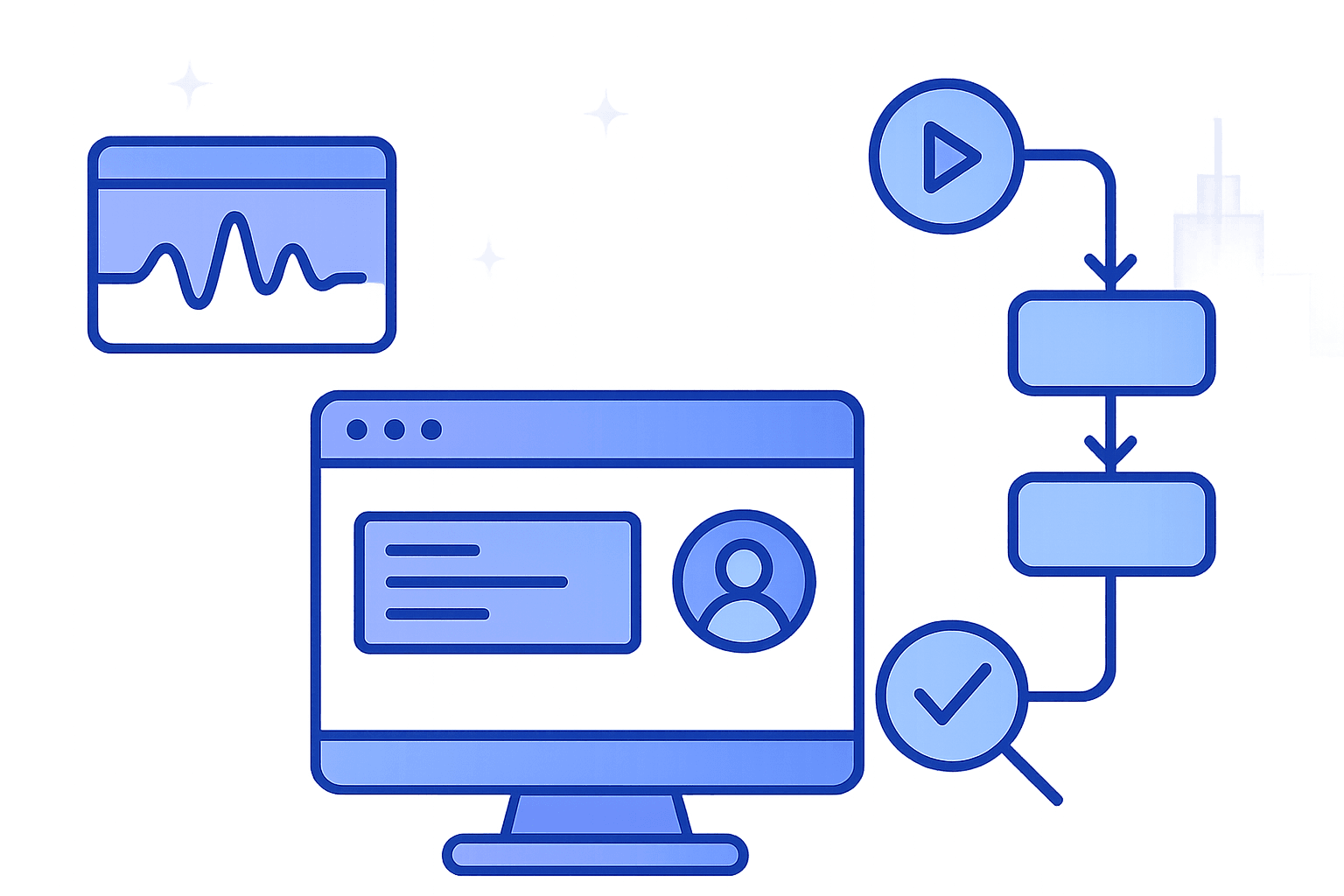
At a high level, we want to connect observability, code, and experimentation:
- Ingest: OpenTelemetry (OTel) logs, traces, metrics → a durable and queryable store.
- Enrich: Normalize, redact PII, attach metadata (service, version, span kind, env), compute embeddings.
- Index: Vector and keyword indices over logs, spans, code symbols, configs, incidents, and PR history.
- Retrieve: For an incident or alert, pull the most relevant slices.
- Reason: LLM chains generate hypotheses, causal chains, and candidate patches.
- Replay: Reproduce the failure in a controlled environment; validate mitigation.
- Propose: Produce small, reviewable diffs and operational mitigations (flags, rollbacks).
- Evaluate: Offline and online evals; guardrails; policy checks.
Architecture Diagram (textual)
- Producers: instrumented services sending OTel data (OTLP/HTTP or gRPC)
- OTel Collector: tail-sampling traces, batching logs → Kafka topics (traces, logs)
- Stream Enricher: Kafka consumers enrich + embed → PostgreSQL/pgvector + object store (Parquet/S3)
- Corpus Builder: indexes code (ctags, LSIF), configs, incidents → vector + inverted indices
- Retrieval Service: query API to fetch incident context
- Reasoning Orchestrator: prompt templates + tools (retriever, code search, replay runner)
- Replay Sandbox: ephemeral k8s namespace + test harness + traffic replayer
- Patch Proposer: LLM + static checks → unified diff + policy check
- Human Review: PR with rationale + telemetry links
Data Pipeline: From OpenTelemetry to a Retrieval Corpus
1) Collect OpenTelemetry data
Use the OTel SDKs in services and an OTel Collector to standardize ingestion. A minimal Python example:
python# app.py
import requests
from flask import Flask
from opentelemetry import trace
from opentelemetry.instrumentation.flask import FlaskInstrumentor
from opentelemetry.sdk.resources import Resource
from opentelemetry.sdk.trace import TracerProvider
from opentelemetry.sdk.trace.export import BatchSpanProcessor
from opentelemetry.exporter.otlp.proto.http.trace_exporter import OTLPSpanExporter

app = Flask(__name__)
FlaskInstrumentor().instrument_app(app)

resource = Resource.create({
    "service.name": "payments-api",
    "deployment.environment": "prod",
    "service.version": "1.42.3"
})
provider = TracerProvider(resource=resource)
provider.add_span_processor(BatchSpanProcessor(OTLPSpanExporter(endpoint="http://otel-collector:4318/v1/traces")))
trace.set_tracer_provider(provider)
tracer = trace.get_tracer(__name__)

@app.route("/charge")
def charge():
    with tracer.start_as_current_span("charge_flow"):
        resp = requests.post("http://card-gateway/authorize", json={"amount": 1000}, timeout=2.0)
        if resp.status_code != 200:
            raise RuntimeError(f"auth failed: {resp.text}")
        return {"status": "ok"}

if __name__ == "__main__":
    app.run(host="0.0.0.0", port=8080)
Collector configuration to export to Kafka in a parseable encoding:
yaml# otel-collector.yaml
receivers:
  otlp:
    protocols:
      http: {}
      grpc: {}
exporters:
  kafka:
    brokers: ["kafka:9092"]
    topic: otel-traces
    encoding: otlp_json
  kafka/logs:
    brokers: ["kafka:9092"]
    topic: otel-logs
    encoding: otlp_json
processors:
  batch: {}
  tail_sampling:
    decision_wait: 2s
    num_traces: 50000
    policies:
      - name: errors
        type: status_code
        status_code:
          status_codes: [ERROR]
      - name: long-latency
        type: latency
        latency:
          threshold_ms: 1000
service:
  pipelines:
    traces:
      receivers: [otlp]
      processors: [batch, tail_sampling]
      exporters: [kafka]
    logs:
      receivers: [otlp]
      processors: [batch]
      exporters: [kafka/logs]
Tail-based sampling keeps the most useful traces (errors, slow spans). Logs export as JSON for easy enrichment.
2) Enrich, normalize, and embed
Use a stream processor to:
- Normalize common attributes (service.name, environment, version, trace_id, span_id, http.*).
- Extract exception fields (exception.type, exception.message, stacktrace from span events).
- Redact PII: emails, card numbers, tokens, IPs.
- Compute text embeddings for retrieval.
A simple Python example using sentence-transformers and pgvector:
python# enricher.py
import json
import re
import psycopg2
from confluent_kafka import Consumer
from sentence_transformers import SentenceTransformer

PII_PATTERNS = [
    re.compile(r"[\w.+-]+@[\w-]+\.[\w.-]+"),
    re.compile(r"\b(?:\d[ -]*?){13,19}\b"),  # crude PAN detector
    re.compile(r"Bearer\s+[A-Za-z0-9\-_.]+")
]

model = SentenceTransformer("intfloat/e5-large-v2")
conn = psycopg2.connect("postgresql://vec:vec@pg:5432/vec")
cur = conn.cursor()

cur.execute("""
CREATE TABLE IF NOT EXISTS events(
  id BIGSERIAL PRIMARY KEY,
  kind TEXT, -- log|span
  trace_id TEXT,
  span_id TEXT,
  service TEXT,
  env TEXT,
  version TEXT,
  ts TIMESTAMPTZ,
  severity TEXT,
  error BOOL,
  message TEXT,
  fields JSONB,
  embedding VECTOR(1024)
);
CREATE INDEX IF NOT EXISTS events_vec_idx ON events USING ivfflat (embedding vector_cosine_ops);
CREATE INDEX IF NOT EXISTS events_trace_idx ON events(trace_id);
""")
conn.commit()

c = Consumer({"bootstrap.servers": "kafka:9092", "group.id": "enricher", "auto.offset.reset": "earliest"})
c.subscribe(["otel-logs", "otel-traces"])  # both exported as otlp_json


def scrub(text):
    if not text:
        return text
    s = text
    for p in PII_PATTERNS:
        s = p.sub("[REDACTED]", s)
    return s

while True:
    msg = c.poll(1.0)
    if not msg or msg.error():
        continue
    payload = json.loads(msg.value())
    # handle logs or spans; simplified for example
    if "resourceLogs" in payload:
        kind = "log"
        for rl in payload["resourceLogs"]:
            res = {a["key"]: a["value"].get("stringValue") for a in rl.get("resource", {}).get("attributes", [])}
            for scope in rl.get("scopeLogs", []):
                for rec in scope.get("logRecords", []):
                    message = None
                    for a in rec.get("attributes", []):
                        if a["key"] in ("log.message", "body"):
                            message = a["value"].get("stringValue")
                    msg_text = scrub(message or "")
                    emb = model.encode([f"query: {msg_text}"])[0]
                    cur.execute("""
                      INSERT INTO events(kind, trace_id, span_id, service, env, version, ts, severity, error, message, fields, embedding)
                      VALUES(%s,%s,%s,%s,%s,%s, to_timestamp(%s/1e9), %s, %s, %s, %s, %s)
                    """, (
                      kind,
                      rec.get("traceId"), rec.get("spanId"), res.get("service.name"), res.get("deployment.environment"), res.get("service.version"),
                      rec.get("timeUnixNano"), rec.get("severityText"), rec.get("severityText") in ("ERROR", "FATAL"),
                      msg_text, json.dumps(rec), emb.tolist()
                    ))
    elif "resourceSpans" in payload:
        kind = "span"
        for rs in payload["resourceSpans"]:
            res = {a["key"]: a["value"].get("stringValue") for a in rs.get("resource", {}).get("attributes", [])}
            for ss in rs.get("scopeSpans", []):
                for span in ss.get("spans", []):
                    err = span.get("status", {}).get("code") == "STATUS_CODE_ERROR"
                    msg_text = scrub(span.get("name", ""))
                    emb = model.encode([f"query: {msg_text}"])[0]
                    cur.execute("""
                      INSERT INTO events(kind, trace_id, span_id, service, env, version, ts, severity, error, message, fields, embedding)
                      VALUES(%s,%s,%s,%s,%s,%s, to_timestamp(%s/1e9), %s, %s, %s, %s, %s)
                    """, (
                      kind,
                      span.get("traceId"), span.get("spanId"), res.get("service.name"), res.get("deployment.environment"), res.get("service.version"),
                      span.get("startTimeUnixNano"), None, err, msg_text, json.dumps(span), emb.tolist()
                    ))
    conn.commit()
In production you’ll want:
- Schematized OTLP ingestion (protobuf parsing), retries, dead-letter queues.
- Parquet data lake for cold storage (S3, GCS) and cost-effective analytics.
- Feature extraction (e.g., failure signature hashes, stack canonicalization).
- Privacy: deterministic tokenization for IDs; reversible redaction gated by RBAC.
3) Build a multi-source corpus
Debugging benefits from more than runtime telemetry. Index:
- Code symbols, call graphs, and comments (ctags, LSIF, or language servers).
- Configs and feature flags (with environment scoping).
- CI/CD artifacts: build IDs, commit SHAs, recent diffs.
- Incident postmortems, runbooks, and historical RCA notes.
- Known-bad patterns: flaky tests, migration pitfalls, dependency deprecations.
Store text embeddings in the same pgvector cluster, with keyword/facet indices for exact filters (service, version, file path). Extract chunks semantically (function-level for code, paragraph-level for docs) and attach provenance.
Retrieval Strategy That Respects Causality
Incident context has a strong causal structure: a specific trace leading to a failure, with neighboring logs, and recent changes. Good retrieval should reflect that.
Key retrieval dimensions:
- Anchored by trace_id and time window. Start from the failing span; gather upstream/downstream spans ±5 minutes, and logs with matching trace_id or request_id.
- Near-duplicate suppression. Collapse repetitive errors with the same signature.
- Change proximity. Prefer code diffs, config updates, and deploys within the last 24–72 hours.
- Schema/contract intersection. If the error mentions a field/endpoint, pull relevant IDL/OpenAPI/proto and call sites.
- Negative evidence. Retrieve prior successful traces using the same path to highlight the delta.
A retrieval query could look like:
sql-- Fetch top-k semantically similar events around a trace plus deterministic neighbors
WITH anchor AS (
  SELECT min(ts) as t0, max(ts) as t1, service, env
  FROM events
  WHERE trace_id = $1
)
SELECT id, kind, ts, service, message, fields
FROM events, anchor
WHERE ts BETWEEN anchor.t0 - interval '5 minutes' AND anchor.t1 + interval '5 minutes'
  AND (trace_id = $1 OR service = anchor.service)
ORDER BY (embedding <=> $2) ASC, ts DESC
LIMIT 200;
Where $2 is the embedding of the error message or exception signature. Combine with targeted lookups:
- Exact lookup: select last N deploys to service X in env Y.
- File-based retrieval: functions referenced in stacktrace.
- Config/flag lookup: flags affecting the endpoint.
Reasoning: From Evidence to Root Cause Hypotheses
Once the retriever surfaces the evidence, a reasoning chain proposes hypotheses. Useful patterns:
- Causal chain extraction: identify failing span, upstream errors, and boundary conditions (timeouts, retries, status codes).
- Invariant checks: expected contract vs observed payload (missing fields, nulls, type mismatches).
- Delta analysis: what changed since last success (version bump, config change, dependency update).
- Common fix library: known-safe patches (increase timeout, add null-guard, idempotency key, circuit breaker threshold, retry backoff jitter).
A skeleton prompt template for the LLM orchestrator:
System: You are a senior SRE + software engineer. Be precise, reference evidence by ID, and propose the smallest safe mitigation first.
User:
- Incident: {incident_id}
- SLO: {slo_name}; error budget remaining: {budget}
- Alerts: {alert_summaries}
- Anchor Trace: {trace_id}
- Evidence (JSONL):
{events_jsonl}
- Recent Changes: {deploys}
- Code Context (functions + diffs):
{code_chunks}

Tasks:
1) Summarize the failure mode and most likely root cause(s). Cite evidence IDs.
2) Propose 1–2 minimal mitigations that reduce SLO impact immediately.
3) Propose a small code/config patch with rationale and blast radius.
4) List tests or a replay plan to validate the fix.
Constraints: Do not assume autonomy. Output diffs only for the minimal patch. Prefer feature flag guards and timeouts over logic rewrites.
## Replay: Reproduce Failures Safely and Deterministically

Hypotheses are much stronger when validated by replay. For distributed systems, perfect determinism is hard, but you can get pragmatic reproducibility.

Principles:

- Isolate: run the target service in an ephemeral Kubernetes namespace with stubbed dependencies or read-only mirrors.
- Time control: freeze time or inject a time offset to match the failure window (Timecop, clock abstraction).
- Input replays: capture inbound HTTP/gRPC requests and relevant upstream responses (VCR-like).
- Side-effect control: sandbox writes, or route to non-production resources.
- Network shaping: emulate latency/packet loss (Toxiproxy, netem) to reproduce timeouts/retries.

A simple replay runner script:

```bash
#!/usr/bin/env bash
set -euo pipefail
NS="replay-$RANDOM"
kubectl create ns "$NS"

# 1) Launch the service image pinned to the failing version
kubectl -n "$NS" run payments --image=registry/payments-api:1.42.3 --port=8080 \
  --env="FEATURE_X=false" --env="ENV=staging"

# 2) Inject network conditions (e.g., gateway latency)
kubectl -n "$NS" apply -f toxiproxy.yaml

# 3) Feed recorded requests (captured from OTel logs or API gateway access logs)
while read -r line; do
  curl -sS -X POST http://$(kubectl -n "$NS" get svc payments -o jsonpath='{.spec.clusterIP}'):8080/charge \
    -H 'Content-Type: application/json' -d "$line" || true
done < recorded_requests.jsonl

# 4) Collect new traces/logs
# Assuming sidecar otel-collector in namespace; export to isolated topic
In code, you can make replay part of the orchestrator’s toolkit:
- Build a request corpus per endpoint from gateway logs indexed by trace_id.
- Wire in chaos toggles (latency, aborts) when upstream spans showed errors.
- Compare matched spans to confirm the failure signature recurs with the patch toggled on/off.
Risk control:
- No writes to prod; use shadow databases or ephemeral test fixtures.
- Scrub or synthesize PII in request bodies.
- Respect rate limits; keep traffic small.
Proposing Minimal Patches Without Risky Autonomy
The assistant should default to safe, reversible changes and never merge code autonomously. A good strategy is a policy-checked patch proposer that:
- Outputs a unified diff with exact files and lines.
- Restricts change size (e.g., < 30 lines) and file count (e.g., < 3 files).
- Targets likely safe categories: timeouts, null checks, feature flag guards, input validation, circuit breaker thresholds, logging and metrics.
- Runs static analysis, tests, and replay validation before surfacing a PR.
Example: Suppose latency spikes in calls to the card gateway cause 2s default HTTP client timeouts to trip. The RCA reveals that recent config reduced gateway pool size, increasing tail latency during high QPS. A minimal patch increases the timeout and adds a circuit breaker with fallback.
Sample Go diff:
diff--- a/internal/gateway/client.go
+++ b/internal/gateway/client.go
@@
-import (
-    "net/http"
-    "time"
-)
+import (
+    "net/http"
+    "time"
+    "github.com/sony/gobreaker"
+)

 type Client struct {
-    http *http.Client
+    http *http.Client
+    cb   *gobreaker.CircuitBreaker
 }

 func New() *Client {
-    return &Client{http: &http.Client{Timeout: 2 * time.Second}}
+    st := gobreaker.Settings{Name: "card-gateway", Interval: 60 * time.Second, Timeout: 10 * time.Second}
+    return &Client{
+        http: &http.Client{Timeout: 5 * time.Second},
+        cb:   gobreaker.NewCircuitBreaker(st),
+    }
 }

 func (c *Client) Authorize(req *AuthorizeRequest) (*AuthorizeResponse, error) {
-    // existing request code
-    resp, err := c.http.Do(httpReq)
+    resp, err := c.cb.Execute(func() (any, error) {
+        return c.http.Do(httpReq)
+    })
+    if resp != nil {
+        r := resp.(*http.Response)
+        defer r.Body.Close()
+        // ...
+    }
-    if err != nil {
-        return nil, err
-    }
+    if err != nil { return nil, err }
     // ... existing response handling
 }
Policy checks to apply before proposing:
- Is the change altering public interfaces? If yes, block and downgrade to a design suggestion.
- Does the diff exceed line/file thresholds? If yes, request a human-authored fix.
- Does the diff introduce new dependencies? If yes, require maintainer approval tag.
- Are there tests added/updated? Preferably add a replay-based test.
For dynamic languages (Python/Node), minimal patches often mean input validation, backoff, or guard clauses:
diff--- a/payments/routes.py
+++ b/payments/routes.py
@@ def charge():
-    resp = requests.post(GATEWAY_URL + "/authorize", json=payload, timeout=2.0)
+    if not payload.get("idempotency_key"):
+        return jsonify({"error": "missing idempotency_key"}), 400
+    resp = requests.post(GATEWAY_URL + "/authorize", json=payload, timeout=5.0)
The assistant should always render a rationale citing evidence:
- “Timeout exceeded on span gateway.authorize (p95 4.3s > 2s). Evidence: span#8743, log#9921.”
- “Increased p95 correlates with deploy payments-api@1.42.3; no code changes in endpoint; gateway pool reduced via config.”
- “Mitigation: bump timeout from 2s to 5s and add circuit breaker to shed extreme tail latency.”
Orchestration: Tools, Chains, and Guardrails
Treat the assistant as a tool-using agent with explicit capabilities and quotas:
- tools.retrieve_context(trace_id, window)
- tools.code_search(symbols)
- tools.replay(trace_id, patch=None)
- tools.create_diff(file_paths, instructions)
- tools.static_check(diff)
- tools.run_tests(selection)
Guardrails:
- Cost/time budgets per incident to avoid agent loops.
- Deterministic prompts and temperature=0 for patch generation.
- Safety policies: no secrets in prompts, no production credentials.
A simple orchestration flow:
- Seed with alert → fetch anchor trace + evidence.
- Generate hypotheses + mitigations.
- If mitigation is config-only, propose a flag/threshold change; otherwise continue.
- Draft code diff with a small template-constrained model.
- Static check + run unit tests + targeted replay.
- Produce PR with summary, evidence links, and replay artifact.
Evals: Proving It Works Before You Trust It
You need a rigorous evaluation plan before this runs in front of on-call engineers.
Categories:
- Golden incidents: Curated historical incidents with ground-truth RCAs and fixed diffs.
- Synthetic faults: Fault injection (timeouts, null fields, schema mismatches) into staging, with automatically labeled causes.
- Mutation tests: Programmatically introduce one-line bugs (off-by-one, missing nil check) and see if the assistant proposes the right minimal fix.
- Retrieval quality: nDCG@k or Recall@k on evidence sets; measure how often the correct span/log/code chunk appears in the top-K.
- Replay success: % of cases where failure is reproduced; % of cases where proposed patch flips failure to success.
- Safety metrics: average diff size, number of blocked patches due to policy, PII leakage rate (should be zero), false positives.
Example eval harness snippet (Python, pytest-style):
python# tests/test_min_patch.py
from assistant import propose_patch, retrieve_context, replay

def test_timeout_bump_minimal():
    ctx = retrieve_context(trace_id="abc123", window_minutes=10)
    patch = propose_patch(ctx)
    assert patch.changed_lines <= 30
    assert "Timeout: 5 * time.Second" in patch.diff or "timeout=5.0" in patch.diff
    pre = replay(trace_id="abc123", patch=None)
    post = replay(trace_id="abc123", patch=patch)
    assert pre.failed and post.succeeded
Run these nightly on staging traffic and new incidents to prevent regressions.
On-Call Workflow: Integrations that Cut MTTR
Don’t make on-call engineers context-switch into a new tool. Embed the assistant in the existing workflow:
- Alerting integration: When an SLO burns or an error-rate alert fires, the bot posts into Slack/PagerDuty with a short RCA summary, links to the trace, and 1–2 mitigations.
- One-click replay: A button triggers a replay in a safe namespace; results come back as a thread with span comparisons.
- PR preview: When a patch is ready, the bot opens a PR with labeled risk class, links to evidence and replay logs, and requests reviewers from the service owners.
- Runbooks: If a runbook applies, the bot cites the exact section (retrieved paragraph) and indicates success rate from past incidents.
- Triage modes: “Suggest only” by default; “Mitigation-only” for config flips during major incidents; strict “Do not propose code” during freezes.
Example Slack message template:
payments-api SLO error budget burn (5%/hr) – suspected cause: Card gateway tail latency regression

Evidence:
- Trace abc123 span gateway.authorize p99 4.3s (log#9921, span#8743)
- Deploy payments-api@1.42.3 (1h ago)
- Config change: gateway_pool_size=8 -> 4 (45m ago)

Mitigations:
1) Increase client timeout to 5s and add circuit breaker (minimal code patch, PR ready)
2) Roll back gateway pool change (config-only)

Actions:
- Replay in staging [Run]
- Open PR [View]
- See runbook section ‘Gateway timeouts’ [Open]
Data Management, Privacy, and Compliance
- PII handling: Apply redaction at ingestion. Use reversible tokenization only for authorized users and never feed raw PII into prompts.
- Retention: Hot vector index for 7–14 days; cold Parquet storage for 6–12 months.
- Access control: Multi-tenant project scopes; service owners can view their services; incident managers get broader scopes during paging.
- Prompt hygiene: Avoid dumping entire logs; retrieve only minimal context to reduce leakage risk and cost.
Practical Performance and Cost Tips
- Sampling: Tail-based for traces; log sampling for high-volume info logs; always keep error and WARN logs.
- Chunking: Don’t embed entire trace trees; embed span names, exceptions, and deduped message templates.
- Index choice: pgvector is great to start; consider Milvus/Weaviate if you exceed tens of millions of vectors and need horizontal scale.
- Embeddings: Prefer small, fast, high-quality open models for cost control; batch encodes.
- Query planning: Hybrid search (keyword + vector) improves precision, reduces hallucinations.
Limitations and How to Mitigate Them
- Non-deterministic failures: Race conditions and memory corruption are hard to replay. Use statistical signals (coincidence with deploys, lock contention metrics) and propose observational mitigations first.
- Cross-service cascades: Root cause may be upstream. The assistant should follow context propagation and escalate to the owning team.
- Overfitting: The assistant may learn biased patterns (e.g., always bump timeouts). Counter with policy checks and require justification evidence.
- Model drift: Re-run evals regularly; freeze model versions and prompt templates; monitor retrieval and patch rates.
Example End-to-End Flow
- Alert: p95 latency SLO burn on payments-api.
- Retriever: Finds error spans in gateway.authorize, increased timeouts, and a config change reducing pool size.
- Reasoner: Hypothesis—pool reduction increased tail latency; client timeouts too aggressive.
- Replay: Emulated latency reproduces failures at 2s timeout; succeeds at 5s with circuit breaker.
- Patch: Proposes minimal diff; static checks pass; unit tests updated; replay passes.
- PR: Opened to owners with low-risk label; link to evidence and replay report.
- On-call: Approves and deploys; SLO burn stops; incident annotated automatically.
Rollout Plan
- Phase 0 – Shadow mode: Only summarize incidents and retrieve context. Measure accuracy and usefulness ratings from engineers.
- Phase 1 – Mitigation suggestions: Propose config toggles and runbook snippets; no code diffs.
- Phase 2 – Minimal code diffs behind strict policies: Small patches only, with replay validation.
- Phase 3 – Broader coverage: Multi-language code patches, dependency-aware suggestions, and richer replay harnesses.
Each phase should have explicit success criteria (MTTR reduction, false-positive rates, engineer satisfaction) and a rollback plan.
References and Further Reading
- OpenTelemetry Specification: https://opentelemetry.io/
- Google SRE Workbook (Incident Response, Postmortems): https://sre.google/workbook/
- pgvector: https://github.com/pgvector/pgvector
- Milvus: https://milvus.io/
- Toxiproxy: https://github.com/Shopify/toxiproxy
- Jaeger (tracing): https://www.jaegertracing.io/
- Grafana Tempo and Loki: https://grafana.com/oss/tempo/ and https://grafana.com/oss/loki/
- Sentence-Transformers: https://www.sbert.net/
Closing Thoughts
RAG flips debugging from a scavenger hunt into an evidence-driven conversation. By grounding reasoning in OTel traces and logs, validating with replay, and proposing minimal, reviewable patches, you can reduce MTTR without ceding control to a risky autonomous agent. The key is disciplined engineering: robust ingestion and enrichment, retrieval that respects causality, a replay harness that earns trust, and evals that keep the system honest.
Start small—index the signals you already have, let the assistant summarize and retrieve, then graduate to mitigations and tiny patches. The value compounds quickly: every resolved incident becomes new training data, your runbooks become executable guidance, and your engineers spend more time fixing and less time searching.