
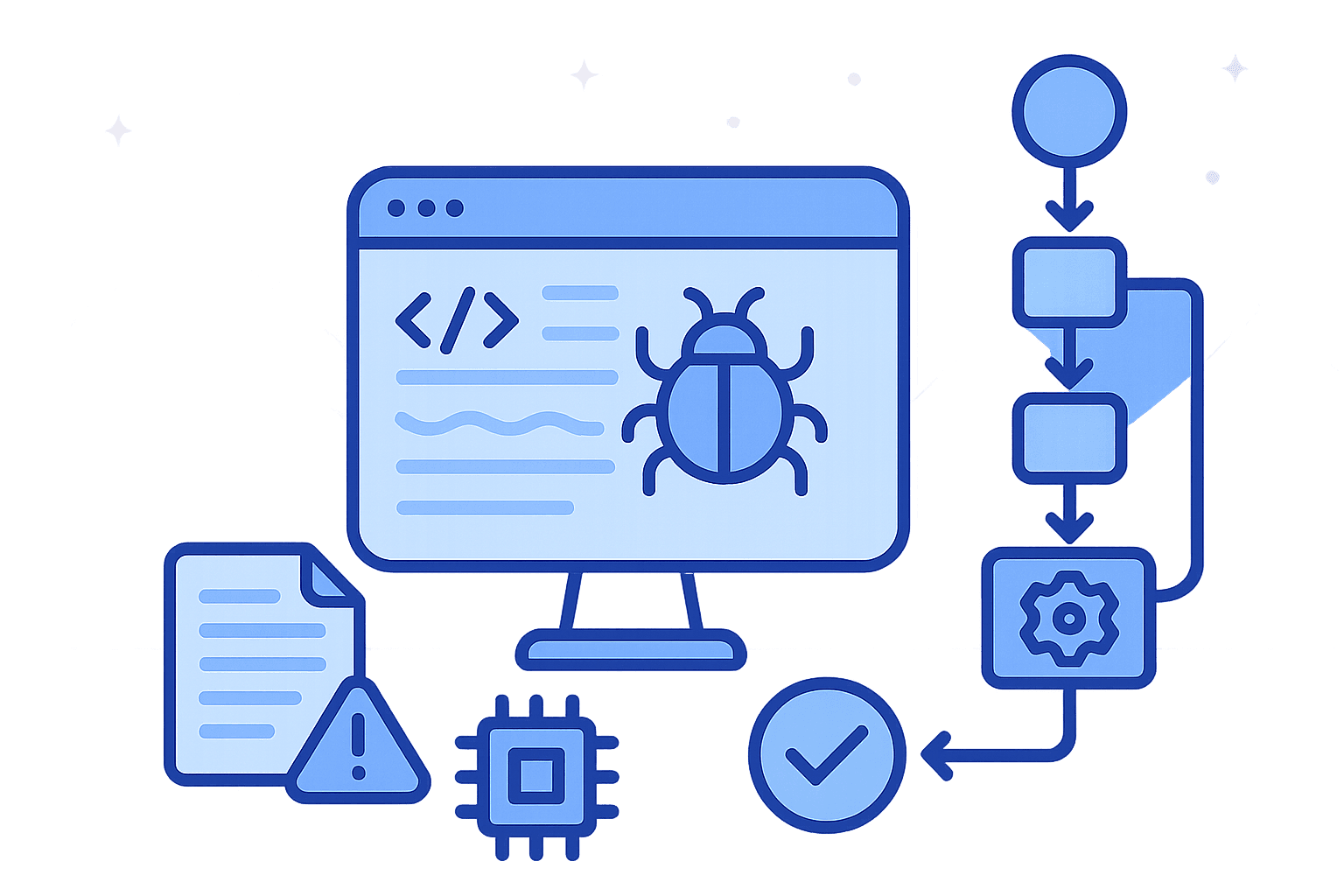
RAG Won’t Fix Your Bugs: Architecting a Code Debugging AI that Reads Traces, Tests, and Telemetry
Large language models can write impressive code. With retrieval-augmented generation (RAG), they can even pull in your repository docs, style guides, or API references. But if you’ve ever chased a 500 in production, you know: RAG alone won’t debug prod. Debugging is an evidence game, not a summarization game. The delta between what you need to know (which request failed with what parameters, under which environment and feature flags, along which call path, and what changed) and what RAG can infer from static text is massive.
This post outlines a pragmatic, end-to-end architecture for a code debugging AI built for production realities. It’s designed to:
- Ground hypotheses in runtime signals: traces, logs, metrics, crash dumps, and coverage.
- Localize faults using evidence (e.g., failing tests vs. passing tests), not vibes.
- Synthesize patches in a sandboxed repro and verify them against tests, contracts, and observability.
- Deliver reproducible artifacts (minimal repro, PR, risks) that engineers trust.
We’ll walk through components, data flows, concrete interfaces, sample code, and references to relevant research and benchmarks. The goal: verifiable fixes and fewer hallucinations.
Why RAG Won’t Debug Production
RAG is great at fetching relevant documentation or code snippets to expand an LLM’s context. For debugging, however, the binding constraint is not missing text—it’s missing state.
Common failure modes when you rely on RAG alone:
- No runtime grounding: You need inputs, timing, and environment to reproduce a bug. Docs and code don’t encode "the request payload at 2026-01-11T03:12Z with feature flag FOO=on and region=eu-west-1".
- Hallucinated causality: The model may propose plausible causes ("probably a null pointer") without considering actual traces or coverage deltas.
- Incomplete fault localization: Without data from failing vs. passing executions, the model can’t compute suspiciousness or isolate the likely culprit lines.
- Poor verification loop: RAG doesn’t ensure reproducibility, tests passing, performance bounds, or safety checks.
Empirically, end-to-end code-repair benchmarks validate this. On SWE-bench Verified, models improve when provided harnesses and tooling that execute tests and validate patches rather than only retrieving context [1]. Research on program repair consistently shows that fault localization and test-based verification are critical for patch quality [2][3]. RAG is a useful ingredient for fetching the right code or doc fragment, but it’s not the oven.
What Debugging in Production Actually Requires
A realistic debugging loop integrates multiple modalities of evidence:
- Failing signals: alerts, crash reports, failing CI tests, or increased error rates in metrics.
- Traces: end-to-end spans (OpenTelemetry/Jaeger/Zipkin) with service boundaries, timing, attributes, errors.
- Logs: structured logs with request IDs, feature flags, inputs, and partial stack traces.
- Coverage: which lines ran (in failing vs. passing tests) and what changed since last green.
- Minimal repro: deterministic harness to recreate failure locally or in a sandbox.
- Test oracles: unit/integration tests, fuzz/property tests, and contracts.
- Build and deploy metadata: commit, environment, feature flags, rollout waves.
These signals let you localize the defect, propose a patch, and verify its correctness. The AI must embody this workflow, not replace it with more text.
Architecture: Evidence-Constrained Code Repair (ECCR)
We propose an Evidence-Constrained Code Repair architecture that makes the AI subordinate to evidence. The system is built around a tight feedback loop:
- Collect signals from prod and CI.
- Construct a deterministic workspace and minimal repro.
- Localize the fault statistically and semantically.
- Generate a patch with constraints.
- Verify with tests and telemetry.
- Explain, package, and gate.
High-level components:
- Signal Ingest and Correlation
- Workspace and Repro Builder
- Fault Localization Engine
- Patch Synthesis Agent
- Verification Orchestrator
- Reporting and Governance
1) Signal Ingest and Correlation
Aggregate runtime and CI artifacts into a normalized store keyed by correlation IDs (request ID, test ID, commit SHA):
- Traces (OpenTelemetry): spans, attributes, service graph, errors.
- Logs: structured JSON logs, parsed into fields (level, message, request_id, user_id hash, payload size, etc.).
- Metrics: error-rate counters, latency histograms, saturation.
- Test results: failing/passing tests, stdout/stderr, exit codes.
- Coverage: per-test coverage maps (e.g., Jacoco, Istanbul, Coverage.py).
- Build/Deploy metadata: feature flags, versions, environment variables, canary cohort.
Tooling suggestions:
- Use OpenTelemetry collectors to export traces/logs/metrics to a warehouse (ClickHouse, BigQuery) and a time-series DB (Prometheus, Mimir) with retention.
- Normalize into a "debugging fact table": (ts, request_id, test_name, commit, service, file:line, span_id, error_code, env, feature_flags, payload_fingerprint).
Example: OpenTelemetry instrumentation snippet (Node.js):
jsimport { NodeSDK } from '@opentelemetry/sdk-node';
import { getNodeAutoInstrumentations } from '@opentelemetry/auto-instrumentations-node';
import { OTLPTraceExporter } from '@opentelemetry/exporter-trace-otlp-http';

const sdk = new NodeSDK({
  traceExporter: new OTLPTraceExporter({ url: process.env.OTLP_URL }),
  instrumentations: [getNodeAutoInstrumentations()],
});

sdk.start();
2) Workspace and Repro Builder
The system must construct a deterministic workspace where the bug is reproducible.
- Checkout exact commit: from failing build or prod release tag.
- Resolve environment: container image, runtime version, feature flags, config.
- Extract inputs: from trace/log attributes (payload sample), or reconstruct with request ID.
- Data fakes: PII-safe synthetic data that preserves distributions (sizes, types, edge cases).
- Sandboxing: run in Firecracker, gVisor, or Docker with seccomp/apparmor profiles; no secrets.
Example: Repro harness builder in Python (simplified):
pythonimport json
import subprocess
from pathlib import Path

# 1) Checkout exact commit
subprocess.run(["git", "fetch", "--all"], check=True)
subprocess.run(["git", "checkout", "--force", "deadbeef"], check=True)

# 2) Reconstruct input from captured trace attributes
trace = json.loads(Path("artifacts/trace.json").read_text())
request_payload = trace["resourceSpans"][0]["scopeSpans"][0]["spans"][0]["attributes"]
payload = json.loads(request_payload["http.request.body"])  # assume structured

# 3) Build minimal repro test
repro_test = f"""
import json
from myservice.handler import handle

def test_min_repro():
    event = {json.dumps(payload)}
    resp = handle(event)
    assert resp["statusCode"] == 200
"""
Path("tests/test_min_repro.py").write_text(repro_test)

# 4) Run test in sandbox (omitted: container launch)
subprocess.run(["pytest", "-q", "tests/test_min_repro.py"], check=False)
The system should aim for a minimal repro. Techniques include:
- Delta debugging on inputs (reduce JSON payload while preserving failure).
- Env minimization (disable non-essential features/flags).
- Fixture synthesis (seeded from production distributions, redacted).
3) Fault Localization Engine
Given a failing test (and a set of passing tests), the engine computes suspiciousness scores per line or function, combining:
- Spectrum-based fault localization (SBFL): metrics like Ochiai, Tarantula from coverage of failing vs. passing tests.
- Dynamic traces: spans with errors and latencies overlayed onto the call graph.
- Change sets: recent diff hunks since last green build.
- Static signals: type errors, taint flows, nullability, pattern matching.
- Heuristics: boundary conditions (off-by-one), timeouts, serialization boundaries, concurrency hotspots.
SBFL quick example (Ochiai):
pythondef ochiai(failed_cov, passed_cov, total_failed, total_passed):
    # failed_cov: number of failing tests covering line l
    # passed_cov: number of passing tests covering line l
    import math
    return failed_cov / math.sqrt(total_failed * (failed_cov + passed_cov))
The output is a ranked list of suspect locations (file:line, function) with supporting evidence:
- Coverage deltas: line executed by failing tests but rarely by passing tests.
- Trace alignment: spans with error tags mapping to the suspect function.
- Change proximity: suspect lines within or adjacent to recent commits.
This yields centroids, not exact truths—but it narrows the search space and constrains the LLM’s attention to evidence-heavy regions.
4) Patch Synthesis Agent
With suspect locations and a reproducible failing test, the agent proposes a patch. Key principles:
- Evidence-constrained prompting: feed only relevant files, diff hunks, and suspect functions, plus the failing test and trace/log excerpts.
- Guardrails: the agent must not modify unrelated files unless required by the type system or build.
- Minimality: prefer smallest diffs that make tests pass.
- Contracts first: if explicit invariants (pre/postconditions) exist, respect them.
Prompt sketch (tool-using LLM):
System: You are a code repair agent. Only modify files specified by the tool "edit". Your changes must be justified by failing tests and traces. Produce small, safe diffs.

User: Here is the failing test output, trace, and suspect locations. Generate a patch.

Tools available:
- read_file(path)
- edit(path, unified_diff)
- run_tests(selector)
- static_analyze()
- format()
- explain()
Concrete constraints:
- Enforce compile/type checks before running expensive suites.
- Run a targeted subset of tests first (those covering suspect areas), then expand to full.
- Use formatting and linting to avoid style-only changes polluting diffs.
5) Verification Orchestrator
Trust is earned by verification:
- Tests: all previously passing tests still pass; failing tests now pass.
- Coverage: added or critical paths covered; no sharp drops in line/function/branch coverage.
- Contracts & properties: property-based tests and runtime assertions hold.
- Static analysis: type checker (MyPy/TypeScript), linters, security scans (Semgrep, CodeQL), SAST.
- Performance: critical routes maintain or improve P50/P95 within tolerance in micro-bench harness.
- Behavioral diffing: golden files or snapshot diffs remain within expected deltas.
A simple orchestrator loop:
bash# short-circuit fail-fast
npm run build || exit 1
npm run typecheck || exit 1
npm run lint || exit 1

# focused tests then full
npm test -- -t "min repro" || exit 1
npm test || exit 1

# static + security
semgrep --config p/ci . || exit 1
codeql database analyze db codeql-suite.qls || exit 1

# perf smoke (budgeted)
node bench/smoke.js || echo "perf skipped on PR" # non-blocking unless regression > threshold
6) Reporting and Governance
The system produces a human-readable and machine-parseable report:
- Root cause hypothesis: in plain language, linked to evidence (trace IDs, logs, coverage lines).
- Diff summary: files changed, LOC, risk score (e.g., touched hot code paths, concurrency code).
- Repro: instructions and artifacts to locally reproduce (inputs, feature flags, commands).
- Validation results: test matrix, coverage deltas, static analysis, perf notes.
- Rollout advice: canary cohort, feature-flag guard, metrics to watch.
Integrations:
- Open a PR with patch and report as a checklist.
- Comment on the failing CI job with repro steps and links to traces/logs.
- Slack/Teams summaries for on-call with "apply patch to canary?" gating.
End-to-End Flow
- Trigger: A specific CI test fails after a merge, or an alert indicates elevated 5xx with a trace sample.
- Ingest: Collect the failing test output, relevant traces/logs, and coverage from the last green build.
- Build repro: Create a sandboxed workspace and minimal repro test harness.
- Localize: Compute suspiciousness score and rank candidate functions/lines.
- Synthesize patch: Constrained LLM edits; first targeted tests, then full suite.
- Verify: Type check, lint, static/security analysis, coverage, property tests, and perf smoke.
- Report and gate: Produce a PR with evidence; require human review for merge.
Walkthrough: A Production 500 in a Node.js Service
Scenario: After a feature flag rollout to EU users, your checkout service shows increased 500s on the /create-order endpoint. Logs show occasional "Cannot read properties of undefined (reading 'currency')". Traces indicate the failure occurs shortly after a call to pricing-service.
Signals:
- Trace spans show orders.create -> pricing.getQuote -> orders.applyDiscount.
- Error attribute attached to orders.applyDiscount span with payload size ~2KB.
- Coverage shows applyDiscount touched only in new tests for discounts, recent diff edits that added optional chaining incorrectly.
Repro harness from captured trace:
js// tests/min_repro.test.js
const { applyDiscount } = require('../lib/discount');

// captured payload from trace (sanitized)
const payload = {
  userId: "u-123",
  items: [{ sku: "abc", price: 1099 }],
  region: "eu-west",
  pricing: { quoteId: "q-999", total: 1099 },
  // missing currency inside pricing due to downstream service change
};

test('minimal repro from prod trace', () => {
  expect(() => applyDiscount(payload)).not.toThrow();
  // acceptable fallback: default to store currency
});
Fault localization:
- SBFL ranks lib/discount.js:42-57 highly suspicious: executed in failing tests, rarely in passing.
- Diff analysis shows a recent commit replaced a defensive default with optional chaining.
- Trace alignment confirms the span error arises within applyDiscount.
Patch synthesis (example):
diff--- a/lib/discount.js
+++ b/lib/discount.js
@@
-function applyDiscount(order) {
-  const pct = getDiscountPct(order.userId); // can be 0..50
-  const currency = order.pricing?.currency; // may be undefined
-  const total = order.pricing.total; // throws if pricing missing
-  return {
-    ...order,
-    pricing: {
-      ...order.pricing,
-      currency, // previously relied on downstream to set
-      total: Math.round(total * (1 - pct / 100)),
-    }
-  }
-}
+function applyDiscount(order) {
+  const pct = getDiscountPct(order.userId);
+  const pricing = order.pricing || {};
+  const total = Number.isFinite(pricing.total) ? pricing.total : 0;
+  // default currency to store default if missing
+  const currency = pricing.currency || process.env.DEFAULT_CURRENCY || 'USD';
+  // if pricing is missing, return order unchanged (no discount)
+  if (!Number.isFinite(total)) {
+    return { ...order, pricing: { ...pricing, currency } };
+  }
+  return {
+    ...order,
+    pricing: {
+      ...pricing,
+      currency,
+      total: Math.round(total * (1 - pct / 100)),
+    },
+  };
+}
Verification:
- All discount unit tests pass, including min_repro.
- Type checks (TypeScript types for pricing: { total: number; currency?: string }) pass.
- Static analysis confirms no unchecked null deref.
- Perf smoke unchanged.
- Coverage: statements +2 lines; critical path covered.
Report summarizes:
- Root cause: pricing.currency missing for EU cohort after downstream change; unsafe optional chaining allowed undefined in discount pipeline.
- Fix: default currency and guard when pricing missing; maintain backward compatibility.
- Risk: low; limited to discount path; validated with unit and integration tests.
Implementation Details: Glue That Matters
Structured Retrieval Beyond RAG
Use RAG to fetch relevant code and docs, but bind it to symbols and runtime facts:
- Symbol-indexed retrieval: map functions/classes to files, call graph nodes, and tests that cover them. Retrieve by symbol rather than naive embeddings of entire files.
- Dynamic slice retrieval: given a failing trace, retrieve involved symbols and their transitive dependencies.
- Time-bounded diffs: prefer code within the last N commits if tests first failed after that window.
Tool Interfaces (JSON Schemas)
Define clean interfaces so the agent can call tools deterministically. Example:
json{
  "tool": "run_tests",
  "inputSchema": {
    "type": "object",
    "properties": {
      "selector": { "type": "string" },
      "timeoutSec": { "type": "integer", "minimum": 1 }
    },
    "required": ["selector"]
  },
  "outputSchema": {
    "type": "object",
    "properties": {
      "passed": { "type": "boolean" },
      "stdout": { "type": "string" },
      "failedTests": { "type": "array", "items": { "type": "string" } }
    },
    "required": ["passed"]
  }
}
The agent’s prompt should include these schemas to encourage structured tool use (ReAct/Toolformer patterns).
Sandboxing and Determinism
- Containerize: use immutable base images with pinned toolchains.
- Network policy: default deny; allow only what the repro needs.
- Time and randomness: fix time (e.g., via time namespace or injection) and seed RNG for deterministic runs.
- File system: ephemeral writable layer, read-only source checkout; prevent secret mounts.
Example GitHub Actions step with Firecracker (via Kata/gVisor) for isolation:
yamljobs:
  debug-ai:
    runs-on: ubuntu-latest
    container:
      image: ghcr.io/yourorg/debug-runtime:1.2.3
      options: --runtime=runsc  # gVisor
    steps:
      - uses: actions/checkout@v4
      - run: npm ci
      - run: node ./.ci/run_debug_agent.js
Property-Based and Invariant Tests from Logs
Mine invariants from logs ("amount >= 0", "sku exists", "currency in [USD, EUR, GBP]") and automatically generate property-based tests to guard against regressions:
pythonfrom hypothesis import given, strategies as st
from mysvc.order import apply_discount

@given(total=st.integers(min_value=0, max_value=10_000), pct=st.integers(min_value=0, max_value=50))
def test_never_negative(total, pct):
    order = {"pricing": {"total": total, "currency": "USD"}, "userId": "x"}
    out = apply_discount(order, pct=pct)
    assert out["pricing"]["total"] >= 0
Coverage-Guided Verification
Integrate per-test coverage to ensure that patches actually exercise suspected lines and that added tests cover the defect:
- Require coverage delta ≥ threshold for suspect areas.
- Block patches that “fix” by bypassing execution without covering the defect lines.
Concurrency and Nondeterminism
Some failures depend on timing. Mitigations:
- Deterministic schedulers or "virtual time" where possible.
- Stress/fuzz runs: run tests N times and detect flakiness.
- Record/replay: capture interleaving (e.g., via rr or JVM Flight Recorder) when feasible.
Evaluation and Metrics That Matter
To build confidence and improve over time:
- Patch acceptance rate: PRs merged after human review without rework.
- Time-to-first-repro: minutes from alert to minimal repro.
- Mean time to validated patch: from repro to green verification.
- Flake-adjusted success: discount flakey tests; measure stable fixes.
- Regression rate: incidents caused by accepted AI patches within 30 days.
- Benchmark performance: SWE-bench Verified [1], Defects4J [2], QuixBugs [3] with the full pipeline, not just LLM-only baselines.
Key observation from recent work: tool-augmented models that can run tests and iterate dramatically outperform static generation, especially on end-to-end correctness [1].
Security, Privacy, and Compliance
- PII redaction: structured scrubbing of logs/traces with reversible tokens only in a secured enclave.
- Data minimization: move only necessary attributes into the repro; never export raw prod payloads outside compliance boundaries.
- Secrets hygiene: zero trust in sandboxes; short-lived credentials; no home directory mounts.
- Audit trail: immutable logs of what the agent accessed and changed, with hashes of artifacts.
Failure Modes and Mitigations
- Heisenbugs: If repro is elusive, switch to probabilistic runs and time-travel debugging if supported.
- Overfitting patches: Prevent by running broader suites and property tests; require coverage on suspect lines.
- Perf regressions: Include perf smoke tests and budget checks with service-specific SLOs.
- Spec ambiguity: When docs contradict behavior, prefer observed invariants and add tests to codify them; request human input when risk exceeds threshold.
Practical Stack Recommendations
- Observability: OpenTelemetry + collector; Jaeger/Tempo for traces; ClickHouse/BigQuery for search.
- Test/coverage: pytest/pytest-cov, Jest/Istanbul, JaCoCo/Gradle.
- Static/security: TypeScript/tsc, MyPy, ESLint/Prettier, Semgrep, CodeQL.
- Sandbox: Firecracker via Kata/gVisor, Docker with tight seccomp profiles.
- Orchestration: GitHub Actions/CircleCI + lightweight orchestrator service for the agent.
- LLM layer: a model with strong code abilities (e.g., GPT-4.1 or successor, Code Llama derivatives) with tool usage; prompt templates that enforce evidence-first behavior.
Beyond MVP: Learning From Real Incidents
- Fine-tune on your incident corpus (sanitized). Include trace snippets, diffs, and which patches were accepted.
- Reinforcement from verification (RFV): reward models for patches that pass tests and decrease error metrics in canary.
- Active learning: when the agent abstains or gets rejected, solicit minimal human feedback and add to training data.
Conclusion
RAG is a useful supporting act for code debugging, not the headliner. Production debugging is about evidence: traces, logs, coverage, and tests. An effective debugging AI must ground itself in that evidence, localize faults statistically and semantically, and close the loop with verifiable patches in a sandboxed environment.
The Evidence-Constrained Code Repair architecture outlined here is a practical path to that goal. Start by plumbing your signals, building deterministic repros, and putting verification at the core. With those foundations, your AI won’t just suggest fixes—it will earn them.
References
-
SWE-bench Verified: A challenge for end-to-end code reasoning and patch validation. https://www.swebench.com/
-
Just, R.; Jalali, D.; Ernst, M.D. Defects4J: A Database of Existing Faults to Enable Controlled Testing Studies for Java Programs. https://defects4j.org/
-
Lin, D.; et al. QuixBugs: A Multi-Language Program Repair Benchmark Set. https://github.com/jkoppel/QuixBugs
-
Abreu, R.; Zoeteweij, P.; van Gemund, A.J.C. An Evaluation of Similarity Coefficients for Software Fault Localization. https://doi.org/10.1109/PRDC.2006.18
-
Monperrus, M. A Critical Review of Automatic Patch Generation Learned from Human-Written Patches: Essays of the Past, Present, and Future. https://arxiv.org/abs/1811.02144
-
OpenTelemetry Project. https://opentelemetry.io/
-
Semgrep: Lightweight static analysis for many languages. https://semgrep.dev/
-
CodeQL: Semantic code analysis engine. https://codeql.github.com/
-
rr: Record and Replay Framework. https://rr-project.org/