A preview link can make a broken product look healthy.
That’s the trap.
A reviewer opens the PR environment, lands on the new page, clicks around for 20 seconds, and says the magic words: “Looks good to me.” CI is green. The deploy bot is happy. The branch preview rendered the right components with the right styles and the seeded test account loaded without obvious explosions.
Then production happens.
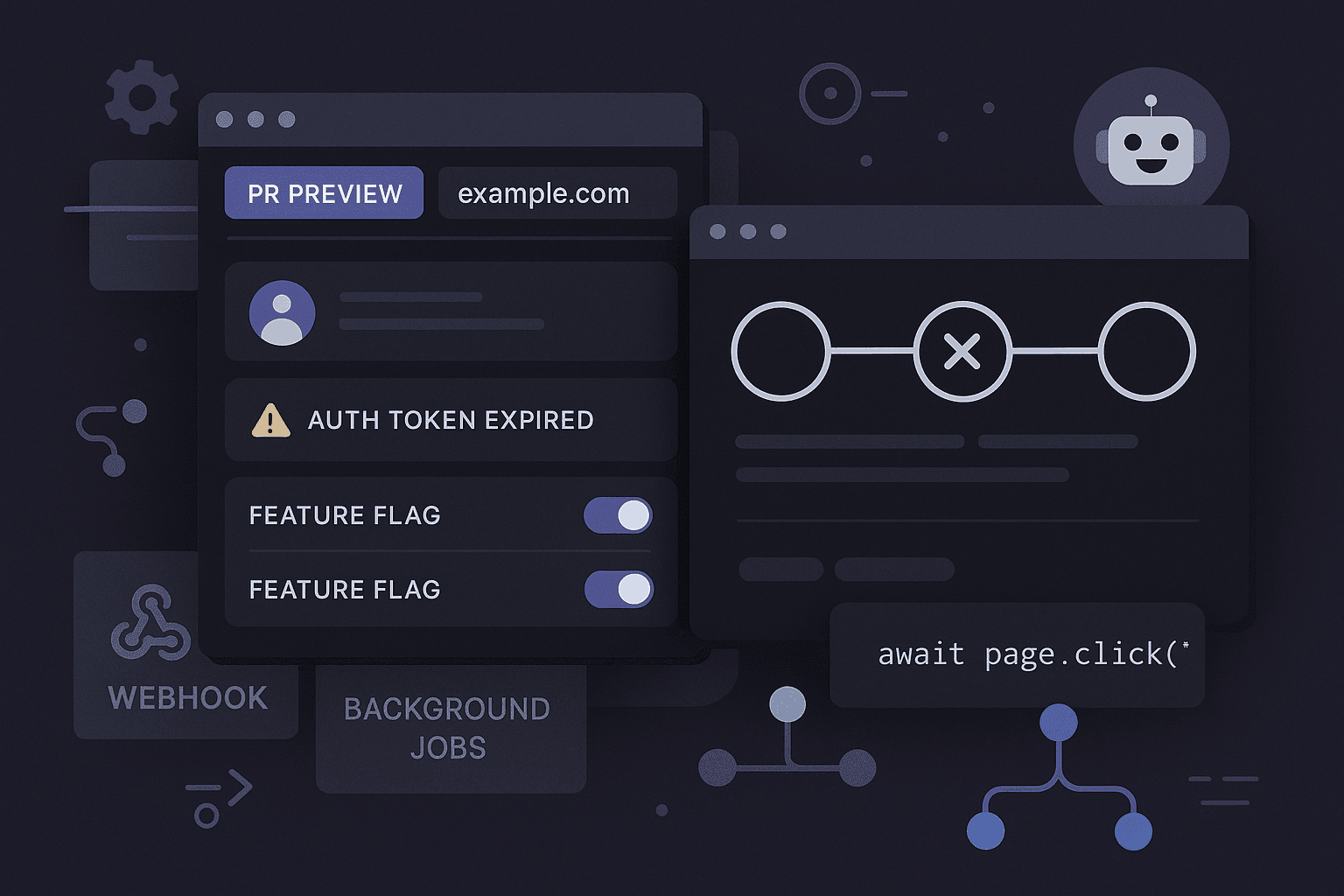
The user session expires midway through checkout. A feature flag flips between the first step and the confirmation page. A background job races the UI and mutates the record you thought was stable. A webhook arrives late. An OAuth callback returns with a slightly different shape than your mock. The account your preview environment seeded starts in a state no real customer ever has. The first click works. The second works. The fifth reveals that the workflow never really existed.
This is where a lot of modern teams are fooling themselves. PR previews prove that pages render. They do not prove that workflows survive changing state.
That distinction matters more now because AI is accelerating code generation faster than most teams are improving testing discipline. You can ship UI surfaces at unprecedented speed. You can also manufacture state-dependent failures at unprecedented speed. More code gets produced, more branches get reviewed through screenshots and preview links, and more people confuse “the screen appeared” with “the system works.”
If you care about reliability, debugging, testing, CI/CD, and developer productivity, you need to stop treating preview environments as evidence of correctness. They are useful, but they are weak proof. They are snapshots. Your users live inside transitions.
The real production failure nobody catches in preview
Consider a common SaaS workflow:
- User starts a trial.
- They verify email.
- They connect a third-party integration.
- A background sync job imports initial data.
- Billing state changes after trial activation.
- A feature flag exposes onboarding step 4 only for certain accounts.
- The user returns the next day and resumes setup.
A PR preview can show every page in that flow. It can make the onboarding UI look complete. It can let a reviewer click “Connect” using a mocked provider and see the success screen.
But the actual failure might require this exact sequence:
- Account created before a flag rollout
- OAuth callback returns after session refresh
- Background sync writes partial records
- User reloads from a stale deep link
- Billing webhook marks account active after the UI cached “trialing” state
- The next action becomes invalid because the backend moved the resource to a new state that the frontend never anticipated
Nothing is visually broken on first render. Every screenshot looks fine. The bug is temporal.
That’s the category many teams underinvest in because their workflow for validation is still anchored to page-level confidence. Preview URLs fit nicely into asynchronous code review. They are easy to share. They feel modern. They demonstrate progress. But they systematically miss the kinds of failures that matter most once an application has auth, async work, external systems, and real users moving between steps over time.
The problem with preview-driven confidence
PR preview environments are not useless. They’re great for visual review, basic smoke checks, stakeholder feedback, and catching environment-specific issues early. They help answer questions like:
- Does the page load?
- Did the route compile?
- Is the styling broken?
- Are obvious runtime errors visible immediately?
- Can a reviewer validate rough UX before merge?
Those are valuable checks. The problem starts when teams elevate those checks into a proxy for release readiness.
A preview environment tends to optimize for static inspection:
- one branch
- one version of code
- one fresh state
- one seeded account
- one happy-path interaction
- one reviewer spending limited time
Real applications fail under dynamic conditions:
- state changes between requests
- retries and races
- stale sessions
- expired auth
- progressive permissions
- asynchronous side effects
- delayed or duplicate webhooks
- partial migrations
- users returning after hours or days
- feature flags changing while workflows are in flight
A preview environment mostly proves that your branch can boot and serve a UI. It rarely proves that the application remains correct as state evolves.
That’s not a small gap. For many products, that gap is the product.
Why modern apps are especially vulnerable to state-dependent bugs
Ten years ago, many internal tools and CRUD apps could get surprisingly far with route-level checks, unit tests, and manual QA. Today’s systems are more event-driven and conditional.
Even relatively simple products now include:
- session tokens and refresh flows
- email verification and magic links
- role-based access controls
- per-account feature flags
- background processing
- search indexing
- analytics pipelines
- webhooks from Stripe, Slack, GitHub, and identity providers
- optimistic UI updates
- cache layers on client and server
- eventual consistency across services
- retries, deduplication, and queue semantics
These are not edge concerns. They’re the normal architecture of software that touches money, identity, collaboration, or integrations.
State is no longer just “row exists in database.” It is a distributed, time-dependent set of conditions across systems. That means the bug surface shifts from rendering logic to transition logic.
The failures users feel most sharply usually happen at boundaries:
- before auth refresh and after auth refresh
- before webhook and after webhook
- before job completion and after job completion
- before flag evaluation and after flag evaluation
- before navigation and after resume
- before optimistic update and after server reconciliation
Preview links freeze one moment. Reliability depends on surviving many moments in sequence.
AI-generated code makes this worse, not better
AI-assisted development is excellent at producing local correctness. It can scaffold a page, generate handlers, wire forms, and satisfy obvious type constraints quickly. It can also create a dangerous illusion: that because the code is coherent at the function or component level, the workflow is safe.
This is where a lot of teams are sleepwalking.
AI tends to produce code that passes the first-order check:
- component renders
- submit button triggers request
- endpoint returns expected shape in the happy path
- unit tests pass against mocked dependencies
But stateful systems don’t fail on first-order checks. They fail when assumptions drift across steps.
Common AI-generated failure patterns include:
- assuming backend state is unchanged between UI steps
- missing retry-safe behavior for duplicate callbacks
- handling success responses but not delayed transitions
- coding against idealized mock payloads rather than real provider payloads
- forgetting that a user may resume a flow from a stale URL
- relying on seeded data conditions that never occur in production
- overfitting tests to implementation details instead of user-visible behavior
The more code AI produces, the more important workflow-level testing becomes. Otherwise you end up with broad surface area and shallow confidence.
This is not an argument against AI. It’s an argument against pretending AI-generated velocity changes the laws of software reliability. Faster code generation increases the need for better testing strategy. It does not reduce it.
Why CI, unit tests, and manual QA still miss these failures
Teams often respond to incidents by saying, “But CI passed.” That statement is usually true and mostly irrelevant.
CI pipelines often validate build integrity, linting, unit coverage, maybe some integration tests, and perhaps a smoke E2E run. That can catch regressions in isolated logic. It does not necessarily validate real workflows over changing state.
Unit tests are too local
Unit tests answer: does this function behave given these inputs?
They rarely answer:
- what if this input is valid on step 1 but stale on step 3?
- what if another process mutated the resource after initial fetch?
- what if a callback arrives twice?
- what if auth changes role claims between page loads?
Unit tests are necessary. They are not enough.
Here’s a classic example in JavaScript:
jsexport function canShowUpgrade(account) {
  return account.plan === 'trial' && !account.subscriptionId;
}
Unit tests can cover this perfectly:
jsimport { canShowUpgrade } from './billing';

test('shows upgrade for trial without subscription', () => {
  expect(canShowUpgrade({ plan: 'trial', subscriptionId: null })).toBe(true);
});

test('hides upgrade when subscription exists', () => {
  expect(canShowUpgrade({ plan: 'trial', subscriptionId: 'sub_123' })).toBe(false);
});
Great. But the production issue isn’t inside that function. It’s that the UI fetched account state before a webhook created subscriptionId, then submitted a checkout action based on stale assumptions. Local correctness, global failure.
Integration tests often mock away the interesting parts
A lot of integration tests are still just better unit tests with HTTP wrappers. They stub external systems, pin API responses, and validate happy paths inside one process. Useful, but often blind to timing, duplication, ordering, and real callback behavior.
If your Stripe, Auth0, or GitHub integration only exists as a clean mock in CI, you are testing a fictional world.
Manual QA is inconsistent and biased toward first impressions
Manual testers, reviewers, and founders are naturally drawn to obvious visual paths:
- open page
- click CTA
- confirm success toast
- move on
They are not usually going to:
- wait for a token to expire
- switch flags mid-session
- replay a webhook
- interrupt the background job and resume later
- retry the action from a stale tab
- test the fifth action after a delayed side effect
Nor should you rely on humans to do that repeatedly with precision. That’s exactly what automation is for.
The core insight: test transitions, not pages
If your feature depends on state, the thing you need to validate is not “can this page render?” but “does this action sequence remain valid as system state changes underneath it?”
That is the center of modern reliability.
Stop thinking in terms of screen existence. Start thinking in terms of workflow invariants.
Examples of workflow invariants:
- A user can resume onboarding safely after auth refresh.
- A billing action is idempotent if the callback is delayed or duplicated.
- A document cannot transition from draft to published if permissions changed mid-flow.
- A setup wizard adapts correctly when feature flags change between steps.
- A user sees the right recovery path when a background import partially completes.
These are not unit-level concerns. They are sequence-level concerns.
The best testing strategy for modern apps is built around state transitions:
- initial state
- user action
- system side effect
- changed state
- follow-up user action
- observed result
You want tests that encode the journey, not just the snapshot.
What this looks like in practice with Playwright
Playwright is valuable here because it lets you test from the user’s perspective while still controlling network, auth, storage, and timing well enough to create meaningful state changes.
A weak preview-style E2E test looks like this:
tsimport { test, expect } from '@playwright/test';

test('onboarding page loads', async ({ page }) => {
  await page.goto('/onboarding');
  await expect(page.getByRole('heading', { name: 'Get started' })).toBeVisible();
  await page.getByRole('button', { name: 'Connect GitHub' }).click();
  await expect(page.getByText('Connected')).toBeVisible();
});
That proves almost nothing besides first-render viability.
A better stateful workflow test encodes transitions:
tsimport { test, expect } from '@playwright/test';

test('user can resume onboarding after auth refresh and delayed sync', async ({ page, request }) => {
  // Create account in initial state
  const createRes = await request.post('/test-api/accounts', {
    data: {
      email: 'user@example.com',
      plan: 'trial',
      featureFlags: { newOnboarding: true },
      integrationStatus: 'not_connected'
    }
  });

  const account = await createRes.json();

  // Login through test helper
  await request.post('/test-api/login', {
    data: { accountId: account.id }
  });

  await page.goto(`/onboarding/${account.id}`);
  await page.getByRole('button', { name: 'Connect GitHub' }).click();

  // Simulate third-party callback completing
  await request.post('/test-api/integrations/github/callback', {
    data: {
      accountId: account.id,
      status: 'connected'
    }
  });

  // Simulate auth/session refresh before next step
  await request.post('/test-api/sessions/refresh', {
    data: { accountId: account.id }
  });

  // Background sync still incomplete
  await page.reload();
  await expect(page.getByText('Sync in progress')).toBeVisible();

  // Complete background import after user has already loaded page
  await request.post('/test-api/jobs/complete', {
    data: {
      jobType: 'initial_github_sync',
      accountId: account.id
    }
  });

  await page.getByRole('button', { name: 'Continue' }).click();
  await expect(page.getByRole('heading', { name: 'Import complete' })).toBeVisible();
});
This test is more representative because it models the exact thing previews hide: state changes during the workflow.
Test the same workflow under different state mutations
Don’t stop at one happy-path sequence. Parameterize the transitions.
tsimport { test, expect } from '@playwright/test';

const scenarios = [
  { name: 'flag stays enabled', beforeContinue: async () => {} },
  {
    name: 'flag disabled mid-flow',
    beforeContinue: async (request, accountId) => {
      await request.post('/test-api/flags/set', {
        data: { accountId, flags: { newOnboarding: false } }
      });
    }
  },
  {
    name: 'role downgraded mid-flow',
    beforeContinue: async (request, accountId) => {
      await request.post('/test-api/accounts/update-role', {
        data: { accountId, role: 'viewer' }
      });
    }
  }
];

for (const scenario of scenarios) {
  test(`workflow handles state transition: ${scenario.name}`, async ({ page, request }) => {
    const createRes = await request.post('/test-api/accounts', {
      data: { email: 'test@example.com', role: 'admin', featureFlags: { newOnboarding: true } }
    });

    const account = await createRes.json();
    await request.post('/test-api/login', { data: { accountId: account.id } });

    await page.goto(`/onboarding/${account.id}`);
    await page.getByRole('button', { name: 'Start setup' }).click();

    await scenario.beforeContinue(request, account.id);

    await page.getByRole('button', { name: 'Continue' }).click();

    if (scenario.name === 'role downgraded mid-flow') {
      await expect(page.getByText('Your permissions changed')).toBeVisible();
    } else {
      await expect(page).not.toHaveURL(/error/);
    }
  });
}
This is where real confidence starts: the same user journey, stressed under changing conditions.
Add backend-level state orchestration in Python
Many teams need test helpers outside the app runtime to set up realistic preconditions. Python is often a good fit for orchestration scripts, fixtures, and callback simulation.
Here’s a simple Flask-based test helper service pattern:
pythonfrom flask import Flask, request, jsonify
from datetime import datetime, timedelta

app = Flask(__name__)

ACCOUNTS = {}
JOBS = {}
WEBHOOK_EVENTS = []

@app.post('/test-api/accounts')
def create_account():
    payload = request.json
    account_id = f"acct_{len(ACCOUNTS)+1}"
    ACCOUNTS[account_id] = {
        'id': account_id,
        'email': payload['email'],
        'plan': payload.get('plan', 'trial'),
        'role': payload.get('role', 'admin'),
        'feature_flags': payload.get('featureFlags', {}),
        'session_expires_at': (datetime.utcnow() + timedelta(minutes=30)).isoformat(),
        'integration_status': payload.get('integrationStatus', 'not_connected')
    }
    return jsonify(ACCOUNTS[account_id])

@app.post('/test-api/flags/set')
def set_flags():
    payload = request.json
    account = ACCOUNTS[payload['accountId']]
    account['feature_flags'].update(payload['flags'])
    return jsonify(account)

@app.post('/test-api/sessions/expire')
def expire_session():
    payload = request.json
    account = ACCOUNTS[payload['accountId']]
    account['session_expires_at'] = (datetime.utcnow() - timedelta(minutes=1)).isoformat()
    return jsonify({'ok': True})

@app.post('/test-api/webhooks/stripe')
def stripe_webhook():
    payload = request.json
    WEBHOOK_EVENTS.append(payload)
    account = ACCOUNTS[payload['accountId']]
    if payload['type'] == 'subscription.created':
        account['plan'] = 'paid'
        account['subscription_id'] = payload['subscriptionId']
    return jsonify({'ok': True})

if __name__ == '__main__':
    app.run(port=5051)
Then your Playwright tests or CI jobs can mutate system state intentionally instead of depending on static seeded fixtures.
That’s the key shift: use seeded data as a starting point, not as proof.
CI/CD should execute workflow matrices, not just smoke tests
Most CI/CD setups still privilege speed over realism in the wrong places. They run many cheap tests that validate implementation fragments, then maybe one or two expensive browser checks.
The result is impressive green dashboards with weak product confidence.
A better pipeline separates concerns:
- Fast unit and component tests for local correctness
- Integration tests for service boundaries
- Workflow E2E tests for state transitions
- Scheduled or pre-release suites for third-party and callback realism
Here’s a GitHub Actions example:
yamlname: CI

on:
  pull_request:
  push:
    branches: [main]

jobs:
  unit:
    runs-on: ubuntu-latest
    steps:
      - uses: actions/checkout@v4
      - uses: actions/setup-node@v4
        with:
          node-version: 20
      - run: npm ci
      - run: npm run lint
      - run: npm run test:unit

  integration:
    runs-on: ubuntu-latest
    services:
      postgres:
        image: postgres:16
        env:
          POSTGRES_PASSWORD: postgres
        ports:
          - 5432:5432
    steps:
      - uses: actions/checkout@v4
      - uses: actions/setup-node@v4
        with:
          node-version: 20
      - run: npm ci
      - run: npm run db:migrate
      - run: npm run test:integration

  workflow-e2e:
    runs-on: ubuntu-latest
    strategy:
      matrix:
        scenario:
          - auth-refresh
          - webhook-delay
          - flag-change
          - background-job-race
    steps:
      - uses: actions/checkout@v4
      - uses: actions/setup-node@v4
        with:
          node-version: 20
      - run: npm ci
      - run: npx playwright install --with-deps
      - run: docker compose up -d
      - run: SCENARIO=${{ matrix.scenario }} npm run test:e2e:workflow

  preview-smoke:
    runs-on: ubuntu-latest
    if: github.event_name == 'pull_request'
    steps:
      - run: echo "Run minimal checks against deployed preview URL"
Notice the shift: preview checks are smoke tests, not the source of truth.
Gate merges on a thin but meaningful workflow suite
You do not need 500 browser tests on every PR. You do need a compact set of high-signal workflow tests covering your critical state transitions:
- sign in and session refresh
- checkout and billing callback
- invite and role change
- integration connect and delayed sync
- create/edit/publish under permission or flag changes
That suite should be curated aggressively. If a flow makes money, provisions access, imports data, or changes irreversible state, it deserves transition-level coverage.
Tools comparison: what each layer is actually good at
Teams get into trouble when they expect one testing layer to answer every question. It won’t.
| Tool / Approach | Good for | Weak at | Best use |
|---|---|---|---|
| PR previews | Visual review, stakeholder feedback, route smoke checks | Stateful workflows, delayed effects, auth expiry, callback realism | Fast inspection and collaboration |
| Unit tests | Pure logic, branch coverage, fast feedback | Cross-step behavior, time-dependent state | Protect local correctness |
| Integration tests | Service boundaries, DB interactions, contract checks | Full user workflows across async transitions | Validate subsystems with realistic dependencies |
| Playwright / browser E2E | Real user paths, UI plus backend interaction, workflow assertions | Very broad coverage if poorly designed, slow if abused | Validate critical sequences and transitions |
| Manual QA | Exploratory discovery, UX nuance, weird edge observations | Repeatability, timing precision, exhaustive transition coverage | Investigate unknowns, not replace automation |
| Production monitoring / tracing | Real failures, debugging complex incidents | Preventing regressions before release | Close the loop and inform test design |
The goal is not to replace previews. It’s to demote them from “confidence artifact” to “rendering artifact.”
Actionable practices for teams shipping stateful features
Here’s what I’d actually recommend if your team keeps getting burned by bugs that only appear after the second or fifth user action.
1. Write test plans as action sequences
Before implementation, describe the workflow like this:
- Start with account in state A
- User performs action B
- System processes event C
- State changes to D
- User resumes with action E
- Expected invariant: F
This forces everyone to think beyond the page.
2. Identify every external or asynchronous state changer
For each feature, list what can change state besides the current request:
- auth/session refresh
- feature flags
- webhooks
- queues/jobs
- search indexing
- permission changes
- admin actions
- retries from third parties
- duplicate callbacks
If it can change state, it can break a workflow.
3. Build test helpers to mutate state intentionally
You need reliable ways to:
- expire sessions
- flip flags
- inject webhook payloads
- complete background jobs
- create stale resources
- duplicate callbacks
- alter roles mid-session
Without state control, your E2E tests stay shallow.
4. Test resumability explicitly
Many important bugs happen when users leave and come back.
Add tests for:
- reload on step 2
- reopen from emailed link
- continue after token refresh
- resume after partial backend completion
- reopen stale tab after state transition
If the workflow only works in one uninterrupted browser session, it’s fragile.
5. Prefer invariant assertions over brittle page assertions
Don’t just assert that a heading exists. Assert that the system behaves correctly.
Examples:
- duplicate webhook does not create duplicate charge
- permission downgrade blocks publish and explains why
- completed import unlocks next step without forcing user to restart
- expired session returns user to login and preserves intended destination
These assertions survive UI changes and reflect business correctness.
6. Treat seeded preview data as suspicious
Seeded accounts often hide reality because they are too clean.
Real systems have:
- partial records
- old records from previous schemas
- duplicated history
- missing optional fields
- accounts created before current flags or onboarding steps existed
Test with ugly state, not just pristine state.
7. Use production incidents to drive workflow coverage
Every serious incident should produce one of two things:
- a new invariant test
- a new state mutation helper
This is how debugging improves testing instead of staying a postmortem ritual.
8. Keep the workflow suite small and brutal
Don’t create hundreds of browser tests that check everything weakly. Create a smaller suite that attacks the places your architecture is most likely to lie:
- identity
- money
- permissions
- async imports
- external integrations
- long-running setup flows
High signal beats broad ceremony.
What teams should validate instead of preview screenshots
If you want stronger release confidence, validate these questions:
- Can the user complete the workflow if state changes between steps?
- Can they recover if the system advances before the UI does?
- Can they resume safely after interruption?
- Are side effects idempotent under retries and duplicate callbacks?
- Do permissions and flags get re-evaluated correctly at each critical action?
- Does the UI handle partial completion instead of assuming atomic completion?
- Are stale links, stale tabs, and stale local caches survivable?
Those questions are far closer to user reality than “did the page render in the preview deployment?”
The uncomfortable truth about developer productivity
A lot of organizations quietly sacrifice reliability in the name of developer productivity, then pay it back with debugging, incidents, customer support, rollback churn, and trust erosion.
That is not productivity. That is deferred cost.
Real developer productivity comes from shortening the path to trustworthy change. If AI helps you ship more code, your testing strategy must evolve so confidence scales with output. Otherwise your team just gets faster at manufacturing uncertainty.
Preview links are convenient. They are good for communication. They are not strong evidence that a stateful feature works.
If your release process still treats PR previews as a meaningful proxy for workflow correctness, you are measuring the easiest thing instead of the right thing.
Conclusion
PR previews lie most convincingly when your product depends on state.
They show that a branch can render a page. They do not show that a user can survive the transitions that define real software: auth expiry, background jobs, feature flag changes, delayed callbacks, webhook races, stale sessions, partial imports, and resumed flows.
That gap is getting more dangerous as AI increases code volume. More code means more branches, more surfaces, more assumptions, and more ways for workflows to fail after the first click.
So keep your previews. Use them for what they are good at. But stop confusing them with proof.
Test action sequences across changing state. Build workflow invariants. Simulate external events. Exercise resumability. Treat CI/CD as a place to validate transitions, not just compilation and happy-path rendering.
Your users do not experience your application as a screenshot.
They experience it as time.
That’s what your testing needs to cover.