
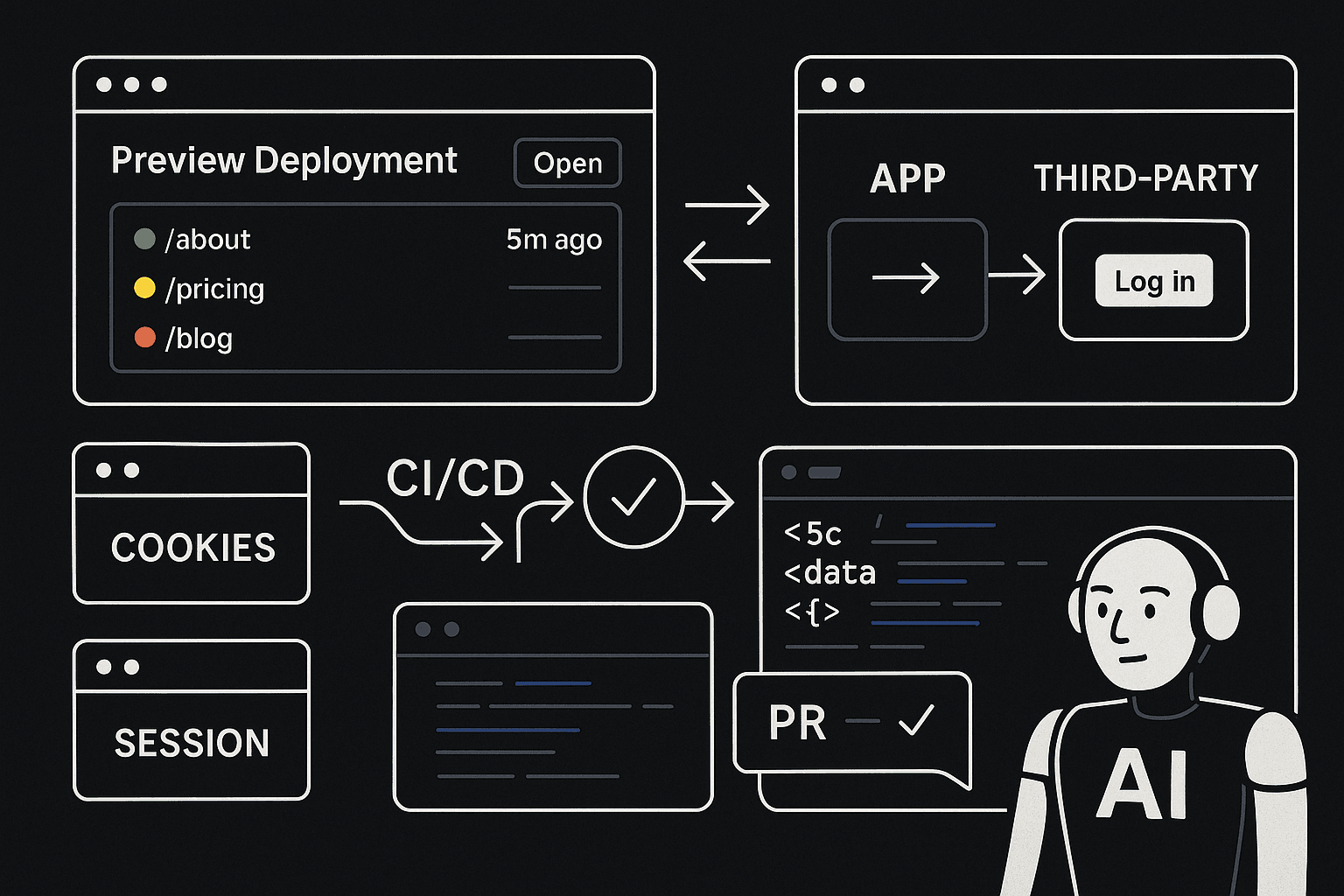
A pull request can look completely healthy right up until the moment someone clicks “Sign in with Google” in a review app and gets bounced into a broken redirect loop.
CI is green. Unit tests pass. Integration tests pass. The preview deploy succeeded. The diff is small. The generated code even looks reasonable. Then the login flow hits a real browser, a real callback URL, a real cookie policy, and a real third-party auth provider, and suddenly none of the confidence signals mean much.
This is not a niche problem. It is one of the most common ways modern teams ship regressions while believing they are covered.
The reason is simple: most PR validation is built around code correctness, while many of the highest-impact failures happen at the workflow boundary. OAuth, checkout, invite acceptance, passwordless magic links, SSO handoffs, embedded payment pages, and multi-domain sessions do not fail because a pure function returned the wrong value. They fail because browsers, environments, redirects, cookie attributes, third-party state, and deployment topology interact in ways your test pyramid usually does not model.
That gap matters more now because AI-assisted development increases the volume of code changes, especially “plausible” changes that compile, pass tests, and still break user-critical flows. AI is very good at producing code that satisfies local constraints. It is not inherently good at understanding the full operational shape of cross-origin workflows in staging, preview, and production-like environments.
If you care about reliability, debugging, testing, CI/CD quality, and developer productivity, you need to validate the actions users actually take, not just the functions developers touched.
The failure pattern teams keep repeating
A familiar sequence goes like this:
- A developer or coding agent updates auth middleware, callback handling, environment variables, cookie configuration, domain logic, reverse proxy rules, or frontend routing.
- Unit tests verify helper functions, token parsing, or route guards.
- Integration tests verify application endpoints with mocked sessions or stubbed providers.
- CI/CD marks the pull request as healthy.
- A preview deployment spins up under a unique subdomain.
- Someone attempts a real login flow.
- The auth provider redirects back to the wrong URL, the session cookie is not sent,
SameSiteblocks the flow, the callback route mismatches the provider config, or the browser treats the review domain differently than localhost.
Everything looked fine until the workflow crossed a boundary that your tests abstracted away.
This same pattern shows up outside OAuth too:
- Checkout passes mocked payment tests but fails 3DS challenge completion in preview.
- Invite links work locally but fail when the email service signs URLs against a different base domain.
- Password reset completes in API tests but breaks when the frontend route is served behind a preview proxy.
- Enterprise SSO works in staging but not review apps because callback whitelists are static.
- Embedded widgets fail because third-party cookies are partitioned or blocked.
These are not edge cases. These are core user actions. If login or checkout is broken, the application is broken.
Why CI/CD gives false confidence here
Most teams have strong opinions about CI/CD because the pipeline is visible, measurable, and easy to gate on. If tests are green, we want to believe the software is healthy.
But CI/CD can only validate what you actually ask it to validate.
In many codebases, CI is dominated by three categories:
- unit tests
- service or API integration tests
- static checks like linting, typing, and build validation
Those checks are useful. You should keep them. They catch a lot of issues cheaply.
What they do not prove is that a user can complete a workflow in a browser, in a deployed environment, with real redirects and browser security behavior.
There are several reasons CI overstates confidence on these flows.
1. Tests run against an artificial topology
Locally and in CI, the app often runs under one host, one origin, one set of assumptions. OAuth flows in production do not.
A realistic login flow may involve:
- your app at
https://pr-482.example.review - an API at
https://api-pr-482.example.review - an auth provider callback whitelist
- a CDN or reverse proxy rewriting headers
- cookies scoped to
.example.reviewor a specific host - redirects through
/auth/start, the provider domain,/auth/callback, and a frontend route
Unit and integration tests usually flatten this topology. Once flattened, they stop testing the thing that actually breaks.
2. Mocking removes the hardest part
Mocking auth providers is attractive because it makes tests deterministic and fast. But the hardest failures in auth are often specifically about the boundary with the provider and browser:
- exact callback URI matching
- state param persistence across redirects
- PKCE verifier storage
- cookie attributes across top-level navigations
- handling blocked third-party storage
- provider-specific redirect quirks
If your test replaces the provider with a fake callback POST, you are no longer validating the workflow risk that matters most.
3. Review apps behave differently from localhost and staging
Review apps often introduce unique domains, wildcard TLS, path rewriting, extra proxies, and environment variable generation logic. They are operationally convenient and semantically dangerous.
A login flow that works at localhost:3000 and in staging.example.com can still fail at pr-482.example.review because:
- redirect URIs are not dynamically registered
- cookies are bound to the wrong domain
Securecookies behave differently under mixed setups- browser anti-tracking policies treat subdomains or cross-site hops differently
- callback URLs are built from an incorrect
APP_URL - framework middleware trusts forwarded headers inconsistently
These are deployment-shape bugs, not function bugs.
4. Green tests hide missing assertions
A lot of tests verify implementation details rather than user outcomes.
For example:
- “returns 302 from
/auth/start” - “sets session cookie after callback handler”
- “renders login button”
All can pass while the real user still cannot sign in.
The meaningful assertion is not “did my route handler run?” It is “did the user complete login and land in an authenticated application state?”
That difference sounds obvious. Many test suites still miss it.
Why unit tests and integration tests are necessary but insufficient
This is not an argument against unit testing. Good unit tests are excellent for validating deterministic business logic and supporting safe refactors.
It is an argument against pretending they cover workflow reliability.
Unit tests answer: did this code path behave as expected?
That is helpful for:
- token expiry calculations
- claim mapping
- route guard logic
- cookie utility helpers
- URL builder functions
- error handling branches
But they cannot tell you whether a browser on a preview URL can complete OAuth.
Integration tests answer: do these components talk correctly under test conditions?
Also helpful for:
- callback endpoint processing
- DB session persistence
- API auth middleware
- CSRF/state validation logic
- framework integration points
But they often run with faked providers, simplified domains, and direct request injection. That means they validate server behavior, not the full user workflow.
Manual QA does not scale or trigger early enough
Many teams rely on a human tester to click through the review app. That is better than nothing, but it has predictable failure modes:
- it happens late
- it is inconsistent
- it is rarely exhaustive
- it does not gate merges reliably
- reproducing intermittent browser-specific issues is painful
- engineers treat it as backup rather than a first-class signal
Manual QA is especially brittle when AI-generated code increases the number of changes. More changes mean more surface area, more plausible regressions, and more opportunities for “looks fine” merges.
The result is a testing stack that is optimized for code confidence, not action confidence.
The core insight: verify actions, not just implementations
If the business-critical risk is that users cannot complete login, checkout, onboarding, invitation acceptance, or billing updates, then your validation must execute those actions in a realistic environment before merge.
That is the core idea.
Not every test must be end-to-end. Not every provider must be hit in every PR. But the system needs a class of checks specifically designed around user-completable workflows in deployed preview environments.
Think in terms of action-level verification:
- Can a user log in from the review app using the configured auth path?
- Can a user return from the provider and establish a real session?
- Can a cart complete checkout through the payment redirect path?
- Can an invite link from email create an authenticated session on the correct tenant?
- Can a magic link open in a fresh browser context and land on the intended route?
These are business actions. They are also the failure points that hurt the most in production.
The testing strategy should reflect that.
What breaks in OAuth and preview environments specifically
OAuth in review apps is a perfect case study because it combines nearly every weak point in modern validation.
Redirect URI mismatch
Providers often require explicit callback URL registration. Review apps generate dynamic hostnames. If your registration process does not accommodate that, the flow fails before your app logic even matters.
Cookie domain and scope errors
If the session or PKCE verifier cookie is scoped to the wrong domain, unavailable on callback, or missing on a subdomain, the login flow fails in a way unit tests rarely model.
SameSite and cross-site navigation
Browser cookie behavior has changed significantly. A session handoff can break because SameSite=Lax or SameSite=None; Secure was chosen incorrectly for your flow. What passes in one browser mode may fail in another.
Forwarded host and protocol confusion
Apps behind proxies often build callback URLs from request metadata. If X-Forwarded-Host or X-Forwarded-Proto handling is wrong, you generate invalid redirect targets.
Provider state persistence issues
OAuth state and PKCE code verifier values are often stored in cookies or server-side session state. If preview app routing or domain scoping changes how that state is stored, callbacks fail with vague “invalid state” errors.
Browser privacy features
Safari, Firefox, and Chrome each have different behaviors around storage, anti-tracking, and partitioned cookies. A happy path in headless Chromium alone is not enough if your users log in from environments with stricter defaults.
Environment variable drift
Preview apps frequently synthesize environment variables differently from staging or production. A single wrong BASE_URL, auth secret, callback path, or tenant mapping can quietly invalidate the flow.
These are exactly the kinds of bugs AI-generated code or AI-suggested config changes can introduce: changes that look internally coherent while still breaking environment-sensitive behavior.
A concrete example: tests pass, login still fails
Consider a Node app using Express and an OAuth provider.
A helper constructs callback URLs:
jsexport function buildCallbackUrl(req) {
  const proto = req.get('x-forwarded-proto') || req.protocol;
  const host = req.get('x-forwarded-host') || req.get('host');
  return `${proto}://${host}/auth/callback`;
}
A unit test passes:
jsimport { buildCallbackUrl } from './auth.js';

function mockReq(headers = {}, protocol = 'https') {
  return {
    protocol,
    get(name) {
      return headers[name.toLowerCase()];
    }
  };
}

test('builds callback URL from forwarded headers', () => {
  const req = mockReq({
    'x-forwarded-proto': 'https',
    'x-forwarded-host': 'pr-482.example.review'
  });

  expect(buildCallbackUrl(req)).toBe(
    'https://pr-482.example.review/auth/callback'
  );
});
An integration test passes:
jsimport request from 'supertest';
import { app } from './app.js';

test('auth start redirects to provider', async () => {
  const res = await request(app)
    .get('/auth/start')
    .set('x-forwarded-proto', 'https')
    .set('x-forwarded-host', 'pr-482.example.review');

  expect(res.status).toBe(302);
  expect(res.headers.location).toContain('redirect_uri=https%3A%2F%2Fpr-482.example.review%2Fauth%2Fcallback');
});
Still, the review app fails. Why?
Maybe the session cookie is set like this:
jsres.cookie('oauth_state', state, {
  httpOnly: true,
  secure: true,
  sameSite: 'strict',
  domain: '.example.com'
});
That looks harmless until you realize the review app lives under .example.review, not .example.com, and SameSite=Strict prevents the cookie from coming back after the provider redirect. Your tests never validated a browser round-trip, so they never exercised the real failure.
The right test is not another unit test. The right test is a browser-driven workflow against the deployed review environment.
Playwright is the right level for this class of failure
For action-level verification, Playwright is often the best default because it operates at the browser layer, handles modern auth flows well, and can run against deployed URLs.
The goal is not to replace all lower-level tests. The goal is to add a class of tests that validates what lower-level tests cannot.
Here is a realistic Playwright pattern.
Example: login flow against a preview deployment
tsimport { test, expect } from '@playwright/test';

const APP_URL = process.env.APP_URL!;
const TEST_USER_EMAIL = process.env.TEST_USER_EMAIL!;
const TEST_USER_PASSWORD = process.env.TEST_USER_PASSWORD!;

test('user can complete OAuth login in preview app', async ({ page, context }) => {
  await page.goto(APP_URL);

  await page.getByRole('button', { name: /sign in with google/i }).click();

  // Provider-hosted login page
  await page.getByLabel(/email/i).fill(TEST_USER_EMAIL);
  await page.getByRole('button', { name: /next/i }).click();
  await page.getByLabel(/password/i).fill(TEST_USER_PASSWORD);
  await page.getByRole('button', { name: /next/i }).click();

  // Back to app
  await page.waitForURL(new RegExp(`${APP_URL.replace(/[.*+?^${}()|[\]\\]/g, '\\$&')}`));
  await expect(page.getByText(/dashboard/i)).toBeVisible();

  // Validate authenticated session state
  const cookies = await context.cookies();
  const sessionCookie = cookies.find(c => c.name === 'session');
  expect(sessionCookie).toBeTruthy();
  expect(sessionCookie?.secure).toBe(true);
});
This test is more expensive than a unit test. Good. It is testing something more expensive to break.
Better pattern: isolate provider setup from app assertions
In practice, teams often use one of three approaches:
- a dedicated test identity in the real provider
- a provider sandbox/tenant
- a controllable internal OIDC provider for pre-merge workflows
If hitting Google or Microsoft directly is brittle in PRs, create an internal auth test tenant that preserves the same redirect/cookie/browser semantics. The important thing is to keep the cross-origin browser flow intact.
Validate failure artifacts for debugging
A good browser test should collect screenshots, traces, network logs, and console output automatically on failure.
tsimport { defineConfig } from '@playwright/test';

export default defineConfig({
  use: {
    trace: 'retain-on-failure',
    screenshot: 'only-on-failure',
    video: 'retain-on-failure'
  },
  retries: 1
});
That matters because workflow failures are often painful to debug after the fact. If your CI only reports “timeout after clicking login,” engineers lose hours guessing whether the issue is DNS, callback URLs, cookie loss, CSP, or provider rejection.
Good debugging artifacts turn flaky-seeming review app failures into solvable engineering problems.
Example: asserting session continuity with Python
If your stack is Python-heavy, the same logic applies. Browser automation remains the point.
pythonfrom playwright.sync_api import sync_playwright, expect
import os

APP_URL = os.environ["APP_URL"]
EMAIL = os.environ["TEST_USER_EMAIL"]
PASSWORD = os.environ["TEST_USER_PASSWORD"]

with sync_playwright() as p:
    browser = p.chromium.launch()
    context = browser.new_context()
    page = context.new_page()

    page.goto(APP_URL)
    page.get_by_role("button", name="Sign in with Google").click()

    page.get_by_label("Email").fill(EMAIL)
    page.get_by_role("button", name="Next").click()
    page.get_by_label("Password").fill(PASSWORD)
    page.get_by_role("button", name="Next").click()

    page.wait_for_url(f"{APP_URL}/**")
    expect(page.get_by_text("Dashboard")).to_be_visible()

    cookies = context.cookies()
    session_cookie = next((c for c in cookies if c["name"] == "session"), None)
    assert session_cookie is not None
    assert session_cookie["secure"] is True

    browser.close()
Again, the point is not language. The point is validating the user action in the environment where it can break.
How to wire this into CI/CD without making it miserable
The obvious objection is speed and complexity. Teams worry that browser-based preview validation will slow everything down or create flaky gates.
That happens when the workflow is designed badly. It is avoidable.
A pragmatic gating strategy
Use layers:
- fast PR checks: lint, typecheck, unit tests, service integration tests
- preview workflow checks: targeted browser tests for business-critical actions
- broader nightly coverage: cross-browser, edge-case scenarios, longer suites
Do not run 400 browser tests on every PR. Run the 5 to 20 workflows that represent revenue, access, and core activation.
Typical pre-merge workflow set:
- login with primary auth method
- logout
- invite acceptance
- checkout happy path
- password reset or magic link
- core dashboard load under authenticated state
That gives you meaningful protection without exploding CI time.
Example GitHub Actions workflow
yamlname: Preview Workflow Verification

on:
  pull_request:
    types: [opened, synchronize, reopened]

jobs:
  deploy-preview:
    runs-on: ubuntu-latest
    outputs:
      app_url: ${{ steps.preview.outputs.url }}
    steps:
      - uses: actions/checkout@v4
      - name: Deploy preview
        id: preview
        run: |
          # Replace with your actual preview deployment command
          URL=$(./scripts/deploy-preview.sh)
          echo "url=$URL" >> $GITHUB_OUTPUT

  critical-flows:
    needs: deploy-preview
    runs-on: ubuntu-latest
    steps:
      - uses: actions/checkout@v4
      - uses: actions/setup-node@v4
        with:
          node-version: 20
      - run: npm ci
      - run: npx playwright install --with-deps
      - name: Run critical browser workflows
        env:
          APP_URL: ${{ needs.deploy-preview.outputs.app_url }}
          TEST_USER_EMAIL: ${{ secrets.TEST_USER_EMAIL }}
          TEST_USER_PASSWORD: ${{ secrets.TEST_USER_PASSWORD }}
        run: npx playwright test tests/critical-flows/login.spec.ts
      - name: Upload Playwright artifacts
        if: failure()
        uses: actions/upload-artifact@v4
        with:
          name: playwright-artifacts
          path: |
            playwright-report
            test-results
The important design choice is that the browser test runs against the actual preview URL, not a local simulation.
Add environment readiness checks
Many flaky E2E runs are just race conditions against an unready deployment. Add a health gate before launching the browser suite.
bash#!/usr/bin/env bash
set -euo pipefail

URL="$1"

for i in {1..30}; do
  if curl -fsS "$URL/health" > /dev/null; then
    exit 0
  fi
  sleep 5
done

echo "Preview app never became healthy: $URL"
exit 1
This small step removes a surprising amount of false noise.
Review apps need first-class auth architecture
If your review app strategy depends on workflows like OAuth, your auth architecture must explicitly support dynamic environments.
That usually means making one of these choices:
1. Wildcard or pattern-based callback support
Some providers support broader callback patterns or multiple registered URLs. Use that capability carefully where allowed.
2. Stable auth broker domain
Instead of sending provider callbacks directly to ephemeral PR hosts, route auth through a stable domain that can restore the session back to the preview app.
This often simplifies:
- callback registration
- cookie handling
- provider configuration
- debugging
3. Dedicated preview auth tenant
Keep preview environments isolated from staging and production identities. This reduces blast radius and makes automated login feasible.
4. Explicit cookie strategy
Document and test:
- cookie domain
SecureHttpOnlySameSite- host-only vs parent domain scoping
- behavior across redirect boundaries
If this is tribal knowledge, it will break again.
Tool comparison: what catches what
Here is the blunt version.
Unit tests
Best for: deterministic logic, fast feedback, refactors
Catches: local computation mistakes, branching bugs, utility regressions
Misses: real browser flows, redirect chains, cookie behavior, environment topology
Integration tests
Best for: service interaction, route handling, middleware, persistence
Catches: server-side wiring issues, API contract mismatches
Misses: cross-origin browser behavior, provider redirects, deployment-specific auth bugs
Manual QA
Best for: exploratory coverage, visual issues, nuanced edge-case observation
Catches: some real workflow failures
Misses: consistency, repeatability, merge gating, scale
Playwright or browser E2E in preview apps
Best for: critical user workflows, auth, checkout, multi-step browser interactions
Catches: the failures that matter most before merge
Misses: it is not a replacement for lower-level tests; can be slower and requires operational discipline
Synthetic production monitoring
Best for: post-deploy verification and regression detection
Catches: real-world breakage after release
Misses: too late for pre-merge prevention
The right answer is not to pick one. It is to map each tool to the failure class it can actually detect.
Actionable practices that improve reliability immediately
If your team wants better developer productivity without shipping auth regressions, start here.
1. Identify your top five workflow boundaries
List the actions that, if broken, make the product effectively unusable. Usually:
- login
- signup/invite acceptance
- checkout
- password reset or magic link
- first authenticated page load
Treat those as mandatory verification targets.
2. Create a “critical flows” suite separate from broad E2E
Do not bury these checks inside a giant flaky end-to-end pack. Give them their own ownership, runtime budget, and merge significance.
A critical flow suite should be:
- small
- stable
- business-centered
- instrumented for debugging
- required before merge when relevant
3. Run critical flows against deployed preview URLs
This is the non-negotiable part for catching review app failures. Local simulation will not uncover domain, proxy, TLS, redirect, and cookie issues with the same fidelity.
4. Store debugging artifacts by default
For each failure, capture:
- screenshot
- browser trace
- HAR or network logs
- console logs
- server request logs correlated by request ID
If an engineer cannot tell why login failed within a few minutes, your observability for testing is too weak.
5. Test with at least one stricter browser profile regularly
Chromium is a fine default, but run Safari/WebKit or Firefox coverage at least nightly for auth-heavy apps. Browser privacy and storage behavior differ enough to matter.
6. Stop treating preview auth config as disposable
Review apps are often managed as temporary infrastructure, so configuration quality slips. That is backwards. Ephemeral environments need more discipline because they expose automation and environment drift problems immediately.
7. Add contract checks around URL and cookie configuration
You can prevent some breakage with targeted assertions before browser tests even run.
For example, validate at startup:
APP_URLmatches the deployed hostname- cookie domain is compatible with that hostname
- callback URL is registered or routed through an allowed broker
SameSite=Nonealways impliesSecure=true
These are cheap guardrails with high leverage.
8. Make auth failures block merges
Not all browser checks should block every PR. But if your login verification fails in the preview app, do not wave it through because the unit suite is green. A broken sign-in path is not a minor issue.
9. Build test accounts and provider tenants intentionally
Do not let every team reinvent fragile auth test setup. Create shared test identities, stable reset mechanisms, and documented provider behavior. Good test infrastructure is part of developer productivity.
10. Assume AI-generated changes need stronger workflow validation
AI code generation changes the economics of review. More code is produced faster. Reviewers increasingly validate plausibility rather than deeply simulating execution in their heads.
That makes workflow-level testing more important, not less.
An AI-generated refactor to auth middleware may look tidy, type-safe, and internally consistent while subtly changing redirect construction or cookie scope. The more code throughput you have, the more you need tests anchored to user actions.
Debugging these failures effectively
When an OAuth flow breaks in a review app, teams often waste time because logs and tests are split across too many layers.
A practical debugging setup includes:
- request IDs propagated from browser entry to callback completion
- structured logs for redirect URI, state creation, state validation, and cookie set/read events
- provider error capture with sanitized metadata
- browser traces attached to CI jobs
- server logs scoped to the preview deployment and test run timestamp
A useful auth callback log should show facts like:
json{
  "event": "oauth_callback_received",
  "request_id": "req_123",
  "host": "pr-482.example.review",
  "expected_state_cookie_present": false,
  "callback_path": "/auth/callback",
  "query_error": null,
  "same_site_policy": "strict"
}
That single log line can save an hour of guessing.
If your debugging story for test failures is weak, engineers will learn to distrust the suite. Once that happens, the suite stops protecting quality.
What technical leaders should change in how they measure confidence
A lot of orgs still use proxy metrics for release confidence:
- test counts
- CI pass rate
- code coverage
- number of automated checks
Those are process metrics, not reliability metrics.
For workflow-critical systems, better questions are:
- Can a user authenticate in every deployable environment?
- Can a buyer complete payment before merge?
- Can an invited user actually enter the product?
- How long does it take to debug a failed workflow check?
- How often do preview-environment issues escape into production?
This reframing matters because it aligns testing with user outcomes instead of code artifact volume.
It also improves developer productivity in a way engineers actually feel. Nothing burns trust faster than green CI followed by a broken preview app. It wastes review time, interrupts release flow, and trains teams to rely on ad hoc manual checking. A smaller number of high-signal workflow checks is often more valuable than another hundred low-signal tests.
Conclusion
“The PR looked fine” is not a reliability strategy.
Modern software breaks at boundaries: browser to app, app to provider, redirect to callback, cookie to subdomain, preview topology to production assumptions. OAuth failures in review apps make this painfully obvious, but the lesson is broader. Login, checkout, SSO, magic links, and other cross-origin actions are exactly where traditional validation gives false confidence.
Unit tests, integration tests, and CI/CD still matter. Keep them. But stop asking them to prove something they cannot prove.
If a workflow is business-critical, verify it as a workflow in a deployed environment before merge.
That means action-level testing. It means browser automation against preview URLs. It means first-class debugging artifacts. It means treating auth and cross-origin behavior as deployment concerns, not just code concerns.
And it means recognizing a hard truth about the current development landscape: as AI helps teams ship more code, the bottleneck is no longer generating plausible implementations. The bottleneck is verifying that real users can complete the actions your business depends on.
That is the testing layer worth investing in.