A login button disappears after a harmless-looking refactor.
A checkout flow starts failing only for users with a saved address.
An onboarding wizard works in local development, passes unit tests in CI, and gets approved in review, then traps new users on step three in production.
None of these failures require a dramatic rewrite. They usually come from small, reasonable patches: a renamed selector, a changed redirect, a feature flag condition, a timing assumption, a permission check moved one layer down, an API response shape altered by one field. In the pull request, the diff looks contained. The tests are green. The reviewer leaves a quick “LGTM.” Then the workflow breaks.
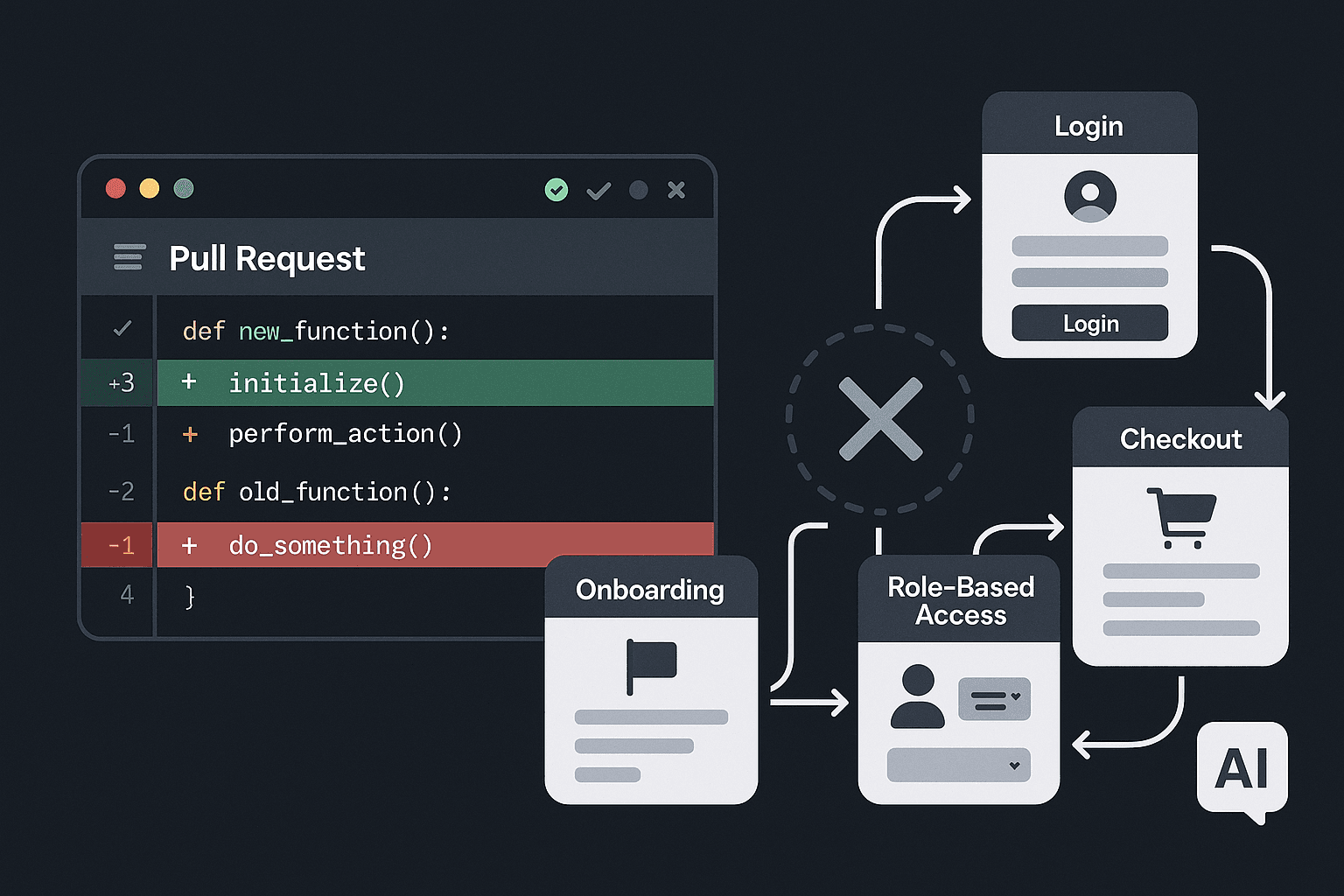
That is the core problem with modern code review: pull requests are evaluated as diffs, but software is experienced as behavior.
This gap has always existed, but AI-assisted development makes it worse. Teams now ship more code, in smaller chunks, with more confidence derived from syntactic correctness and passing local checks. The output often looks plausible. The patch is coherent. The unit tests may even be updated correctly. But plausibility at the line level is not reliability at the workflow level.
If your release process treats “the diff seems fine” as meaningful evidence that login, onboarding, checkout, permissions, and other critical journeys still work, you are depending on the wrong signal.
The problem: reviewers inspect changes, users traverse flows
A reviewer sees changed files, modified functions, updated tests, and maybe a screenshot. A user does not care about any of that. A user clicks “Continue with Google,” lands on a callback route, gets redirected through middleware, loads profile state, hits a role check, opens a dashboard, and expects the system to work.
Those are different units of truth.
Code review is optimized for questions like:
- Is this implementation understandable?
- Does it follow local conventions?
- Is the logic obviously wrong?
- Are there security or maintainability issues in the patch?
- Are the tests aligned with the implementation?
Users expose a different class of question:
- Can I sign in?
- Can I complete onboarding?
- Can I recover from an expired session?
- Can an admin do what an admin should do without exposing user-only paths?
- Can I complete checkout with my real account state, browser timing, and data dependencies?
A diff is a narrow representation of change. A workflow is a sequence across components, routes, async state, browser behavior, and external services. Reviewers are being asked to infer behavior from implementation details they cannot fully execute in their head.
That works sometimes for isolated logic. It fails routinely for interaction-heavy systems.
The reason is simple: workflows are emergent. They depend on the composition of many “correct-looking” changes.
A PR can change only ten lines and still break a business-critical journey because those lines sit at a junction point:
- auth callback handling
- route guards
- analytics side effects that block navigation
- feature flag evaluation
- role-based access conditions
- serialization assumptions between frontend and backend
- loading states and retries
- form validation edge cases
Small patches create large behavioral consequences when they intersect with action sequences.
Why AI-assisted development makes this mismatch worse
AI code generation increases throughput. That is useful. It also increases the volume of code that appears reasonable enough to merge.
This matters because review quality is bounded by attention, context, and time. If a team previously reviewed five substantial PRs per week and now reviews twenty smaller ones assisted by AI, they are not suddenly doing four times more deep behavioral reasoning. More often, they are doing thinner review across more surface area.
AI-generated changes often have a few characteristics that make diff-based review especially fragile:
- They are locally coherent but globally unaware.
- They update adjacent code correctly while missing hidden invariants.
- They satisfy existing tests rather than real usage.
- They preserve type correctness while breaking state transitions.
- They mimic project style convincingly enough to lower reviewer skepticism.
The problem is not that AI writes uniquely bad code. The problem is that it amplifies an old failure mode: mistaking plausible implementation for verified behavior.
That distinction is central to debugging and testing in modern teams. If more code is being produced faster, then validation must move closer to real user actions, not stay anchored to line-by-line confidence.
Why current approaches fail
Most teams already have some combination of code review, unit tests, CI/CD checks, manual QA, and maybe a few integration tests. The problem is not the total absence of testing. The problem is that these systems create confidence in the wrong layer.
1. PR review is not designed to validate workflows
Reviewers are good at spotting certain categories of issues:
- obvious logic bugs
- naming or clarity problems
- maintainability concerns
- broken abstractions
- unsafe database or security patterns
They are much worse at validating multi-step behavior from a patch alone.
Imagine this React change:
js// before
const afterLoginPath = user.isOnboarded ? '/dashboard' : '/welcome';
router.push(afterLoginPath);

// after
const afterLoginPath = user.isOnboarded ? '/app' : '/welcome';
router.push(afterLoginPath);
Looks harmless. Maybe /app is the new top-level route. Maybe the dashboard moved. But what if /app is protected by a middleware check that still expects profile.completed === true, and newly authenticated users do not have profile state hydrated yet? The user bounces between routes or lands on a blank loading screen.
Nothing in the diff necessarily reveals the runtime sequence:
- OAuth callback returns.
- Session cookie is set.
- Client requests current user.
- Middleware checks onboarding state.
- User object is partially loaded.
- Redirect loop starts.
The reviewer sees changed lines. The user sees a broken login.
That is not reviewer incompetence. It is a limit of the medium.
2. Unit tests verify functions, not journeys
Unit tests are useful. They catch regressions cheaply. They improve debugging by localizing failures. They should exist.
They are also deeply insufficient for workflow reliability.
A team might have tests like this:
jsimport { getAfterLoginPath } from './navigation';

describe('getAfterLoginPath', () => {
  it('sends onboarded users to app', () => {
    expect(getAfterLoginPath({ isOnboarded: true })).toBe('/app');
  });

  it('sends new users to welcome', () => {
    expect(getAfterLoginPath({ isOnboarded: false })).toBe('/welcome');
  });
});
This test suite passes. It proves the function returns the expected strings. It tells you nothing about whether /app is reachable after authentication, whether middleware agrees with the same state model, or whether the rendered route can load with the user data available at that moment.
This is a common anti-pattern in CI/CD: high test counts with low behavioral coverage.
Unit tests can only validate assumptions inside the boundaries you define. Workflow failures happen across boundaries.
3. CI/CD often confirms build health, not product health
A lot of pipelines are really build pipelines with a testing label.
Typical status checks include:
- type checking
- linting
- unit tests
- bundle build
- API schema generation
- code coverage thresholds
All of that is useful. None of it means “a user can still log in.”
Here’s a representative GitHub Actions workflow that creates false confidence:
yamlname: ci

on:
  pull_request:

jobs:
  validate:
    runs-on: ubuntu-latest
    steps:
      - uses: actions/checkout@v4
      - uses: actions/setup-node@v4
        with:
          node-version: 20
      - run: npm ci
      - run: npm run lint
      - run: npm run typecheck
      - run: npm run test
      - run: npm run build
If this pipeline passes, what do you know?
You know the code compiles, style checks pass, and unit-level expectations still hold.
What do you not know?
- whether auth redirects work
- whether session persistence works in a browser
- whether onboarding still progresses step to step
- whether checkout completes under real UI timing
- whether role-based access blocks or allows the right screens
This is the uncomfortable truth: many green pipelines certify code structure, not user outcomes.
4. Manual QA does not scale to PR velocity
Some teams answer this by saying QA will catch it. Sometimes they do. Often they can’t.
Why manual QA misses workflow regressions in PRs:
- It is too slow for every change.
- It is inconsistent across testers and environments.
- It tends to focus on expected paths, not stateful edge cases.
- It usually happens too late, after merge or before release.
- It cannot keep pace with AI-accelerated commit volume.
Manual QA remains valuable for exploratory testing and ambiguous UX issues. It is a poor primary defense against frequent workflow regressions introduced in day-to-day pull requests.
Core insight: review code by diff, verify behavior by action
The right way to think about this is not “review is broken” or “unit tests are useless.” It is that each mechanism answers a different question.
- Review asks: does this change make sense as code?
- Unit tests ask: do isolated rules still hold?
- CI/CD asks: is the artifact buildable and internally consistent?
- Workflow tests ask: can a user still accomplish a goal?
That last question is what most teams under-invest in.
If a pull request touches any part of a critical user journey, the PR should contain evidence at the action level, not just the implementation level.
Action-level verification means testing the sequence a user performs:
- open app
- authenticate
- navigate
- submit form
- observe redirect
- verify access
- complete transaction
This is where browser automation and end-to-end testing become strategically important. Not because they replace all other forms of testing, but because they validate the thing your business actually depends on: working flows.
A login test that runs in a real browser provides a stronger release signal than fifty unit tests around helper functions that support login.
That does not mean writing brittle, giant test suites that click every pixel. It means identifying critical workflows and turning them into stable executable checks attached to pull requests.
What workflow regressions actually look like
To understand why debugging these issues is painful, consider how regressions surface in practice.
Authentication breakage from a tiny patch
A backend change updates cookie attributes for security:
python# before
response.set_cookie("session", token, httponly=True, samesite="Lax")

# after
response.set_cookie("session", token, httponly=True, samesite="Strict")
Looks reasonable. Tests may pass because API-level authentication checks still succeed when cookie handling is simulated. In the browser, your OAuth redirect flow now fails because the session cookie is not sent in the expected cross-site transition.
Review sees a security hardening change. Users see “login succeeded” followed by “why am I still signed out?”
Onboarding breakage from loading-state refactors
A frontend cleanup consolidates loading flags:
jsconst isLoading = isSubmitting || isFetchingProfile;

if (isLoading) {
  return <Spinner />;
}
Seems fine. But isFetchingProfile remains true on step transition because a query is invalidated during navigation. Step three never renders; the user is trapped behind a spinner.
A unit test for the component may pass with mocked state. A reviewer may approve because the abstraction is simpler. Only a real step-by-step run reveals the dead end.
Role-based access breakage from schema drift
Suppose the API returns role: 'admin', but a generated client model is updated to expect roles: string[]. Frontend logic falls back to [], and admin-only screens disappear.
Everything can compile. Mocked unit tests can still pass if fixtures were updated inconsistently. The regression only appears when a real admin account navigates through the UI.
These are not exotic edge cases. They are normal production failures created by small, individually rational changes.
What action-level verification looks like in practice
The most effective pattern is simple: attach a minimal set of critical workflow tests to pull requests and run them in CI/CD against preview or ephemeral environments.
The best tool for many web teams is Playwright because it runs real browsers, handles modern UI behavior well, and supports tracing for debugging.
Here is a basic Playwright login workflow test:
jsimport { test, expect } from '@playwright/test';

test('user can log in and reach dashboard', async ({ page }) => {
  await page.goto(process.env.APP_URL);

  await page.getByRole('button', { name: 'Sign in' }).click();
  await page.getByLabel('Email').fill('user@example.com');
  await page.getByLabel('Password').fill('correct-horse-battery-staple');
  await page.getByRole('button', { name: 'Continue' }).click();

  await page.waitForURL('**/dashboard');
  await expect(page.getByRole('heading', { name: 'Dashboard' })).toBeVisible();
});
That single test validates much more than it appears to:
- page rendering
- login form behavior
- API communication
- session handling
- redirect behavior
- route protection
- final page load
If it fails, the trace gives developers something review never could: evidence of the exact action sequence that broke.
Now compare that to trying to reason about the same failure from a six-line diff.
Onboarding workflow test
jsimport { test, expect } from '@playwright/test';

test('new user completes onboarding', async ({ page }) => {
  await page.goto(process.env.APP_URL);
  await page.getByRole('button', { name: 'Create account' }).click();

  await page.getByLabel('Email').fill(`new-user-${Date.now()}@example.com`);
  await page.getByLabel('Password').fill('Welcome123!');
  await page.getByRole('button', { name: 'Create account' }).click();

  await page.getByLabel('Full name').fill('Test User');
  await page.getByRole('button', { name: 'Next' }).click();

  await page.getByLabel('Company name').fill('Example Co');
  await page.getByRole('button', { name: 'Next' }).click();

  await page.getByRole('button', { name: 'Finish' }).click();

  await page.waitForURL('**/dashboard');
  await expect(page.getByText('Welcome to your workspace')).toBeVisible();
});
This catches a huge class of regressions that no reviewer can reliably infer:
- broken next-step navigation
- invalid state persistence between steps
- missing API fields
- hydration timing bugs
- redirect misconfiguration
Role-based access workflow test
jsimport { test, expect } from '@playwright/test';

async function login(page, email, password) {
  await page.goto(process.env.APP_URL);
  await page.getByRole('button', { name: 'Sign in' }).click();
  await page.getByLabel('Email').fill(email);
  await page.getByLabel('Password').fill(password);
  await page.getByRole('button', { name: 'Continue' }).click();
}

test('admin can access team settings', async ({ page }) => {
  await login(page, 'admin@example.com', 'password123');
  await page.goto(`${process.env.APP_URL}/settings/team`);
  await expect(page.getByRole('heading', { name: 'Team settings' })).toBeVisible();
});

test('regular user is denied team settings', async ({ page }) => {
  await login(page, 'user@example.com', 'password123');
  await page.goto(`${process.env.APP_URL}/settings/team`);
  await expect(page.getByText('You do not have access')).toBeVisible();
});
This is the level where behavior becomes trustworthy.
Putting workflow checks into CI/CD
If these tests only run locally, they help developers but do not protect merges. The real shift is making workflow verification a first-class PR requirement.
A practical GitHub Actions setup might look like this:
yamlname: pr-workflows

on:
  pull_request:

jobs:
  app-tests:
    runs-on: ubuntu-latest
    timeout-minutes: 20
    steps:
      - uses: actions/checkout@v4

      - uses: actions/setup-node@v4
        with:
          node-version: 20

      - run: npm ci
      - run: npx playwright install --with-deps

      - name: Start app
        run: |
          npm run db:migrate
          npm run start:test &
          npx wait-on http://localhost:3000

      - name: Run critical workflow tests
        env:
          APP_URL: http://localhost:3000
        run: npx playwright test tests/workflows

      - name: Upload Playwright trace
        if: failure()
        uses: actions/upload-artifact@v4
        with:
          name: playwright-report
          path: playwright-report/
This is already better than most pipelines because it verifies business-critical behavior before merge.
An even better setup runs against preview deployments, where infrastructure, auth providers, environment configuration, and production-like routing are closer to reality.
yamlname: preview-e2e

on:
  pull_request:

jobs:
  e2e:
    runs-on: ubuntu-latest
    steps:
      - uses: actions/checkout@v4
      - uses: actions/setup-node@v4
        with:
          node-version: 20
      - run: npm ci
      - run: npx playwright install --with-deps
      - name: Run against preview
        env:
          APP_URL: ${{ secrets.PREVIEW_URL }}
          E2E_USER_EMAIL: ${{ secrets.E2E_USER_EMAIL }}
          E2E_USER_PASSWORD: ${{ secrets.E2E_USER_PASSWORD }}
        run: npx playwright test tests/workflows/login.spec.js
The exact environment model varies by stack, but the principle does not: critical user actions should be executable in the same automation layer that gates merges.
Tools comparison: what each layer is good for
Teams often argue about unit tests versus end-to-end tests as if one must replace the other. That is the wrong framing.
Here is the practical comparison.
Unit tests
Best for:
- pure logic
- edge-case business rules
- parser/transformer behavior
- fast debugging of isolated failures
- high-volume regression coverage at low cost
Weak at:
- browser behavior
- redirects and navigation
- auth/session handling
- UI timing issues
- integrated state transitions
Integration tests
Best for:
- service boundaries
- API/database interactions
- component plus store interactions
- catching mismatched assumptions between modules
Weak at:
- full browser workflows
- third-party auth reality
- route guards and user journey sequencing
End-to-end/browser workflow tests
Best for:
- login
- onboarding
- checkout
- role-based access
- account settings flows
- validating production-like behavior
Weak at:
- pinpointing internal root cause without traces/logs
- exhaustive edge-case coverage
- speed if overused indiscriminately
Manual QA
Best for:
- exploratory testing
- visual polish
- ambiguous user experience evaluation
- pre-release sanity checks on novel features
Weak at:
- consistency
- PR-level gating at scale
- repeated regression protection
The strongest teams use all of these, but they reserve workflow confidence for workflow tests.
Actionable practices for teams that want fewer “looked fine in review” incidents
You do not need a giant testing transformation. You need a tighter mapping between change risk and verification method.
1. Define your critical workflows explicitly
Most teams know their important journeys but never formalize them. Write them down.
Typical examples:
- user login
- password reset
- new user onboarding
- checkout completion
- subscription upgrade
- admin invitation flow
- role-based settings access
- file upload and processing
If a workflow affects revenue, activation, retention, or support burden, it deserves executable coverage.
2. Gate PRs on a small workflow suite, not a giant end-to-end suite
Do not start by trying to automate everything. That creates brittle pipelines and organizational backlash.
Start with 5–10 high-value flows.
A good PR workflow suite should be:
- small
- stable
- business critical
- debuggable when it fails
- fast enough to run on every pull request
The goal is not exhaustive testing. The goal is catching severe regressions that diff review will miss.
3. Trigger workflow tests based on risk
You do not necessarily need every workflow on every PR. You can route test execution by changed areas.
Examples:
- changes to auth, session, middleware, routing → run login and access-control workflows
- changes to signup, profile, onboarding components → run onboarding workflow
- changes to billing, cart, order APIs → run checkout workflow
This improves developer productivity because teams get stronger coverage without turning CI/CD into a bottleneck.
4. Make workflow failures easy to debug
End-to-end tests get a bad reputation when failures are opaque. The fix is not to avoid them. The fix is observability.
Use:
- Playwright traces
- screenshots on failure
- video capture when useful
- network logs
- server logs correlated to test runs
- stable test data and deterministic environments
A failing workflow test should answer: what step failed, what did the browser see, what request failed, and what state was missing?
If your test stack supports debugging well, developers stop seeing workflow testing as ceremonial friction and start seeing it as a faster path to root cause.
5. Use production-like authentication paths whenever possible
Mocking auth is fine for component tests. It is not enough for verifying whether login still works.
Where possible, exercise:
- real session creation
- real cookies
- real redirects
- real middleware and route protection
Authentication is one of the most common sources of workflow regressions because it spans frontend, backend, browser policy, and infrastructure. Treat it as a system behavior, not a helper function.
6. Add reviewer evidence beyond diffs
If a PR changes a critical flow, require behavioral evidence in the PR itself.
Examples:
- link to passing workflow test run
- trace artifact
- short recorded browser run
- checklist of affected workflows executed automatically
This changes review culture in a useful way. Instead of asking reviewers to imagine whether a sequence still works, you show them that it does.
7. Stop using coverage percentages as a proxy for safety
Coverage is often a vanity metric in discussions about testing.
You can have 85% line coverage and still fail the first click after login.
Coverage tells you code was executed during tests. It does not tell you a workflow succeeded under realistic conditions. Do not confuse code exercise with user-level assurance.
8. Keep unit tests, but move confidence claims up a layer
Unit tests still matter. They accelerate debugging, document expectations, and catch cheap regressions. Keep writing them.
But change what you claim from them.
Bad claim:
- “The auth area is well tested.”
Better claim:
- “The auth helper logic is well tested, and the login workflow is verified in-browser in CI.”
That is a much more honest and operationally useful statement.
9. Design the app for testability
If workflow tests are impossible or flaky, the product architecture is often contributing.
Improve testability by:
- using stable accessible selectors
- reducing arbitrary timeouts
- exposing reliable loading and success states
- making test account setup easy
- isolating external dependencies where possible
- using seeded data or repeatable fixtures
Testability is not separate from engineering quality. It is part of reliability engineering.
10. Treat workflow regressions as process failures, not isolated bugs
When login breaks after a reviewed, green PR, the lesson should not be “someone missed it.” The lesson should be “our validation process did not cover the behavior we depend on.”
That reframing matters.
Blaming reviewers leads to anxiety and slower reviews. Improving workflow verification leads to stronger systems.
A practical rollout plan
If you are leading engineering or platform work and want to improve this without causing chaos, use a phased approach.
Phase 1: identify top workflows
Pick the journeys that matter most commercially and operationally. Usually this is 3–5 flows.
Phase 2: automate them in Playwright
Do not over-engineer. Build straightforward, readable tests that mirror user behavior.
Phase 3: run them in CI/CD for pull requests affecting risky areas
Start targeted. Expand only when the suite proves stable and useful.
Phase 4: add debugging artifacts
Require screenshots, traces, and logs for failures so engineers can diagnose issues quickly.
Phase 5: make behavioral evidence part of review culture
Reviewers should expect proof of working flows for risky PRs, not just polished diffs.
This rollout is manageable for most teams and has a far better return than adding dozens of extra unit tests around already-tested helpers.
Conclusion
“The PR looked fine” is not a defense against a broken login, failed onboarding, or blocked checkout.
It is a description of a process mismatch.
Diff-based review is useful for evaluating code changes. It is not a reliable method for validating user workflows, especially in a world where AI-assisted development increases code volume and makes more patches look mergeable on first inspection.
Users do not experience your diffs. They experience action sequences.
So if your team wants real confidence, not ceremonial confidence from green checks and plausible patches, you need to verify behavior at the level users actually encounter it.
Keep code review. Keep unit tests. Keep CI/CD.
But stop pretending they prove workflow integrity on their own.
Add action-level verification to pull requests. Run critical browser workflows before merge. Use traces and artifacts to make failures easy to debug. Put your strongest confidence signal where your highest business risk lives.
Because a pull request can look perfectly fine right up until login breaks. And by then, the diff is no longer the thing that matters.