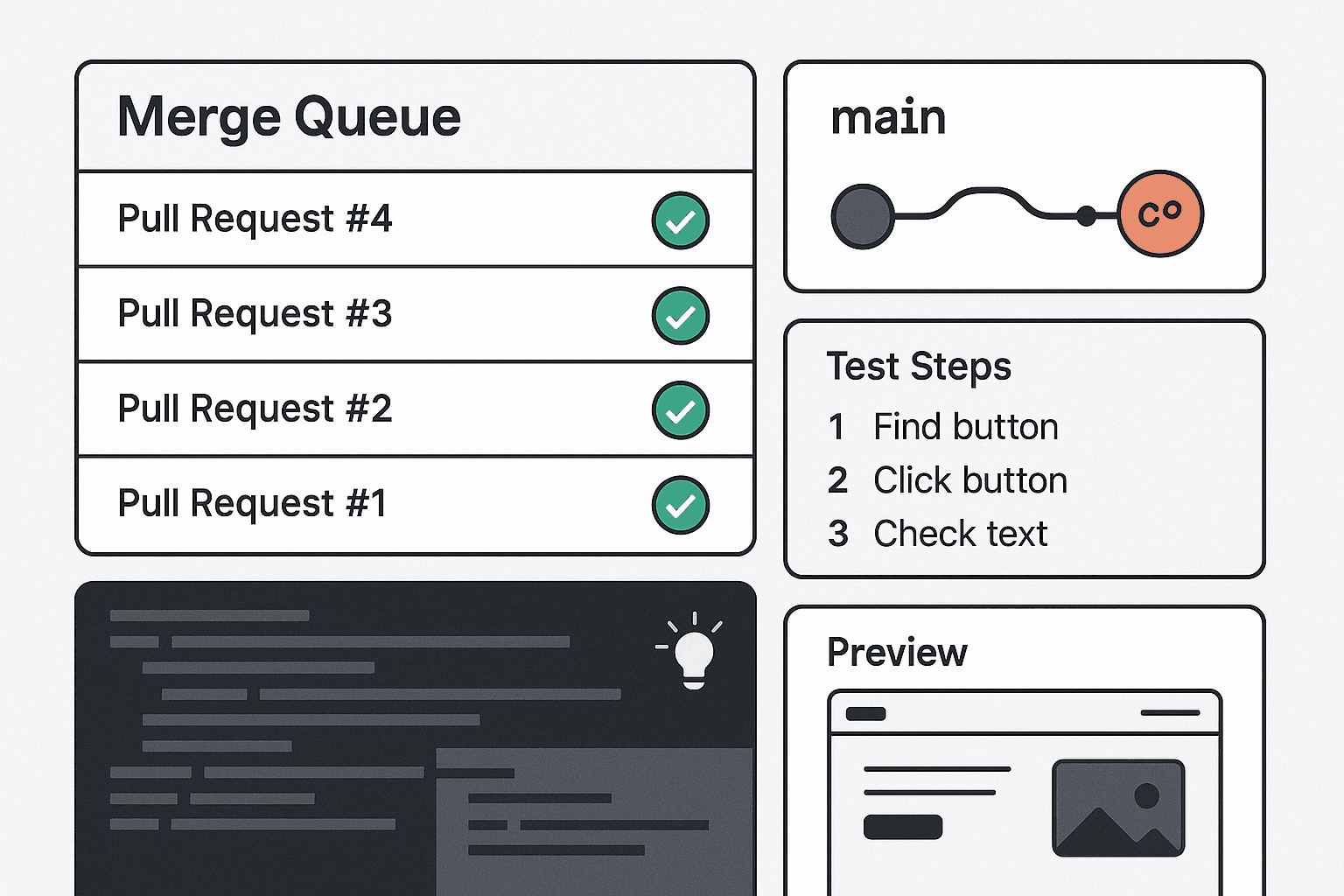
A team merges six pull requests in an afternoon. Every check is green. Unit tests passed. Integration tests passed. The merge queue did exactly what it was supposed to do: serialize changes, protect main, and keep throughput high.
An hour later, a user tries to upgrade their plan, add a teammate, and export billing history. The button works. The API works. The database migration worked. The auth middleware worked. But the workflow fails anyway.
Why? Because no single pull request broke the system. The system broke in the space between them.
One PR changed how feature flags were resolved for team-scoped billing. Another updated the export job to read a new permission field. A third refactored a frontend loading state around plan changes. A fourth adjusted a webhook retry path. Alone, each change was valid. Together, they created a product nobody had actually tested.
That is the merge queue mirage: every PR passed, and main still broke.
This is becoming a more common failure mode for teams shipping faster, especially teams using AI to generate more code, more refactors, and more low-context changes. The bottleneck is no longer writing code. It is validating that the combined behavior of rapidly merged code still matches what users do.
Traditional testing was built around a simpler assumption: if each change passes tests, the branch is probably safe. That assumption gets weaker as throughput rises, dependency surfaces expand, and CI/CD pipelines optimize for isolated verification rather than real merged behavior.
The uncomfortable truth is that merge queues often increase confidence in the wrong thing. They prove that pull requests are individually plausible. They do not prove that the product users receive after those pull requests are combined still works.
The real problem is not broken code, it is broken composition
Most production failures are not dramatic syntax errors or obvious regressions. They are composition failures.
A composition failure happens when several correct-looking changes interact in a way that breaks a real user workflow. The individual components still pass their contracts. The failure emerges from timing, state, assumptions, or sequencing across boundaries.
That distinction matters.
Engineers often ask, "How did this pass CI?" The answer is usually simple: CI tested the code paths it knew about, in the environments it had, under assumptions that were true before adjacent changes landed.
Merge queues worsen this in subtle ways. They create a serialized path to main, which sounds safer. But the queue usually validates candidate merges under limited conditions:
- each PR rebased on a recent base
- a speculative merge with current main
- a subset of tests chosen for speed
- checks focused on service boundaries rather than user workflows
That is useful. It is not reality.
Reality is the eventual merged product after multiple queued changes have landed, background jobs have started using new state, caches have warmed inconsistently, frontend bundles have updated, and a user performs a workflow spanning auth, API, UI, jobs, and permissions.
The merge queue does not fail because it is poorly designed. It fails because teams ask it to answer a question it was never built to answer.
It can answer: "Does this PR appear safe against the current branch state?"
It cannot reliably answer: "Will the resulting product still work end to end once several individually safe changes are combined and exercised like a user would exercise them?"
Those are different questions, and modern engineering teams keep confusing them.
Why AI-generated code makes the gap worse
AI did not invent this problem. It amplifies it.
When developers use AI assistants effectively, they produce more code, more quickly. That includes boilerplate, test updates, refactors, config churn, migration helpers, and cross-layer implementation details. This can improve developer productivity. It also increases the rate of change entering the system.
Higher throughput changes the economics of testing.
When a team shipped five carefully reviewed PRs a day, human intuition sometimes caught cross-change conflicts. When a team ships fifty PRs a day, many partially authored by AI, that intuition collapses. Reviewers inspect local correctness, style, and obvious risk. They do not simulate how fifteen adjacent changes modify the same workflow over four services and a browser session.
AI-generated code also tends to be locally coherent and globally naive.
That is not a criticism. It is a predictable property of code generated from a narrow prompt. The generated change often satisfies the explicit task while missing nearby assumptions:
- a field rename that updates type definitions but not analytics consumers
- a UI state change that works on a happy path but races with a background mutation
- a permission check added to one endpoint but not another endpoint in the same workflow
- a migration staged correctly for one deploy step but incompatible with queue-driven merge ordering
Each change can still pass unit and integration tests because those tests are usually scoped to the request or function the PR touched.
AI increases surface area faster than most testing strategies evolve. That means more green checks, more confidence theater, and more broken composition on main.
Why unit tests miss the problem
Unit tests are excellent for narrowing debugging scope and protecting local behavior. They are also one of the easiest places to hide from reality.
A unit test asks: does this function, class, or module behave correctly under these inputs?
That is a valuable question. But users do not experience functions. They experience workflows.
If a billing upgrade requires:
- rendering the correct plan options
- requesting a server-side session
- applying permissions for the current team context
- persisting the subscription state
- updating a job that generates invoices
- enabling an export action in the UI
then dozens of unit tests can pass while the workflow is broken between steps 3 and 6.
Here is a toy example in JavaScript. The unit tests are all green:
js// permissions.js
export function canExportBilling(user, team) {
  return user.role === 'admin' && team.billingEnabled;
}

// plan.js
export function canUpgrade(plan) {
  return plan !== 'enterprise';
}
jsimport { canExportBilling } from './permissions';
import { canUpgrade } from './plan';

test('admin can export billing when enabled', () => {
  expect(canExportBilling({ role: 'admin' }, { billingEnabled: true })).toBe(true);
});

test('pro plan can upgrade', () => {
  expect(canUpgrade('pro')).toBe(true);
});
Now another PR changes billing enablement to be scoped by workspace feature flags instead of team.billingEnabled:
js// permissions.js after PR B
export function canExportBilling(user, team, flags) {
  return user.role === 'admin' && flags.includes(`billing:${team.id}`);
}
Another PR updates the export page but forgets to pass the new flags source during the post-upgrade redirect. Unit tests for each module still pass. The export page works for old sessions and fails for newly upgraded sessions. Nothing is syntactically wrong. The workflow is broken.
The bug is not in a function. It is in the interaction between assumptions.
This is why teams overestimate what unit coverage means. High unit coverage is not proof of shipped reliability. It is proof that many isolated facts remain true.
Why integration tests miss it too
Integration tests are supposed to close the gap. Often they only move it.
A typical integration suite verifies service-to-service contracts, API responses, database writes, or a local test environment with mocked dependencies. That catches many important failures. But merge queue bugs often live above the integration boundary.
Consider a Python backend that now requires a new permission claim in a token, introduced by one PR:
python# access.py

def can_download_invoice(claims: dict, account_id: str) -> bool:
    return account_id in claims.get("billing_accounts", [])
Its integration test passes:
pythondef test_can_download_invoice_allows_linked_account():
    claims = {"billing_accounts": ["acct_123"]}
    assert can_download_invoice(claims, "acct_123") is True
A separate frontend PR refreshes tokens after plan changes using an older auth endpoint that does not include billing_accounts. Browser tests for the upgrade page are mocked at the API layer and still pass. Backend integration tests still pass. The deployed workflow fails only when a real browser upgrades a plan and immediately tries to download an invoice.
That is not a unit problem or an integration problem in the narrow sense. It is a sequence problem.
Many integration suites are also stale representations of architecture. The codebase evolves, but the test suite keeps asserting older boundaries:
- mocked third-party APIs instead of real callback behavior
- fixtures that skip auth refresh timing
- seed data that ignores migration order
- API-only checks that never validate frontend state transitions
- single-service tests that ignore asynchronous jobs
As systems become more event-driven and more UI-mediated, integration tests can become polished snapshots of conditions users no longer experience.
QA cannot scale to this failure mode
Manual QA is still valuable for exploratory testing and catching weirdness automation misses. But it does not solve the merge queue mirage.
Why not?
Because the issue is not just coverage. It is timing and combinatorics.
If ten PRs each affect one part of three workflows, the number of possible interactions grows faster than a human QA process can validate before merge. High-throughput CI/CD pressures teams to reduce cycle time, not increase manual staging validation. So QA becomes selective, late, or symbolic.
This is where many teams quietly drift into false confidence:
- unit tests are green
- integration tests are green
- smoke tests are green
- QA checked the feature that motivated the PR
- merge queue is healthy
But no one tested the actual combined product state that users will get after the queue drains.
The missing artifact is not another test type. It is a different target.
The core insight: test the merged product, not the proposed diff
The right question is not, "Did each PR pass?"
The right question is, "Does the merged result support the workflows users actually perform?"
That sounds obvious, but most pipelines are not built around it.
Most pipelines are optimized for per-PR validation because it is computationally cheaper, easier to parallelize, and easier to assign ownership for failures. That made sense when code velocity was lower and interactions were simpler.
Today, reliable testing needs a second layer of verification focused on the action level:
- what does a user click?
- what state transition should happen next?
- what background work must complete?
- what permissions should be refreshed?
- what cross-service side effects must become visible?
This is not just end-to-end testing in the old brittle sense. It is merged-state verification in environments that represent the product users will actually hit.
The practical version looks like this:
- Build the candidate merged state, not just the PR branch.
- Deploy it into an ephemeral environment with realistic dependencies.
- Run action-level workflow checks against that environment.
- Gate merge or post-merge promotion on those checks.
- Preserve artifacts for debugging when workflows fail.
The important shift is that the test subject is no longer the isolated code change. The test subject is the assembled product.
What action-level verification looks like
Action-level verification focuses on user-observable behavior. Instead of asserting that an endpoint returned 200, it asserts that a workflow completed successfully from the browser through backend side effects.
A simple Playwright example:
tsimport { test, expect } from '@playwright/test';

test('admin upgrades plan and exports billing history', async ({ page }) => {
  await page.goto(process.env.APP_URL!);

  await page.getByLabel('Email').fill('admin@example.com');
  await page.getByLabel('Password').fill('password');
  await page.getByRole('button', { name: 'Sign in' }).click();

  await page.getByRole('link', { name: 'Billing' }).click();
  await page.getByRole('button', { name: 'Upgrade to Business' }).click();
  await page.getByRole('button', { name: 'Confirm upgrade' }).click();

  await expect(page.getByText('Plan updated')).toBeVisible();

  await page.getByRole('link', { name: 'Invoices' }).click();
  await page.getByRole('button', { name: 'Export billing history' }).click();

  await expect(page.getByText('Export started')).toBeVisible();
  await expect.poll(async () => {
    const res = await page.request.get(`${process.env.APP_URL}/api/exports/latest`);
    const json = await res.json();
    return json.status;
  }).toBe('complete');
});
This kind of test does a few things traditional suites often do not:
- verifies the UI state transition after a plan change
- exercises the real auth session lifecycle
- depends on merged backend permission logic
- validates a background export side effect
- checks the user-observable outcome, not just internal response codes
Done badly, browser tests become flaky theater. Done well, they become the only tests that answer the question stakeholders actually care about: does the product work?
The trick is not to automate everything. The trick is to automate the workflows whose failure would make green CI meaningless.
Ephemeral environments are the missing infrastructure
Action-level verification only works if the environment is credible.
Running browser tests against mocks or a static shared staging environment does not solve the merge queue problem. Shared staging is usually contaminated by unrelated changes, manual data drift, test collisions, and unclear ownership.
What you need is an ephemeral environment created from the exact merged candidate state, with predictable data and enough real dependencies to exercise workflow behavior.
That usually means:
- application deployed from the candidate merged commit
- isolated database or schema
- migrations applied in the same order production would use
- seeded users, orgs, plans, and permissions
- background workers enabled
- auth configured realistically
- third-party providers stubbed only where unavoidable
A simplified GitHub Actions sketch:
yamlname: merged-workflow-verification

on:
  merge_group:
    types: [checks_requested]

jobs:
  deploy-preview:
    runs-on: ubuntu-latest
    steps:
      - uses: actions/checkout@v4

      - name: Build app
        run: |
          docker build -t app:${{ github.sha }} .

      - name: Provision ephemeral environment
        run: |
          ./ops/create-preview-env.sh \
            --sha ${{ github.sha }} \
            --env-file .ci/preview.env

      - name: Run migrations
        run: |
          ./ops/run-migrations.sh --sha ${{ github.sha }}

      - name: Seed workflow fixtures
        run: |
          ./ops/seed-preview-data.sh --scenario billing-upgrade-export

  verify-workflows:
    runs-on: ubuntu-latest
    needs: deploy-preview
    steps:
      - uses: actions/checkout@v4
      - uses: actions/setup-node@v4
        with:
          node-version: 20

      - run: npm ci

      - name: Run Playwright workflow checks
        env:
          APP_URL: ${{ secrets.PREVIEW_URL }}
        run: |
          npx playwright test tests/workflows

      - name: Upload debugging artifacts
        if: failure()
        uses: actions/upload-artifact@v4
        with:
          name: playwright-artifacts
          path: |
            playwright-report
            test-results
The key is not the exact CI syntax. The key is that verification happens against the merged candidate, in a disposable environment, with artifact capture when failures happen.
That changes debugging from guesswork into inspection.
Why this is a debugging strategy, not just a testing strategy
Teams often separate testing and debugging as if they happen in different worlds. In practice, your testing architecture determines how hard production debugging will be.
Per-PR green checks are weak debugging assets. When main breaks after several merges, engineers are forced into archaeological work:
- compare adjacent PRs
- inspect queue ordering
- replay environment state mentally
- rerun partial suites locally
- guess whether issue is frontend, backend, auth, data, or async jobs
That is expensive and demoralizing.
Merged-state workflow verification creates better debugging signals:
- video of the user flow failure
- browser traces
- request/response history
- logs from the exact merged artifact
- seeded scenario reproduction
- deterministic commit/environment mapping
A failed action-level check can tell you far more than 500 passing unit tests.
For example, if the export workflow test fails only after a plan upgrade and trace data shows the token refresh response lacked billing_accounts, the root cause narrows immediately. You are debugging a user journey, not a generalized codebase.
That is a major developer productivity gain. Better testing is not just about catching bugs sooner. It is about shrinking the search space when bugs happen.
Tools comparison: what each layer is good for
No single testing layer is enough. The mistake is expecting one layer to answer all reliability questions.
Here is the blunt version.
Unit tests
Good for:
- local logic correctness
- fast feedback during development
- edge case validation
- regression protection around pure behavior
Bad for:
- workflow confidence
- async state transitions
- cross-PR interactions
- merged product verification
Integration tests
Good for:
- service contracts
- database interaction
- API semantics
- catching schema and serialization issues
Bad for:
- browser-visible regressions
- auth/session sequencing
- queue-induced composition failures
- validating what users actually do
Shared staging smoke tests
Good for:
- broad sanity checks
- deployment verification
- quick post-release confidence
Bad for:
- deterministic debugging
- merge candidate isolation
- reproducing exact queue outcomes
- testing high-risk workflows reliably
Manual QA
Good for:
- exploratory testing
- visual/UI nuance
- uncovering weird edge behavior humans notice
- validating product intent
Bad for:
- scaling with throughput
- repeated regression verification
- timing-sensitive interaction matrices
- guarding a fast merge queue
Action-level workflow checks in ephemeral environments
Good for:
- merged-state verification
- user journey confidence
- cross-service and cross-PR interaction bugs
- high-signal debugging artifacts
- aligning CI/CD with real product behavior
Bad for:
- replacing all lower-level tests
- ultra-fast feedback on every tiny local edit
- cheaply covering every possible branch
This is the pattern mature teams eventually land on: keep lower-level tests for speed and scope control, then add a narrow set of workflow verifications that test the assembled product before users do.
Practical patterns that work
You do not need a giant end-to-end suite. You need a disciplined shortlist of workflows that represent business-critical truth.
1. Define workflow contracts
Write down the few user journeys that must never silently break on main.
Examples:
- sign up, verify email, create workspace
- upgrade plan, invite teammate, assign role
- connect integration, sync data, view results
- reset password, re-authenticate, access protected resource
- generate invoice, export history, receive notification
If a workflow matters to revenue, activation, retention, or compliance, it deserves action-level verification.
2. Test state transitions, not just page loads
A smoke test that checks whether the billing page renders is not enough. The risky part is what happens after actions mutate state.
Prefer checks like:
- after upgrade, does permission scope refresh?
- after invite acceptance, do role-based controls change?
- after webhook delivery, does UI reflect the new state?
- after data import, can the user complete the next task?
This is where merge queue failures hide.
3. Keep fixtures scenario-based
Seed data around workflows, not generic entities.
Bad fixture mindset:
- one admin user
- one team
- one project
Better fixture mindset:
- workspace on pro plan upgrading to business
- pending invoice export job
- teammate with viewer role awaiting invite
- feature flag state before and after upgrade
Scenario fixtures produce more realistic debugging signals.
4. Capture artifacts by default
When workflow verification fails, the system should automatically preserve:
- browser traces
- screenshots and video
- application logs
- job logs
- network events
- environment metadata
If engineers need to rerun manually before they can start debugging, your pipeline is wasting time.
5. Gate on a small, opinionated suite
Do not attempt to run hundreds of full browser flows on every merge candidate. That leads to slow, flaky pipelines and organizational backlash.
Instead, gate on a concise set of high-value workflows. Think of them as product invariants.
A common pattern:
- run unit/integration suites on every PR
- run merged-state workflow checks on merge queue candidates or pre-promotion builds
- run broader exploratory or scheduled suites asynchronously
6. Model asynchronous completion explicitly
Many modern workflow bugs are timing bugs. Background jobs, eventual consistency, cache invalidation, and token refresh windows all matter.
Your tests should represent that honestly rather than hiding it behind sleeps.
Good:
tsawait expect.poll(async () => {
  const res = await page.request.get(`${process.env.APP_URL}/api/invoices/latest`);
  return (await res.json()).status;
}).toBe('available');
Bad:
tsawait page.waitForTimeout(5000);
Explicit polling improves both reliability and debugging clarity.
7. Verify production-like migrations and deploy order
Some of the worst merge queue bugs come from rollout assumptions:
- code expects a column before backfill finishes
- worker uses a new enum before all producers are updated
- frontend reads a field added behind a flag but delivered in the wrong order
Ephemeral verification should apply migrations and startup order the way production does. Otherwise the environment is too kind.
8. Track escaped defects by missing workflow
When main breaks, ask one operational question: which workflow should have caught this?
If the answer is none, add one.
This shifts the testing conversation away from coverage percentages and toward observable reliability.
A concrete merged-state example
Suppose your merge queue processes three PRs:
- PR 101: rename
team.billingEnabledto feature-flag lookup - PR 102: refresh auth token after plan change
- PR 103: refactor invoice export button to use a shared permissions hook
Each PR passes:
- unit tests validate each module
- integration tests validate API responses
- browser smoke test confirms billing page loads
The queue merges all three.
On main, the real flow is:
- admin upgrades plan
- frontend triggers token refresh
- refreshed token comes from old endpoint shape
- permissions hook now depends on feature flags missing from token context
- export button renders disabled
- users cannot export invoices
No single PR “caused” the issue in isolation. The issue exists only in the merged sequence.
A merged-state workflow check would catch it because it exercises the exact path users follow after the combined changes are deployed.
That is the difference between validating code and validating a product.
What teams should change this quarter
If your organization already has a merge queue and reasonably good CI/CD, the next step is not a total rebuild. It is a correction in where confidence comes from.
Here is the practical rollout plan.
Phase 1: Identify the confidence gap
Review recent production bugs and near misses. Tag them:
- isolated defect
- environment/config defect
- cross-service defect
- cross-PR interaction defect
- workflow sequencing defect
Most teams discover that a meaningful percentage of painful incidents were invisible to per-PR checks.
Phase 2: Choose 3 to 5 critical workflows
Pick workflows whose failure would make green CI feel absurd. Revenue, onboarding, access control, and export/compliance paths are good candidates.
Phase 3: Add ephemeral merged-state verification
Integrate a preview environment into the merge queue or pre-promotion stage. Start small. One stable environment pattern is worth more than a dozen slide-deck plans.
Phase 4: Capture debugging artifacts and failure ownership
A workflow gate without usable failure data becomes political quickly. Make failures inspectable and assignable.
Phase 5: Tune suite size and flake budget
If the suite is flaky, engineers will route around it. Be ruthless:
- remove low-signal checks
- stabilize fixtures
- poll for state, do not sleep
- isolate external dependencies
- quarantine brittle visual assertions unless they matter
Phase 6: Make workflow health visible
Show trends:
- merge candidate pass rate
- top failing workflows
- mean time to debug workflow failures
- escaped defects by uncaught workflow
That reframes testing as operational reliability rather than ritual.
The bigger lesson for modern engineering teams
The old story was that more automation means more safety.
The current reality is harsher: more automation often means more unearned confidence unless the automation targets real user behavior.
Merge queues, AI-assisted coding, and high-throughput CI/CD are all useful. But they combine to create a dangerous illusion when teams stop at isolated green checks. You end up proving that many small pieces still work alone while the actual product has never been exercised as a whole.
That is why main breaks after every PR passed. Not because testing is worthless. Not because CI/CD is broken. Not because AI code is uniquely bad. Main breaks because the thing you validated is not the thing you shipped.
Reliable teams understand this and adjust their testing strategy accordingly. They keep unit and integration tests because those are still essential for fast feedback and focused debugging. But they stop pretending those layers are enough. They add merged-state, action-level verification in ephemeral environments so the assembled product is tested before users become the test harness.
That is the real shift modern teams need.
Not more green checks.
Better truth.