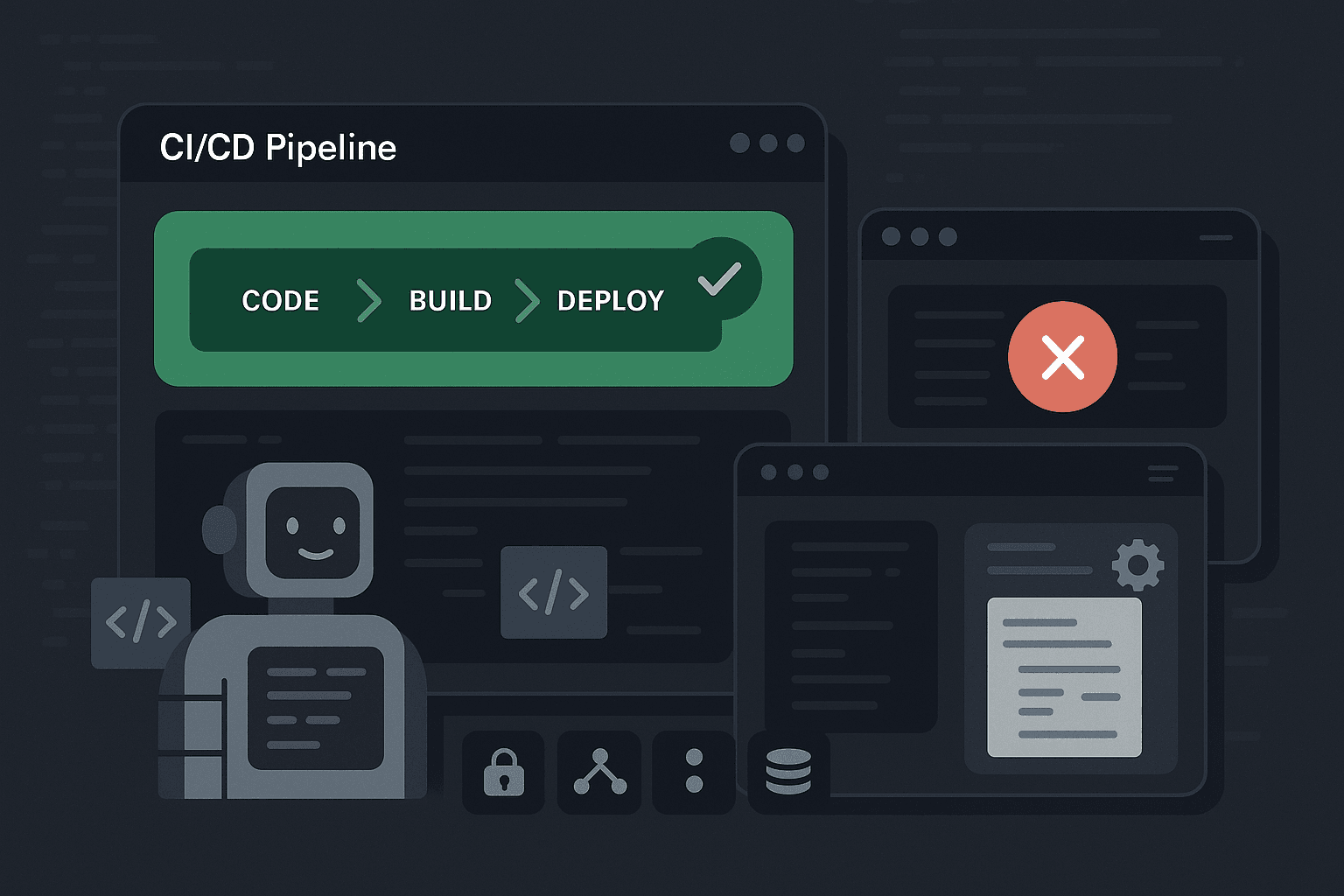
A pull request goes green. Unit tests pass. Integration tests pass. Preview deployment looks fine. The AI agent that opened the PR even left a neat summary explaining what changed and why the risk is low.
Then the code hits a production-like environment and checkout stops working for users signed in through your enterprise SSO provider. Or account creation succeeds, but the webhook that provisions billing never fires because the callback URL differs outside preview. Or the UI renders correctly in preview, but a third-party fraud script blocks the payment button only when the full production tag bundle loads. Or a feature flag defaults one way in CI, another way in staging, and the “tested” path is not the one users actually get.
This is the green pipeline trap: teams mistake a clean CI/CD run for evidence that the system works under the conditions that matter. That mistake is getting more expensive now that AI generates more code, more pull requests, and more configuration-touching changes than human reviewers can deeply reason about.
The next gap in modern testing is not just broader workflow coverage. It is environment-parity verification: validating critical user actions against the same configuration surfaces, runtime dependencies, and integration behavior that exist after deployment.
If your current pipeline proves the code works in a synthetic environment but not that the product works in a production-mirroring one, you do not have reliability. You have a fast way to produce false confidence.
The failure pattern teams keep repeating
Most teams do not get burned by obvious syntax errors anymore. CI catches those. The painful incidents are subtler:
- OAuth works against a local test app but fails with the real identity provider redirect rules.
- A queue consumer is disabled in preview, so a “successful” action never completes the asynchronous side effects users depend on.
- Feature flags in CI use defaults, but production has targeting rules that route users into a different code path.
- Webhook signatures validate in test mode but fail in staging because the secret source differs.
- Redis is absent in CI, so fallback in-memory behavior hides stale cache or locking bugs.
- A payment flow passes in headless browser tests, but breaks when consent managers and analytics tags load in the real deployment.
- Background jobs run synchronously in tests but asynchronously in deployment, exposing race conditions that never appeared before merge.
None of these failures are rare. They are normal consequences of how modern systems are built: distributed dependencies, environment-specific configuration, externally hosted identity and billing systems, asynchronous workflows, conditional rollouts, and browser behavior shaped by third-party code.
What has changed is the speed and scale of change. AI coding tools generate more code touching more of these surfaces. They are good at satisfying local constraints: pass the linter, update the test, adjust the API call. They are much worse at understanding the real operational shape of your environment.
That does not make AI-generated code uniquely bad. It makes environment-sensitive failure modes more common because code arrives faster, with broader blast radius, and often with plausible-looking tests that validate implementation details instead of user outcomes.
Why traditional testing gives false confidence
A lot of engineering organizations quietly rely on a stack that looks comprehensive on paper:
- unit tests
- integration tests
- end-to-end tests against mocks or preview apps
- static analysis
- code review
- QA spot checks
- staged deployment with alerts
Individually, these are useful. Together, they still leave a major hole.
Unit tests validate logic, not operational reality
Unit tests answer questions like:
- Does this function transform input correctly?
- Does this component render the expected state?
- Does this service call the expected dependency contract?
Those are valuable checks. But they intentionally abstract away the environment. The whole point is isolation.
That isolation becomes a liability when failures emerge from configuration, permissions, redirect URIs, headers, network boundaries, secret injection, queue timing, or incompatible third-party behavior.
A login helper can be 100% unit-tested and still fail in the only place that matters: the real browser flow using the real provider configuration.
Integration tests usually integrate the wrong things
Many integration tests verify application modules against local databases, test containers, or mocked HTTP services. That is not the same as integrating with the environment you deploy into.
Teams say “we have integration tests” when what they often mean is:
- app code integrates with a test database
- services integrate with mocked downstream APIs
- queue producers integrate with an in-memory broker
- auth is bypassed with a test token
That helps catch internal wiring errors. It does not verify that your live configuration surfaces are coherent.
A system can be internally consistent and still externally broken.
Preview deployments are not production mirrors
Preview environments are useful for visual review and basic smoke testing. They are often terrible approximations of production runtime conditions.
Common preview differences include:
- different auth app registrations
- missing or stubbed webhooks
- disabled background workers
- alternate DNS or callback hosts
- simplified CSP and cookie settings
- different feature flag projects or defaults
- missing edge/CDN behavior
- excluded analytics, fraud, or consent scripts
- reduced data volume and concurrency
- absent caches, queues, or cron triggers
The result is predictable: flows that seem healthy in preview break after merge because the preview was never exercising the same dependency graph.
QA cannot scale to config-sensitive regressions
Manual QA can catch obvious workflow bugs. It cannot systematically validate every environment-conditioned branch before merge.
The problem is not effort. It is observability and repeatability.
A human tester may confirm that “signup works” in a preview URL. That says nothing about:
- whether the production webhook endpoint is accepted
- whether feature flag targeting changes the path
- whether cache invalidation behaves correctly after asynchronous processing
- whether a same-site cookie policy differs under the production domain
- whether an injected third-party script interferes with a CTA under certain consent states
These failures require automated, environment-aware checks, not heroic manual testing.
Why AI PRs amplify configuration-sensitive failures
AI-generated changes increase throughput. They also amplify a specific reliability risk: changes that appear safe at the code level but are unsafe at the environment level.
Here is why.
AI optimizes for local success criteria
Coding agents are excellent at finding the path that makes the build green. If the repository contains tests and fixtures that reward mocked success, the agent will satisfy those constraints.
It may:
- add or update tests that reinforce mocked assumptions
- preserve existing bypasses for auth or queue behavior
- select simplified code paths that work in CI but not in deployment
- miss implicit environment contracts not expressed in code
The output can look disciplined because every artifact in the repository says it is disciplined.
AI changes broader surfaces per PR
Human engineers often make smaller, context-aware edits because they know which neighboring systems are dangerous. Agents tend to refactor across boundaries more freely:
- route handlers
- middleware
- feature flag gates
- webhook payload parsing
- environment variable access
- client/server rendering boundaries
- async orchestration
That broad reach increases the odds of a change interacting badly with deployment-specific configuration.
Reviewers over-trust green automation
When an AI PR includes generated tests, a nice explanation, and a green pipeline, reviewers are more likely to merge without reconstructing runtime implications. This is not laziness. It is economic reality. Reviewers cannot manually simulate every external dependency.
So the burden shifts to the pipeline. If the pipeline does not validate environment parity, the organization is effectively trusting synthetic evidence.
The core insight: test actions, not code paths, in deployment-real conditions
The missing layer is simple to describe and harder to operationalize:
Before merge, verify the critical user actions that make the business run, against a production-mirroring environment that uses the same classes of configuration and runtime dependencies as post-deploy reality.
Not every path. Not every permutation. The critical actions.
Examples:
- user signs in with the real auth provider configuration class
- user completes checkout and receives the expected post-payment state
- admin changes a flag-governed setting and sees downstream effects
- user submits a form that triggers a webhook, queue, cache update, and confirmation UI
- customer upgrades a plan and entitlements update end-to-end
- support agent performs an account recovery flow under real cookie and domain rules
The important shift is what you are proving.
Not “the handler returned 200.”
Not “the component rendered.”
Not “the mocked integration was called.”
You are proving that a business-critical action works when the environment behaves like the deployed environment.
That means parity across:
- auth configuration
- feature flags and targeting logic
- webhook endpoints and secrets
- queue and worker execution
- cache behavior
- cookies, domains, and CSP
- external scripts and browser policies
- secret injection and env var resolution
- deployment topology where relevant
This is not full production testing before merge. It is targeted production-mirroring validation for the actions that matter most.
What environment parity actually means
Environment parity does not mean cloning production perfectly. That is expensive and often impossible.
It means reproducing the configuration surfaces and runtime dependency behavior that materially change the outcome of critical actions.
A practical parity model usually includes:
1. Same integration class, not always same account
Use the real auth protocol, real webhook verification, real queue technology, real cache type, real browser bundle behavior.
You may use non-production tenant accounts or isolated test credentials. That is fine. The point is to avoid replacing core behaviors with mocks or shortcuts.
2. Same config shape
If production depends on redirect URIs, cookie domains, feature flag targeting, secret names, CSP rules, callback hosts, and worker toggles, your verification environment should too.
Many teams fail because CI has a different config shape, not just different values.
3. Same async execution model
If production uses queues and workers, do not run jobs inline in verification. Inline execution erases timing, retries, ordering, and eventual consistency behavior.
4. Same client-side interference profile
If production includes consent tooling, fraud scripts, analytics, chat widgets, or tag managers that can alter the browser environment, include them in the verification environment for critical flows.
5. Same permission boundaries
Service roles, webhook secrets, storage policies, and auth scopes should resemble deployed reality. Relaxed test privileges hide real failures.
A concrete example: a PR that passes everything and still breaks checkout
Imagine an AI-generated PR updates your checkout completion flow. It does three things:
- Refactors the frontend to optimistically show success after payment redirect.
- Changes the webhook handler to parse a newer event shape.
- Moves entitlement updates into an async worker.
The PR includes unit tests for the parser, component tests for the success page, and an integration test that posts a mocked payment event and verifies the database update. CI is green.
But in a production-like environment, the flow fails:
- The payment provider signs webhook payloads with a secret loaded from a different path than CI.
- The worker is enabled only outside preview, so entitlement updates never actually ran during PR validation.
- A feature flag in staging routes enterprise users through a different return URL than the preview test used.
- The UI shows success before the async job completes, so users land on an account page without access.
Your pipeline validated implementation pieces. It never validated the user action end-to-end under deployment-real conditions.
That is the trap.
How to add environment-parity verification before merge
You do not need to rebuild your entire delivery system. Start by inserting a new quality gate for a small number of critical actions.
The pattern looks like this:
- Create a production-mirroring verification environment.
- Define the top 5 to 10 user actions that must never break silently.
- Run browser-driven or API-driven action tests against that environment on every risky PR.
- Assert business outcomes, not just HTTP status codes.
- Make the gate visible in the PR alongside unit and integration results.
Step 1: Define your critical actions
Good candidates are workflows that combine user value and operational complexity:
- sign up / sign in
- checkout / upgrade / cancel
- form submission with async follow-up
- invite / accept invite
- file upload / processing / retrieval
- account recovery
- entitlement changes
- admin config changes with user-facing effects
If a workflow touches auth, flags, queues, webhooks, caches, or external scripts, it belongs on the shortlist.
Step 2: Trigger parity tests based on change risk
Not every PR needs the full suite. Use path-based and semantic triggers.
Examples:
- changes under
auth/,middleware/,billing/,worker/,webhooks/ - modifications to env var definitions
- feature flag evaluation logic changes
- dependency updates affecting browser/runtime behavior
- AI-authored PRs that touch multiple services
A lightweight approach is to run a small smoke set on every PR and a broader parity suite on risky changes.
Step 3: Use Playwright for user-action verification
Playwright is a strong fit because it validates from the user boundary, handles modern browser behavior, and can observe network and UI state together.
Here is a simplified example for a sign-in plus post-login entitlement check.
tsimport { test, expect } from '@playwright/test';

test('user can sign in through real auth flow and access entitled area', async ({ page }) => {
  await page.goto(process.env.VERIFY_BASE_URL!);

  await page.getByRole('link', { name: 'Sign in' }).click();

  // Real auth tenant test user flow
  await page.getByLabel('Email').fill(process.env.TEST_USER_EMAIL!);
  await page.getByLabel('Password').fill(process.env.TEST_USER_PASSWORD!);
  await page.getByRole('button', { name: 'Continue' }).click();

  await expect(page).toHaveURL(/dashboard/);
  await expect(page.getByText('Welcome back')).toBeVisible();

  // Assert actual business capability, not just login success
  await page.goto(`${process.env.VERIFY_BASE_URL}/billing`);
  await expect(page.getByText('Pro Plan')).toBeVisible();
  await expect(page.getByRole('button', { name: 'Download invoice' })).toBeEnabled();
});
Now a more realistic async workflow test: submit a form, confirm webhook-driven processing, and verify cached UI reflects final state.
tsimport { test, expect } from '@playwright/test';

test('lead submission completes async processing and appears in dashboard', async ({ page, request }) => {
  const email = `test-${Date.now()}@example.com`;

  await page.goto(`${process.env.VERIFY_BASE_URL}/demo-request`);
  await page.getByLabel('Work email').fill(email);
  await page.getByLabel('Company').fill('Parity Labs');
  await page.getByRole('button', { name: 'Request demo' }).click();

  await expect(page.getByText('Thanks, we received your request')).toBeVisible();

  // Poll internal verification endpoint backed by real queue/worker state
  await expect.poll(async () => {
    const res = await request.get(`${process.env.VERIFY_BASE_URL}/internal/verify/lead-status?email=${email}`, {
      headers: { 'x-verify-token': process.env.VERIFY_TOKEN! }
    });

    const data = await res.json();
    return data.status;
  }, {
    timeout: 45000,
    intervals: [1000, 2000, 5000]
  }).toBe('processed');

  await page.goto(`${process.env.VERIFY_BASE_URL}/dashboard/leads`);
  await page.reload(); // catch stale-cache issues
  await expect(page.getByText(email)).toBeVisible();
});
The point is not just browser automation. It is asserting final user-visible or business-visible outcomes after real environment behavior occurs.
Step 4: Add backend verification helpers carefully
Pure UI checks are sometimes insufficient for async systems. It is reasonable to expose internal verification endpoints in your parity environment for test assertions.
For example, a minimal Node endpoint:
jsapp.get('/internal/verify/lead-status', async (req, res) => {
  if (req.header('x-verify-token') !== process.env.VERIFY_TOKEN) {
    return res.status(403).json({ error: 'forbidden' });
  }

  const email = req.query.email;
  const lead = await db.leads.findUnique({ where: { email } });

  if (!lead) {
    return res.json({ status: 'missing' });
  }

  return res.json({
    status: lead.processedAt ? 'processed' : 'pending',
    assignedRep: lead.assignedRep,
    crmSyncState: lead.crmSyncState,
  });
});
And a Python worker-side health probe for queue-backed actions:
pythonfrom flask import Flask, request, jsonify
import os

app = Flask(__name__)

@app.route('/internal/verify/job/<job_id>')
def verify_job(job_id):
    if request.headers.get('x-verify-token') != os.environ['VERIFY_TOKEN']:
        return jsonify({'error': 'forbidden'}), 403

    job = load_job_from_store(job_id)
    if not job:
        return jsonify({'status': 'missing'})

    return jsonify({
        'status': job.status,
        'attempts': job.attempts,
        'last_error': job.last_error,
    })
These helpers should exist only in controlled verification environments and be protected appropriately. They are there to make asynchronous correctness testable before merge.
CI/CD integration: add a dedicated parity gate
This layer should be visible and explicit in CI/CD. Do not bury it inside a generic end-to-end job.
A GitHub Actions example:
yamlname: PR Verification

on:
  pull_request:
    types: [opened, synchronize, reopened]

jobs:
  unit-integration:
    runs-on: ubuntu-latest
    steps:
      - uses: actions/checkout@v4
      - uses: actions/setup-node@v4
        with:
          node-version: 20
      - run: npm ci
      - run: npm test

  deploy-verify-env:
    runs-on: ubuntu-latest
    outputs:
      verify_url: ${{ steps.deploy.outputs.verify_url }}
    steps:
      - uses: actions/checkout@v4
      - name: Deploy production-mirroring verification environment
        id: deploy
        run: |
          ./scripts/deploy-verify-env.sh > deploy.out
          echo "verify_url=$(cat deploy.out)" >> $GITHUB_OUTPUT

  parity-actions:
    needs: [deploy-verify-env]
    runs-on: ubuntu-latest
    if: |
      contains(join(github.event.pull_request.changed_files, ','), 'auth') ||
      contains(join(github.event.pull_request.changed_files, ','), 'billing') ||
      contains(join(github.event.pull_request.changed_files, ','), 'webhooks') ||
      contains(join(github.event.pull_request.changed_files, ','), 'worker')
    steps:
      - uses: actions/checkout@v4
      - uses: actions/setup-node@v4
        with:
          node-version: 20
      - run: npm ci
      - run: npx playwright install --with-deps
      - name: Run environment-parity action tests
        env:
          VERIFY_BASE_URL: ${{ needs.deploy-verify-env.outputs.verify_url }}
          TEST_USER_EMAIL: ${{ secrets.TEST_USER_EMAIL }}
          TEST_USER_PASSWORD: ${{ secrets.TEST_USER_PASSWORD }}
          VERIFY_TOKEN: ${{ secrets.VERIFY_TOKEN }}
        run: npx playwright test tests/parity
In practice, you will probably want a more robust changed-files detector and a stable verify environment lifecycle. But the principle matters: parity verification is a distinct gate with its own purpose.
Tools comparison: where existing approaches help and where they fail
Teams often ask which tool category solves this. The answer is that no single tool solves it unless your process is aligned around environment parity.
Unit test frameworks: Jest, Vitest, Pytest
Strengths:
- fast feedback
- good for logic correctness
- excellent developer productivity
- easy CI/CD integration
Weaknesses:
- isolated by design
- poor at surfacing config-sensitive failures
- encourage mocking of exactly the systems causing production regressions
Verdict: necessary, not sufficient.
Integration test tooling: Testcontainers, service harnesses, local stacks
Strengths:
- catches internal wiring problems
- validates DB and service contracts better than pure mocks
- useful during development and debugging
Weaknesses:
- often stops at local replicas
- misses hosted auth, webhook, CDN, cookie, and script behavior
- async execution often simplified
Verdict: valuable for engineering confidence, weak for deployment-real action verification.
Browser E2E in preview environments: Playwright, Cypress
Strengths:
- validates user workflows
- catches UI and browser issues
- useful for regression prevention
Weaknesses:
- preview environments often lack parity
- many suites bypass real auth and external dependencies
- green tests can still mean broken post-deploy behavior
Verdict: strong mechanism, wrong environment in many teams.
Synthetic monitoring after deploy
Strengths:
- validates production reality
- useful for fast detection
- valuable for ongoing reliability
Weaknesses:
- detects after merge, often after exposure
- too late for preventing AI-generated regressions from landing
Verdict: required, but not a substitute for pre-merge parity checks.
Manual QA and staging checks
Strengths:
- can catch obvious issues quickly
- useful for exploratory debugging
Weaknesses:
- inconsistent
- hard to scale
- poor coverage of async and configuration-sensitive behavior
Verdict: supplemental only.
The practical winner is usually a combination:
- unit and integration tests for code-level correctness
- Playwright-style action tests
- production-mirroring verification environment
- targeted internal verification hooks for async assertions
- post-deploy synthetic monitoring as the final safety net
Actionable practices that improve reliability quickly
You do not need a platform rewrite to get value here. Most teams can improve within a sprint or two.
1. Map your config-sensitive surfaces
Create a simple inventory:
- auth providers and redirect dependencies
- feature flag systems and targeting rules
- webhook producers and consumers
- queues, schedulers, and workers
- caches and invalidation paths
- third-party browser scripts
- secret sources and environment variable resolution
- domain, cookie, CSP, and CDN behavior
If a critical action touches any of these, mark it parity-required.
2. Stop calling preview “production-like” unless it is
This sounds semantic, but it matters. Teams make bad decisions when environment names imply safety they do not provide.
If preview bypasses auth, disables workers, or excludes third-party scripts, say so plainly. That environment is useful for UI review, not reliability validation.
3. Build a minimal parity suite, not a giant E2E suite
Start with 5 to 10 actions. Keep them high signal.
Bad target: “cover every page.”
Good target:
- sign in
- checkout
- invite acceptance
- file upload and processing
- account recovery
- one admin action that changes customer-visible behavior
A small suite that exercises real dependencies is far more valuable than a huge flaky suite in the wrong environment.
4. Assert outcomes across async boundaries
Do not stop at “form submitted” or “redirect succeeded.”
Assert:
- the webhook was accepted
- the queue job completed
- the cache reflects fresh state
- entitlements changed
- the user can perform the next meaningful action
That is where many CI/CD pipelines currently lie to teams.
5. Add change-based routing for expensive checks
Parity verification can be slower and costlier than unit tests. Be intentional.
Run it when changes affect:
- auth
- billing
- middleware
- flags
- background jobs
- infrastructure config
- SDKs for key third parties
You can also require it for AI PRs above a certain file count or service count threshold.
6. Make parity failures easy to debug
If this layer fails, engineers need artifacts:
- Playwright traces and videos
- network logs
- webhook delivery logs
- queue/job execution traces
- feature flag evaluations
- resolved env/config snapshots with secrets redacted
Environment-parity verification is only useful if failure analysis is fast. Otherwise teams will disable it.
7. Track parity escape metrics
Measure what this layer catches:
- parity failures per month
- incidents that passed CI but failed parity
- incidents that passed parity but failed after deploy
- mean time to debugging for parity failures
- PR classes most associated with config-sensitive regressions
This data helps justify investment and identifies weak spots in your test strategy.
Common objections, answered directly
“This is too expensive.”
Production incidents are more expensive. Especially the silent ones that corrupt state or break revenue flows while every dashboard still says CI passed.
You do not need parity coverage for everything. You need it for the actions that matter commercially and operationally.
“We already test in staging.”
If staging checks happen after merge, the prevention point is too late. If they are manual, they are inconsistent. If staging differs materially from deployment runtime, they do not solve the problem.
“Our unit and integration coverage is excellent.”
That is good. It does not address environment mismatch. Coverage percentage is not a reliability metric when failures emerge from config and runtime interactions.
“AI code quality is improving.”
Maybe. Irrelevant. Even perfectly reasonable code can fail under the wrong environment assumptions. This is a systems problem, not a model benchmarking problem.
What mature teams will do next
The teams that adapt fastest will stop treating CI/CD as a binary green/red ceremony and start treating it as layered evidence.
They will ask:
- Did the code logic pass?
- Did internal integrations pass?
- Did critical user actions work in a production-mirroring environment?
- Can we debug failures quickly when parity breaks?
That is a much better reliability model for the era of high-velocity, AI-assisted software delivery.
Because more generated code means more surface area, not more truth. A green pipeline is only meaningful if the pipeline validates the conditions users actually experience.
Conclusion
The green pipeline trap is not that CI/CD is useless. It is that teams ask it to prove something it was never designed to prove.
Traditional testing can tell you whether code paths behave in controlled conditions. It often cannot tell you whether critical user actions survive real auth rules, real feature flags, real webhooks, real queues, real caches, and real browser-side interference.
AI-generated PRs make this gap harder to ignore. They increase change velocity, broaden system touch points, and generate convincing but local evidence. That means developer productivity gains on one side and a greater need for deployment-real verification on the other.
The missing pre-merge layer is environment-parity verification.
If you add one new practice this quarter, make it this: define your most important user actions and validate them against a production-mirroring environment before merge. Not every route. Not every branch. The actions that keep your product trustworthy.
Because users do not care that your tests passed in CI. They care that the product works where they use it. And increasingly, that is the only definition of testing that matters.