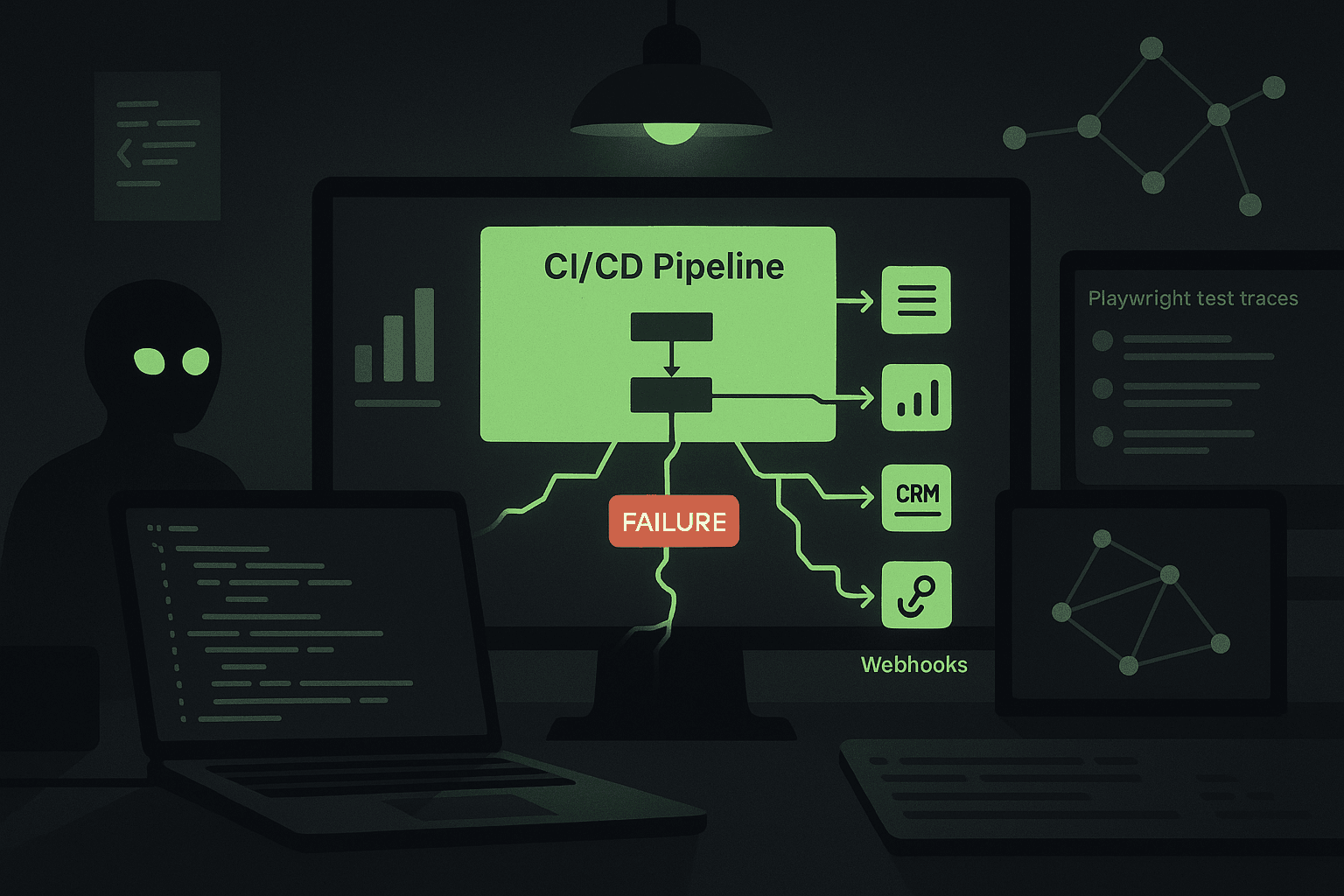
A team ships a checkout fix on Friday afternoon. The pull request is clean. Type checks pass. Unit tests are green. End-to-end tests click through the purchase flow and confirm the success screen renders. CI/CD posts its familiar badge of reassurance: all checks passed.
By Monday morning, support has fifty tickets.
Customers were charged, but half the orders never reached fulfillment. The app created records in the primary database, returned a happy success state to the browser, and even emitted an internal event. But the webhook payload shape changed just enough that the warehouse automation ignored it. No one noticed in review because the UI still worked. No one caught it in CI because the pipeline only verified what happened inside the app boundary. Production discovered the bug because the business process stalled in a different system.
That is the failure mode modern teams keep underestimating.
And in the agent era, it gets worse.
As AI generates more application code, more test code, and more infrastructure glue, teams are shipping changes that are locally correct far more quickly than they are globally reliable. An agent can refactor a controller, update a schema, patch a serializer, and make every existing test pass. It can optimize for the interfaces visible in the repo. What it cannot reliably prove, unless you explicitly make it do so, is that a user action still produces the correct chain of side effects across email, payments, queues, analytics, CRM, and internal ops tooling.
This is the blind spot behind a lot of “green pipeline, broken business” incidents. Traditional testing validates code paths. Users experience workflows. Revenue depends on side effects.
If your CI only proves that a button click returns 200 and a success toast appears, then your pipeline is giving false confidence. The real question is whether the action triggered the right downstream consequences, exactly once, in the systems that actually run the business.
The failure class most teams don’t model clearly
Most engineering organizations are good at talking about a few common categories of failure:
- syntax or type errors
- broken unit-level logic
- integration mismatches inside the app
- flaky browser tests
- post-merge conflicts
- infrastructure drift
- production-only scaling issues
But there is another class of failure that often gets lumped into “integration bugs” even though it deserves separate treatment:
The user-visible action succeeds, but the downstream business process silently fails, duplicates, or misfires across systems.
That distinction matters.
This is not just “the database state is wrong.” It is not just “a test didn’t cover an edge case.” It is not just “staging differs from prod.” It is a distributed workflow correctness problem.
Examples are painfully familiar:
- Signup succeeds, account exists, but the welcome email never sends.
- Refund UI reports success, but no payment reversal is created with the processor.
- A demo request form writes to the app database, but the lead never appears in Salesforce or HubSpot.
- Order completion emits duplicate webhooks, causing downstream fulfillment or notifications to run twice.
- A support escalation is marked complete in the app, but the internal Slack or PagerDuty notification never triggers.
- Subscription cancellation updates local state, but the billing provider remains active and charges again next month.
- Feature flag enrollment appears successful, but the analytics identify call never fires, corrupting experiment attribution.
In all of these cases, the app may appear correct if you observe only its local state and its HTTP responses. The code path ran. The request completed. The browser showed success. CI is green.
But the workflow failed.
That is what users, operators, and revenue teams actually care about.
Why AI-generated code amplifies this blind spot
This problem existed long before code generation tools. AI just makes it more frequent, faster, and harder to reason about manually.
Agentic coding systems are very good at local optimization:
- satisfying the immediate acceptance criteria in a ticket
- updating call sites to match a changed interface
- writing unit tests that mirror implementation details
- getting Playwright tests to click through happy paths
- making CI pass with minimal repo-local evidence
That sounds useful because it is useful. But it also creates a trap.
When a human engineer manually authors a change, they often carry some fuzzy but valuable system context: “If I rename this event field, the CRM sync probably breaks,” or “This refund flow touches our worker queue and payment gateway, not just this endpoint.” They may still miss things, but they have a chance to reason across boundaries.
An AI agent usually reasons from what is explicit and testable in the available context. If your repo does not encode downstream expectations, the agent will optimize around them. If your CI does not verify side effects, generated changes can quietly preserve all local invariants while violating business invariants.
This is the central reliability gap of the agent era:
We are increasing the rate of code change faster than we are increasing the quality of workflow-level verification.
And because AI-generated changes often come with fresh tests, teams can become even more confident in the wrong evidence. The danger is not red pipelines. The danger is pipelines that are green for the wrong reasons.
Why current approaches fail
Most teams assume some combination of unit tests, integration tests, end-to-end browser tests, QA, and production monitoring will catch these issues. In practice, each layer misses this failure mode for structural reasons.
Unit tests prove functions, not outcomes
Unit tests are great for deterministic logic. They are terrible at proving distributed business effects unless you model those effects explicitly.
A typical unit test for a signup flow might verify:
- the controller returns 201
- a user record is created
sendWelcomeEmail()was called
That looks fine until you remember that the actual business requirement is not “a function was called.” The requirement is “the correct welcome email request reached the provider, was enqueued with the right metadata, and can be observed by downstream systems.”
A mock passing in a unit test proves almost nothing about that.
The same problem appears everywhere:
- mock payment gateway client returns success, but no real refund object would be created
- mocked queue publish returns true, but message schema changed and worker rejects it
- mocked analytics client gets called, but event naming drift breaks attribution pipelines
- mocked CRM client receives a request, but required custom fields are missing
Mock-heavy tests optimize for developer convenience, not workflow truth.
Integration tests usually stop at the app boundary
A lot of teams call tests “integration tests” when they mean “the app talks to its own database and maybe a local dependency.” That still leaves the most fragile part unverified: what happens after the app hands off work.
For example, a refund integration test might confirm:
- POST
/refundsreturns 200 - refund row is inserted locally
- background job is enqueued
Useful, but incomplete. The real integration surface includes:
- the payment processor API call
- idempotency behavior
- asynchronous reconciliation
- internal notifications
- accounting or ERP sync
If you stop at “job enqueued,” you are asserting intent, not effect.
Browser E2E tests overfit to UI success
Modern end-to-end testing tools like Playwright are excellent for simulating real user actions. But most teams still use them to verify rendered state, not system consequences.
A typical Playwright test says:
- click submit
- expect success toast
- expect redirect
- maybe check a row in the UI table
That is an interaction test, not a workflow verification test.
The browser can only see what the app chooses to display. The app often reports success before downstream side effects are complete, acknowledged, or even attempted.
The result is false confidence with a realistic UI harness.
Manual QA cannot scale across hidden systems
QA can catch visible regressions. They can notice broken forms, disabled buttons, missing redirects. What they usually cannot do efficiently in every release candidate is verify distributed side effects across:
- ESP dashboards
- Stripe or Adyen refund records
- queue state
- webhook consumers
- Salesforce objects
- Slack alerts
- warehouse systems
- feature flag or analytics profiles
Even if they can, manual verification is slow, inconsistent, and hard to automate into CI/CD.
The problem is not that QA is weak. The problem is that the workflow surface area exceeds what a person can reliably inspect per change.
Production monitoring is too late
Many organizations effectively rely on support tickets, revenue anomalies, or operator dashboards as their first cross-system verification layer.
That is not monitoring. That is incident discovery.
By the time you detect that welcome emails stopped sending, refunds are not processing, or leads are not entering the sales pipeline, the blast radius already exists. Customers are confused. Operations teams are doing cleanup. Trust is gone.
You do not want production to be the first environment where distributed workflow correctness is exercised end to end.
The core insight: verify side effects, not just code paths
The missing layer is straightforward to describe and surprisingly absent in many pipelines:
For critical user workflows, CI and preview environments should verify the observable side effects produced across connected systems, not just local state changes or UI success.
This is not a replacement for unit tests, integration tests, or browser tests. It is a different layer with a different purpose.
Think of it as cross-system side-effect verification.
For a given workflow, your test should define:
- The triggering user action
- The expected local outcome
- The expected downstream effects
- The expected sequencing or timing
- The absence of duplicate or forbidden effects
For example, “user requests refund” is not complete until you verify something like:
- refund UI action succeeds
- local refund record exists
- one and only one refund request appears in payment provider sandbox
- correct amount and transaction ID are used
- reconciliation event is published
- support notification is sent
- analytics event is recorded exactly once
That is a business workflow assertion. It speaks the language of reliability.
What this looks like in practice
You do not need to hit every production dependency in every test. But you do need a credible way to observe side effects in environments tied to code changes.
There are several practical patterns:
- sandbox accounts for external providers
- test inboxes for email verification
- webhook capture endpoints
- queue consumers that expose received messages for assertions
- CRM sandbox tenants
- analytics debug streams or event capture proxies
- internal audit/event log endpoints for verification
- ephemeral preview environments wired to isolated test infrastructure
The key is observability with assertions.
Not “we emitted an event internally.”
But “the downstream system received the right effect.”
Example 1: signup succeeds but welcome email never sends
A weak test:
js// Weak: proves local success only
import { test, expect } from '@playwright/test';

test('user can sign up', async ({ page }) => {
  await page.goto('/signup');
  await page.fill('[name=email]', 'new-user@example.com');
  await page.fill('[name=password]', 'StrongPass123!');
  await page.click('button[type=submit]');

  await expect(page.getByText('Welcome!')).toBeVisible();
});
This test tells you the UI completed the flow. It says nothing about whether the welcome email was actually sent.
A stronger pattern uses a test inbox provider or email capture API.
jsimport { test, expect } from '@playwright/test';

async function waitForEmail(emailAddress, subject) {
  const started = Date.now();
  while (Date.now() - started < 30000) {
    const res = await fetch(
      `${process.env.TEST_INBOX_API}/messages?to=${encodeURIComponent(emailAddress)}`,
      {
        headers: { Authorization: `Bearer ${process.env.TEST_INBOX_TOKEN}` }
      }
    );

    const messages = await res.json();
    const match = messages.find(m => m.subject === subject);
    if (match) return match;

    await new Promise(r => setTimeout(r, 2000));
  }

  throw new Error(`No email with subject ${subject} received`);
}

test('signup sends welcome email', async ({ page }) => {
  const email = `user-${Date.now()}@test-inbox.local`;

  await page.goto('/signup');
  await page.fill('[name=email]', email);
  await page.fill('[name=password]', 'StrongPass123!');
  await page.click('button[type=submit]');

  await expect(page.getByText('Welcome!')).toBeVisible();

  const message = await waitForEmail(email, 'Welcome to Acme');
  expect(message.to[0].email).toBe(email);
  expect(message.html).toContain('Get started');
});
Now the test verifies an actual business side effect. It is still end-to-end testing, but now it covers the system users care about.
Example 2: refund UI says success but no payment reversal occurs
Here the right assertion is not “refund row created locally.” It is “sandbox provider contains a matching refund.”
pythonimport os
import time
import requests
from playwright.sync_api import sync_playwright

PAYMENTS_API = os.environ["PAYMENTS_SANDBOX_API"]
PAYMENTS_TOKEN = os.environ["PAYMENTS_SANDBOX_TOKEN"]
APP_URL = os.environ["PREVIEW_URL"]

def find_refund(charge_id, amount_cents, timeout=30):
    started = time.time()
    while time.time() - started < timeout:
        resp = requests.get(
            f"{PAYMENTS_API}/refunds",
            params={"charge_id": charge_id},
            headers={"Authorization": f"Bearer {PAYMENTS_TOKEN}"},
            timeout=10,
        )
        resp.raise_for_status()
        refunds = resp.json()["data"]
        for refund in refunds:
            if refund["amount"] == amount_cents and refund["status"] in ["pending", "succeeded"]:
                return refund
        time.sleep(2)
    raise AssertionError("Refund not found in payment sandbox")

with sync_playwright() as p:
    browser = p.chromium.launch()
    page = browser.new_page()
    page.goto(f"{APP_URL}/orders/order_123")
    page.click("text=Refund")
    page.fill("[name=amount]", "25.00")
    page.click("button:has-text('Confirm refund')")
    page.wait_for_selector("text=Refund submitted")
    browser.close()

refund = find_refund("ch_123", 2500)
assert refund["charge_id"] == "ch_123"
assert refund["amount"] == 2500
This catches a whole class of defects that local mocks miss:
- authentication misconfiguration
- API field mapping drift
- currency conversion mistakes
- amount serialization bugs
- provider-side validation failures
- async dispatch never happening
Example 3: form submissions save locally but never reach CRM
This one hits growth teams hard because engineering often treats “saved in our DB” as success while sales sees dropped pipeline.
jsimport { test, expect } from '@playwright/test';

async function waitForCrmLead(email) {
  const started = Date.now();
  while (Date.now() - started < 45000) {
    const res = await fetch(`${process.env.CRM_SANDBOX_API}/leads?email=${encodeURIComponent(email)}`, {
      headers: { Authorization: `Bearer ${process.env.CRM_SANDBOX_TOKEN}` }
    });

    const data = await res.json();
    if (data.items?.length) return data.items[0];
    await new Promise(r => setTimeout(r, 3000));
  }

  throw new Error('Lead not found in CRM sandbox');
}

test('demo request creates CRM lead', async ({ page }) => {
  const email = `buyer-${Date.now()}@example.com`;

  await page.goto('/demo');
  await page.fill('[name=name]', 'Taylor Buyer');
  await page.fill('[name=email]', email);
  await page.fill('[name=company]', 'Example Co');
  await page.click('button[type=submit]');

  await expect(page.getByText('We will be in touch soon')).toBeVisible();

  const lead = await waitForCrmLead(email);
  expect(lead.email).toBe(email);
  expect(lead.company).toBe('Example Co');
  expect(lead.source).toBe('website_demo_request');
});
That is a business-critical CI check, not a “nice to have” UI test.
Example 4: duplicate webhooks corrupt downstream automation
This is where side-effect verification becomes more than presence checks. You also need to verify uniqueness and idempotency.
Suppose order completion should emit exactly one fulfillment webhook.
pythonimport os
import time
import requests

WEBHOOK_CAPTURE_API = os.environ["WEBHOOK_CAPTURE_API"]
WEBHOOK_CAPTURE_TOKEN = os.environ["WEBHOOK_CAPTURE_TOKEN"]
ORDER_ID = f"order-{int(time.time())}"

def list_events(order_id):
    resp = requests.get(
        f"{WEBHOOK_CAPTURE_API}/events",
        params={"order_id": order_id},
        headers={"Authorization": f"Bearer {WEBHOOK_CAPTURE_TOKEN}"},
        timeout=10,
    )
    resp.raise_for_status()
    return resp.json()["items"]

# ... perform order completion through UI or API ...

time.sleep(10)
events = list_events(ORDER_ID)
fulfillment = [e for e in events if e["type"] == "order.fulfilled"]

assert len(fulfillment) == 1, f"Expected exactly 1 fulfillment webhook, got {len(fulfillment)}"
assert fulfillment[0]["payload"]["order_id"] == ORDER_ID
This protects against a nasty category of bugs where retries, race conditions, or event replay logic generate duplicate side effects that look harmless in app logs but create expensive downstream damage.
Side-effect verification needs better test architecture
If you try to bolt this onto an already chaotic test suite, it will feel flaky and expensive. The solution is not to avoid it. The solution is to design the layer deliberately.
A good architecture usually has these pieces:
1. Isolated environment wiring
Your preview or CI environment should connect to sandboxed dependencies, not shared production-like accounts where tests interfere with each other.
Examples:
- dedicated email sandbox domain
- payment processor test merchant
- CRM sandbox workspace
- isolated webhook sink per branch or per run
- queue namespace keyed by build ID
Isolation reduces both flakiness and cleanup pain.
2. Correlation IDs everywhere
Every workflow test should stamp a unique identifier that propagates across systems.
Examples:
- email address with run ID
- metadata fields like
test_run_id - webhook headers such as
X-Test-Run-Id - payment metadata
- CRM custom property
- analytics event property
Without correlation IDs, debugging distributed test failures becomes miserable.
3. Polling with time bounds
Many side effects are asynchronous. Your tests need robust wait logic with clear timeouts and useful error messages.
Do not rely on arbitrary sleep(10) unless you have no alternative. Poll for observable conditions.
4. Strong assertions on payload shape
Presence is not enough. Verify the important fields.
For example:
- right recipient, not just some email
- right amount, not just some refund
- right CRM owner or source
- right event name and version
- right dedupe key or idempotency token
5. Negative assertions where important
Some workflows should prove that an effect did not happen twice or did not happen before approval.
This is critical for preventing duplicate charges, duplicate notifications, and premature automations.
CI/CD implementation: where this fits
Not every commit deserves a full distributed workflow suite. But every critical workflow deserves automated side-effect verification somewhere before production.
A pragmatic CI/CD strategy often looks like this:
- fast lane on every PR: unit tests, static analysis, local integration tests
- workflow lane on preview deploy: targeted cross-system side-effect verification for impacted flows
- nightly or pre-merge full suite: broader business workflow coverage
- post-deploy smoke checks: a small set of production-safe synthetic verifications where possible
Here is a simple GitHub Actions example:
yamlname: ci

on:
  pull_request:
  push:
    branches: [main]

jobs:
  app-checks:
    runs-on: ubuntu-latest
    steps:
      - uses: actions/checkout@v4
      - uses: actions/setup-node@v4
        with:
          node-version: 20
      - run: npm ci
      - run: npm run lint
      - run: npm run typecheck
      - run: npm run test:unit
      - run: npm run test:integration

  preview:
    needs: app-checks
    runs-on: ubuntu-latest
    steps:
      - uses: actions/checkout@v4
      - run: ./scripts/deploy-preview.sh

  workflow-verification:
    needs: preview
    runs-on: ubuntu-latest
    env:
      PREVIEW_URL: ${{ secrets.PREVIEW_URL }}
      TEST_INBOX_API: ${{ secrets.TEST_INBOX_API }}
      TEST_INBOX_TOKEN: ${{ secrets.TEST_INBOX_TOKEN }}
      PAYMENTS_SANDBOX_API: ${{ secrets.PAYMENTS_SANDBOX_API }}
      PAYMENTS_SANDBOX_TOKEN: ${{ secrets.PAYMENTS_SANDBOX_TOKEN }}
      CRM_SANDBOX_API: ${{ secrets.CRM_SANDBOX_API }}
      CRM_SANDBOX_TOKEN: ${{ secrets.CRM_SANDBOX_TOKEN }}
    steps:
      - uses: actions/checkout@v4
      - uses: actions/setup-node@v4
        with:
          node-version: 20
      - uses: actions/setup-python@v5
        with:
          python-version: '3.11'
      - run: npm ci
      - run: pip install -r requirements.txt
      - run: npm run test:workflow
      - run: pytest tests/workflows
The important idea is not the YAML. It is that workflow verification is treated as a first-class pipeline stage, not an afterthought.
Debugging changes when side-effect checks fail
This is where teams often gain the biggest developer productivity boost.
Without side-effect verification, debugging a support report like “refund didn’t happen” involves:
- searching app logs
- checking queue workers
- opening provider dashboards
- guessing whether issue is data-specific
- comparing prod and staging configs
- trying to replay requests manually
With deliberate cross-system verification, your failing test already gives you a scoped reproduction:
- trigger action: refund order
order_123 - local state: passed
- payment sandbox refund: missing
- queue event: present
- webhook sink: absent
- correlation ID:
ci-run-8472
That changes debugging from archaeology into engineering.
This is one of the most underrated benefits of better testing. Reliable workflow assertions do not just catch failures earlier; they sharply reduce the time to isolate where they occurred.
Tooling options and tradeoffs
You can build this layer with existing tools, but each category has limits.
Playwright
Strengths:
- excellent for realistic workflow triggering
- strong debugging traces and screenshots
- integrates well with preview environments
Weaknesses:
- by itself, mostly sees UI state
- needs custom helpers or external APIs to verify downstream effects
Playwright is a great trigger layer, not the whole solution.
Cypress
Strengths:
- good browser-based testing ergonomics
- familiar to many teams
Weaknesses:
- same core limitation as Playwright for hidden side effects
- less ideal than Playwright for some modern multi-tab and tracing workflows
Postman or API test runners
Strengths:
- good for direct API workflow invocation
- easy to script assertions across HTTP-accessible systems
Weaknesses:
- misses UI-specific regressions and client-side triggers
- can drift from how users actually exercise workflows
Contract testing tools
Strengths:
- useful for validating interface expectations between services
- can reduce schema drift surprises
Weaknesses:
- contract conformance does not prove the full workflow happened
- does not detect duplicate or missing business effects by itself
Observability platforms
Strengths:
- useful for tracing events across systems
- excellent for debugging and production detection
Weaknesses:
- usually not an assertion framework in CI/CD
- detection often arrives after deployment
Mock servers and service virtualization
Strengths:
- fast, deterministic, cheap
- useful for edge cases and failure simulation
Weaknesses:
- poor proxy for real side-effect correctness if overused
- easy to assert “client called mock” and miss provider reality
The right approach is usually hybrid:
- browser or API harness to trigger workflows
- sandbox or capture systems to observe effects
- test utilities to correlate and assert results
- CI/CD orchestration to run them reliably
What to verify first
Do not start by trying to cover every single workflow in your company. Start with workflows where silent side-effect failure causes obvious business damage.
A useful prioritization framework:
Tier 1: money movement
- charges
- refunds
- subscription changes
- invoicing
- payouts
Tier 2: customer communication
- transactional emails
- SMS
- support notifications
- internal escalations
Tier 3: revenue pipeline
- lead capture
- demo requests
- contact routing
- CRM sync
Tier 4: fulfillment and operations
- order routing
- warehouse handoff
- provisioning
- ticket generation
- partner webhooks
Tier 5: analytics and experimentation
- conversion events
- attribution markers
- identify/profile sync
- experiment enrollment effects
If you only implement five side-effect workflow tests this quarter, choose the five incidents you least want to discover from customers.
Actionable practices for engineering teams
Here is the practical version.
Define workflow invariants in business language
Stop writing requirements like “endpoint returns 200” for critical flows. Write them like:
- “signup creates account and sends welcome email within 60 seconds”
- “refund request creates exactly one provider refund with matching amount”
- “demo form creates CRM lead with source metadata”
- “order completion emits one fulfillment webhook and one analytics conversion event”
These are testable invariants.
Add side-effect observability endpoints or sinks
If your systems are impossible to assert against in test environments, that is an architecture problem.
Create mechanisms to inspect:
- sent emails
- captured webhooks
- outbound API requests
- queued events
- internal workflow audit logs
Make verification easy on purpose.
Propagate correlation metadata
Every critical action should carry traceable metadata across systems. This helps both CI and production debugging.
Treat duplicates as first-class failures
Many teams check only for missing effects. Duplicate side effects are often just as dangerous.
Always ask:
- did it happen?
- did it happen correctly?
- did it happen exactly once?
Keep the suite targeted
This layer should cover business-critical workflows, not every tiny interaction. If you try to verify every side effect for every click, the suite becomes slow and noisy.
Focus on high-value actions with meaningful downstream consequences.
Fail with diagnostic evidence
When a workflow verification test fails, attach:
- correlation ID
- local app logs
- outbound request logs
- webhook payloads
- sandbox object IDs
- Playwright trace or screenshot
Good failure artifacts turn debugging into a short loop.
Make AI-generated changes earn trust
If your team uses coding agents, do not judge them only by whether they preserve unit test coverage. Judge them by whether critical workflows still produce correct side effects.
That is the actual acceptance bar.
The bigger shift: from application correctness to workflow correctness
A lot of CI/CD culture still reflects a monolithic mental model:
- compile the code
- run tests
- deploy if green
But modern product behavior spans SaaS APIs, queues, workers, webhooks, and internal automation layers. What your customer experiences is not just your application. It is the composed behavior of your application plus every system it triggers.
That means reliability can no longer be measured only by application correctness. It must include workflow correctness.
This is especially true as software teams increase throughput with AI assistance. Faster code generation without better distributed verification just means faster incident creation. The bottleneck is no longer writing implementation code. The bottleneck is proving that the business workflow still works across boundaries.
That is why green pipelines increasingly lie.
They tell you the repository is internally consistent.
They do not tell you whether signup sends the email, whether the refund reaches the processor, whether the lead lands in CRM, whether the order webhook fires once, or whether your internal ops systems got the signal they depend on.
Those are not edge concerns. For many products, they are the product.
Conclusion
Traditional testing is still necessary. Keep your unit tests. Keep your integration tests. Keep your browser automation. But stop pretending those layers alone prove distributed workflow reliability.
The new failure class is clear: a user action succeeds in the UI while the downstream business process silently fails, duplicates, or misfires across connected systems. AI-generated code makes this easier to ship because it optimizes for local correctness unless you explicitly verify global effects.
The answer is not more generic testing. It is more specific testing.
Verify side effects.
For your most critical workflows, build CI and preview checks that assert what happened in email, payments, queues, analytics, CRM, and ops tooling. Test the business consequence, not just the code path. Treat cross-system side-effect verification as the missing layer between conventional automated testing and production incident discovery.
Because in the agent era, a green pipeline that cannot prove workflow correctness is not a reliability signal.
It is a comforting dashboard for bugs that have not reached support yet.