
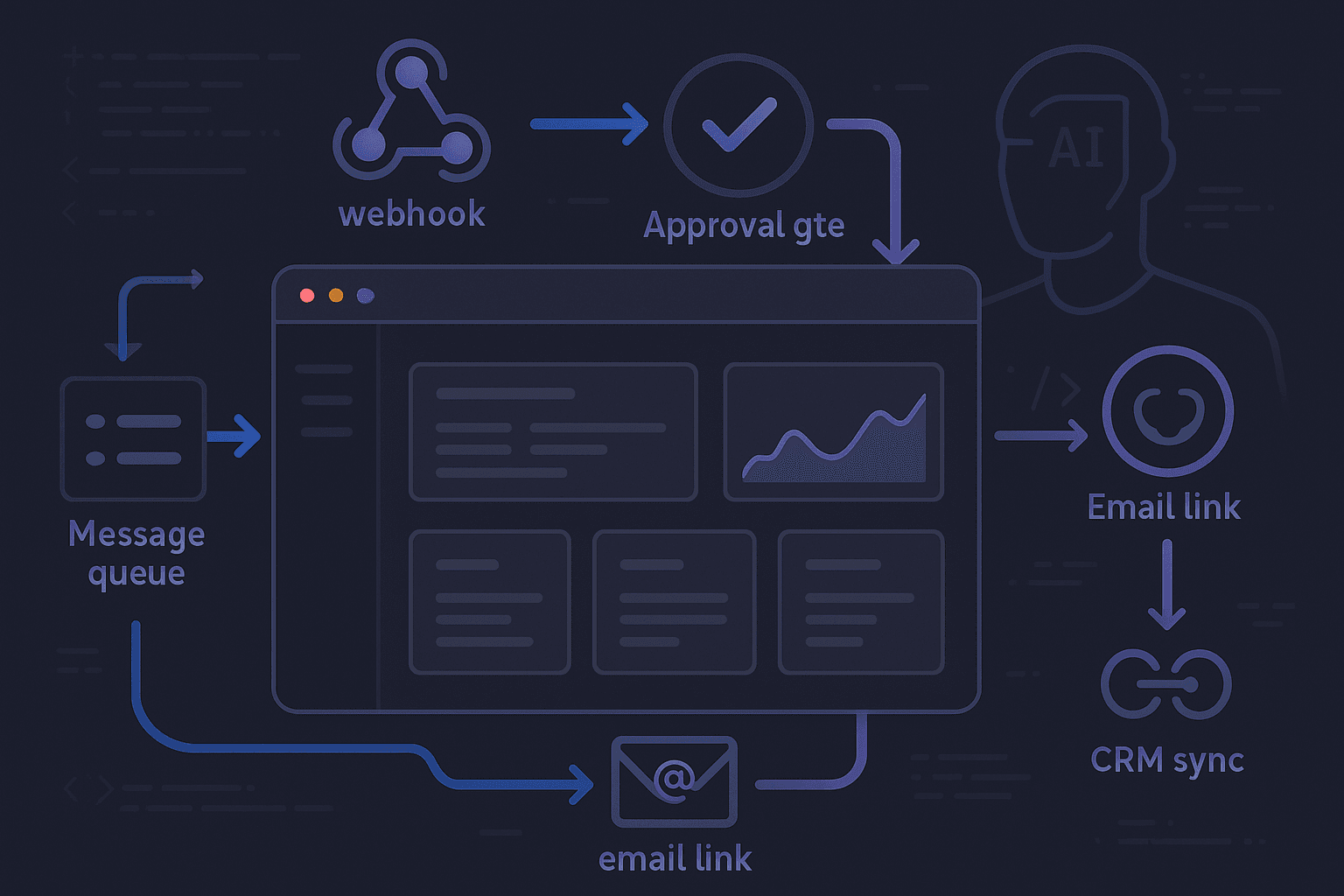
A team ships a new onboarding flow on Friday afternoon. The browser test passes. The unit suite is green. CI/CD reports success in under nine minutes. The PR was mostly written by an AI coding agent, reviewed quickly by a tired engineer, and merged because the changes looked harmless: a few form fields, a webhook payload tweak, a queue consumer refactor, and one “small” approval rule cleanup.
By Monday, support has 47 tickets.
Users can submit the onboarding form. They see the success screen. But the follow-up email never arrives for some accounts. Sales never gets the CRM record for others. High-risk customers bypass the manual approval queue entirely because the approval event was emitted with a renamed field that no downstream consumer recognized. Nobody notices immediately because the frontend worked, the API returned 200, and the tests only verified the rendered state plus a couple of mocked function calls.
This is the failure class AI-generated code is making more common: not obvious UI breakage, not simple unit regressions, but broken handoffs between systems. The agent didn’t break the page. It broke the workflow contract.
That distinction matters. Modern software is no longer a single request-response loop ending at a DOM assertion. It is a chain of delayed side effects: jobs pushed onto queues, webhooks delivered to third parties, approval steps paused on humans, state synced into CRMs, emails containing signed links, retries scheduled after transient failures, compensating actions triggered when something times out. If you only test what renders in the browser or what returns from the controller, you are validating the easiest part of the system and ignoring the part most likely to quietly cost you money.
The Real Problem Isn’t Broken Features. It’s Broken Handoffs.
AI-assisted development increases output. That is not controversial anymore. More code gets written. More refactors get proposed. More “cleanup” changes land in places that connect one system to another. And those boundary layers are exactly where confidence is weakest.
An LLM can generate a route handler that looks reasonable, a serializer that almost matches the old schema, or a queue publishing call that uses the new field name consistently inside the local codebase. The generated code can be internally coherent and still incompatible with every downstream dependency that was not represented in the prompt or the test harness.
That is why so many failures now look like this:
- The UI says “Order submitted” but the fulfillment job was never enqueued.
- The queue contains the job, but the consumer discards it because the event version is wrong.
- The consumer processes it, but the webhook signature changed and the partner rejects delivery.
- The webhook succeeds, but the approval gate never triggers because the risk score field is null after serialization.
- The approval request is created, but the email contains an expired token due to a timezone bug.
- The approver clicks the link, but the CRM sync retry policy deadlocks the status update.
From the perspective of a user and your revenue metrics, the workflow failed. From the perspective of your test suite, everything may still be green.
This is why “it passed end-to-end tests” has become less meaningful than teams think. Many so-called end-to-end tests stop at the browser or a mocked backend response. They validate that a button click reaches a success page. They do not validate that the actual chain of actions across queues, webhooks, humans, and delayed side effects completed correctly.
Why Current Approaches Fail
Most engineering organizations already have testing. Many have a lot of it. That is not the same as having coverage for workflow handoffs.
CI/CD Optimizes for Fast Signal, Not Complete Workflow Truth
CI/CD pipelines are built to produce quick, automatable confidence. That usually means:
- unit tests
- API tests against local services
- UI tests against seeded environments
- static analysis
- linting and type checks
All of those are useful. None of them reliably prove that the workflow contract across systems still holds.
Why? Because CI works best when dependencies are deterministic, local, and controllable. But real workflow failures live in places CI tends to abstract away:
- asynchronous queue processing
- delayed retries
- external webhook delivery and idempotency
- expiring links and tokenized email flows
- approval steps blocked on people or role resolution
- eventually consistent systems like CRMs and billing tools
- scheduler behavior and timeout handling
The result is false confidence. CI says the code path is valid. Production says the business process is broken.
Unit Tests Assert Functions, Not Contracts
Unit tests are good at one thing: proving a small piece of code behaves as expected in isolation.
They are bad at proving that one system’s output is still a valid input to another system three hops later.
A classic unit test for a publisher might look like this:
jsimport { publishOrderCreated } from './publisher'
import { bus } from './bus'

jest.mock('./bus', () => ({
  bus: { publish: jest.fn() }
}))

test('publishes order created event', async () => {
  await publishOrderCreated({
    orderId: 'ord_123',
    userId: 'usr_456',
    total: 4999
  })

  expect(bus.publish).toHaveBeenCalledWith('order.created', {
    orderId: 'ord_123',
    userId: 'usr_456',
    total: 4999
  })
})
This test may pass even if the downstream consumer expects amount_cents instead of total, or requires event_version, or now depends on risk_level being present. The unit test proves a call happened. It does not prove the handoff still works.
That is the core mismatch: unit tests verify implementation behavior, while production failures often come from contract drift.
Browser E2E Tests Stop Too Early
A lot of teams think they are doing workflow verification because they use Playwright or Cypress. But if the browser test stops after the success toast appears, that is not workflow verification. That is UI confirmation.
A Playwright test that does this is useful but incomplete:
tsimport { test, expect } from '@playwright/test'

test('user can submit onboarding form', async ({ page }) => {
  await page.goto('/onboarding')
  await page.fill('[name=email]', 'new@example.com')
  await page.fill('[name=company]', 'Acme Inc')
  await page.click('button[type=submit]')

  await expect(page.getByText('Onboarding submitted')).toBeVisible()
})
The test proves the browser got a success response. It does not prove:
- an onboarding job entered the queue
- the worker consumed it
- the approval request was created for high-risk cases
- the email was sent with a valid link
- the CRM sync succeeded or retried correctly
Yet these are the exact places revenue, compliance, and customer trust get lost.
Manual QA Rarely Waits for Asynchronous Reality
Human testers are also constrained. They naturally focus on immediate visible behavior. They click through screens, verify copy, inspect logs if asked, and maybe check one or two backend records.
But few QA processes consistently validate these questions:
- Was the webhook delivered and acknowledged?
- Did a retry happen after a simulated 500?
- Was the approval routed to the correct role after org policy lookup?
- Did the email link remain valid across environments and time windows?
- Was idempotency preserved on duplicate deliveries?
- Did the CRM eventually converge on the expected state?
This is not a criticism of QA. It is a tooling and systems design problem. Most teams have not instrumented their workflows to make these handoffs easy to observe and verify.
The Core Insight: Verify Actions Across Boundaries, Not Just States Inside One App
The missing layer in many modern testing strategies is action-level verification across system boundaries.
Not just “did the page render?”
Not just “did the database row update?”
But:
- Did the expected action happen?
- Did it cross the boundary?
- Was it accepted by the next system?
- Did the delayed side effect complete?
- If it failed, did the retry or approval path behave correctly?
This is different from generic end-to-end testing.
Generic E2E usually focuses on a user journey inside one app. Workflow verification focuses on the contract between steps in a distributed process, including asynchronous and human-mediated transitions.
This is also different from stateful verification alone.
Stateful verification might assert that an order row became approved. Useful, but insufficient. That final state can hide missing intermediate guarantees. Maybe approval happened automatically when it should have gone to a human. Maybe the CRM synced stale data. Maybe two duplicate webhook deliveries caused inconsistent side effects before the final state settled.
What you need is evidence of the workflow itself:
- event emitted
- payload shape correct
- consumer accepted it
- side effect executed
- retries honored
- approval gate enforced
- final downstream state consistent
That is the level where AI-generated changes most often create silent damage.
A Concrete Example: An AI PR That “Works” but Breaks Onboarding
Imagine an onboarding workflow like this:
- User submits onboarding form in the web app.
- API stores application in database.
- API emits
onboarding.submittedto a queue. - Worker enriches the record and computes risk.
- Low-risk users get an activation email.
- High-risk users create a manual approval task.
- Approved users sync to CRM and billing.
An AI agent proposes a refactor to “standardize naming.” It changes riskLevel to risk_score_band in the worker output and updates all local TypeScript types. Unit tests pass. The browser flow still ends on “Application received.”
But the approval service still expects riskLevel. It sees missing data and falls back to auto-approval.
Now your tests are green and your compliance workflow is gone.
Here is how such a bug can slip through.
Local code looks fine
ts// worker.ts
export async function processOnboarding(message: OnboardingSubmitted) {
  const risk = await calculateRisk(message.applicationId)

  await eventBus.publish('onboarding.evaluated', {
    applicationId: message.applicationId,
    risk_score_band: risk.band,
    evaluatedAt: new Date().toISOString()
  })
}
Approval service still expects old schema
ts// approval-consumer.ts
export async function handleOnboardingEvaluated(event: any) {
  if (event.riskLevel === 'high') {
    await createManualApprovalTask(event.applicationId)
    return
  }

  await autoApprove(event.applicationId)
}
Unit tests still pass
tstest('worker publishes onboarding evaluated event', async () => {
  await processOnboarding({ applicationId: 'app_1' })

  expect(eventBus.publish).toHaveBeenCalledWith(
    'onboarding.evaluated',
    expect.objectContaining({ applicationId: 'app_1' })
  )
})
No test asserted the contract between publisher and consumer. No workflow verification checked that high-risk users actually create approval tasks.
What Workflow Verification Looks Like in Practice
You need tests and observability that follow the action through the system.
The basic pattern is:
- Trigger a user workflow through a realistic entrypoint.
- Capture emitted events or queued jobs.
- Assert payload contracts.
- Let downstream consumers process them.
- Assert resulting external actions: webhook calls, emails, approval tasks, CRM writes.
- Simulate failure conditions.
- Verify retries, idempotency, and human gates.
Example: Playwright plus workflow probes
The browser can still be your trigger point. But the test must continue beyond the UI.
tsimport { test, expect } from '@playwright/test'
import { getQueueMessage, getApprovalTask, getSentEmail, getCrmRecord } from './workflow-probes'

test('high-risk onboarding requires manual approval and does not auto-sync to CRM', async ({ page }) => {
  await page.goto('/onboarding')
  await page.fill('[name=email]', 'risk@example.com')
  await page.fill('[name=company]', 'Risky Co')
  await page.fill('[name=country]', 'US')
  await page.check('[name=highRiskScenario]')
  await page.click('button[type=submit]')

  await expect(page.getByText('Application received')).toBeVisible()

  const submitted = await getQueueMessage('onboarding.submitted', {
    email: 'risk@example.com'
  })
  expect(submitted.payload.email).toBe('risk@example.com')

  const approvalTask = await getApprovalTask({
    applicationId: submitted.payload.applicationId
  })
  expect(approvalTask.status).toBe('pending')
  expect(approvalTask.assigneeRole).toBe('risk_ops')

  const email = await getSentEmail({
    applicationId: submitted.payload.applicationId,
    template: 'activation'
  })
  expect(email).toBeNull()

  const crmRecord = await getCrmRecord({
    applicationId: submitted.payload.applicationId
  })
  expect(crmRecord).toBeNull()
})
This is a fundamentally different test from a pure browser assertion. It verifies the workflow contract: high-risk means no activation email, no CRM sync, pending manual approval.
Example: Contract verification for queue consumers
You also need machine-checkable contracts between producers and consumers.
In JavaScript:
tsimport { z } from 'zod'

export const OnboardingEvaluatedEvent = z.object({
  applicationId: z.string(),
  riskLevel: z.enum(['low', 'medium', 'high']),
  evaluatedAt: z.string().datetime(),
  eventVersion: z.literal(1)
})

export type OnboardingEvaluatedEvent = z.infer<typeof OnboardingEvaluatedEvent>
Producer:
tsawait eventBus.publish('onboarding.evaluated', OnboardingEvaluatedEvent.parse({
  applicationId,
  riskLevel: risk.band,
  evaluatedAt: new Date().toISOString(),
  eventVersion: 1
}))
Consumer:
tsexport async function handleOnboardingEvaluated(raw: unknown) {
  const event = OnboardingEvaluatedEvent.parse(raw)

  if (event.riskLevel === 'high') {
    await createManualApprovalTask(event.applicationId)
  } else {
    await autoApprove(event.applicationId)
  }
}
This does not replace workflow verification, but it reduces silent contract drift.
In Python, the same idea with Pydantic:
pythonfrom pydantic import BaseModel
from typing import Literal

class OnboardingEvaluatedEvent(BaseModel):
    applicationId: str
    riskLevel: Literal['low', 'medium', 'high']
    evaluatedAt: str
    eventVersion: Literal[1]
Consumer:
pythonasync def handle_onboarding_evaluated(raw_event: dict):
    event = OnboardingEvaluatedEvent(**raw_event)

    if event.riskLevel == 'high':
        await create_manual_approval_task(event.applicationId)
    else:
        await auto_approve(event.applicationId)
Example: Webhook verification with retries
If your system depends on outbound webhooks, you should test delivery, failure, and retry behavior explicitly.
tstest('order webhook retries after 500 and preserves idempotency key', async () => {
  const deliveries: any[] = []

  await webhookReceiver.stub('/partner/orders', [
    { status: 500, body: 'temporary failure' },
    {
      status: 200,
      capture: (req) => deliveries.push(req)
    }
  ])

  const order = await createOrderViaApi({
    email: 'buyer@example.com',
    total: 4999
  })

  await waitForWebhookAttempts(order.id, 2)

  expect(deliveries).toHaveLength(1)
  expect(deliveries[0].headers['idempotency-key']).toBeDefined()

  const attempts = await getWebhookAttempts(order.id)
  expect(attempts[0].status).toBe(500)
  expect(attempts[1].status).toBe(200)
  expect(attempts[0].headers['idempotency-key']).toBe(
    attempts[1].headers['idempotency-key']
  )
})
This is where real debugging value appears. You are not asking whether a function called sendWebhook(). You are verifying that your actual workflow tolerated a boundary failure and recovered correctly.
Example: Human approval steps are testable too
Teams often treat human approval as outside the scope of automated testing. That is a mistake. You can test the gate, the routing, and the consequences.
pythonasync def test_high_value_refund_requires_finance_approval(client, probes):
    refund = await client.create_refund({
        "payment_id": "pay_123",
        "amount": 250000
    })

    approval = await probes.wait_for_approval_task({
        "resource_id": refund["id"],
        "approval_type": "finance_refund"
    })

    assert approval["status"] == "pending"
    assert approval["assignee_role"] == "finance_manager"

    ledger_entry = await probes.get_ledger_entry(refund["id"])
    assert ledger_entry is None

    await probes.approve_task(approval["id"], approver="mgr_42")

    ledger_entry = await probes.wait_for_ledger_entry(refund["id"])
    assert ledger_entry["status"] == "posted"
That verifies the workflow held the action until a human approved it.
The CI/CD Gap: What Pipelines Usually Miss
The average CI/CD pipeline still treats asynchronous workflow tests as optional because they are slower, harder to seed, and more operationally messy than unit tests.
That is understandable. It is also why critical failure classes escape.
A typical pipeline:
yamlname: ci
on: [pull_request]

jobs:
  test:
    runs-on: ubuntu-latest
    steps:
      - uses: actions/checkout@v4
      - uses: actions/setup-node@v4
        with:
          node-version: 20
      - run: npm ci
      - run: npm run lint
      - run: npm run test:unit
      - run: npm run test:e2e
This pipeline is not wrong. It is incomplete.
A more realistic workflow-focused setup might separate contract and asynchronous verification:
yamlname: ci
on: [pull_request]

jobs:
  fast-tests:
    runs-on: ubuntu-latest
    steps:
      - uses: actions/checkout@v4
      - uses: actions/setup-node@v4
        with:
          node-version: 20
      - run: npm ci
      - run: npm run lint
      - run: npm run test:unit
      - run: npm run test:contracts

  workflow-tests:
    runs-on: ubuntu-latest
    services:
      postgres:
        image: postgres:16
        env:
          POSTGRES_PASSWORD: postgres
        ports: ['5432:5432']
      redis:
        image: redis:7
        ports: ['6379:6379']
      rabbitmq:
        image: rabbitmq:3-management
        ports: ['5672:5672', '15672:15672']
    steps:
      - uses: actions/checkout@v4
      - uses: actions/setup-node@v4
        with:
          node-version: 20
      - run: npm ci
      - run: docker compose up -d app worker mailhog webhook-mock crm-mock
      - run: npm run test:workflow
Notice the difference. The second job acknowledges that reliable testing of queues, webhooks, and delayed side effects requires the relevant infrastructure, not just a headless browser.
You do not need every external dependency to be real. But you do need realistic boundary behavior.
Tools Comparison: What Helps and What Doesn’t
No single tool solves this problem. The issue is not lack of frameworks. It is using the wrong layer of framework for the failure mode.
Unit test frameworks: Jest, Vitest, Pytest
Best for:
- pure business logic
- transformation correctness
- edge-case handling in isolation
- debugging regressions quickly
Weak for:
- proving cross-system contracts
- verifying delayed side effects
- detecting integration drift
Verdict: necessary, not sufficient.
Browser automation: Playwright, Cypress
Best for:
- user-visible workflows
- form interactions
- auth flows
- UI regressions
Weak for:
- queue semantics
- webhook retries
- human approval enforcement
- eventual consistency checks unless extended with custom probes
Verdict: strong trigger mechanism, weak alone.
Consumer-driven contracts: Pact, schema validation, OpenAPI checks
Best for:
- detecting producer-consumer drift
- keeping event or API payloads explicit
- failing fast when schemas change
Weak for:
- proving side effects happened
- validating retry logic
- confirming approvals and external sync outcomes
Verdict: high leverage, but only one layer.
Ephemeral environments and docker-compose integration stacks
Best for:
- realistic system boundaries
- exercising queues, workers, databases, schedulers
- reproducing production-like debugging scenarios
Weak for:
- speed
- maintenance burden
- flaky setup if poorly designed
Verdict: necessary for critical workflows, should be targeted not universal.
Observability tooling: logs, traces, event audit streams
Best for:
- understanding where handoffs fail
- making workflow tests debuggable
- production verification and incident response
Weak for:
- prevention by itself
Verdict: workflow verification without observability becomes guesswork.
Synthetic monitors and post-deploy checks
Best for:
- catching environment-specific failures after release
- verifying webhook endpoints, mail links, and approval systems in production-like conditions
Weak for:
- precise root-cause isolation during PR review
Verdict: important last line of defense, not a substitute for pre-merge validation.
Actionable Practices That Actually Reduce This Failure Class
This is the part teams usually skip because it sounds harder than adding more unit tests. It is harder. It is also where the reliability gains are.
1. Define workflow contracts explicitly
For every critical workflow, write down:
- entry action
- emitted events/jobs
- downstream consumers
- external side effects
- approval gates
- retry behavior
- idempotency expectations
- terminal success/failure states
If this is not explicit, AI-generated changes will mutate assumptions faster than humans notice.
2. Maintain a catalog of critical handoffs
Not all workflows deserve the same depth. Prioritize handoffs tied to:
- money movement
- user provisioning
- compliance approvals
- fulfillment
- account activation
- third-party syncs that sales/support depend on
If a silent drop would trigger support tickets or financial loss, it needs workflow verification.
3. Add probes, not just assertions
You need test helpers that can inspect the workflow at boundary points:
- queue readers
- webhook capture endpoints
- email inbox APIs
- approval task query APIs
- CRM mock servers
- event audit queries
Without probes, your tests can only inspect the UI and database, which is exactly the blind spot.
4. Verify negative paths and delays
Most failures live in retry and timeout logic, not the happy path.
Test these cases:
- webhook returns 500 then succeeds
- queue consumer crashes before ack
- duplicate event delivery occurs
- approval approver is missing or unauthorized
- email token expires
- CRM API rate-limits and recovers
- scheduler runs late
If you never test delayed and degraded behavior, your workflow is unverified where production is least forgiving.
5. Treat approval gates as first-class system behavior
A human approval step is not “manual stuff outside the test scope.” It is part of the software contract.
Verify:
- who gets assigned
- what blocks before approval
- what unlocks after approval
- what happens on rejection or timeout
- whether escalation rules work
This is especially important when AI-generated code touches policy evaluation or role-based routing.
6. Stop mocking away the boundaries you most need to trust
Mocking queue publishers, webhook clients, and email services is convenient. It is also exactly how teams hide contract failures.
Use mocks for unit tests. Use realistic stubs or sandbox services for workflow tests.
The rule is simple: if production reliability depends on the boundary, at least one test layer must exercise the boundary.
7. Add contract checks to PRs, workflow checks to merge gates, and synthetic checks post-deploy
Different checks belong at different speeds.
- PR: schema validation, contract tests, targeted unit tests
- Merge gate: workflow verification for critical paths
- Post-deploy: synthetic checks for environment-specific drift
Do not force every workflow test into the fastest CI stage. Stage them intentionally.
8. Instrument every handoff with correlation IDs
Workflow debugging collapses without a shared identifier.
Every user-triggered workflow should carry a correlation ID across:
- frontend request
- backend records
- queue messages
- webhook attempts
- approval tasks
- emails
- CRM sync jobs
Then both automated tests and human debugging can reconstruct the chain.
9. Measure workflow success, not just request success
Dashboards often show:
- request latency
- error rates
- test pass rates
- deploy frequency
Useful, but incomplete.
Also measure:
- percent of submitted orders that reached fulfillment
- percent of onboardings that completed activation within SLA
- approval tasks created vs expected
- webhook retries per workflow type
- dead-lettered jobs by business process
- CRM sync lag and divergence
This is where developer productivity and debugging improve in meaningful ways. You stop hunting abstract system health and start measuring whether actual user workflows finish.
10. Review AI-generated PRs by boundary impact, not line count
A ten-line AI change in a serializer can be riskier than a hundred-line UI refactor.
Update code review heuristics:
- Does this change alter an event payload?
- Does it rename fields crossing service boundaries?
- Does it touch retry, queue ack, webhook delivery, or approval routing?
- Does it affect tokens, emails, or external sync timing?
- Which workflow tests must pass before merge?
This is how you adapt review practices to AI-generated code realistically, without panic and without hype.
A Better Mental Model for Modern Testing
The old mental model was: if code paths are covered and the UI works, the feature is probably safe.
The modern mental model should be: if the workflow crosses system boundaries, the feature is unsafe until those handoffs are verified.
That shift matters because AI speeds up local correctness while doing nothing to guarantee distributed correctness. In some teams it actually makes the gap worse, because more changes are proposed in integration layers that no single engineer fully remembers.
This is why debugging modern production failures increasingly looks like workflow archaeology. You are tracing a request into an event, into a worker, into a webhook, into an approval queue, into a CRM task, trying to find which boundary silently dropped meaning.
Testing has to evolve to meet that reality.
Not by abandoning unit tests.
Not by pretending browser E2E is useless.
But by adding the missing layer: verification that actions made it across boundaries and produced the intended delayed side effects.
Conclusion
The dangerous thing about AI-generated changes is not that they obviously destroy the UI. Most of the time they do not. The dangerous thing is that they make it easier to ship code that looks correct within one service, one screen, or one test harness while breaking the handoff to the next system in the chain.
That is where modern reliability lives or dies.
If your CI/CD pipeline mostly validates rendered pages, response codes, and isolated function behavior, you are overweighting the parts of the stack that are easiest to test and under-testing the places where revenue, compliance, and trust actually leak away.
Workflow verification means following the action past the browser, past the controller, past the mocked dependency, and into the queue, webhook, approval gate, email, retry loop, and downstream system. It means treating delayed side effects as part of the feature, not implementation detail. It means designing tests for contracts and handoffs, not just code paths.
That is not generic end-to-end testing. It is a more honest definition of what “working” means.
And in a world where agents write more of the glue code than ever, honesty is exactly what your testing strategy needs.