
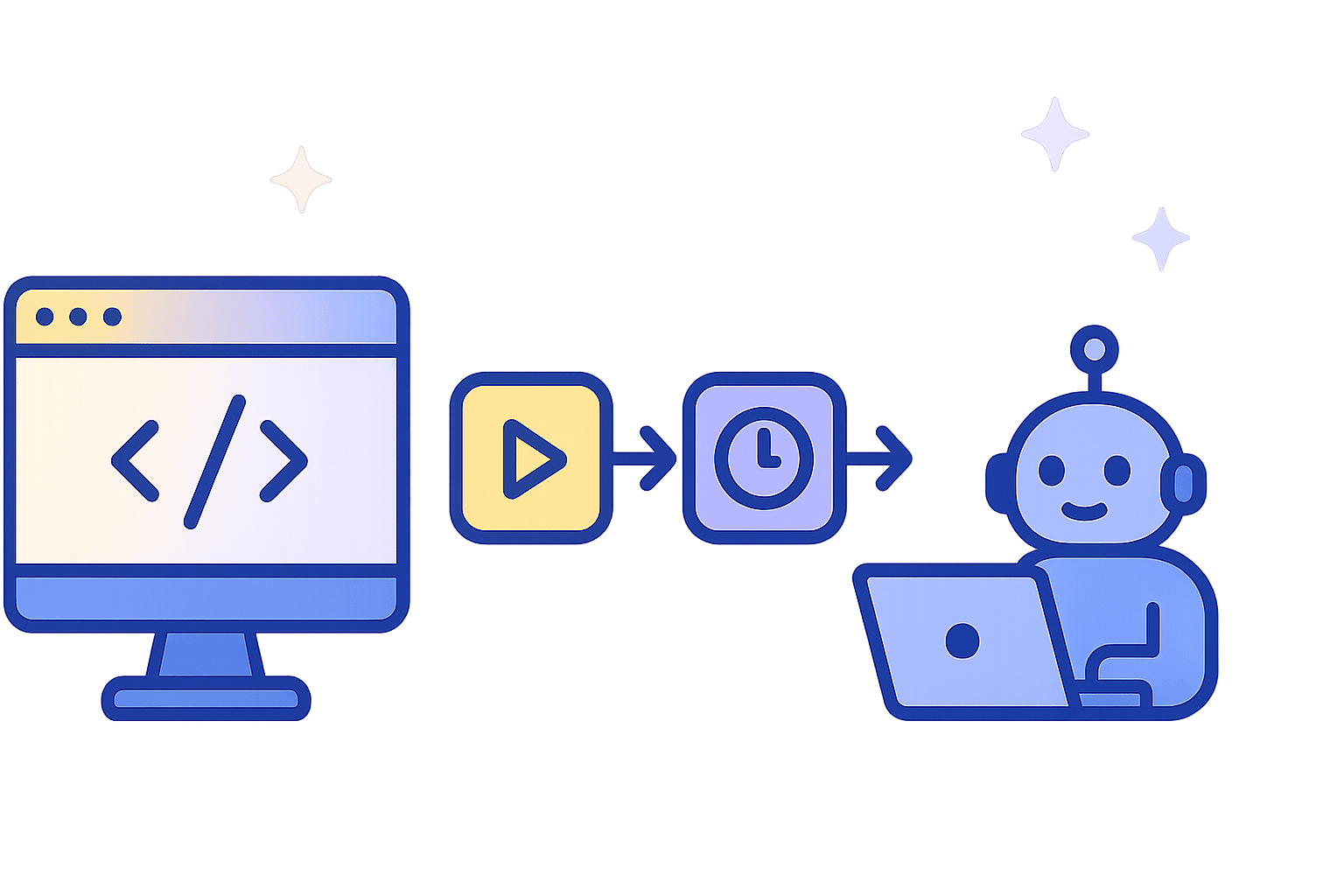
Deterministic Debug AI: Record‑Replay, Time‑Travel Context, and Stable Fixes in CI
Modern teams are starting to delegate bug triage and patch proposals to large language models (LLMs). The dream is compelling: a debug AI that reads failing logs, infers the root cause, and proposes a safe, minimal fix. Yet many teams discover a sobering reality—LLM fixes often don’t stick. They pass in one run and fail in the next, or they fix a symptom only to resurface elsewhere.
The reason is rarely that models are incapable. It’s that our debugging context is nondeterministic. If runs aren’t reproducible, any fix—human or machine—rests on shifting sand.
This article argues that reproducibility is the missing primitive for AI-assisted debugging and shows a practical blueprint:
- Use record‑replay to capture the execution that failed.
- Provide time‑travel context so the AI can reason causally, not just correlate logs.
- Enforce invariant checks so generated patches are CI‑safe and regression‑resistant.
We’ll walk through the architecture, tooling, and workflows that make LLM‑assisted fixes deterministic—and therefore trustworthy—in CI.
TL;DR
- LLM fixes fail when the run context is missing or nondeterministic. Make executions reproducible, not just observable.
- Capture record‑replay traces (syscalls, scheduling, inputs, randomness, clock), plus snapshots of key state.
- Feed a debug AI with time‑travel context: structured events, state diffs, and causal edges—not just logs.
- Guard AI changes with invariant checks and property‑based tests that generalize beyond the replay.
- Build all of this into CI: hermetic builds, deterministic replays, red/green validation, and automatic bisection.
Why LLM fixes fail when runs aren’t reproducible
LLMs are strong at pattern completion: given a stack trace and a code region, they can predict reasonable fixes. But if the failure depends on nondeterministic factors—thread scheduling, time, random seeds, network timing—the model may propose a patch that appears to fix the observed failure yet does not generalize.
Symptoms you may recognize:
- “Fix” passes the replayed CI job but flakes later under different timing.
- Logs used for diagnosis aren’t correlated to the actual execution path that caused the failure.
- A failing record is not captured; the AI extrapolates from a different run, missing critical details.
The fix is not more context in the abstract, but precise, replayable context. Determinism gives the AI a stable substrate to reason over causality, not coincidence.
Determinism is the missing primitive
Human debuggers reach for determinism instinctively: reduce the problem to a minimal, reproducible test case. Do the same for your AI. Determinism provides:
- Causality: If the failure replays exactly, changes that remove the cause are real; changes that merely change the timing are not.
- Bisectability: You can binary‑search code changes or environment changes to isolate regressions.
- Auditability: The same record can be reanalyzed, re‑replayed, and re‑validated as tooling improves.
To get there, you need two building blocks:
- Record‑replay: Capture and faithfully re‑execute the failing run.
- Time‑travel context: Extract and structure the execution timeline for the AI.
Then layer invariant checks on top to validate patches across wider conditions than the single failing run.
Record‑Replay 101: What to capture and how
At a minimum, deterministic replay requires controlling or recording every source of nondeterminism:
- Inputs: CLI args, env vars, config files, feature flags.
- Filesystem: file contents and metadata (mtime), working directory, permissions.
- Network: inbound/outbound packets or higher‑level protocol transcripts.
- Time: wall‑clock, monotonic time, time zones.
- Randomness: RNG seeds, RNG calls.
- Concurrency: thread scheduling, interleavings, syscalls ordering.
- Hardware: CPU features, instruction set differences impacting FP behavior.
- OS/kernel: syscalls results, signals, locale.
How to capture these depends on your stack:
- Linux/C/C++ native:
- Mozilla rr: records syscalls, signals, nondeterministic sources, enabling single‑threaded replay with time travel in gdb. [https://rr-project.org/]
- eBPF/DTrace/ptrace: capture syscalls and I/O. Use with care to avoid probe effects.
- JVM:
- Java Flight Recorder (JFR) for low‑overhead event streams; synchronized with controlled seeds and time shims for determinism.
- Deterministic builds + fixed seeds for tests; intercept time via java.time Clock.
- Go:
- Go execution traces, race detector, and controlled time via time.Now override (through dependency injection or build tags).
- Record network via pcap or HTTP round‑trip caches.
- .NET/Windows:
- Time Travel Debugging (TTD) in WinDbg for native/managed apps. [https://learn.microsoft.com/windows-hardware/drivers/debugger/time-travel-debugging-overview]
- JavaScript/Web:
- Browser record‑replay (Replay.io) captures deterministic browser sessions. [https://www.replay.io/]
- Node.js: fake timers (sinon/jest), intercept Math.random, record network through Nock/Polly.js.
For services in distributed systems, pure record‑replay at machine level is expensive. Instead, target subcomponents at appropriate layers:
- Capture RPCs via service meshes or OpenTelemetry spans with request/response bodies.
- Snapshot databases with a checkpoint (e.g., PostgreSQL base backup + WAL position) and replay queries.
- Stub external services with recorded transcripts.
Key principle: You only need enough fidelity to reproduce the observed failure and its root cause. Over‑recording raises storage and privacy costs; under‑recording sacrifices determinism.
A pragmatic capture matrix
- Unit tests: hermetic inputs, seeded RNG, fake clock, no network. No heavy recorders needed.
- Integration tests: record network/transcripts and DB snapshots; intercept clocks and randomness.
- Native/system debugging: rr/TTD when feasibly attached to the failing process.
- Browser/UI: Replay.io or DevTools performance profiles plus network logs.
If you can’t capture everything at runtime, introduce shims to centralize nondeterminism:
- Time service: a Clock interface injected everywhere; default wired to system time, test wired to a virtual clock.
- RNG provider: deterministic seed surfaces; tests set seeds, prod logs them.
- I/O broker: network/file access goes through a library that can record and replay.
Storage and indexing
Recordings must be searchable and cheap enough to retain:
- Store event streams in a columnar format (Parquet) or as compressed newline‑delimited JSON with zstd.
- Content‑address large blobs (CAS) to dedupe repeats (e.g., identical fixtures across test runs).
- Index by commit SHA, build ID, test name, seed, failure signature (hash of stack + message + invariant hits), and timestamps.
These choices pay off when you train or prompt an AI on historical failures, not one‑offs.
Time‑Travel Context: Give the AI a causal timeline
Logs lie. They’re great for humans, but they’re lossy and interleaved. A debug AI needs an execution graph:
- Ordered events with causal edges (happens‑before relations): syscalls, function entries/exits, lock acquire/release, goroutine/thread spawn/join, GC pauses, RPC boundaries.
- State snapshots or diffs at strategic points: variable values, heap summaries, cache contents, DB snapshot metadata.
- Cross‑component correlation: trace/span IDs that tie events to a request or transaction.
This allows the model to answer:
- Which thread wrote this incorrect value first?
- Was the read logically concurrent with the write?
- Did a timeout fire before or after the retry loop obtained its lock?
Provide this in a structured, compact form—think compressed JSON lines with event types, timestamps, thread/goroutine IDs, and keys for relevant state.
Example event representation:
json{
  "run_id": "bld_2025-11-22_14-22-10_sha1a2b3",
  "events": [
    {"ts": 1000123, "thread": 12, "type": "lock_acquire", "lock": "cache.mu", "file": "cache.go", "line": 87},
    {"ts": 1000207, "thread": 12, "type": "call", "func": "Get", "file": "cache.go", "line": 91, "args": {"key": "u:42"}},
    {"ts": 1000251, "thread": 9,  "type": "write", "var": "cache.map[u:42]", "value": null, "file": "cache.go", "line": 140},
    {"ts": 1000264, "thread": 12, "type": "read",  "var": "cache.map[u:42]", "value": null, "file": "cache.go", "line": 96},
    {"ts": 1000300, "thread": 12, "type": "unlock", "lock": "cache.mu"}
  ],
  "snapshots": [
    {"ts": 1000000, "heap": {"alloc_bytes": 1032192}, "vars": {"cache.size": 1024}}
  ]
}
The model now sees the race: write to cache.map[u:42] as null occurs between acquire and read.
Prompting the model with time‑travel context
Your prompt should:
- Describe the failure and expected invariant.
- Supply the relevant event window around the failure.
- Provide code snippets for implicated regions.
- Ask for causal explanation first, patch second.
- Constrain the patch to maintain invariants and minimize footprint.
Example prompt skeleton:
Failure: TestCacheEviction flaked. Expected Get("u:42") to return a value after Put, but returned nil.
Invariant: If Put(k,v) returns, then subsequent Get(k) must return v until Evict(k) occurs.

Context window [ts=1000100..1000350]:
- Events: (see JSON events above)
- Code: cache.go lines 80-160

Tasks:
1) Explain the causal chain that produces nil at cache.go:96.
2) Propose the smallest patch to enforce the invariant. Avoid global locks; prefer per-key locking or atomic maps.
3) Provide a regression test that deterministically reproduces the prior failure.
You’ll get more reliable, smaller patches when the model reasons through causality explicitly.
Invariant checks: Nonnegotiable guardrails for AI‑generated patches
A deterministic replay proves a fix for one execution. Invariant checks generalize it.
- Define invariants as executable contracts: pre/postconditions, idempotency, monotonicity, ordering, resource safety.
- Use property‑based testing (QuickCheck/Hypothesis/fast‑check) to explore input spaces.
- Add metamorphic tests (e.g., sorting twice yields same result, scaling signals preserves rank order) where applicable.
- Attach invariants to traces: when replaying, detect violations automatically and mark event windows.
Examples:
- API invariants: HTTP POST is idempotent under retry with the same idempotency key.
- Cache invariants: After Put(k,v) without intervening Evict(k), Get(k) returns v.
- Concurrency invariants: Lock acquisition must form a DAG (no cycles); atomicity for specific operations.
Tie these to CI gates: No patch merges unless it passes both the replay and the invariant suite at randomized seeds.
Architecture: A debug AI loop that is CI‑safe
A practical implementation comprises five loops:
-
Capture loop (on failure):
- On any test/service failure, record: inputs, environment, seeds, time, network transcripts, and an event stream.
- Store artifacts with content addressing and metadata indexes.
-
Replay loop (in CI):
- Build hermetically (deterministic toolchains, pinned deps).
- Spin a runner that replays the recording deterministically.
-
Analysis loop (AI):
- Extract time‑travel context windows for windows flagged by invariants.
- Prompt the model with events + code and ask for causal explanation + patch.
-
Validation loop (CI):
- Apply the patch in a disposable branch.
- Run replay: must turn red to green.
- Run randomized invariant suite; fuzz edge cases.
- Run performance smoke checks if relevant.
-
Governance loop:
- Size and risk check: diff size, files touched, dependency of hot paths.
- Human review for policy‑sensitive code, or auto‑merge for low‑risk modules.
A text “diagram” of data flow
- Failure => Recorder emits {trace, snapshot, artifacts} => Artifact store
- Artifact store + code@SHA => Replayer => Deterministic run
- Replayer + Invariant engine => Event windows => Prompt builder
- Prompt builder + Code + Events => AI => Patch + Rationale + Tests
- Patch => CI => Replay green + Invariant suite => Gate => Merge
Handling each source of nondeterminism
You’ll get the biggest ROI by eliminating or recording these sources explicitly.
- Time
- Inject a Clock interface. In prod, log seeds/time sources; in tests, fix time or step it explicitly.
- For Node: use fake timers (Jest/sinon) and advanceTimersByTime deterministically.
- Randomness
- Centralize RNG via an injected source; export and log a run_id and RNG seed.
- Prefer splittable RNGs (e.g., xoshiro, SplitMix64) for parallel determinism.
- Concurrency
- Record scheduling decisions or serialize specific critical sections for replay.
- Use Microsoft CHESS‑style controlled scheduling for systematic testing of interleavings. [https://www.microsoft.com/en-us/research/project/chess/]
- Network
- For HTTP/gRPC, record full request/response bodies and essential headers.
- For message queues, log message IDs and ack/nack order; snapshot offsets.
- Filesystem
- Snapshot directories used by the test; mount as read‑only during replay.
- Floating point
- Pin architectures/flags (e.g., -ffast-math off); prefer deterministic math lib builds.
When full capture is infeasible, adopt hermetic design patterns:
- Hermetic tests: no network; all data via fixtures; dependencies injected.
- Reproducible builds: build in Nix/Bazel; pin toolchains and compilers.
Concrete examples
Example 1: A flaky Go cache due to a race
Bug: A concurrent cache occasionally returns nil after a Put due to a read not seeing a write when the lock is released too early.
cache.go (buggy):
gopackage cache

import (
    "sync"
)

type Cache struct {
    mu   sync.RWMutex
    m    map[string]interface{}
}

func New() *Cache {
    return &Cache{m: make(map[string]interface{})}
}

func (c *Cache) Put(k string, v interface{}) {
    c.mu.RLock() // BUG: using RLock when mutating
    defer c.mu.RUnlock()
    c.m[k] = v
}

func (c *Cache) Get(k string) interface{} {
    c.mu.RLock()
    defer c.mu.RUnlock()
    return c.m[k]
}
Flaky test (stress):
gofunc TestCachePutGet(t *testing.T) {
    c := New()
    done := make(chan struct{})
    go func() {
        for i := 0; i < 100000; i++ { c.Put("u:42", i) }
        close(done)
    }()
    var last interface{}
    for i := 0; i < 100000; i++ {
        v := c.Get("u:42")
        if v == nil { t.Fatalf("expected value, got nil at i=%d", i) }
        last = v
    }
    <-done
    _ = last
}
In CI, the run sometimes fails with “expected value, got nil.” The recorder captures events and reveals the misuse of RLock.
AI rationale (abridged): Using RLock for writes breaks mutual exclusion; a reader can proceed concurrently and observe a nil map entry. Patch: use exclusive Lock() in Put. Optionally use sync.Map to avoid explicit locking.
Patch:
difffunc (c *Cache) Put(k string, v interface{}) { - c.mu.RLock() - defer c.mu.RUnlock() + c.mu.Lock() + defer c.mu.Unlock() c.m[k] = v }
Regression test with deterministic scheduler: use GOMAXPROCS=1 plus -race; also run with stress tool.
GitHub Actions job snippet to replay and validate:
yamlname: ci
on: [push, pull_request]
jobs:
  test:
    runs-on: ubuntu-latest
    steps:
      - uses: actions/checkout@v4
      - uses: actions/setup-go@v5
        with: { go-version: '1.22' }
      - name: Run flake-capturing test
        run: |
          export GOMAXPROCS=1
          go test -race -run TestCachePutGet -count=100 -json > test.json
      - name: Upload artifacts
        uses: actions/upload-artifact@v4
        with:
          name: replay-artifacts
          path: |
            test.json
            artifacts/**
In a more advanced setup, you’d capture Go execution traces:
bashgo test -run TestCachePutGet -trace trace.out
Then annotate events to produce the time‑travel context fed to the AI.
Example 2: Node.js service with nondeterministic timeouts
Bug: Occasional 504s due to a race between request timeout and a retry loop; tests flake depending on timer granularity.
Bad pattern:
jsasync function getWithRetry(fetchFn, url) {
  let attempts = 0;
  const start = Date.now();
  while (attempts < 3 && Date.now() - start < 1000) {
    try {
      return await fetchFn(url);
    } catch (e) {
      attempts++;
    }
  }
  throw new Error('timeout');
}
Fix pattern:
- Inject a Clock interface for time.
- Use absolute deadlines and jittered backoff, not loop conditions tied to wall‑clock.
- Drive timers via fake timers in tests and record the seed.
Patch:
jsclass Clock { now() { return Date.now(); } sleep(ms) { return new Promise(r => setTimeout(r, ms)); } }

async function getWithRetry(fetchFn, url, {clock = new Clock(), deadlineMs = 1000} = {}) {
  let attempts = 0;
  const deadline = clock.now() + deadlineMs;
  while (attempts < 3) {
    try { return await fetchFn(url); } catch (e) { attempts++; }
    const remaining = deadline - clock.now();
    if (remaining <= 0) break;
    const backoff = Math.min(remaining, 50 * Math.pow(2, attempts));
    await clock.sleep(backoff);
  }
  throw new Error('timeout');
}
Deterministic test with fake timers:
jsimport {jest} from '@jest/globals'

test('retries until deadline deterministically', async () => {
  jest.useFakeTimers();
  let calls = 0;
  const clock = {
    now: () => Date.now(),
    sleep: ms => new Promise(r => setTimeout(r, ms))
  };
  const fetchFn = async () => { calls++; throw new Error('fail'); };
  const p = getWithRetry(fetchFn, 'http://x', {clock, deadlineMs: 200});
  jest.advanceTimersByTime(200);
  await expect(p).rejects.toThrow('timeout');
  expect(calls).toBeGreaterThan(1);
});
With record‑replay at the HTTP layer (e.g., Polly.js), you remove network variance and ensure the AI sees a deterministic sequence of retries and time advances.
CI integration: Make reproducibility the default
If your builds aren’t hermetic, replays won’t be either. Bake determinism into your CI pipeline.
- Hermetic builds
- Use Bazel or Nix to pin compilers, linkers, toolchains, and dependencies.
- Avoid system‑wide global state; build inside pinned containers.
- Reproducible runner environment
- Pin OS images; set locale, tzdata, ulimits; disable ASLR if using low‑level recorders that need stable addresses.
- Export deterministic environment variables: LANG, LC_ALL, TZ.
- Artifact capture
- On failure, always upload the replay bundle: trace, inputs, seeds, snapshots, logs.
- Hash artifacts by content; dedupe to control cost.
- Replays as first‑class tests
- Introduce a test target per captured failure that replays the run: bazel test //replay:run_abcdef.
- Promote stabilized replays to a regression suite.
- Gates for AI patches
- Patch must: turn the red replay green; maintain invariants; pass randomized seeds; respect bundle’s seed/time constraints.
- Auto‑revert on newly discovered invariant violations.
Example Bazel snippet for deterministic test rule:
pythonsh_test(
    name = "replay_run_1a2b3c",
    srcs = ["replay.sh"],
    data = [":bundle_1a2b3c.zip"],
    env = {"TZ": "UTC", "LANG": "C.UTF-8"},
)
replay.sh unpacks the bundle, sets seeds, mounts snapshots, and runs the binary with interposers (LD_PRELOAD for RNG/time, pcap replay for network).
Making logs useful: From lines to structured events
Move from log lines to event logs:
- Use OpenTelemetry (OTel) to emit spans, attributes, and events. [https://opentelemetry.io/]
- Enrich spans with deterministic IDs, seeds, and snapshot refs.
- Correlate failures to event windows by span IDs.
Convert logs into structured windows for the AI:
- Build a reducer that slices the event stream around invariant violations (e.g., ±5 ms or ±N events).
- Annotate code locations with line numbers, blame metadata (commit, author), and coverage.
- Provide heap/value summaries to reduce token budget without losing signal.
Data privacy and cost controls
Capturing rich traces raises privacy and cost considerations:
- PII scrubbing
- Redact sensitive fields at capture time using allowlist schemas.
- Use format‑preserving tokenization for keys that need correlation.
- Storage controls
- zstd compression of JSON lines; columnar storage (Parquet) for long‑term analytics.
- Retain full bundles for recent failures; down‑sample older ones to metadata + minimal windows.
- Access governance
- Separate CI‑safe synthetic data from prod‑derived traces.
- Limit who can replay prod incidents; ensure segregated infra with data retention policies.
Measuring success: Determinism and stability metrics
Track whether your debug AI actually improves reliability:
- Flake rate: percentage of tests with nonzero flakiness. Target steady decline.
- Replay pass rate: fraction of captured failures that reproduce reliably on first attempt.
- Patch acceptance rate: fraction of AI patches that pass gates and get merged.
- Regression rate: fraction of AI patches later reverted due to new failures.
- MTTR for flaky failures: median time from first flake to merged fix.
A healthy setup shows high replay pass rates, steady drops in flakiness, and low regression rates for AI patches.
Implementation roadmap
- Phase 0: Hygiene
- Seed RNGs, introduce Clock interfaces, ban nondeterministic APIs in tests.
- Add basic OTel traces and IDs that link failures to requests.
- Phase 1: Targeted record‑replay
- Choose one domain (e.g., HTTP client, DB interactions) and record deterministically.
- Build replay runners for that domain.
- Phase 2: Time‑travel context + AI loop
- Build event reducers, add invariant checks, wire a prompt builder.
- Start with human‑in‑the‑loop patch proposals.
- Phase 3: CI gates and automation
- Auto‑open PRs for low‑risk changes; enforce invariant suites; auto‑revert on violations.
- Start training/evaluating on your own failure corpus.
Opinionated guidance: what matters most
- Don’t start with generic log‑parsing. Start with deterministic replay. Without it, you’ll overfit to noise.
- Keep the AI’s scope narrow initially. Fixes should be local, mechanical, and backed by invariants.
- Use time‑travel context religiously. Causal chains beat guesswork.
- Make reproducibility visible. Surface the run_id, seed, and snapshot refs in error messages.
- Prefer shims over global recorders where possible—they scale better and reduce privacy risk.
Useful tools and references
- Record‑replay and time travel
- rr (Linux C/C++): https://rr-project.org/
- Pernosco (time‑travel debugging UI for rr): https://pernos.co/
- WinDbg Time Travel Debugging (Windows): https://learn.microsoft.com/windows-hardware/drivers/debugger/time-travel-debugging-overview
- Replay.io (browser record‑replay): https://www.replay.io/
- Concurrency testing
- Microsoft CHESS: https://www.microsoft.com/en-us/research/project/chess/
- Go race detector: https://go.dev/doc/articles/race_detector
- Observability
- OpenTelemetry: https://opentelemetry.io/
- Hermetic and reproducible builds
- Bazel: https://bazel.build/
- Nix/NixOS: https://nixos.org/
- Reproducible Builds project: https://reproducible-builds.org/
- Property‑based testing
- Hypothesis (Python): https://hypothesis.readthedocs.io/
- QuickCheck (Haskell/Elixir/Erlang variants)
- fast‑check (TypeScript): https://dubzzz.github.io/fast-check/
- Fuzzing and symbolic execution (for deeper validation)
Putting it all together
Debug AI is powerful, but only as reliable as the ground truth you give it. If runs are nondeterministic, you’re asking it to infer causality from noise. By capturing record‑replay traces, building time‑travel context, and enforcing invariants, you convert flaky logs into deterministic investigations. The result is not just better AI patches—it’s a more reproducible, auditable engineering process.
Treat determinism as a first‑class feature of your CI. Every failure becomes a reproducible artifact, every fix is validated against causal evidence, and every regression is caught by invariants you can enforce automatically. That’s how you ship AI‑assisted fixes you can trust.